
Category Archives: Security

Germany Funds Far-Right Memes That Spread Antisemitism

A German association that receives about one million euros a year from the Federal Interior Ministry has published a video that identifies Jew-haters by flag, scarf and blue hair. The association’s own campaign page carries this sentence:

Wer Judenhass nur beim politischen Gegner erkennt, bekämpft ihn nicht – er instrumentalisiert ihn.

In English: whoever recognizes hatred of Jews only in the political opponent does not fight it, he instrumentalizes it. I agree with the sentence, and I apply it to the video and to the minister whose ministry funds the association.

Using Jews as a lever against other groups is itself antisemitism. That is my judgment. It rests on a simple test: a statement that invokes Jews in order to punish, deport or discredit another group treats Jews as an instrument of the speaker’s politics, and their safety becomes the argument for something else. A federally funded campaign now does this in pictures. Interior Minister Alexander Dobrindt has done it in words 15 times. Earlier posts cover the antisemitism post Dobrindt left empty and Chancellor Merz calling German Jews foreigners.

The Campaign

WerteInitiative e. V. published the video and poster “Antisemitismus ändert die Farbe. Der Hass bleibt gleich.” on 7 November 2026. Antisemitism changes color, the hatred stays the same. Posters run in several German cities in November 2026 and January 2027.

A chameleon turns brown over a neo-Nazi torch march, green over an Islamist rally and red over a left-wing pro-Palestinian demonstration.

The page carries the logo “Gefördert durch das Bundesministerium des Innern”, funded by the Federal Interior Ministry. The association says its budget consists of membership dues, donations and the ministry grant, and that the clip was paid from that budget.

What the Clip Shows

Image scholar Roland Meyer took the clip apart in a thread on 17 November. He identifies it as AI-generated and names the genre slopaganda.

The red scene marks people as Jew-haters by Palestinian and Soviet flags, keffiyehs, garbled “Intifada” placards and young women with blue and green hair. The clip attributes zero statements about Jews to any of them. Costume carries the whole accusation. Meyer’s phrase is “semiotic excess”.

The blue-haired woman is a stock figure of far-right anti-“woke” memes, and Meyer shows an example from 2023. A figure the far right built to mock the left now appears in a federally funded campaign as the face of left-wing Jew-hatred.

The brown scene shows a 1990s skinhead cliché.

It leaves out the AfD, the antisemitic party that sits in German parliaments. AfD Holocaust denial is on camera. Its leader in Thuringia, Björn Höcke, was convicted twice for a Nazi slogan. The Central Council of Jews and about 40 other Jewish organizations named it in 2018 “eine rassistische und antisemitische Partei”. Dobrindt, in thirteen years and in nothing I could find, has never called the AfD antisemitic. Leaving out the best-known antisemitic party in Germany.
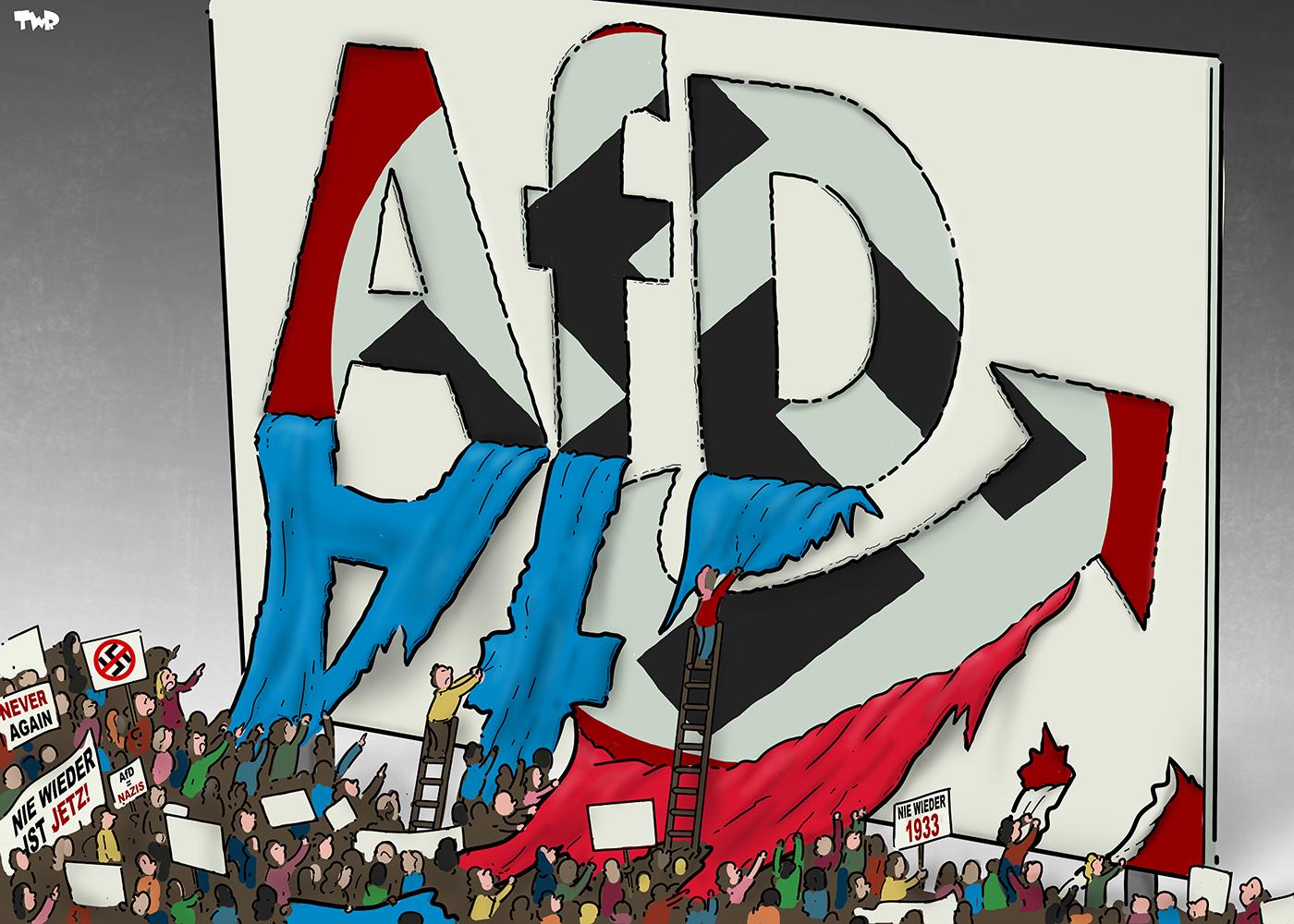
Source: TWR

Instead we see curated figures morph into one another, which falsely equates these three camps into one. Meyer describes it as the work slopaganda does. It makes clichés look natural, then links the stereotyped people in a chain of equivalence until they merge into one composite enemy. He connects that to the process Simon Strick calls fascistization.

Meyer also points out that one hidden force behind opposing camps is the structure of conspiracy thinking.

Meyer adds a footnote. In 1944 the Nazi-era Simplicissimus printed a caricature by Wilhelm Schulz, “Im politischen Zoo”, that shows Bolshevism as a red chameleon. The parallel is his, offered as a footnote on the history of the image.

Where the campaign found its chameleon is a question for the association to answer.

The Money

The Lobbyregister entry R001599 lists €960,001 to €970,000 from the ministry in 2025 as institutional funding. The association reports 256 members. Institutional funding goes into the association’s general budget, the same budget that paid for the clip.

Einzelplan 06 of the federal budget shows the trend.

Year Ministry funding
2024, paid €770,000
2025, budgeted €1,000,000
2026, planned €1,070,000
2027, draft €1,151,000

The ministry funded the association by project in 2019 and 2020 and institutionally since 2021. Dobrindt took office on 6 May 2025. The funding predates him, and it has risen about 40% since 2024.

The Minister

I have documented 15 occasions, from 2018 to 23 October 2026, on which Dobrindt used antisemitism as the stated reason to go after another group. Seven came before he took office and eight since.

Eleven target migrants and Muslims. Eight of the eleven pair antisemitism with a demand for punishment or deportation. His term from October 2023 is “importierten Antisemitismus”, imported antisemitism.

Date Where
28 Mar 2018 Bild
18 May 2021 Press statement
23 May 2021 Bild am Sonntag
12 Oct 2023 Bundestag
15 Oct 2023 Bild am Sonntag
9 Nov 2023 Bundestag, Pogromnacht debate
7 Jan 2024 Kloster Seeon
21 May 2025 Bundestag
14 Aug 2025 Halle
Jan 2026 Welt TV
24 May 2026 Funke

Four target the Berlin Linke (his political opponents), all within 32 days.

Date Where
22 Sep 2026 Statement on the Berlin Linke
24 Sep 2026 ZDF: “Na doch”
7 Oct 2026 Bebelplatz
23 Oct 2026 Bild

The January 2026 and May 2026 items came from English paraphrase. I still count them without the exact quote.

In all 15 the form is the same: Antisemitism is the reason given and another group is the target. That is the lever, and it is the basis for calling the observed pattern of Dobrindt antisemitic.

My 5 November post counted zero antisemitic statements by Dobrindt and set these uses in a second column. I hold them both up for examination. Under the count as it stands, each statement taken alone passes, and the pattern of use is what I call antisemitic.

The Channel

The ministry’s own feed reads quite different. I downloaded the entire public Mastodon feed of @bmi@social.bund.de (8.4K followers): 1,841 posts from 27 October 2022 to 16 November 2026.

Since Dobrindt took office the account has posted 257 times. Twenty-six of those posts concern Jews, antisemitism or Israel. The word “importiert” appears zero times. The Linke is never mentioned. None of the eight statements he has made as minister appears there. They were made in the Bundestag, on television, in newspapers and at public events. The feed covered two of the occasions, Halle and Bebelplatz, on the day, and quoted other lines. One post, from 5 November 2025, concerns the ban of Muslim Interaktiv and invokes hatred of Jews.

The open feed is also shrinking. It averaged 61 posts a month in 2024, 40 a month from January to April 2025 and 9 a month from January to October 2026.

The ministry’s X account, @BMI_Bund (201.2K followers), shows five posts to a visitor who is logged out and then a login wall. Of the five newest visible posts, dated 1 to 16 November 2026, one also appeared on Mastodon. An X account in his name, @DobrindtA, shows 0 posts; I could not confirm it is his.

I measured the Mastodon decline. What the ministry posts behind the X login wall is unmeasured. The measured part is enough to say that the ministry’s open, archivable channel has gone quiet, while the eight statements he has made as minister sit in newspapers, broadcasts and parliamentary minutes.

The AFD extreme right rally in Germany was headlined by the X CEO

The Request

On 19 November 2026 Ottenheimer GmbH filed a request with the ministry under the Freedom of Information Act (IFG). It asks for:

  • the 2025 and 2026 grant decisions
  • the 2025 spending report
  • all correspondence on the campaign, including any approval before publication
  • internal notes on the campaign
  • the files on the funding increase

What I can show today is that the ministry funds the association and that the association says it paid for the clip from its budget. The request asks whether the ministry’s part went further.

On 2 July 2026 the coalition agreed to restrict the IFG to natural persons with a “legitimate interest” and to change the fee rules. Human Rights Watch objected within the week. No bill has been published. A GmbH is a legal person, so a request like this one is the kind the plan would end.

Why Nobody Can Sue

German insult law requires an identifiable person or a small, bounded group. “The left” and “Muslims” are neither. Activists who sued over the Bundestag’s BDS resolution lost in all three administrative courts. Below the threshold of incitement, stereotyping a population has no legal consequence. Documents are what remains, which is why the records request matters.

What the Association Says

The association says antisemitism from left-extremist and Islamist milieus is real and under-acknowledged. It says the clip simplifies on purpose. It says the campaign also names the right and the “Mitte”, the political center.

Antisemitism in those milieus could be real. The clip shows something else. It shows people marked as Jew-haters by their flag, scarf and hair, with zero words about Jews attributed to them. The accusation of antisemitism comes with zero evidence of antisemitism. By the association’s own sentence, recognizing hatred of Jews by the look of a political opponent is instrumentalizing it. The clip aims the accusation where the evidence is thinnest and away from where it is thickest. Public money should not pay for that.

A federally funded budget paid for a far-right meme in a campaign that appears antisemitic to me, run in the name of protecting Jews.

The request asks whether anyone at the ministry saw it before the public did.
Everything Tech is Trump’s Reflecting Pool Now

Upgrading the reflecting pool had a disastrous outcome. It’s been mocked relentlessly across every possible domain, although Trump tried to blame all of the failures on others.

Now we are seeing the same pattern across other sectors, where “upgrades” to technology are failing, causing disasters. You’ll never guess who doesn’t want to accept blame.

While it does not appear that these disruptions were caused by a cyberattack, government and banking officials have told lawmakers that they stem from attempts to fix gaps in cyber defenses identified by AI models, the sources said. The fixes, however, temporarily overwhelmed the systems.

To be more precise, the plan for fixes failed. There are insufficient tests, with untrained and inadequate staffing, where use of AI models is just a symptom of those issues. The reflecting pool fixes were bad, but I think we can all agree it stemmed from the overall plan itself as well as the project management being the problem. “Wrong type of paint” or “expensive upgrades made everything worse” tells us where the blame should go.

Scoopenomics: Space Rogue’s Shame Embargo

Quiet! Quiet! The Carnival Barkers Want Quiet in the Tent

Space Rogue says shame works. He says it in a blog post about embargo breakers that leaves the offender… unnamed and unshamed.

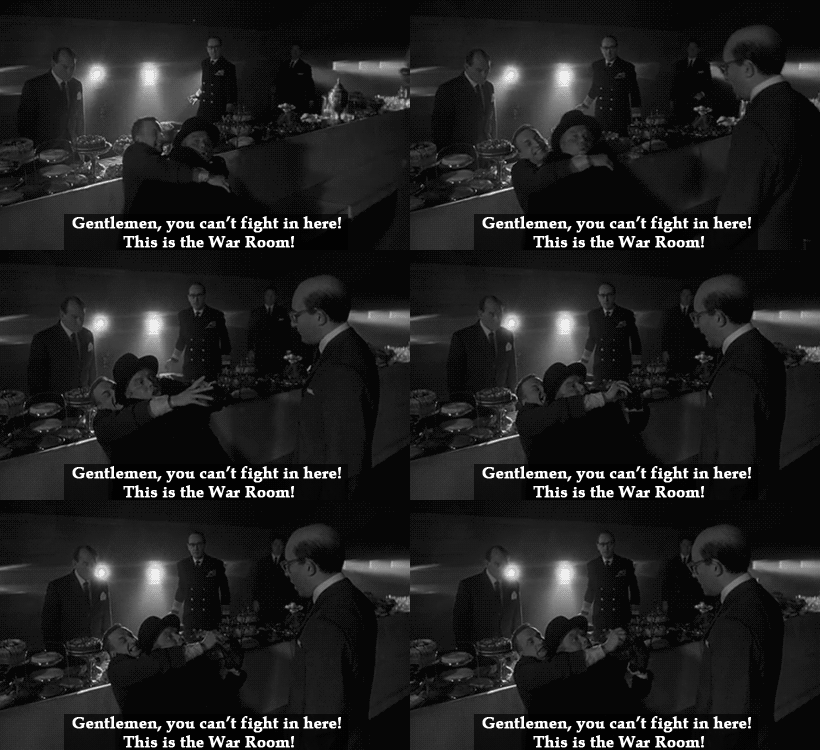
“Embarrassment works,” he writes of the full disclosure years. The data says it works only when a firm’s own customers are the ones harmed. Regular readers of this blog will note that I do not tend to withhold names. But his main offender stays unnamed for his whole post, while he argues that naming is the whole point. That is a shame embargo, on the premise that shame works, while complaining embargos should not be broken. It reminds me of Dr. Strangelove pointing out that a Doomsday machine kept secret deters nobody. And of the President insisting there is no fighting in the war room.

As a likely peer, who was doing the same things at the same time, I always saw the L0pht route to success as marketing. They were the best at promotion, like stage performers, rejecting the norm of silence for attention. In the late 1990s I was pentesting bulk energy across the midwest. One day I popped thousands of routers across five states. The report went into a meeting and a remediation plan. Never public. Meanwhile, on May 19, 1998 seven of the L0pht crew sat before the Senate Committee on Governmental Affairs under hacker handles and told senators they could make the entire Internet unusable within 30 minutes. I mean, plaintext auth such as Telnet was still the default everywhere. It was as obvious as it was a decade earlier when CFAA landed.

By their own account the flaw behind the 30-minute claim was already patched, and the plan was to release it at the hearing. Space Rogue says the handles “had to have been for show”. In other words, when Mudge made testifying under hacker names his condition for appearing, Space Rogue later said he suspected the Senate had already run background checks on them.

Security experts at the time called the claim possible hyperbole. Those of us testing networks knew it was plausible. The difference was the norms of disclosure back then: to go to the press and say what is what, risked being shameless. When we could get fixes in without the noise, without attracting shame, who benefited most from it? The L0pht vigorously broke the thing that folks like me did not, and they basked in the limelight for it. In January 2000 their success with that attention merged into @stake, a new consultancy run by Internet executives.

Scholars of “the scene” have plainly described what they found. Matt Goerzen and Gabriella Coleman’s history of 1990s hackers credits part of a rise in standing to “PR stunts, media collaborations, and rhetorical interventions”. Their talk on the research carries the title Security by Spectacle.

But that is the literal opposite of my “quiet professional” training, where attention is not the objective and usually is avoided. Was I not in the club? Did I miss out by not trying to be shamed?

Carnival barkers built a market that pays whoever shouts first and loudest. Space Rogue is right that the L0pht kept its agreements with vendors. The market pays the same whether an agreement exists or not. The blog post by the old barker seems to object that a younger act is now shouting earlier. On the day of his post, Calif.io announced Java4Shell with a joke that PHP had too small an audience, so they targeted:

something a little more familiar: Java

That in itself is a laugh. PHP is far more familiar, while Java is unfortunately still around. It is like saying gasoline cars have too few drivers so they are targeting garbage trucks. Haha, so funny.

The economics of all this indeed is the most interesting part. And it has been measured for a long time. Karpoff and Lott found large reputational losses hit the firms that defraud their own customers. Makes sense. However, with Wehrly they found the reputational penalty negligible for environmental violations, where outsiders carry the harm. We tend to talk about the “externality” of harm. An embargo breaker’s customers see speed (and hopefully accuracy) where harm lands on the competitors, not on the customers. L0pht broke the informal norm of silence, as absurd as it was, while many of us stayed away from the shame they attracted. L0pht rose and rose to celebrity. Should they have now the authority to tell others to avoid the kinds of shame that they banked on?

Kannan and Telang modelled vulnerability brokers in 2005 and found the broker’s own incentive is to leak. Then they bray about it like a stuck donkey. Keeping an embargo only bothers people who value being in the club. I guess I can attest to the fact that I was surprised in the 1990s to see someone celebrated for breaking the silence I lived under. Those who value the scoop more than the old club, are going to choose breaking club rules. If I had a dollar for every time I consciously didn’t scoop, I would have retired at least 20 years ago. In actual fact, I know a hacker who built an entire career and cashed out on a scoop I gave him 25 years ago. Good for him, I guess. He loved the profitability of the shame.

In a perfect example, I found a critical 9.8 vulnerability in Qdrant in February this year and spent months following a quiet professional disclosure process. The vendor notice records my report on 9 July and the release on 22 October. It also credits zerovulnlabs, a “crew” created in August, for reporting the same issue, much later and far louder than me. The notice treats us as if we should be seen as equals, because quiet work now is so steeply undervalued.

So, shame on someone from the L0pht for claiming shame works.

What their brand represents is the American economics of lookatme lookatme, which has demonstrated the value of a shameless barker.

Dam Shame: Ethiopia’s ICE Car Ban and the Solar Transition

I was reading Energy Transition Africa, because it announces that Ethiopia banned petrol cars and “climate was never the real story”.

Attention grabbing title!

The article under it then quotes the transport ministry stating the fiscal motive, which is what AP reported about fuel costs and foreign currency reserves.

Huh. Seems like there is nothing new. The article ends with Ethiopia hosting COP32 and electric transport at the centre of its national climate plan. Is the reveal just a position the government announced a while ago? So long ago that AFP ran it eight months earlier?

But wait. There also is bad math. Every row below comes from the article’s own figures or from the old and original reports.

Reported Wrong
EVs are “nearly 6 percent” of the fleet 115,000 of 1.5 million is 7.7%. AP reports about 8%.
A fleet of 1.5 million, later 1.7 million Two fleet sizes in one article. They give 7.7% and 6.8%.
EV share is “above the global average of 4 percent” Energy for Growth Hub counts nearly 5% of cars, level with the global average. The ministry total has no breakdown by vehicle class.
Fuel imports cost $7 billion a year AP reports about $4.2 billion.
The national fuel bill is the case for electric cars The 115,000 EVs displace about 2.6% of that bill at pump prices. Petrol is the smaller part of fuel imports.
Electricity costs $0.10 per kWh The utility says households pay about $0.005. The top tier is 5.1 birr, about 3 cents.
Switching saves $576 a year, or 72% That uses the $0.10 price. A driver told AFP his monthly cost fell from $27 to $4, an 85% cut.
500,000 EVs by 2032 The ministry told AFP “in 10 years”, which is 2035.
Growth of 58.92% a year through 2030 That is a market revenue forecast. Applied to vehicles it passes 500,000 in about three years and 1.1 million by 2030.
A charging hub prevented 521 tonnes of CO2 That is Ethio Telecom’s own claim, at 1.38 kg per kWh delivered. The article’s fuel example gives about 350 tonnes.
The GERD “produces 5,150 megawatts” That is installed capacity. The builder estimates 15,700 GWh a year, an average of about 1,800 megawatts.
Nigeria’s weak grid blocks the model A car needs about four rooftop panels. Nigeria imported 1.7 GW of panels in a year.
Rwanda has “a ban on ICE motorcycles already in force” Kigali stopped registering new petrol motorcycle taxis. Existing petrol bikes keep running.
A household on $50 a month saves by switching The $23,000 car is 38 years of that income. The $800 fuel bill in the example exceeds the $600 annual income.

The article writes about cars, yet it cites a national fuel bill and the national grid. The national issue is not just cars, which use a small energy slice. Look at how 115,000 EVs use about 258 GWh a year, for example, which is a whopping 1.6% of the 15,700 GWh the GERD is built to deliver. Less than 2%.

The 500,000 target means about 700 megawatts of solar panels, at 1,600 kWh a year per kilowatt. Ember counts Africa installing 47 megawatts of solar a day in 2026, so the whole target equals 15 days of installations.

A car needs about 1.4 kilowatts, which is only four rooftop panels. At an assumed $1,000 per installed kilowatt those panels cost $1,400 and replace about $936 of petrol a year at the current pump price. Cars can charge from the roof.

My takeaway from the article is cars should use decentralized energy led by consumers, which also makes it resilient. Let the government focus its energy debates on public transit. Shame about that dam.