The Epstein files keep landing at elite universities, and the pattern is so consistent it’s raising the story to national security levels.
How many kids going to college are exploited into a human trafficking system of powerful men running these institutions?
At Yale, computer science professor David Gelernter appears 563 times in the files. For example, he emailed Epstein in 2011 recommending a student for a job. He described her as a “v small goodlooking blonde.” This was three years after Epstein’s conviction for soliciting prostitution from a minor. When caught, Gelernter told the dean he was just keeping “the potential boss’s habits in mind” since Epstein was “obsessed with girls” like “every other unmarried billionaire in Manhattan; in fact, like every other heterosex male.”
Yale has barred him from teaching pending review.
At Duke, the world’s most famous researcher on dishonesty, already credibly accused of falsifying data in a study about honesty — appears 636 times. Behavioral economics professor Dan Ariely met Epstein at least seven times between 2010 and 2016. In one email he asked Epstein for the name and contact of a “redhead” who “seemed very very smart,” signing it “Honestly* yours, Dan.”
At Harvard, former president Larry Summers, the former Treasury Secretary and recent OpenAI board member, asked Epstein for advice on pursuing a romantic relationship with a woman he called a mentee. Epstein called himself Summers’ “pretty good wing man.” Summers’ strategy, laid out in emails to a convicted sex trafficker: make the woman conclude “she can’t have it without romance / sex.” He corresponded with Epstein until the day before Epstein’s 2019 arrest.
Harvard “opened an investigation.”
This is just three universities.
This is just three professors.
So far.
The same mechanism shows up every time: powerful men in hierarchical institutions treat young girls in their care instead as their currency in transactions with a convicted sex offender. Institutional language is leaned on to minimize it when emails expose them.
Gelernter says gentlemen don’t read each other’s mail.
Ariely says the contact was “infrequent, largely logistical.”
Summers says he’s “deeply ashamed” while Harvard investigates whether shame is sufficient.
.
Why did these universities respond identically? Reviews. Statements. Passive constructions. Yale “does not condone the action taken by the professor.” Well, that’s about a minimal as you can get. Duke’s center closure was “finalized in December.” Good. Harvard? Come on Harvard.
None of them rise to the level of admitting a convicted sex offender had years-long access, via their faculty, to harm students. They’re investigating the embarrassment to protect their reputation, not the evidence of a human trafficking pipeline.
Epstein stands out less as the one man causing the corruption of these institutions and more as the kind of man they invited because he wasn’t supposed to be caught. He recognized what was there, with the help of foreign intelligence, and preyed on older men who held authority over vulnerable young girls (and boys?).
I’m reminded of American universities who were “endowed” by South African apartheid, or the Vietnam War. The funding model apparently tries to ignore where the money comes from, so Epstein was welcomed to plug himself in to harm children.
The United States is the only country in the world refusing to sign the Convention on the Rights of the Child. Think about that. The ONLY country that won’t protect children. The Epstein files now are required reading for parents around the world, because they show the reason.
An Anthropic safety researcher loudly and publicly resigned this week with an alarmist yet vague letter warning that the world is “in peril” from “interconnected crises.”
Let me break down why this happened. It’s not a mystery.
Mrinank Sharma said he had “repeatedly seen how hard it is to truly let our values govern our actions” at Anthropic.
Water is wet. News at 11.
He offered zero specifics about any of it, declined comment to Forbes, and announced he may pursue a poetry degree to “devote myself to the practice of courageous speech.”
I’ve achieved what I wanted to here… I arrived in San Francisco two years ago, having wrapped up my PhD and wanting to contribute to AI safety.
Dude.
You stepped up to bat and then stepped down to announce you’d like to learn how to step up to bat?
Sharma ended his farewell by citing William Stafford’s poem “The Way It Is,” about holding a thread others can’t see. Then he announced he plans to “let myself become invisible for a period of time” and “get away from the structures that have held me.” A man who held a thread of safety concerns nobody could see, took pay for holding it, refused to show it to anyone on his way out, and then announced he’s going invisible. That poem is a confession.
And to be fair this isn’t actually about Sharma, although he gives us the headlines today and we unfortunately can’t leave him out. He seems like a highly successful researcher who rose up the ranks to do what he was trained to do. The problem is what Anthropic trained him on, and what this company calls “safety” let alone its “constitution“.
Sharma led Anthropic’s Safeguards Research Team. He has an Oxford PhD in machine learning, which is admittedly very far from the seasoned steps of an actual security professional. His team studied whether Claude would help users do bad things like assist with bioterrorism, flatter users into distorted realities and that sort of academic thought exercise. His last published study found “thousands” of reality-distorting chatbot interactions occurring daily, and concluded this “highlights the need for AI systems designed to robustly support human autonomy and flourishing.”
That sentence could be appended to any AI paper about any AI problem and be equally meaningless. It’s the game, not this player. It’s the output of a system designed to produce exactly this kind of sophisticated irrelevance.
You can have a PhD in mechanical engineering and study if long sharp knives help users do bad things. That’s not actual security leadership. That’s usability research on weapon design, understanding how people interact with a product and whether the interaction has a safety built-in. In threat-model terms, that’s looking for solutions first and skipping right past the entire threat exercise.
Worst Form of Product Safety Management
The unregulated American market drives an AI race to the bottom. Like how unregulated dairy or meat caused mass suffering and death. Remember The Jungle? The Pure Food and Drug Act of 1906? Children dying from swill milk in the 1850s?
Most if not all product managers need a proper wall built for them by regulators, or they are heavily incentivized to flood the market with toxic shit. The worst version of safety management is actually the most preferred by software product managers in tech companies today, because it lets them ignore stuff they don’t want to hear. Other industries regulated this out long ago because harms are so predictable and externalized. It’s like a pill manufacturer asking the safety research team to narrowly assess the best format to open a pill box and to swallow a pill, completely ignoring whether threats make the pill unsafe.
The entire Tylenol 1982 cyanide-laced pill murders lesson is supposed to prevent this kind of scoped-down thinking. It forces a fundamentally different posture than proper security. An attacker isn’t scoped down. Security professionals thus look how bad things happen, constantly, and consider every system already has been compromised until proven safe. It works backward from failures to build defenses.
To put it plainly, from 2012-2016 when I said AI was a dumpster-fire of security vulnerability (e.g. “the fourth V of Big Data’s three Vs“) I was told to shut up so that AI could have a chance of getting off the ground. Then suddenly in 2016 people like Elon Musk said he’d have driverless cars solved in a year and people living on the Moon in four. Security flaws weren’t allowed into the discussion until future-leaning “upside” claims could drown them out anyway.
Threat modeling done right ignores discussion of design and solutions, because “we’ll fix that” thinking will inherently interfere with raw development of attacks that the product team hopes and prays never come.
Sharma’s team studied whether Claude would answer dangerous questions within the product as intended to be used. A security team would ask after someone has already forced bad answers, what happens next.
That distinction matters. Anthropic chose to call user-experience-level product development research “safety,” staff it with ML researchers, and present it to the public as though the hard problem was being worked on. What they built was just QA with ethical branding, which is a classic mistake of engineering groups that lack seasoned security expertise.
Actual Safety Work
We need to ask different questions differently.
Security asks “why” before “what.”
Why is there pre-authentication, given an attack surface exists? Why is the model embedded in environments where security is being gutted to feed AI demand? Why is a child not the same as a parent and a parent not the same as a guardian? Why is there no distinction between different roles in mental health crisis and why are people in crisis allowed at all?
What happens when someone walks around a filter entirely in minutes? What does authentication and authorization look like when AI agents act autonomously in a world where identity is a fuzzy and contested concept? What happens when the safeguard itself becomes the attack surface, because you’ve published your red-team methodology and handed your adversaries a map of your defenses?
That last point reveals a fundamental disciplinary mismatch. Publishing results is the ML researcher’s instinct to push towards open science, peer review, reproducibility. It is also the opposite of the professional security instinct. Need to know. Role based access. Minimal target surface. These fields have incompatible default behaviors around disclosure, and Anthropic staffed a safety-critical function with people oriented on the marketing end of the spectrum to look “open” about everything. That’s hardly Sharma’s mistake, as he played the game he was told to win. That’s a corporate philosophy that chose academic soft noodling over hard operational security crackers.
I’ve been doing the poetry of information security here since 1995.
Three decades of writing about the space where technology meets institutional failure. I worked for Tim Berners-Lee for years, including him pulling me into a building dedicated to him at Oxford. And what did I find there? A broken hot water kettle pump. Everyone standing around looking at each other and wondering how to have a tea. I broke it apart, hacked it back together, so the man standing in a huge building dedicated to his life’s work could share tea with his guests. The institution of Oxford is very impressive in ways that don’t interest me much. I didn’t wait for a service to come throw away the “broken” thing to justify a new one even more likely to fail. I hacked that old kettle. Sir Tim poured. I’m impressed more by humans who figure out how things work, take them apart and confidently stand and accept the risk that comes with sharing their grounded understanding.
So when the Oxford-trained Sharma announces he’s leaving product safety to study poetry to practice “courageous speech,” I admittedly take it personally.
Poetry is not a retreat from truth to power.
Poetry is what truth to power looks like when the form matches the urgency of the content. This blog is no different than a blog of poetry Sharma could have been writing the whole time he was at Anthropic. It is the hardest kind of speech, not the softest. Poets get exiled, imprisoned, and killed precisely because the form carries dangerous specificity that institutional language is designed to suppress.
Sharma has it exactly backward.
He left a position where he could have said something specific and dangerous into the public, said only vague things, and now wants to go learn the art of saying things that matter. That sequence tells you why Anthropic has been running the wrong team with the wrong leader.
The stand is what’s missing from his resignation.
He said he witnessed pressures to “set aside what matters most.” He didn’t say what those pressures were. He didn’t name the compromise. He didn’t give anyone — bloggers, regulators, journalists, the public — anything to act on. Courageous speech is the specific true thing that costs you something. A self-assuaging resignation letter full of atmospheric dread to pressure others with responsibility and no particulars is the opposite. This too is a structural problem more than a personal one.
Oxford Patterns
If you ever go to Oxford, make sure to look at the elephant weathercock on top and the elephant carving on the corner of the 1896 Indian Institute at Broad Street and Catte Street. This is the building where the British Empire trained its brightest graduates to ruthlessly administer the Indian subcontinent for extraction. They weren’t stupid. They were brilliant, institutionally fluent, and formatted by the institution rather than formed by the work.
India Institute carving of an elephant. “There are still many signs of the original use of the building.” Source: Oxford
This isn’t a new observation. At the exact same time in 1895, the Fabian Society founded the London School of Economics specifically because they saw Oxford and Cambridge as obstacles to social progress. They saw institutions that reproduced elite interests and trained people to serve power rather than challenge it. Sound like Anthropic? Silicon Valley?
Back then it was Shaw, the Webbs, and Wallas who looked at Oxbridge and saw a machine producing administrators for the existing order, and decided the only answer was to build something outside it. Sidney Webb said the London School of Economics would teach “on more modern and more socialist lines than those on which it had been taught hitherto.”
LSE Coat of Arms “to learn the causes of things”, a foundation of scientific thought that forms the exact opposite to Oxford’s motto “The Lord is my light”.
Christopher Wylie went to LSE. He did exactly what Sharma didn’t, he named the company, named the mechanism, named the harm, accepted the consequences.
I made Steve Bannon’s psychological warfare tool.
“To learn the causes of things” was put in action. Oxford trains you to administer. LSE, rejecting harmful elites using technology as an entitlement pipeline, graduated generations of thinkers to investigate and report accurately.
In other words we have the fitting critique from 130 years ago: Oxford produces people who can run systems beautifully without ever questioning whether the systems should exist. They generate pills to be easier to swallow without ever really asking what’s in the pills.
When you produce people whose entire identity is institutional, they follow one of two tracks when they lose faith in the mission: they keep executing inside the machine, or they collapse and retreat in confusion. Neither option includes standing outside and clearly naming what went wrong. Nobody at Oxford is taking the obvious weathervane off the India Institute and putting it in a museum with the phrase “colonialism”.
Sharma chose a quiet, personal retreat. And his first move is to seek another credential in a poetry degree.
Think about the poets most people admire. Bukowski drove a mail truck. Rumi was a refugee. Darwish wrote under military occupation.
Write down! I am an Arab.
They didn’t study courageous speech. They performed it, at personal cost, because the content demanded the form. A person who needs an institution’s permission to find his voice has already answered the question of whether he has one.
Post Resignation Revelation
The indictment lands on Anthropic. They built a safety team that was structurally incapable of seeing the actual safety problems. They defined the threat as “what if someone asks Claude a bad question” rather than “what happens when unregulated technology hands power to people who intend harm yet face no consequences.” They staffed that narrow definition with researchers whose training reinforced it. And when one of those researchers sensed something was wrong, he didn’t have the framework to articulate it, because the role was never designed to look at the real risks.
Anthropic got exactly the safety theater it paid for. And the theater’s timing is exquisite.
Sharma resigned Monday. On Tuesday, Anthropic’s own sabotage report admitted that Opus 4.6 shows “elevated susceptibility to harmful misuse” including chemical weapons development, and is “more willing to manipulate or deceive other participants, compared to prior models.”
Ouch.
The same day, Seoul-based AIM Intelligence announced its red team broke Opus 4.6 in 30 minutes and extracted step-by-step instructions for manufacturing sarin gas and smallpox. Anthropic’s own system card reveals they dropped the model’s refusal rate from 60% to 14% to make it “more helpful” — deliberately widening the attack surface that AIM Intelligence walked right through.
Sharma’s team spent millions if not more studying whether Claude would answer dangerous questions. Perhaps they also studied if touching a hot plate will burn you. He quit without specifics. The next day, his employer confirmed the model answers dangerous questions, and an outside team proved it in half an hour.
The specifics Sharma wouldn’t provide, Anthropic and AIM Intelligence provided for him. He is now off to get a degree so he can write a poem. Meanwhile reality bites.
Sharma deserves better questions to work with and the academic environment to avoid facing the hardest questions. The rest of us deserve actual answers about what he saw, like asking for whom exactly Oxford built its ugly elephant-engraved India Institute.
First of all, let’s just admit that the British love the spectacle of suffering and gore. London is littered with “museums” glorifying the worst chapters in human history, almost as joyful interpretations of others’ suffering.
Perhaps you could call it the “keep calm and carry on” being a deeper cultural pun about “keep calm and carrion”? Or perhaps I spent too much time in the dank, dark corridors of the London Dungeon.
Notably, a compelling new Samurai exhibit is being held away from Japan.
…some of the country’s most formidable warriors were a group of female samurai called the Onna-bugeisha.
They were every bit as deadly and powerful as their male counterparts and were trained using the same self-defense and offensive maneuvers. They used a special weapon called a naginata…
Eeeeeek. Nails on chalkboard?
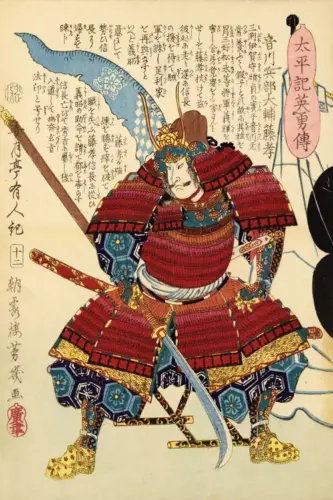
This weapon analysis is bullshit. The naginata polearm was used by samurai, foot soldiers, and warrior monks from the Heian period onward.
Utagawa Yoshiiku’s “Taiheiki Eiyūden” (Heroes of the Tale of the Great Peace). Painted by Yoshiiku, Chōōrō studio
It was a primary weapon during the Genpei War (1180–1185) and Nanboku-chō period (1336–1392). When it became associated with women, it was centuries later during the Edo period’s long peace (1603–1868). The weapon was dated, as they always are, and lost battlefield relevance. Women of the samurai class carried it when it had been repurposed as a status symbol and for self-defense. The association therefore was a Tokugawa-era development, not an origin story.
Dare I say this exhibit’s source material retrojects a gendered identity onto a weapon that spent centuries as a general-purpose military tool primarily used by men, because a fraudulent “designed for women” framing creates modern narrative more useful than the actual history?
So, second of all, this exhibit sees ideology in the past but not in its own mirror. It tells us why it deconstructs Meiji myth-making, while it is performing 2026 myth-making.
This British exhibit could have led with the insight that the West fundamentally misunderstands what being a “samurai” meant. It could have used the women’s history to blow open that misunderstanding for everyone, male and female. Instead it drives deeper into a narrow definition and pushes women into it. That makes it representation without revision.
Notice the reporters who focus on fierceness and brutality of woman, which I’m not sure is the correct path towards redeeming women in history.
“It’s a surprise that comes from a narrow use or a narrow understanding of the word samurai, because samurai doesn’t mean warrior,” Dr Rosina Buckland, Asahi Shimbun curator of Japanese Collections, told The Independent.
According to the exhibition, the most celebrated female samurai was Tomoe Gozen who died in 1247, and whose exploits are the subject of The Tale of the Heike. She was reported to have ripped off the head of the samurai Uchida Saburo leyoshi who tried to capture her for ransom.
The curator literally says “samurai doesn’t mean warrior”, an arguably radical claim because it reframes everything, and then the exhibit’s marquee story becomes a woman warrior ripping someone’s head off. I’m only left wondering if she also shit down his neck?
The corrective gets completely swallowed by the very framework it’s supposedly correcting.
The exhibit claims “women made up half of the samurai class” by expanding “samurai” to mean social class rather than warrior caste, then promotes the exhibit with gorified stories that rely on a narrow warrior definition. It’s using both definitions simultaneously depending on which one serves the current sentence.
That’s not scholarship, it’s rhetoric.
Third, something smells off about this whole thing. The Huo Family Foundation sponsorship is a buried detail. A China-based foundation sponsoring an exhibit in Britain to re-frame Japan’s martial identity raises, well, red flags. The funding source may be the context.
Others have pointed out the curation within context is problematic. The object selection gives us a tsuba with a world map (exceedingly rare) cherry-picked to suggest Edo-period global consciousness that wasn’t representative. It offers ornate ceremonial armor that the Japanese don’t consider authentic to samurai identity. Neither curator is a weapon or armor specialist, a fact I find almost impossible to believe given the British adoration of weapons and armor in their exhibits. They seem to have set up evidence which coincidentally fits a Chinese thesis about Japan, rather than building from evidence.
To be fair, Broderick and Buckland clearly agree that the samurai meant more than warrior. The failure becomes that their exhibit couldn’t commit to this story without also promoting gratuitous violence to seek attention in the British market.
Fourth, and finally, this is a familiar pattern: women are admitted to the canon by demonstrating they can meet criteria, not by challenging whether those criteria are correct. The Onna-bugeisha become legible to a museum audience not because samurai culture encompassed governance, education, estate management, arts, and social organization — important recognition of the proper definition and all things women were deeply embedded in — but because a woman ripped the head off someone. The entry ticket to historical recognition is unnecessarily reset to brutality.
It reminds me how Hillary Clinton worked for Goldwater. She didn’t enter politics by articulating an alternative vision; she entered by proving she could operate within the most aggressive, unfit for rule, existing framework available, then spent decades unable to fully shed her origin story. The price of admission shaped the thing it would allow her to be.
The President is in violation of the Constitution he swore to defend.
Executive Summary
The President of the United States failed to nominate Senate-confirmable U.S. Attorneys. He used procedural gimmicks to keep unconfirmed personal loyalists in those roles. Courts ruled his installations unlawful. Rather than comply, he directed political prosecutions through unlawfully serving officers, then fired a lawfully appointed replacement within hours of his swearing-in, citing the very constitutional provision that authorized the appointment. He is systematically dismantling separation of powers that prevent Trump becoming monarch and appointing his wife as his successor.
The Trump administration conduct is criminal on its face. The use of state machinery to punish political opponents through proceedings the government knew lacked legal authority, carried out by officers the government knew were unlawfully installed, under the direction of a Deputy Attorney General who spent nine years learning exactly how federal prosecution is supposed to work, then burned every bridge in his professional life to ensure it never works that way again.
Article II, Section 2
Congress may “by Law vest the Appointment of such inferior Officers, as they think proper… in the Courts of Law.” Congress did that. 28 U.S.C. § 546(d) is that law.
It is the constitutional design working exactly as written.
When Trump’s personal criminal defense lawyer, and Deputy Attorney General, Todd Blanche tweeted “Judges don’t pick U.S. Attorneys, the president does. See Article II” he actually cited the provision that says judges can pick U.S. Attorneys when Congress authorizes it.
It’s like he’s saying Enron accountants don’t balance the books, their CEO does.
The second-highest official at the Department of Justice publicly misrepresented the Constitution he swore to uphold, on a public media platform, to fraudulently represent firing an officer who had been lawfully appointed under the very clause he was citing.
The Trump legal 3-part tragedy runs like this:
A president has absolute authority to appoint U.S. Attorneys under Article II. But Trump didn’t appoint one here. He let the 120-day interim expire. He failed to get a nominee confirmed by the Senate. He didn’t do his job under the very article he’s invoking.
An Attorney General can then use a congressional statute (the Vacancies Reform Act and § 546) to install a loyalist through a back door — naming former campaign attorney John Sarcone “first assistant” to keep him in place. Statutory authority is legitimate when it serves the president’s interests.
However, when a federal judge uses the same statute’s next provision — § 546(d), the part that activates when the president’s 120 days expire — suddenly congressional authority over appointments is unconstitutional. The statute is valid in subsection (a) but void in subsection (d). The same law. The same page.
The position is that law applies to everyone except the president. It’s the monarch position, in direct violation of the Constitution and why America was founded.
The King’s attack already hit five districts
Look at the identical tragedy unfolding in New York, New Jersey, California, Virginia, and Nevada.
The president nominates a loyalist on an interim basis. The 120 days expire. Rather than submit to Senate confirmation — the process Article II actually requires for principal officers — the administration uses procedural maneuvers to keep unconfirmed people in place. When judges rule those hamfisted monarchist maneuvers unlawful, Trump either ignores the rulings or, as here, unlawfully fires the court’s lawful replacement within hours.
A systematic strategy to staff the federal prosecution apparatus without Senate confirmation. Similar to how Trump ran out the clock on appointments to the National Archives so he could inject someone who would destroy them. The one thing the Appointments Clause was specifically designed to prevent. The Framers included Senate confirmation because they had just fought a revolution against a king who appointed his own prosecutors, judges, and tax collectors.
Eastern District of Virginia alone makes the case
The unlawfully serving U.S. Attorney Lindsey Halligan brought criminal indictments against Letitia James and James Comey — known political enemies of the president. A judge threw those indictments out because Halligan had no authority to bring them. Halligan then brazenly continued using the title “United States Attorney” in court filings after being told she was not allowed. A federal judge warned she could face discipline for making false statements to the court.
This is what the unconfirmed prosecutors were for.
There’s nothing sophisticated here. It is plainly the political prosecution of Trump’s personal targets, carried out by people who serve at his pleasure because they were never subjected to Senate scrutiny as required by the Constitution. When judges tried to enforce the law, the administration spun disinformation attacks. They tried to say up is down, left is right, and the judiciary enforcing the Constitution to prevent abuse of power is an “abuse of power”. Obviously, without question, the president firing a court-appointed officer within hours is the abuse of power.
This Deputy Attorney General’s crimes appear intentional
Todd Blanche spent nine years as an Assistant U.S. Attorney in the Southern District of New York. He tried cases under the very appointment framework he’s now dismantling. He won the DOJ Director’s Award for superior performance as a federal prosecutor. He knows what § 546(d) says. He knows what a lawful appointment looks like. He knows what Article II authorizes. The misrepresentation on X was not ignorance.
It was a deliberate application of expertise in reverse, known well to historians of Nazi Germany, where the former prosecutor uses his knowledge of how the system works to prevent it from working.
Before becoming Deputy AG, Blanche was the president’s personal criminal defense attorney in three separate criminal cases — including the one that produced 34 felony convictions. He represented Paul Manafort, convicted of fraud and conspiracy. He represented Igor Fruman, a Giuliani associate who pleaded guilty to campaign finance crimes. He founded a solo law firm for the sole purpose of representing Trump after Cadwalader, Wickersham & Taft pushed him out for taking the client. He moved his family to Palm Beach County near Mar-a-Lago. He switched his voter registration from Democrat to Republican.
He switched his entire professional life to serving one man’s legal survival against the Constitution, and his reward was the second-highest law enforcement position in the country to destroy the Constitution.
The leader’s private lawyer now oversees every federal prosecution in the republic. In healthier systems, such an appointment would not be possible.
Blanche record in office
He personally conducted a two-day proffer interview with Ghislaine Maxwell — a convicted child sex trafficker — at the U.S. Attorney’s office in Tallahassee. A Deputy Attorney General has no business running a proffer session; that is line prosecutor work. Unless the purpose is controlling which questions get asked and which answers get recorded. The transcripts confirm the priority: Maxwell told Blanche the president “was never inappropriate with anybody… he was a gentleman in all respects.” She was subsequently transferred to a minimum-security facility.
He refused to open a civil rights investigation into the ICE killing of Renée Good — a mother shot in the head by a federal agent — despite video evidence that 82% of Americans said showed unjustified force, and despite a dozen federal prosecutors in Minneapolis and Washington resigning in protest. He announced the decision on television before the FBI investigation was complete. He then called Governor Walz and Mayor Frey “terrorists” on X and confirmed investigations into them instead — the elected officials who called for peaceful protest, not the agent who fired into a car that was turning away from him.
He was simultaneously installed as acting Librarian of Congress — a legislative branch position — after Trump fired Carla Hayden two years before her term ended. Library staff refused to recognize his authority. DOJ officials reportedly attempted to assume physical control of the building and were turned away.
Every action follows the same criminal logic. Shield Trump from legal exposure for his crimes. Punish anyone trying to hold him accountable. Extend Trump’s control into institutions where he has no authority. The client list didn’t change when Blanche moved from defense attorney to Deputy Attorney General. The billing arrangement did.
Blanche announced the firing of a court-appointed U.S. Attorney using the known Trump meme on a social media platform: “You are fired, Donald Kinsella.” He incorrectly cited a constitutional provision, which he knows opposes him and Trump. He appears confident that his audience won’t know he just said the opposite of the truth, intentional disinformation. This is the manner in which legal authority is exercised when its legitimacy is no longer the point.
The sequence deserves clinical attention: the leader’s personal attorney becomes the state’s chief prosecutor. Investigations migrate away from the leader and toward his political opponents. Courts intervene. The regime fires the court’s appointees and calls judicial review an abuse of power. The prosecutorial function has not been eliminated. It has been reversed. It now protects its patron and punishes his critics, and the man operating it got the job by keeping his client out of prison.
Criminal exposure: specific and documented
18 U.S.C. § 242 — deprivation of rights under color of law. Letitia James and James Comey were subjected to the coercive power of federal prosecution by an officer a court ruled had no authority to wield it. The administration was informed of that ruling and continued anyway. The willfulness element — usually the hard part — is handed to you by the court orders. They knew. They kept going.
18 U.S.C. § 1505 — obstruction of proceedings. The Renée Good civil rights investigation was killed before it could begin, over the objection of career prosecutors, announced on television before the FBI had completed its work. The use of positional authority to prevent a lawful federal proceeding from occurring.
18 U.S.C. § 371 — conspiracy to defraud the United States. Five districts, same pattern, same result. Install unlawfully serving prosecutors, maintain them after court orders, use them to bring political prosecutions. A scheme to impair the lawful function of the Department of Justice. Blanche sits at the top of that scheme as the official who oversees all 93 U.S. Attorney’s offices.
The logic is disbarment
Blanche is a member of the New York bar. Rule 8.4(c) prohibits conduct involving dishonesty or misrepresentation — his public statement that Article II gives the president sole appointment authority, when he knows Article II explicitly authorizes court appointments, is a material misrepresentation of law made in his official capacity to justify an official act. Rule 8.4(d) covers conduct prejudicial to the administration of justice — personally conducting a proffer session with a convicted sex trafficker to elicit statements exonerating his former client, while that former client controls her clemency prospects, is the corruption of a prosecutorial function. Rule 1.7 covers conflicts of interest — his former client is the president, his current role requires oversight of investigations implicating the president, and the Maxwell interview proved he cannot separate the two.
Every piece of it is on the public record because he announced it himself on X.
The problem was never the evidence. The problem is the defendant controls the courthouse.
a blog about the poetry of information security, since 1995