If you have AI/ML projects and aren’t sure how to validate their safety, this presentation is for you. Don’t let another AI project go forward without security assessments being in the conversation.
Abstract: For years the security industry has discussed the leap into cloud computing as a paradigm shift. Get ready for another leap, as data platforms are rapidly becoming AI/ML development that requires its own new species of safety validations. This presentation, based on years of field tests, provides a quick intro and practical list for security teams to comfortably engage data science projects.
Standard disclaimer: I am not a national security lawyer, always seek professional advice***
Please consider the huge significance to the future of science and scientific inquiry in America when you read the latest headlines:
Pompeo says ‘we don’t know when, we don’t know where’ Soleimani had planned ‘imminent attacks’
This is what radical “end is neigh” evangelical thinking looks like when shoe-horned into modern concepts of self-defense that usually require leaders to accept scientific realities like clock and compass.
I mean any garden-variety dictionary would tell you “imminent” means “happening soon…menacingly near”.
Normally that means we would be checking a clock as we talk about soon and near events as detailed and measurable concepts (given centuries if not millennium of time-telling technology)… and yet the White House claims they “don’t know” how to predict either.
Let me now philosophically break the faith-based White House policy position into the three logical parts:
1) “We don’t know when”
The science of measuring time is called horology, which refers to timekeeping and advances in related technology (e.g. clocks and watches).
Saying we know something is “imminent” and yet don’t know when it will happen is a dog-whistle (dare I say a god-whistle) rejection of science; a wide rejection of scientific disciplines from history to physics that predict imminence.
More specifically, physicists are prone to argue things like “time is an arrow” and say deep things like this about looking forward:
We remember the past but we don’t remember the future. There are irreversible processes. There are things that happen, like you turn an egg into an omelet, but you can’t turn an omelet into an egg.
A natural scientist of course would laugh at the example and simply say if a snake or lizard eats an omelet it can lay an egg, thus easily proving how and when an omelet turns into an egg. They probably could even tell you when a new egg is considered imminent after eating an omelet.
It begs the obvious question if science can tell us with great precision and detail when something is going to happen, why is Pompeo declaring he has rejected science with “we don’t know” yet still claim he knows something “imminent”?
2) “We don’t know where”
Speaking of arrows…
The science of measuring space is called cartography, which refers to spacial scale making and advances in related technology (e.g. maps and geographic information systems).
Saying something is “imminent” and yet don’t know where it will happen is a dog-whistle (dare I say a god-whistle) rejection of science; a wide rejection of scientific disciplines from history to physics that predict imminence.
More specifically, I think you can see where I’m going with this…
It begs the obvious question if science can tell us with great precision and detail where something is going to happen, why is Pompeo declaring he has rejected science with “we don’t know” yet still claim he knows something “imminent”?
3) “Imminent attacks”
Pompeo allegedly welcomes “end-times” Evangelical faith as a strategy. When is the end of end-times? It is famously considered by faith-based groups to be “imminent” while also very importantly…unknown when and where.
Conlusion: White House is Waging a War Against Science
More than 30 states introduced legislation to require GE labeling in 2013 and 2014, with laws recently passed in Vermont, Connecticut and Maine…
Imagine that, Americans were using science in governance to make it a requirement they know when and where something harmful might come their way.
In response, Pompeo said he wanted people to not use science or know when or where harms would come and instead have faith in the word from on high. To be fair, DARK literally said this:
Preempts any state or local requirement respecting a bioengineered organism intended for a food use or application, or food produced from, containing, or consisting of a bioengineered organism. Sets forth standards for any food label that contains claims that bioengineering was or was not used in the production of the food. Preempts any state and local labeling requirements with respect to bioengineered food. Requires the Secretary to issue regulations setting standards for a natural claim on food labels. Preempts any state or local regulations that are not identical to the requirements of this Act.
Pompeo sponsored America going DARK to make science difficult for harm predictions. You can see he required state and local thought to be identical to what the federal secretary opaquely thought about harms, regardless of science.
People may joke about Communism being dead. Yet it is Pompeo’s brand of un-American top-down centrally-planned dictation of knowledge that reminds me most of a 1980s meme “In Soviet Russia…”.
Today the ad would be more like “in Pompeo America, party imminently knows when and where you are”!
I deserve no credit for pointing this out
In honor of scientific method having citations I am far from being the first to notice a war against science going on with the White House, let alone wider political party attempts.
There are many who deserve credit. Here are only a few examples:
I’m just applying this kind of ongoing reporting to an important area of security like the ethics of self-defense and targeted assassination of foreign state leaders.
The US could have shown deference to scientific thought or methods and gone with a Robert Baer (CIA Middle East field officer) “we assassinate*** because…these reasons” document in the open. Then it would have worked with other states to lay out logical/moral justification claims within inherited (internationally accepted) systems of ethics, and submitted for peer-review.
Instead it has Pompeo standing alone and naked in the streets making a god-whistle while wrapped only in the isolationist trope of destroying science because “national security” is declared a higher order than a public’s right to know. As Foreign Policy wrote, probably without meaning any irony, it is the voices of locals that need to be heard on these issues if bad leadership is meant to be ended:
Mistaken support for a terrible political leader is hardly unique to the Middle East.
Terrible political leadership? The concept of “imminence” is before our very eyes being diluted into a religious war cry by a faith-based group in a so called “ok to prey if you pay” system. It is the Evangelical state of being both always and never in danger.
It is the knowledge that His coming is soon that puts a little bit of immediacy into our step and determination into our service.
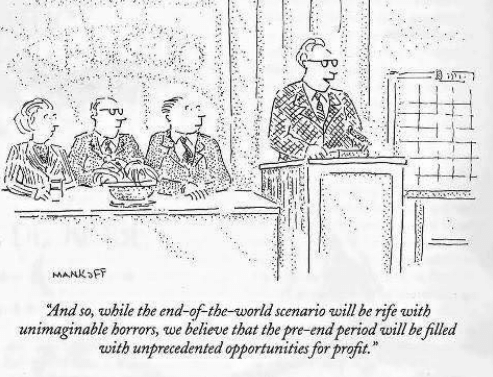
Or as the New Yorker famously put it…
Bob Mankoff was the cartoon editor of The New Yorker from 1997 to 2017
Why would any American willingly do that (again)? The anti-science tactics fundamentally (pun not intended) encourage corrupt over-centralized belief-based systems, which used to be considered the exact opposite of successful public American foreign policy let alone domestic.
My assessment of science denialists has changed a lot since I started writing my dissertation on anti-science propaganda 5 years ago. I used to think they were stupid and culpable. My position has changed 180 degrees. I now believe these people are victims of sophisticated and well-funded manipulation campaigns that prey on social trust and our necessary reliance on others for knowledge.
And since we’re now obviously talking here about denialists running a war-machine after an assassination of foreign state leader, I’m also reminded of WWI. The current administration has many same hallmarks of “the Kaiser in 1914…who saw his empire first defeated and then dismembered” due to German leadership faith-based mystical belief in “Der Tag”
*** Per my disclaimer at the top, lawyers have recommended listening to Episode 106 of the ABA National Security Today Podcast from yesterday:
The first speaker, Bellinger, makes the point that use of terms like assassination and reprisals are to describe illegal acts. Pompeo (if he cares to abide by law) thus has to frame his doctrine as “targeted killing” of a leader of a state that was to prevent some imminent terrorist act (because there is no declaration of war).
Bellinger also brings up a lot of interesting detail on the lack of legal authorization for targeted killing and lack of necessary communication with Congress. At one point he says the American people should be told the exact reason for immediacy. References:
Executive Order 13382 and Executive Order 13224
War Powers Resolution of 1973
Even against such legal podcast terminology, my point hopefully remains clear. Pompeo is engaging in a particular type of contradictory rhetoric, consistent with other attempts to destroy science, by saying he both does not know and does know something to be true.
To put it simply, the term where means a place has been targeted for a terrorist act and the term when means soon enough to require immediate action. If Pompeo says he didn’t know where or when then in what possible way will an imminent terror attack be proven to be real instead of being faith-based?
There are many, many versions of the January 8, 1815 Battle of New Orleans. None of them, so far, seem to tell the history in a manner that would be most fair to the participants.
Most ignore completely the most important detail:
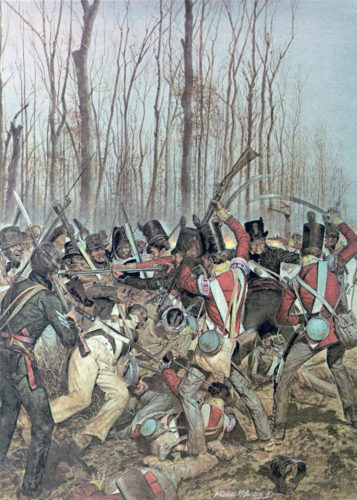
American forces were made of “free men of color”. Specifically, of the 1,000 Louisiana militia and volunteers in the battle, it was nearly 50% non-white. The U.S. Army even has a print set called “The American Soldier” with a depiction of a the free men of color battalion in action to celebrate this fact.
Battle of New Orleans. Night attack of December 23. The painting shows the Choctaws and a mixed group of Major Daquin’s Battalion of Free Men of Colour. The latter were mostly attired in civilian clothes because they had been organized only for a few weeks. They are led by an officer distinguishable by his sword and red sash. Facing them are members of the British 85th Regiment in red coats with yellow facings and white lace, and members of the British 95th Regiment in green uniforms with black facings and white lace. Source: “The American Soldier.” U.S. Army Center of Military History.
[Jackson] included a large number of both free men of color and enslaved black men in and around the city. To recruit the former, Jackson promised them the same wages and, equally important, the same respect as their white compatriots — a unique opportunity for black and Creole residents living in a Southern city committed to white racial superiority. For those enslaved, he appealed to their desire for freedom.
Take a moment to question the statement New Orleans was “committed to white racial superiority”. Lacking any citation at all, it sounds suspicious to me for a city known to be highly diverse in the 1800s.
Although it is true that New Orleans brutally put down a huge slave revolt in 1811, the free men before and afterwards still were present and exercising their rights up until America started shutting them down.
During both Spanish and French rule of the colony of Louisiana the “free men of color” regularly served in militias. So when the U.S. took over New Orleans, it started with an integrated military.
At the time of the Louisiana Purchase in 1803, about 16% of the roughly 8000 people living in New Orleans were free people of color. The first official U.S. census of the Orleans Territory in 1810 counted 7,585 free persons of color, or about 10% of the total population.
Remember how above I mentioned 50% of Jackson’s force from Louisiana was non-white? That’s a huge jump up from being just 10% of the population.
The above quote from the Tennessee History site is followed-up soon after on the same page by another odd statement:
Jackson not only ordered all black troops out of New Orleans at the behest of white residents who were fearful of armed black city-dwellers; he also reneged on his offer to free his enslaved troops and instead, ordered them to return to their slave-owners.
Let me try to untangle this.
First, Jackson saw all men of color as a potential enemy.
When Governor Claiborne offered the free men of color as a veteran militia, Jackson responded that arming them and putting them into harms way was a good way to prevent them siding with the British.
The free men of colour…will not remain quiet spectators of the interesting contest. They must be for, or against us — distrust them, and you make them your enemies, place confidence in them, and you engage them by every dear and honorable tie to the interest of the country who extends to them equal rights and privileges with white men.
This probably explains the exceptionally high percentage of free men of color serving, relative to population numbers. It is incredibly tempting to read that letter and think Jackson had in mind at least some advance to equal rights and privileges, however there’s a fundamental problem with such a line of thinking.
When Jackson arrived in New Orleans he declared military (martial) law for the first successful time in United States history. He proclaimed it necessary because “those who are not for us are against us, and will be dealt with accordingly” and then “refused to lift his order instituting martial law for months…”.
A Louisiana State senator expressed unease about the ongoing state of martial law in a March 3 newspaper article; Jackson promptly had the senator arrested. When a U.S. District Court Judge demanded that the senator be charged or released, Jackson not only refused, he ordered the judge jailed before banishing him from the city. (When Jackson eventually lifted martial law, the returned judge proceeded to charge him with contempt and levied a thousand-dollar fine, which the “Hero of New Orleans” paid.)
It is worth considering how martial law was Jackson’s preferred method of rule, completely inverted from his letters he sent that said to “place confidence” in the public would gain their loyalty.
He seemed very keen to convince people he had their best interests in mind while he also demanded they pick a side. Martial law stemmed from his complete lack of trust in allowing freedoms. The key to unlocking Jackson’s true feelings seems to be that his concerns over spies and dissent was related to what he saw as a “largely foreign city” (French and Spanish). Jackson fundamentally distrusted New Orleans residents because they were not white like himself.
In other words, what if martial law was Jackson’s manner of dealing with discomfort and protest from a militia of non-whites he planned to defraud?
Don’t forget the Peninsular War kicking off in 1807 between France and Spain meant that by 1809 Cuba expelled Franco-Haitian and French residents. They became refugees escaping to New Orleans, which doubled the population of the city, and tripled the size of its free people of color population two years before the 1811 slave revolt. Martial law may really have been Jackson’s way of dealing with how to maintain white supremacy.
Dozens of “citizens without charges” were put in jail for weeks, not to mention Americans put in jail on spurious basis such as just being in the wrong place at the wrong time. Jackson even tried (unsuccessfully) to enforce blatant military censorship on local newspapers.
Another line of reasoning is that martial law helped obscure a true casualty rate of the American militias, as well as lack of true threat from the British. Most accounts of American deaths seem low, even though hundreds of the “professional” British soldiers had laid down and played dead rather than fight.
Second, Jackson did not have honest intentions.
Of course the freemen were promised equal pay, equal treatment, freedoms and so forth but Jackson appeared to have every interest in bringing non-whites to his side, with no plan of honoring his word to them when he no longer needed them.
In other words, a large U.S. military force of veteran free men of color and slaves was used by Jackson to deliver victory yet his response was to deny those men freedom (as he had promised) at the time of victory and then, as he became U.S. President allegedly in part from the tales of this battle, to strip non-whites in America of their voting rights and perpetuate/expand slavery.
To be fair…while Spanish/French colonial-era slave codes had granted complete rights and equality to a “free man of color” (allowed to be educated, serve in military, own land, business, and even slaves) it was only the March 4, 1812 Louisiana Constitution that removed the right to vote from 2/3 of the people living there. That was long before Jackson would fight a vicious political campaign at the federal level to do them even more harm.
When you think of a battle for “freedom” from British rule, consider the new state’s constitution was so undemocratic and exclusionary, property worth at least $5,000 had to be owned by a white man for him to be a candidate for governor and then he would be chosen by the legislature not voters. So it wasn’t just Jackson trying to build a new aristocratic empire, denying democratic rights to Americans.
However, Jackson was a major influence on the undemocratic and racist direction of America in the mid-1800s. While the British abolished slavery in 1833 (led in 1829 by Mary Prince, an escaped slave from Bermuda), not to mention New York in 1827, or Mexico in 1824, America instead was about to be dragged down by Jackson’s seemingly endless thirst to use his authority for enslaving and massacring non-white Americans.
Extensive administrative and diplomatic experience since Washington was a norm for anyone serving as President of America. Jackson found this unnecessary and dismissed critics who pointed to his lack of time in any Cabinet post or even travel abroad. Jackson had poor writing skills in English alone, so studies in advanced topics such as foreign travel and languages seemed out of the question.
The thing Jackson really leveraged was brutality of his plantations and militancy against non-whites. It was in this context the stories told about the Battle of New Orleans under his martial law and strict control of the press worked to his political advantage.
Although stories of valiant brutality (despite the truth being British soldiers laid down and pretended to be dead) stoked his persona as a war hero by 1824, Jackson failed to navigate the process required to become President. Described as a simple “military chieftain” by his opponents, he proved the title accurate as he initiated a vicious campaign against the newly elected President Adams.
A truly barbaric personality, Jackson spent the next years in bitter opposition to everything and anything American government was doing, framing himself as a benevolent dictator. President Adams, who had been duly voted into office in 1824 under the 12th Amendment, was being challenged to lead the country given vicious and underhanded tactics coming from Jackson’s desire to shut the entire government down if he wasn’t the one put in charge.
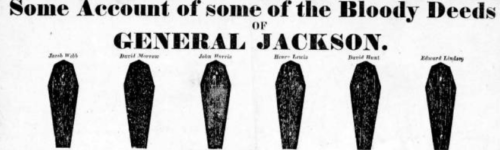
When Jackson ran again for President in 1828, he framed himself a victim of free press and set about trying to take control of political discourse through disinformation tactics. For example, a famous “coffin handbill” depicted American militia men who had been unjustly ordered executed as six black coffins, suggesting that they had been murdered by Jackson. These basically were accurate criticisms of Jackson’s background.
Jackson was alleged to have “illegally and wantonly shed the blood of his countrymen and fellow soldiers” ordering six militiamen executed on 1815 Feb 21 after a military trial in which they were convicted after leaving camp to return home during their tours of duty. The handbill stresses that the men realized their error and returned to camp voluntarily to resume service but instead were detained and slowly shot dead one-by-one.
While the press fairly pointed out a record of unjust brutality and lawlessness within Jackson’s only claim to fame, his campaign responded by cooking up a series of total falsehoods to target and destroy his opponent’s character. Jackson basically and openly lied in response to the press pointing out how awful Jackson was, all the while calling himself the real victim.
Jackson delighted in this process, even personally contacting papers with guidelines in what was basically an information warfare campaign by a military chieftain to undermine democracy. Once President, Jackson expanded his war on the press, as I’ve written before:
In 1844 former-President Adams won an eight-year long campaign in the House of Representatives and overturned the Jacksonian bans on free speech, but torture and murder by pro-slavery terrorists continued to rise.
Anyway, PBS has posted an excellent explanation of how free men under Jackson suffered greatly, as he pivoted from credit for this battle to lay the foundation for white-nationalist sentiments and stoke racial divisions in America that remain a challenge today.
Before 1800, free African American men had nominal rights of citizenship. In some places they could vote, serve on juries, and work in skilled trades. But as the need to justify slavery grew stronger, and racism started solidifying, free blacks gradually lost the rights that they did have. Through intimidation, changing laws and mob violence, whites claimed racial supremacy, and increasingly denied blacks their citizenship. And in 1857 the Dred Scott decision formally declared that blacks were not citizens of the United States. […] The concepts of ‘black’ and “white” did not arrive with the first Europeans and Africans, but grew on American soil. During Andrew Jackson’s administration, racist ideas took on new meaning. Jackson brought in the “Age of the Common Man.” Under his administration, working class people gained rights they had not before possessed, particularly the right to vote. But the only people who benefited were white men. Blacks, Indians, and women were not included.
Without taking credit away from the free men of color for their role in the Battle of New Orleans, and stoking up its significance for his own political campaigns, Jackson may never have succeeded in his information war to become President, gag abolitionists and perpetuate slavery, precipitating Civil War.
Jackson’s sentiments greatly foreshadowed not only the Trail of Tears and Civil War but also treatment of American blacks who served in much later wars. Most notable perhaps was the 1921 massacre of WWI veterans in Tulsa by the KKK restarted by President Wilson under the America First campaign.
A couple months ago I wrote a post about a U.S. judge who ruled that online hate speech is physical harassment and I optimistically thought this would have an impression on people.
More recently a computer science student told me he refused to engineer social media content controls because he thought John Stuart Mill argued for absolutely unlimited speech.
I’m not sure where this crazy interpretation of Mill comes from or how, but it is very wrong (as I wrote back in 2011). That student was not the first to grab onto it.
A bad Mill reference deflated my recent optimism. The famous philosopher very clearly had a harm principle, widely discussed and documented; it really shouldn’t be hard to understand what Mill considered harmful and why he developed a principle to restrict speech.
It is these unfortunate misunderstandings of famous philosophers, let alone ignoring rulings by judges in actual courts, that surely leads to people saying their freedom of speech is some weird absolute.
“Social media allows you to share your views with the world in seconds, but it does not give you the right to threaten violence against others. The FBI stands ready to investigate whenever threatening language crosses the line to a crime,” said Special Agent in Charge Strong. According to filed court documents and evidence presented at trial, on March 13, 2018, Twitter user @DaDUTCHMAN5, later identified as Vandevere, used his social media account to send a message that contained a threat to injure an individual identified in court records as Q.R.
The defendant literally argued that sending a death threat wasn’t a threat because it was a political exchange of views while also not being a political view:
The tweet included a picture of a lynching and read, “VIEW YOUR DESTINY.” Vandevere argued his indictment must be dismissed on First Amendment free speech grounds, claiming the communication in question was not a “true threat.” […] “In 2019, the political arena necessarily includes the public exchange of political views that occurs daily on Twitter and other social media sites,” wrote his attorney, Andrew Banzhoff.
The judge wasn’t impressed by these weak arguments. Obviously telling a stranger their destiny is a lynching is a clear threat, and an exchange of political views is harmed by threats of violence.
The 4th U.S. Circuit Court of Appeals has held that “mere political argument, idle talk or jest” are not true threats, Cogburn noted. “However,” the judge added, “a true threat dressed up in political rhetoric or artistic expression alone does not render it a non-threat.”
What is especially interesting about this case is the victim claimed it was one of many similar threats on Twitter.
“It spikes any time there is (anti-Muslim) rhetoric from the political leadership of this country,” he said. “It’s almost predictable.”
This case therefore also provides credible evidence that federal anti-Muslim rhetoric has been increasing hate crimes, as already documented by researchers.
But what we think is interesting is that Trump’s tweets and hate crime only appear to be correlated after the start of his presidential run. It is also interesting that this correlation seems to be driven by areas with many Twitter users.
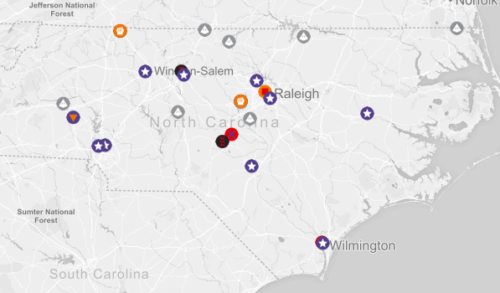
The above case is exactly what hate crime researchers have been warning about, given areas with a history of domestic terrorism (lynchings) and certain types of Twitter users:
…40 hate groups active in North Carolina. And many have argued that the 2015 murder of three Muslim students in Chapel Hill was fueled by Islamophobia, though the killer was not charged with a hate crime.
a blog about the poetry of information security, since 1995