The concept is simple, like looking at constellations of stars as a form of communication: A drone slowly moves in patterns, acting as a light paintbrush on the night sky. A slow exposure camera records its movements as message(s).
This drone flying to its many waypoints would look random to the human eye, yet the camera would be able to reconstruct the message whether it be an image or text. It’s a simple and inexpensive way to communicate covertly over long distances without exposing positions.
Manufacturers like DJI have posted guides, and basic proof-of-concept instructions by photographers have been posted online:
When creating these drone patterns in the sky I use the program Litchi that you can buy for 10 bucks from the app store on Android or Apple. You can use other apps such as Red Way Point or any app that can place waypoints to do this same thing, but I find Litchi has more finesse. The reason it does is that it can connect to Google Earth. […] A tried and true spot is around 900 ft by 600 ft. This is also important because waypoints can’t be too close or the drone won’t fly the pattern (This is only if you are working in a horizontal plane).
Here is an example of their text experiment:
Source: PetaPixel, Russell Klimas
And here’s a video that has been greatly sped up for the human eye to see connected waypoints for an image:
Adding more drones would solve for the waypoint distance issue, such that a swarm could write tight messages and just look like a dance of randomness.
Naturally to really achieve covertness, the messages being painted would be encrypted. Even a substitution cipher would do, and also could help reduce waypoint distance issues.
As a final thought, swarms of machines embedded in the field with visual sensors pointed to the sky could be commanded and controlled by this form of drone sky painting (e.g. a box means stop, an arrow means advance, a circle means retreat). And in reverse (view from above) a low-flying drone or a laser pointed at the ground could assist targeting from higher-flying drones.
This doesn’t necessarily have to be something insidious; temperature numbers painted in the sky at night could change sensors across an agricultural field to start/stop watering or deploy drones equipped for pest management.
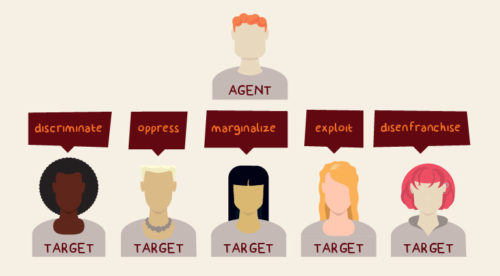
Source: MSW@USC Diversity Toolkit: Guide to Discussing Identity, Power and Privilege
We should worry “boundaries” increasingly set by algorithms will mean people may lose authorization to operate outside the “authenticity” boxes they’re placed in by others; denial of identity freedom may require generating more sophisticated forms of non-conformity.
In a couple recent blog posts I point out how an American expansion westward was driven by slavery economics and marked by concentration camps and genocidal campaigns.
Victims of humanitarian disasters in America were in theory offered an “exit” from total annihilation, if they chose to conform entirely by abandoning any freedoms of identity. Expression in speech wasn’t harshly limited, you see, just an “authenticity” of identity.
The Native American people were cruelly forced to operate on soon-to-be industrialized U.S. platforms, which meant sacrifice of self-determination. They were told at gunpoint to dress differently, speak a different language, sing/play/dance to different music, eat different foods, cook different meals, do different work…they were forcibly transformed from private owners to public “users” and every aspect of their identity had to change to conform to the encroaching immoral platform owners.
The “longhair” revolution of the 1960s often attributed to white “freak flag” communities, for perspective, was in fact adopted from a Native American movement to reclaim their identity rights.
…the physical cutting of hair is a manifestation of the loss of a loved one, a loss of a relationship, and a loss of a part of self…
You perhaps can see why identity self-determination was so important. Native Americans suffered greatly under U.S. tactics that forced them to conform to “Christian” identity requirements or face starvation (a 1902 Bureau of Indian Affairs “haircut order” required short hair to receive rations).
We unfortunately, despite lessons from the past, see a similar conformance campaign ethic driven by Facebook today. While being implicated in genocide, Facebook has taken a tactic to harshly prosecute people for freedoms of identity instead of clamping down on the speech that actually foments genocide.
Anyone attempting anything less than what platform owners consider “real” or “authentic” is eliminated from the platform. Facebook mistakenly calls this culling of identity freedoms a security measure, which to me reads like someone studied only the imitation game (Turing test) in computer science and skipped history classes.
Meanwhile Facebook does very little or nothing at all to address the real harms caused by the people they judge as authentic.
…we will not send organic content or ads from politicians to our third-party fact-checking partners for review.
It’s like Facebook saying the white supremacist diatribes of user Stanford couldn’t be blocked from facilitating genocide on their platform because he did so from an authentic identity. Only if he had done things like put on a strange coat of feathers and wore long hair, or grew a beard and put on a hat to look like the user Lincoln could he have been de-platformed.
From both a security and history perspective, Facebook has been wrong to blindly repeat the worst mistakes in history and force a dangerous conformity on their self-serving expansionist terms.
Edge cases of true impersonation (an integrity risk, such as stolen valor and authorization fraud) exist and should be stopped. “Deep fakes”, to that end, has been generating a lot of excitement. Yet it mostly begs old questions about whether new low-cost generation of content still should be regulated as art or expression.
People need to consider seriously whether a much greater threat to freedom is the opposite effect, Facebook operating a Kafkaesque identity conformance program of “deep realism” (e.g. already for several years I have met with government regulators concerned about harms to society including national security and the economy).
The risks from identity abuse edge cases of fraud/authorization are far less compared to dangers of militant removal of freedom and creativity of identity on global platforms. One could even argue, for example, the entire concept of the modern cosmopolitan lifestyle made famous in markets like NYC, Paris, London…is the high art of regionally managed platform identity freedom.
The best intelligence analysts already know this tactic. Adversaries love conformity because they can predict moves so easily and camouflage isn’t even necessary. A “weird” analyst by comparison becomes a nightmare of any adversary, because prediction of how they will react becomes impossible.
Another appropriate reaction is rotating focus back to harm, which means pushing a standard for filtering by actual risks while letting people express themselves from whatever identity they choose to develop and the communities to which they belong.
Take for just one example the concept of gendered color coding.
Pink is considered by some even to this day a shade of the “warlike” red, as in the British Red Coats. It stems (pun not intended) from Oliver Cromwell’s “New Model Army” adopting distinctive “Tudor Rose” dye as their uniform for war.
This of course was reconsidered around WWI when machine guns and snipers were killing anything identifiable, and military uniforms shifted to more muted tones to impersonate surroundings.
Meanwhile others, particularly in America, somehow came to see pink as their tool for encoding female identity:
“…a kind of early gender coding that worked especially on young girls. The decade of the Fifties was characterized by an ideological emphasis on conformity, and by fashion images that were sharply age- and gender-specific.”
In that sense pink in America really represents strangely planned attempts to make science more anti-social and eliminate women who scored high on social-good measures:
…programming’s shift from a women-friendly occupation to one that is hostile to women. In the 1950s and ‘60s, employers began relying on aptitude tests and personality profiles that weeded out women by prioritizing stereotypically masculine traits and, increasingly, antisocialness.
Even with this history of encoding and sexism it should never be wrong for any gender to associate pink with their identity. There generally is no harm of the color (with rare exceptions, such as war). Compare that to someone wearing an offensive hate speech patch or logo designed to do harm and expand suffering, on the other hand, and you see more logical security control areas.
Facebook’s genocide-facilitating platform is likely coming for your community with its AI, trying to get a lock on all the identities using things like “coding that worked especially on young girls”.
Thus more non-conforming behaviors should develop as fundamental survival tactics. Where can your data live that it will have freedom for identity?
I have long advocated for, and concur with latest research, that we need to assess code as potentially malicious (whether human or machine) and emphasize filters as a useful control for individuals to operate.
Researchers at the University of Cambridge have proposed a software program that treats online “hate speech” like a computer virus.
Scientific anti-pollutant concepts of continuous collection for known harms are a far more sensible approach than those of Facebook (repeating mistakes of American history) pushing to oppress identities through opaquely self-serving and centrally-planned concepts of what they call authenticity.
However, as you scroll down the list, perhaps the most interesting hit of all is this one warning that Stanford should be known as a “primary architect of annihilation”:
“Genocide” is a powerful word, but one whose impact has been diminished through overuse. Madley doesn’t use the word carelessly, even though he’s writing about US policy toward American Indians, a subject that often leads people to toss the term around quite loosely. His book does not contend, as more polemical works do, that all Indian policy was genocidal. He concentrates instead on a particular place and time: California from 1846 to 1873. […] Madley argues—and this is the core of his book—that California’s elected officials were in fact “the primary architects of annihilation,” and that they were funded and enabled by the federal government. Together, state and federal officials created what Madley describes as a “killing machine” composed of US soldiers, California militia and volunteers, and slavers and mercenaries (so-called “Indian hunters”) in it for the money.
Overall, it is clear that Stanford’s success was built on a system that was often exploitative and unjust, which benefited from extreme violence, repression, and genocide.
Stanford served in California state legislature as a Senator in the 1850s and oversaw Native American policy as a member of the Committee on Indian Affairs. That foreshadowed his governorship actions in 1862 to 1863, when he signed into law appropriations bills specifically meant to fund a “killing machine” that would wipe out Native American tribes in the state, a policy of forced removal of Native Americans from their ancestral lands.
Keep in mind at the point Stanford “oversaw” the fate of Native Americans, their population of approximately 310,000 just had been reduced to about 150,000 in the prior 77 years. Stanford’s push for a “killing machine” then totally decimated surviving populations, reducing them to just 12,000 people.
Stanford not only was head of government he was involved in business ventures that benefited from the displacement and exploitation of Native American communities, including the acquisition of land that had been taken from those communities through violent means.
Stanford University sits on ancestral land stolen from the Muwekma Ohlone Tribe.
Leland Stanford solicited volunteers for his Civil War-era army campaigns against California Indians and, as governor, signed into law appropriations bills to fund those killing expeditions. He later founded Stanford University in the name of his son, Leland Stanford Jr. Both Hastings and Stanford had made fortunes in real estate. Their ability to acquire land titles was facilitated by the massacre of the rightful claimants, a near-extinction they promoted and funded. As UCLA professor Benjamin Madley wrote in his sobering “An American Genocide,” published in 2016 by none other than Yale University Press, both Stanford and Hastings had “helped to facilitate genocide.”
California is birthed in genocide. […] As governor of California from 1861 to 1863, [Stanford] signs into law appropriation bills to finance those killing expeditions. Stanford’s favorite Indian killer is Major James D. Savage, leader of a militia called the “Mariposa Battalion.” Facilitated by the successes of extermination, both Hastings and Stanford acquire vast tracts of land and make fortunes in real estate. Their ability to acquire land titles is facilitated by their massacre of the rightful claimants.
Stanford wealth and assets came from massacres.
While all these references may seem to be ancient history, don’t forget Stanford recently hired Facebook’s disgraced head of security after he allegedly helped to facilitate genocide.
Change seems necessary and long overdue.
Is renaming from Stanford possible?
It appears to me this University moving to a better name is not out of the question.
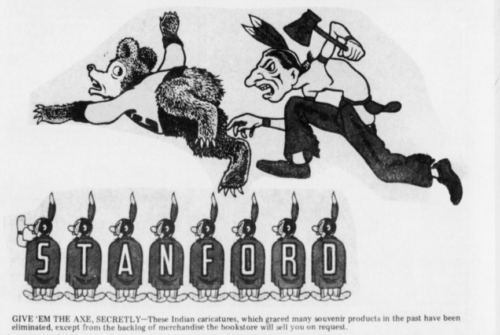
We already know Stanford agreed to remove cartoonish and degrading “Indian” imagery as its mascot. If you read the fine print on the following example it says offensive memorabilia was declared eliminated by making it secret, meaning easily available from the bookstore on request.
Source: The Stanford Daily Archives
In other words Stanford moves quickly when it wants to and uses creative solutions to deal with those uncomfortable with change/progress. The school offers an official timeline explaining how in just two years time they switched to being the Cardinals in 1972.
On November 22, 1970, Stanford American Indian Organization (SAIO) members petition for removal of Stanford’s Indian mascot—both the logo (as a “false image of the American Indian”) and the man, Timm Williams (whose live performances at sporting events were a “mockery of Indian religious practices.”) Native American students position themselves outside the Stanford Stadium at the Big Game against the University of California with banners saying “Indians are people, not mascots.”
SAIO members retell the story a little more broadly. They point out Governor Ronald Reagan’s “Indian staff person” is who voluntarily dressed and danced as a human mascot, and was breaking a promise he made to cease derogatory and demeaning acts:
The big issue with Timm Williams was his mockery of Indian religions. He would dance around in a faux Indian dance at the games. Even though he was a Yurok Indian, he wore the recognizable Plains Indian headdress and clothes to every game. He would make the “woo woo” sound with his hand slapping his mouth. We met with him a month after we got there, and he promised not to do it anymore. Shortly afterward he became the Indian staff person to Gov. Ronald Reagan, who infamously did nothing to understand Indians, most of whom had lost their Indian status when their treaties were terminated in the 1950s. But Timm did it again the next week. That was it for us. The Indian symbol, the caricatured Indians with the big noses, the religious denigration—all of it had to go. It took two years, but we finally got it done.
Governor Reagan fired Williams just months after Stanford changed its mascot.
Outside pressure clearly has worked on Stanford. Also, inside pressure has shown to be effective, as explained by members of the Stanford marching band who transformed it into a protest against a history of exterminating native cultures.
Part of assimilating Indigenous children in boarding schools into American society was handing them European music instruments to play European music. The government thought it would assist with wiping away their traditional musical practices. Marching bands came into play. […] “When it comes to discipline, the Stanford band is zero discipline,” said the Miwok citizen with a laugh and an emphasis on zero. The university’s marching band is “pretty nontraditional. Technically, we’re a scatter band,” Brown said. So they don’t actually march. They run from one formation to the other. What else makes the band nontraditional? No experience is required. It’s zero commitment meaning they welcome beginners to advanced musicians. This can also be current students, alumni or community members. Members hardly wear bucket hats and military-style uniforms. If they do, they can customize it with buttons and pins. Other university bands, like the University of Southern California, hate them. People yell at them and get upset because they’re not traditional.
I write this all in response to those who have asked me what to do after they read history of America and its episodes of genocide, a history that quite frankly historians tend to point out Nazi Germany studied for inspiration.
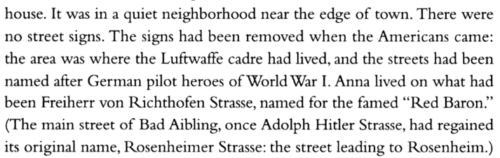
Let me put it this way. If Germans asked what to do about a university named for someone who committed genocide, what would any American probably tell them to do? Renaming should be an obvious answer here, though Americans seem not to welcome the very step that they enforced on Germany during occupation.
Binding Up the Wounds: An American Soldier in Occupied Germany, 1945-1946, by Leon C. Standifer, p 131
Other states already have figured out how to turn the corner. Take for example Minnesota’s Governor who very clearly came forward and condemned a past Minnesota Governor known for saying the U.S. should exterminate Native Americans.
“I am appalled by Governor Ramsey’s words and by his encouragement of vigilante violence against innocent people; and I repudiate them,” Gov. Mark Dayton said in a statement released Thursday. “The viciousness and violence, which were commonplace 150 years ago in Minnesota, are not accepted or allowed now.” Dayton called for flags to fly at half-staff from sunrise to sunset Friday, declaring it a day of remembrance and reconciliation on the 150th anniversary of the start of the six-week U.S.-Dakota War of 1862. He asked Minnesotans “to remember that dark past; to recognize its continuing harm in the present; and to resolve that we will not let it poison the future.”
We have yet to see California leaders take even basic steps to call out Governor Stanford for who he was and what the Stanford name means to this day — resolve to stop letting it poison the future by demanding change in the present.
In case that reference to Stanford isn’t clear, his gubernatorial candidate acceptance speech of 1859 allegedly was “I prefer free white citizens to any other race”. Then, after becoming Governor of California, in his first speech he wrote clearly white supremacist life goals straight into the official record books:
There can be no doubt but that the presence of numbers among us of a degraded and distinct people must exercise a deleterious influence upon the superior race, and, to a certain extent, repel desirable immigration.
Racial purity? As Stanford’s basis for genocide and internment camps?
Go ahead and tell me how this is any different from someone following Hitler’s orders.
Stanford is an important domino towards addressing wider American systemic racism.
Of course some warn it won’t be easy erasing this genocidal xenophobic white supremacist’s name, while they also ironically point out how Stanford already has been renaming things (again thanks to outside pressures).
California has a racist past. But removing monuments sparks debate about how to reflect an ugly history…Stanford University last month decided to rename three campus references to Father Junipero Serra, who founded the California mission system in the 1700s and whose legacy came under fire for the missions’ treatment of Native Americans.
I’m not saying by any means that Stanford was the only bad guy to focus on, and thus also agree with removing Serra (Stanford has very shamelessly replaced Serra with… Stanford).
What I’m saying is that even Stanford admits there is an important point to renaming anything that reflects “ugly” treatment of Native Americans.
Stafford Poole, the renowned historian on colonial Latin America, explains at a macro level how Stanford really was a powerful cog in a wider context of U.S. creating California to exterminate Native Americans.
The true villain is James K. Polk, the [1845 to 1849] president who maneuvered the country into an immoral war for which he was opposed by a congressman named Abraham Lincoln.
For those unfamiliar with the Bay Area, Polk tends to be a popular and significant street name.
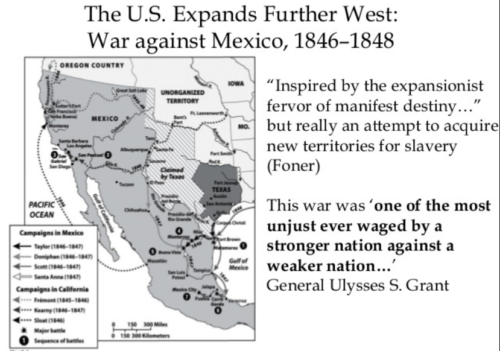
Poole is of course not only right, his point should be taken to mean the U.S. President Polk who in 1846 invaded Mexi-Cali to eradicate people living there and replace with white settlers…also probably shouldn’t have his name on anything today.
Source: Professor Grace Chee, Los Angeles Community Colleges
Note that quote from Grant, a true American hero in every sense. If you want to celebrate someone in American history, he’s the real deal.
Stanford stands out as the most significant target for renaming due to the heavy and widespread use as an honorific badge among scholars — influence is an understatement — not to mention the University obviously has aspirations to prevent further genocide (see initial links at the top of this blog).
When Stanford finally renames it likely will have influence on others to follow.
After Stanford in 1972 dropped their “Indian” mascot Dartmouth did the same.
I imagine after Stanford gets a better name someone will petition for places like San Francisco’s rather obscure yet busy Polk Street to be renamed (take note how “Polk Gulch” bloggers chastise other place names while apparently ignoring their own name).
The SAIO proved to the world in 1970 that Stanford University is capable of change, even rapidly evolving away from its ugly past.
We’re long past time to course correct the shameful “Stanford asshole” trend. Renaming Stanford to something not so “ugly” would be more than a symbolic way to help.
I propose Ohlone be consulted for the new name. Let them decide what the their land should be called.
And in the meantime go ask anyone brandishing the genocidal Stanford name to explain why they promote his crimes against humanity.
Oh, and also perhaps also ask why Mrs. Stanford was murdered with poison yet school officials refused to admit the facts, instead trying to claim she died from having too nice a lunch.
Nearly 60K people in London lost Internet access when their Virgin fiber was ripped out by a crew that didn’t check for authorization before drillingCompare and contrast:
The usual industry and education narrative about cell phones, social media, and digital technology generally is that they build community, foster communication, and increase efficiency, thus improving our lives. Mark Zuckerberg’s recent reformulation of Facebook’s mission statement is typical: the company aims to “give people the power to build community and bring the world closer together.” Without their phones, most of my students initially felt lost, disoriented, frustrated, and even frightened. That seemed to support the industry narrative: look how disconnected and lonely you’ll be without our technology. But after just two weeks, the majority began to think that their cell phones were in fact limiting their relationships with other people, compromising their own lives, and somehow cutting them off from the “real” world.
David Kaye, the United Nation’s special rapporteur on freedom of opinion and expression, has described the ongoing shutdown as a “communications siege” and “collective punishment without even the allegation of an underlying offense.”
Within security theory we would see this as an authorization dilemma.
In the first story the teacher clearly is an authority over students, although she does admit to asking for their permission before taking away their Internet.
In the second story the government clearly also is an authority over citizens, however that permission step becomes the rub. What if the citizens object to their government?
In either case, it’s interesting to see how the teacher builds a case that Internet removal generates a lot of fear and anxiety at first, before shifting to a realization it may be even more harmful to have it restored.
Self-determination is one issue, obviously needing to be kept in the debate, yet the other much more interesting situation here is that shutdowns could have a positive effect (e.g. especially if Facebook is being used by anyone, as it tends to be the tool of dictatorship, mass atrocities and destruction of self-determination).
The FBI says fiber cables in Fremont, Berkeley and San Jose have been intentionally severed in 11 instances since July 2014. Federal officials say there is no evidence that the San Francisco Bay Area acts are linked with the sabotage of a Pacific Gas & Electric Co. substation in April 2013. The nighttime attack knocked out phone and emergency 911 service in Silicon Valley.
Not to mention the odd coincidence that Bay Area fiber cables were cut 04/2013 at 0100 and 04/2009 at 0100.
Most of the 10 severed fiber-optic cables were in San Jose, where the first four were cut shortly before 1:30 a.m. Thursday in an underground vault along Monterey Highway north of Blossom Hill Road. Those belong to AT&T. Four more underground cables, at least two of which belong to AT&T, were cut about two hours later at two locations near each other along Old County Road near Bing Street in San Carlos, authorities said. Two others were cut in south San Jose. Each time, the vandals had to pry up manhole covers, climb down into vaults and chop through the thick cables.
Someone has been working hard for over a decade on multiple levels to destroy critical infrastructure. I also remember an even bigger event around 2002 that disconnected much of San Jose but there seems to be no reports anymore on the web.