President Hakainde Hichilema, whose party was in opposition for over two decades, had promised that he would scrap the laws if elected to the top job.
“President Hakainde Hichilema has assented to the penal code of 2022 abolishing the imposition of the death penalty and the offence of criminal defamation of the president, which has been on the Zambian statute books since (the) pre-independence era,” presidential spokesman Anthony Bwalya said in a statement on Friday.
Human rights activist Brebner Changala said the decision was a “huge milestone in the removal of colonial laws that do not fit in the democratic dispensation of the country”.
It puts Black African leaders in stark contrast to the white African CEO of Twitter, since he arbitrarily terminates digital personas especially anyone critical of him.
Who predicted a world where an African country demonstrates far more innovative, egalitarian and progressive leadership than a backwards and chaotic silicon valley media company run by a coin operated tinpot dictator?
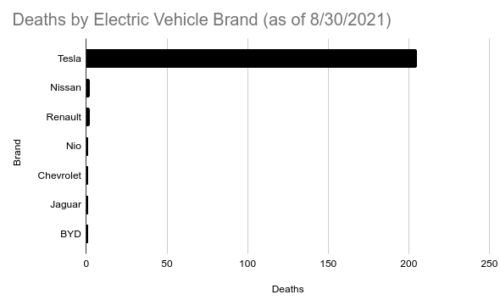
A new report looked at 11 fatalities by driverless systems over a few months (May to September).
One wasn’t a Tesla, but it also turned out to be a car that didn’t have driverless.
Oops, miscategorization.
The remaining 10 people were killed by Tesla engineering. As I’ve warned since at least 2016, crash investigations bring us to the same place: Elon Musk should be held liable for intentionally and systematically reducing road safety.
I think there’s a pretty clear pattern of bad behavior on the part of Tesla when it comes to obeying the edicts of the (federal) safety act, and NHTSA is just sitting there,” he said. “How many more deaths do we need to see of motorcyclists?”
[Center for Auto Safety’s executive director] noted that the Tesla crashes are victimizing more people who are not in the Tesla vehicles.
“You’re seeing innocent people who had no choice in the matter being killed or injured,” he said.
When a person is killed in a crash caused by a defective car, that manufacturer is liable.
After my 2016 BSidesLV keynote presentation I faced many people who said they thought Tesla was in a perfect loophole that the U.S. government would leave open — future leaning claims about safety “innovations” that weren’t true yet wouldn’t be regulated because profits.
Tesla shared its profits with politicians, to put it mildly.
At this point it is beyond obvious Tesla regularly lied to rapidly push known defective products that killed people; misrepresented hardware and software even when it posed grave danger to human life.
Raj Rajkumar, an electrical and computer engineering professor at Carnegie Mellon University who studies automated vehicles, said he wouldn’t be surprised if Tesla was found to have had a high number of crashes involving its driver-assist systems. Tesla…stopped using radar in its system and instead relies solely on cameras and computers — a system that Rajkumar calls “inherently unsafe.”
To be clear, making a car that an engineering professor calls “inherently unsafe” is something unique to Tesla.
It falls further and further behind other brands, which have been rising to their safest records in history.
Take for example Nissan has dominated all time EV sales in the highly competitive and demanding Norwegian market (many more cars for more miles than Tesla), facing challenging roads in bad weather. Widespread adoption of Nissan’s innovative “assist” technology has resulted in zero crashes.
Nissan, with over 560,000 vehicles on the road using its ”ProPilot Assist,” didn’t have to report any crashes, the company said.
There’s no more excuse.
If the CEO of FTX can be charged with loss of assets, why can’t the CEO of Tesla be charged with loss of lives?
As someone who has struggled to find an EV computer that understands how to drive through fluids (e.g. sand)… I got a chuckle from a new Rivian blog post.
…the new drive mode relaxes the accelerator pedal response for smoother, more gradual acceleration and deceleration in wintery on-road conditions. Snow mode also introduces a new low Regenerative Brake setting, which is exclusive to this mode.
Ok, a sluggish pedal to prevent spin is basic stuff. Makes sense. They even added some nice detection logic.
The vehicle will automatically nudge you to switch to the new mode if you’re in Conserve and it detects wheel slip and an ambient outdoor temperature of 34 degrees Fahrenheit or lower.
Cold outside and slippery, again makes sense. I was just beginning to yawn when…
The punch line:
Snow mode is meant solely for driving on roads and highways and is not meant for off-road scenarios. We recommend using the Off-Road All-Terrain drive mode for snowy off-road adventures.
LOL. OK, OK, “snow” mode is for slippery cold roads, NOT for… driving through snow.
Perhaps at best they should have marketed it as a snow road mode?
Or slow mode?
Or let’s be honest and call it the old fashioned traction control.
Again, fluids seriously blow up the traction logic in a vehicle computer. Sand, snow, deep rivers… forget about it. That’s still human territory.
I was hoping someone has worked on an actual computer snow mode.
Alas, this is just reducing tire spin on a flat surface after detecting tire spin and cold.
Motor Trend in 2017 wisely called the Chevy Bolt their car of the year. They’re now positively gushing over their prediction, calling the electric car’s engineering refreshing; very modestly it just keeps getting better and better.
While most buyers largely ignored it, the Bolt, like a fine red wine, kept getting better with age. The Bolt EUV launched in 2021 with more interior space, a more modern look, and the option to equip it with the best hands-free highway driving system on sale today. Now, a massive price cut for 2023 is transforming what was already a good car at a reasonable price into a veritable bargain.
That’s very high praise from a very respected authority.
Chevy is described as delivering the best hands-free electric car in America for just $19K in 2023.
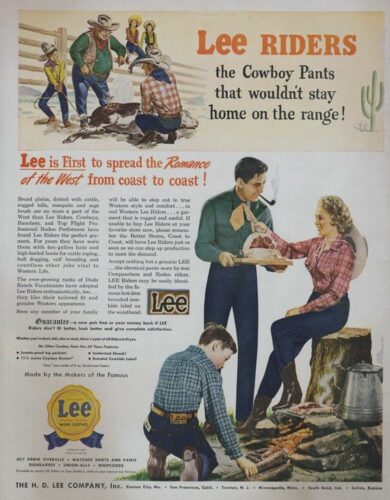
It’s everything right about America boxed up into a car, like wearing a classic inexpensive pair of sturdy well-built blue jeans.
Fun history tangent, the word “denim” in jeans comes from “serge de Nimes”. It was industrious Frenchmen in Nimes weaving wool-silk “serge” materials for hard working shepards, who had their product name shortened to de-Nim. Somewhere along the line (pun not intended) Americans switched cotton threads into denim, marketing this result as lower cost yet still highly durable jean.
Reliable, durable yet inexpensive.
Recently I was taking a stop in the sleepy beach-side town of Monterey, California when I noticed every car in a parking lot row was… the Chevy Bolt.
Every car a Bolt?
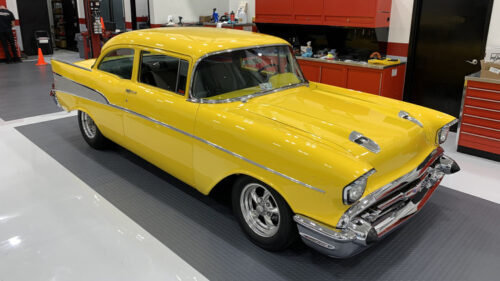
This bucolic small town, with its down-to-earth scene, reminded me of the buzz that only a cherry 1957 Chevy could generate, yet it was in 2023 and electric.
The 1957 Chevrolets were good cars mechanically. They took abuse fairly well, and when they did break, they were often cheaper to repair than their contemporaries. Thus, a higher percentage of them survived to become hobby/collector cars.
Something definitely was going on in the quiet back streets among those who could own anything. A sort of quiet, unassuming yet powerful statement that Chevy was THE electric vehicle to own.
This is going to sound a bit repetitive, but it needs to be said again: since we bought the 1957 Chevy, now named Project X, for $250 back in 1965, its sole reason for existing has been to act as a testbed for new hot rodding trends and technologies. …it’s clear that EV is here to stay and, just like always, Project X is on the leading edge to try out this new technology.
The quintessential hot rod for everyone, a Chevy initially costing $250, turned up in 2021 as a mouth watering EV.
Honestly, I have to admit I kind of expected engineering innovators like Kia or Fiat to be getting motorhead magazine accolades and maybe even Porsche, yet an honest and reliable Chevy looks like the real and clear winner year after year.
Meanwhile, Elon Musk’s half-baked jalopies have proven to be about as valuable as over priced ugly Russian designer pants that dissolve in the laundry. This blatantly anti-democratic racist predictably has dumped little more than hot snake oil directly on consumers (to undermine and delay protections from his fraud).
Worse and worse engineering problems hidden by intentionally misleading marketing have Tesla embroiled in class-action lawsuits, far too many funerals, and widespread investigations after reducing overall road safety for everyone.
Regulators looking at the remarkable success Chevy has achieved, given a huge market of improving electric car options reaching back to the 1940s, now more than ever should seriously consider a ban to remove the intentionally sub-par Tesla products from public roads.
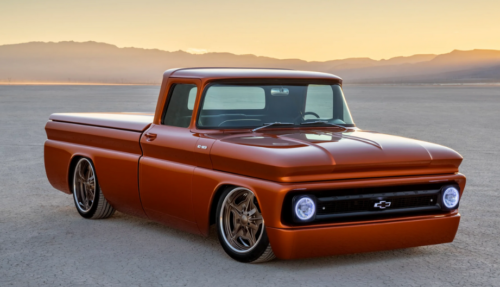
The Chevy Bolt is hidden beneath this brilliant E10 concept that someday may be proven safe enough for the mass market.
Elon Musk has criticized other car companies for having concept cars they never launch. However, the wise and cautious approach taken by Chevy is FAR more ethical than Tesla’s greed-driven clown show, which callously treats humans like disposable crash test dummies.
a blog about the poetry of information security, since 1995