
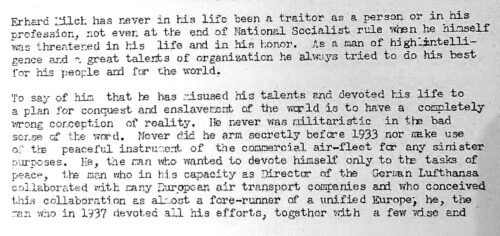
Erhard Milch read his closing statement to the Nuremberg tribunal on 25 March 1947.
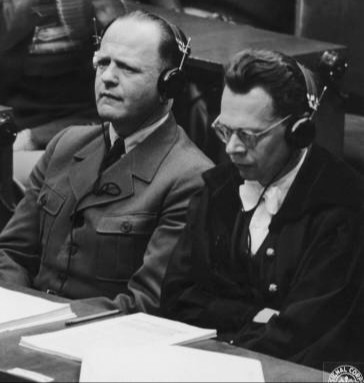
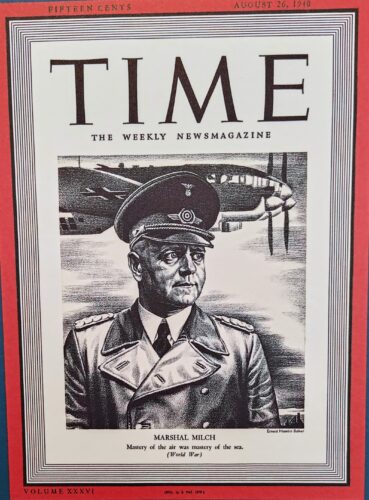
He had been one of three managing directors at the founding of German airline “Luft Hansa” in 1926, then moved to the Air Ministry as state secretary in 1933, and ran the Third Reich’s fighter production program that consumed forced labor by the thousands.
His statement runs two typed pages. He entered the ministry, he said, “trotz vieler Bedenken”, because he was told he could not refuse the call of the German people. He said he rejected the war and knew nothing of its planning. On the workers he gave the tribunal this:
Wenn ich auch mit der Beschäftigung der Arbeiter, also auch der Fremdarbeiter, nichts zu tun hatte, so habe ich es doch für meine Pflicht gehalten, genaue Erhebungen über die Zulässigkeit der Fremdarbeit zu machen, die mir bejaht worden ist, ebenso wie ich mich bemühte, die Zahlen so niedrig wie nur möglich zu halten.
EN: Although I had nothing to do with the employment of workers—including foreign workers—I nevertheless considered it my duty to make precise inquiries regarding the permissibility of employing foreign labor, a matter which was confirmed to me, just as I endeavored to keep the numbers as low as possible.

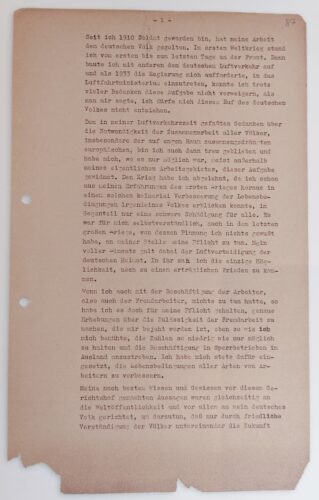
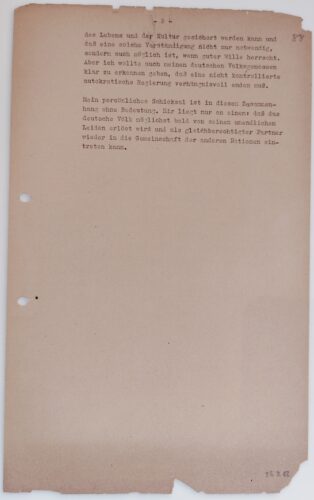
He had no hand in the labor, he said. He just examined its permissibility, he said. The examination came back affirmative. He kept the numbers low, he said. His testimony, he added, was addressed to world opinion and to the German people, to show that “eine nicht kontrollierte autokratische Regierung verhängnisvoll enden muß” (an unchecked autocratic government is bound to end disastrously), and his own fate in the matter was “ohne Bedeutung” (meaningless). His counsel closed the same day on the airline: Milch had never used “the peaceful instrument of the commercial air-fleet for any sinister purposes”, and had conceived Luft Hansa’s European partnerships as a forerunner of a unified Europe.
It was all lies.
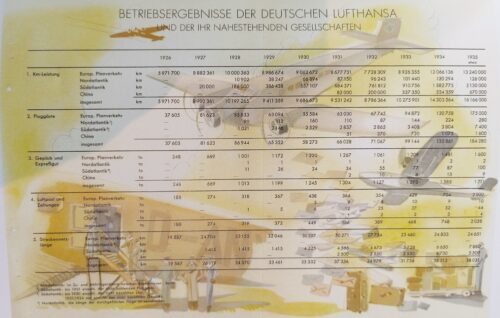
Lufthansa’s own chief executive said so on 3 February 2026, seventy-nine years after the plea: the airline was part of the system, and the commercial fleet was just cover for a clandestine air force built on slave labor.
The Lufthansa history exhibition in the Tempelhof tower of Berlin states it plainly: Lufthansa served as cover for building a German air force under the Weimar Republic, with Milch as the director driving it. Some planes (He 111 and Do 17) were designed with few passengers in mind, because they were meant to be bombers.
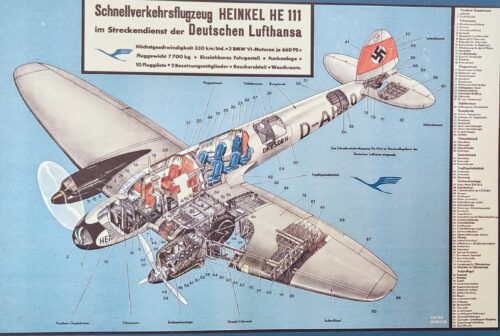
By 26 August 1939 the airline’s “Verkehrsinspektion Berlin” (traffic inspection) had become Kampfgeschwader zur besonderen Verwendung 172 (special bomber wing), commanded by Lufthansa director Carl August von Gablenz.
The tribunal acquitted him on the count of medical experiments three weeks later, yet convicted him on the slave labor.
Lufthansa traded on his lies for seventy years. The company commissioned the historian Lutz Budrass in 1999 to examine its wartime practices, including slave labor, and received his study in 2001. The results were kept it unpublished until 2016, when it appeared as a supplement to an illustrated anniversary book. Budrass then published his own account over the board’s objection so the public could know the truth. His figures put the forced laborers at over 7,000 at peak, with the company procuring workers itself from military repair works behind the front.
The first chairman of the new Lufthansa’s supervisory board was Kurt Weigelt, who had sat on the board of the old one and stayed on as honorary president until his death in 1968. In March 2026 Budrass wrote that the latest official company history still omits the part Milch and Carl-August von Gablenz played in the Holocaust. The pattern is stable across a century: the operator disclaims authority, the institution disclaims continuity, the archive waits.
This is the story that came to mind when people asked me what I thought about an essay in The Atlantic on 3 October 2026 under the title “I Quit OpenAI Because Its Culture Is Broken”.
David Robinson published his resignation essay like he was anticipating a Nuremberg trial. Reuters carried it the same morning. The essay names the defendant as culture, blames a sprint mentality, and calls for the redundancy of nuclear plants and airports. It also contains the sentence that invokes his place alongside the above Lufthansa record: “I never encountered a colleague who had experience making airplanes fly safely.” Looking at his own career path and choices perhaps explains why.
Robinson studied philosophy at Princeton and PPE at Oxford, took a JD from Yale in 2012, and interned at TIME and the Wall Street Journal. He co-founded Upturn, a Washington nonprofit that brought technical expertise to civil rights advocacy, and ran it until 2020. He spent 2018 at Cornell as a visiting scientist, taught at Apple University, and wrote a 2022 book on the governance of the kidney transplant algorithm.
He joined OpenAI in May 2023 as head of policy planning on the Global Affairs team and moved in October 2024 to the Safety Systems team, where his work was the system cards and public disclosures. Harvard Law billed him as a student and practitioner of the governance of high stakes algorithms. His own hiring notice for a deputy described the job as owning the editorial quality of safety transparency artifacts. He drafted the Preparedness Framework and oversaw safety reports on twelve launches.
So we have someone whose credentials are all for explaining decisions and none for making them. Remember what Milch claimed?
Although I had nothing to do with the employment of workers—including foreign workers—I nevertheless considered it my duty to make precise inquiries regarding the permissibility of employing foreign labor, a matter which was confirmed to me….
Upturn wrote reports for civil rights groups that carried the fights. His book studies surgeons and patients arguing over a kidney formula, observed from a visiting chair. Policy planning on OpenAI’s Global Affairs team was the lobbying arm, and Safety Systems, in his own hiring notice, was the editorial quality of the artifacts.
The man sent twelve launch reports out under his supervision and his essay names exactly none that he refused. Remember what Milch claimed?
…I endeavored to keep the numbers as low as possible.
On the one decision that Robinson’s own thesis required, he writes that he perhaps should have stayed and fought, and that he and his colleagues were too busy sprinting to consider big changes. The three researchers fired on 1 October took the risk he describes as impossible, and they lost their jobs for it. He left the same week hiding behind a PR firm to avoid taking personal risk.
Milch man.
Let’s go back and consider the two side-by-side. Milch said he entered the Air Ministry despite many doubts; Robinson says he did not leave OpenAI lightly. Milch said he rejected the war and knew nothing of its planning; Robinson says he was busy inside low-level sprints he followed.
Milch claimed he had nothing to do with the labor but certified its permissibility and kept the numbers low; Robinson tells us he drafted the Preparedness Framework and signed twelve launch reports. Not a couple, not a few, twelve.
Milch addressed world opinion on the fate of uncontrolled autocracy and said he spoke to the German people; Robinson addressed The Atlantic, through a retained PR firm, on what he calls a broken culture that made it hard for him personally.
Milch’s personal fate was without significance; Robinson’s decision to speak and draw attention to himself was his alone. What Milch really leaned on in 1947 was the claim that nobody had known. That’s the turning point in the comparison for me. The differences are legion. But on this one Robinson joined in May 2023, after the broken culture problems were already in print. He knew. He had to.
OpenAI folded safety into its research division in July 2026, which tells us something was changing in how the company managed its risk staff. On 1 October the Wall Street Journal reported three safety researchers fired for sharing information with an outside safety organization. Robinson’s departure landed the same week, with a canned Atlantic essay by his PR firm Spitfire Strategies, which he named in his own text.
When I say the problems were already in print, look at this very blog for example. It wasn’t quiet, ever.
| March 2023 | ChatGPT outage: what evidence exists for any confidentiality or integrity safety at all |
| August 2023 | OpenAI and WorldCoin: a product that lies by design, run by a company that ignores stop signs |
| September 2023 | Altman as Strangelove: the dangerous-model-we-won’t-release line as marketing |
| November 2023 | Board fires Altman: constant integrity breaches are a management decision |
| August 2024 | Trojan Horse: CISOs should plan to detect and exclude OpenAI from their operations |
| October 2025 | CISO as Theranos: we cannot solve this, attackers will exploit it, we’re shipping anyway |
| April 2026 | Firing on all cylinders: growth measured against the suicide reporting |
| August 2026 | Black Hat: discovery by availability failure, agents retained write access after the rebuild |
| August 2026 | The open letter: a sales catalogue asking governments to expedite the product |
| September 2026 | The basics: two incidents and a recurrence, each closed by egress control |
Milch’s closing statement was built to hold for one day in Nuremberg, with the crimes barely understood and a noose on the table. Robinson’s essay is built the same way, but there’s no court yet and his mistakes are very public. The tribunal convicted Milch on the labor he said he never touched. Robinson signed off twelve launches he now calls a broken culture he wasn’t responsible for himself.