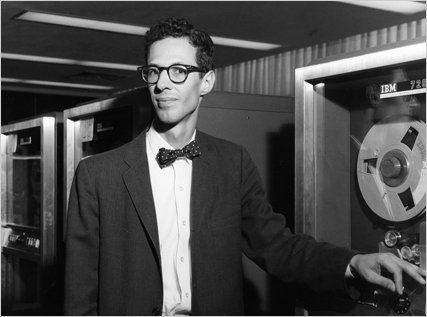
Using computers during the 50s was an exercise in frustration because the huge, monolithic machines could only handle one processing job at a time.
In a bid to overcome this limitation, Dr Corbato developed an operating system for computers called the Compatible Time-Sharing System (CTSS).
Rather than have the machine dedicated to one person, CTSS divided up the processing power of a computer into small slices so it could do little bits of work for lots of people.
Given all that…the BBC decided to run their story with a title of “Computer password inventor dies aged 93”.
Password inventor?
A lot of people think of the late Corbato this way, yet I’m not sure why that’s a good idea to keep saying it. The BBC could do better.
We are in an age where sharing systems are wildly popular and everyone hates passwords. Perhaps people think focusing on the password story will get more clicks? I don’t like how it distracts from the bigger picture.
It’s a bit like calling the guy who invented police (another sharing system) the inventor of the nightstick. Why focus on the latter when the former was their actual intent and more notable contribution? Even if there were other sharing systems around that time, Corbato’s sharing system work was seminal and very influential.
Second, the BBC describes antique compute power as “so fast”.
Even in the 50s and 60s computers were so fast that no user noticed they were only getting a small portion of a machine’s processing power at any one time.
WE have both “an exercise in frustration” because jobs had to be stacked, and yet at the same time “no user noticed they were only getting a small portion”. I find it hard to reconcile how frustration drove a user to solve something that no user noticed. Was it frustrating or was it invisible?
Also the story at this point ignores the development of batch processing in the late 1950s.
Anyway Wired describes the situation entirely differently, suggesting that slow speed actually led to hacking passwords.
In the spring of 1962, Scherr was looking for a way to bump up his usage time on CTSS. He had been allotted four hours per week, but it wasn’t nearly enough time to run the detailed performance simulations he’d designed for the new computer system. So he simply printed out all of the passwords stored on the system.
That makes more sense.
And finally, third, this whole narrative misses the point that Dr Corbato himself describes the use of a secret to gain entry as an obvious solution for shared systems.
He was reluctant to take credit for passwords, which begs the question why people are so intent on sticking it to him, instead of credit for a compute sharing model that can uniquely authenticate people.
I’ve seen some people reference IBM in the 1950s, when really there should be an investigation into Philco, RCA, ERA, NCR, GM NAA, Tymshare, National CSS, Dial Data and Fairchild computers from that time.
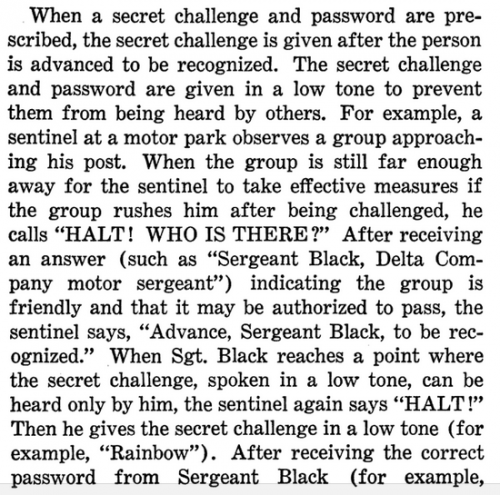
Many computer systems under development in the late 1950s were serving the US military. So by way of example, here is a page from a 1956 US Army FM26-5 booklet on the language used to handle access to an “internal” shared resource:
A while ago I explained in “Lost History of Knob Creek” how American history of whiskey production is tied to slavery.
In particular, Jack Daniel took his recipe from emancipated slaves even though he used his own name for the brand.
Now the man who taught Jack Daniel, “Nearis” Green, is getting his own brand. Proceeds from the sale of this new whiskey are going to fund college education of the master distiller descendants
See if you can trace how the story originally flowed from being “never a secret” to something they can only “embrace, tentatively” to a “gauzy and unreliable” tale, to an allegation that they hope would “never be definitively proved”…
Daniel, the company now says, didn’t learn distilling from Dan Call, but from a man named Nearis Green — one of Call’s slaves.
This version of the story was never a secret, but it is one that the distillery has only recently begun to embrace, tentatively, in some of its tours, and in a social media and marketing campaign this summer.
[…]
Frontier history is a gauzy and unreliable pursuit, and Nearis Green’s story — built on oral history and the thinnest of archival trails — may never be definitively proved.
Then a successful writer comes onto the scene and quickly realizes there is a market for trust and ethics, scientifically eroding the structural white supremacist deception and lies that intentionally obscure roots of American innovation.
…when she got to Lynchburg, she found no trace of Green. “I went on three tours of the distillery, and nothing, not a mention of him,” she said.
Rather than leave, Ms. Weaver dug in, determined to uncover more about Green and persuade Brown-Forman to follow through on its promise to recognize his role in creating America’s most famous whiskey. She rented a house in downtown Lynchburg, and began contacting Green’s descendants, dozens of whom still live in the area.
Scouring archives in Tennessee, Georgia and Washington, D.C., she created a timeline of Green’s relationship with Daniel, showing how Green had not only taught the whiskey baron how to distill, but had also gone to work for him after the Civil War, becoming what Ms. Weaver believes is the first black master distiller in America. By her count, she has collected 10,000 documents and artifacts related to Daniel and Green, much of which she has agreed to donate to the new National Museum of African American History and Culture in Washington.
So much for the thinnest of archival trails. Congratulations to Ms. Weaver and the Green family for restoring and preserving American history.
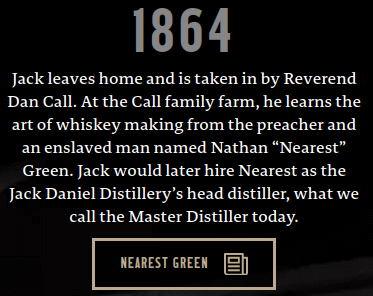
On his farm, Call had a still and Jack quickly took interest in it. Now this was back in the days prior to the Civil War and Emancipation and the Call still was under the watch and care of an enslaved man named Nathan “Nearest” Green. The Reverend Call and his distiller, Nearest, taught Jack how to make whiskey. Most of that mentoring, however, fell to Nearest who worked side by side with Jack and taught the young distiller what would become his life’s passion.
After the Civil War, Reverend Call’s congregation and wife gave the preacher an ultimatum: walk away from making whiskey or walk away from his work as a minister. Call made the decision to sell his business to Jack. And so Nearest, now a free man, was hired by Jack and became the very first head distiller – or what we’d call a master distiller today – of the Jack Daniel Distillery. While slave labor was a part of life in the South prior to the Civil War’s close, Jack Daniel not only never owned slaves but he worked side-by-side with them as a hired hand to Dan Call. When it came time after the war to establish his own distillery, Jack’s crew were all hired men.
Nearest would work with Jack as his first master distiller until Jack moved his operation to the Cave Spring Hollow sometime after 1881. There, Nearest’s sons George and Eli and his grandsons Ott, Jesse and Charlie continued the Green family tradition, working at Jack’s distillery in the Cave Spring Hollow.
More than 150 years have passed since Nearest and Jack first began making whiskey together, and, to this day, there has always been a member of the Green family working at the Jack Daniel Distillery.
Bottom line here? Why didn’t Call sell the distillery run by Green to… Green?
Nobody had heard of Green because Daniel centered the brand and story around himself despite obviously taking advantage of slaves and freemen alike just because of race.
Statements like “While slave labor was a part of life in the South prior to the Civil War’s close” are bogus. Two important points here:
1) Saying “back in the days prior to the Civil War and Emancipation” does NOT excuse slavery or make it acceptable in any way. The Colony of Georgia had abolished slavery in 1735 and the American revolution was in part fought to expand slavery. Indeed, the colony of Vermont had abolished slavery in 1777. Philadelphia passed a 1780 Act for the Gradual Abolition of Slavery and George Washington went out of his way to find loopholes just so he could continue slavery. American legends such as President Grant however had no slaves when the Civil War started because he already had ended the practice on his own accord (setting free the only slave he ever had, a man “gifted” to him by his wife’s father). General Burnsides as well had seen his father emancipate their slaves. There are many examples like this and the point is anyone claiming “part of life” phrasing for slavery is engaging in toxic apologist nonsense given America re-established slavery by forcibly making it part of life where it had NOT been. Indeed, Florida under Spanish rule was where slaves in America went to be free of American tyranny… until America invaded Florida to claim the land in order to re-establish slavery.
2) Slavery was all over America because its proponents had been violently forcing it to continue, yet it had been naturally ending in the North anyway for a long time (like the rest of the world). Those viciously attacking anyone who dared speak of freedom and liberty in America, censoring black voices, thus could also be called pro-slavery. Texas seceded from Mexico on a singular (“Lone Star”) agenda to violently expand slavery (white immigrants brought slaves into abolitionist Mexico and then violently seized the land to form a new slavery state). And while there were many brave Americans (e.g. Lovejoy, murdered in 1837 by violent slaveholder mobs) who stood up to such expanding violence, people who fought to free black men from the tyranny of America… Jack Daniel clearly was not one of them. His legacy is censoring black voices, erasing and revising history, to falsely market other ideas as his own. He even went by “Uncle Jack”.
Making whiskey together? Jack was learning, taking from Nearest. Working side-by-side with slaves and taking credit for their work, even after emancipation, is in no way the same as freedom.
While it’s tempting to tell white insecurity mobs today that their bourbon was invented by black Americans, this particular story rings the most hollow. We wouldn’t have to seek an Uncle Nearest story today instead if Jack Daniel had done the right thing.
Narrated by Emmy-Award winning actor Jeffrey Wright. This beautifully shot short film tells the extraordinary legacy of the first known African-American master distiller. It’s a story of honor, respect, and an unlikely friendship, that would forever change the whiskey industry. Perhaps the greatest American story you never heard.
The truth has finally found the light, no thanks to Jack Daniel. And while the story may be told that Jack Daniel paid Uncle Nearest well enough to prosper and take care of offspring, note that selling whiskey today to “fund college education of master distiller Nearest’s descendants” exposes the exact opposite.
Does a fund for education sound right, or like a given? Just think of a need for education money in terms of the wealth and fame accumulated by Jack Daniel appropriating so much and returning so little.
A new study that positioned “animals are friends” to Americans had an interesting outcome. Pork became unpalatable by the subjects, while beef was still seen as edible.
…we show that the negative effect of anthropomorphism on consumers’ attitudes and behavioral intentions toward (pork) meat consumption is mediated by increased feelings of anticipatory guilt (Studies 3a and 3c). Nevertheless, no such effect was found with another kind of meat (beef), which indicates that anthropomorphizing meat animals through the friendship metaphor cannot be successfully applied to all commonly eaten species (Study 3b).
While the researchers claim there is some literature angle that may explain the difference, it reminds me of families I know in rural American communities.
They regularly eat cattle they treat as pets. I’ve never heard of pigs treated as pets that see the same end.
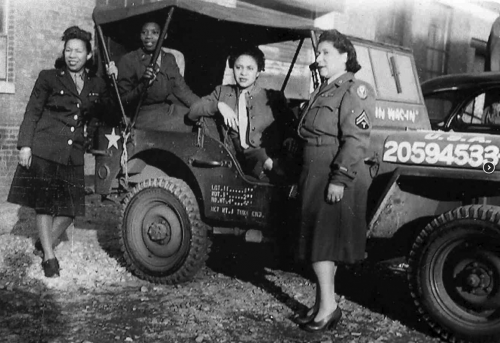
During WWII the 6888th (SixTripleEight) Central Postal Directory (CPD) all-black women battalion cleared nearly 20 million messages for Allied forces, The battalion adhered to the motto “No mail, low morale”.
Service medals weren’t given to members of the battalion until 2014 and only last year a monument was dedicated in Fort Leavenworth, Kansas. This year the battalion finally received an Army Meritorious Unit Citation…although the US Army history site makes it seem like a lot more has happened during the prior 70 years.
Four members of the 6888th. Source: United States Department of Defense.
a blog about the poetry of information security, since 1995