All posts by Davi Ottenheimer

French Food Chains Hacked With Freezer Bug, Following US Military Base Case

The refrigerated cases in about four hundred French supermarkets ran their defrost heaters through the night of 11 to 12 October with the setpoint at 50 degrees Celcius. That’s hot, even in Fahrenheit.

Attackers reached the Danfoss refrigeration controllers in roughly 300 Intermarché and Netto stores, under a hundred Coopérative U stores, and outlets of Leclerc, Carrefour Market and Monoprix, and held the defrost on for about six hours. Fresh and frozen stock was destroyed, with losses in the millions of euros. The Paris prosecutor opened an investigation on its own initiative and assigned it to the national anti-cybercrime office, citing fire starts alongside the food loss. The attack remains unclaimed and unattributed.

A spoiled summer, now fall

The attack hit the aisle already under the most strain. French fresh-produce prices rose 5.9 percent year on year in August, up from 2.7 percent in June, with salads and tomatoes each up more than 20 percent after the summer heat. Farm diesel was up 50 percent and nitrogen fertiliser had doubled by May after the Strait of Hormuz blockage. Dominique Schelcher, the Coopérative U chief who called the attack unprecedented, had already told France 2 in April to expect food prices up four to five percent. Economists expect this summer’s weather to push eurozone food inflation toward 3 percent in 2027, with fresh food first.

One night of spoiled stock across four hundred stores is small against national food spending. It lands on households already watching the fresh aisle, and it puts empty cases in front of them when their budgets are tightest.

Danish intelligence describes the aim of Russia’s hybrid campaign as creating insecurity in the targeted countries. A visible hit on food during a cost-of-living squeeze serves that aim quite clearly.

The noise of destruction was the point.

The same controllers can be made to spoil stock quietly, with no heat and no alarms. The attacker took the opposite route, pushing the cases to 50 degrees and emptying whole aisles by opening time. A quieter attack was available, and the attacker passed it over. Whoever did this wanted the damage seen and left no name on it. That is the shape of a message. Everything the heat touched had to be dumped, so the loss fell on the chains and stopped short of a customer incident.

The common factor across the chains was a refrigeration-control platform reachable over the network and running software a year past its fix. European law covers only part of this. The Cyber Resilience Act reaches the product with reporting required since last September, as explained below. NIS2 reaches the operator if they are wholesale, meaning not these stores (retail).

The mechanism

A supermarket runs its cold cases and cold rooms from one supervisory controller, here the Danfoss AK-SM family, which sets the temperatures and schedules the defrost for every case in the store. The controller is networked so a contractor can monitor and adjust hundreds of sites from one desk. An Intermarché spokesperson confirmed that the attackers targeted outdated versions of the control software on consoles reachable over an inadequately secured remote channel. A stolen password would have worked on any version, so the reported version cutoff points to an exploit aimed from a scan.

Claroty’s Team82 published its research on the AK-SM 800A in August: a hidden authentication path built on a daily code, logged as CVE-2025-41450, and 2,765 of the controller’s management interfaces exposed on the public internet. Danfoss had shipped the fix in firmware R4.3.1 in 2025. The stores hit were running vulnerable older firmware.

Where the law ends

France’s cyber agency is treating the attack as a product fault. A person close to Prime Minister Lecornu said ANSSI had identified a vulnerability in software supplied by a Danish company and contacted the vendor. The agency is working with its European counterparts because other countries may be affected, and is searching for other exposed French companies before the attack spreads. The response therefore follows the product, across many operators and borders.

The Cyber Resilience Act covers product fault, and part of it is already in force. Since 11 September, manufacturers have had to report actively exploited vulnerabilities in their products to ENISA and a national CSIRT within 24 hours of becoming aware of them, a duty that extends to products sold before the regulation fully applies.

This attack falls a month inside that window.

The full requirements, secure-by-default design and security updates across a defined support period, will start to apply from 11 December 2027. Old controllers with internet-facing interfaces and a vendor-built hidden authentication path are the case those requirements address, next year.

Liability is the real gap, which let bad network-connected software spread in the first place. For forty years a manufacturer had to answer for a defective physical product. However, software was shipped as a licensed service that disclaimed the same duty. A controller is both at once, a box on the wall and the code inside it, and the code lacked an equivalent liability. That gap has allowed a business case for shipping an internet-facing controller with a hidden authentication path and leaving the fix to a firmware update the field apparently never installs.

Berlin’s own breach this year ran on the same arrangement, with 21 state systems whose admin passwords only the vendors could change. The revised Product Liability Directive closes it, treating a missing security update as a defect the maker answers for, though only for products placed on the market from 9 December 2026.

Controllers already installed fall under the 1985 directive, where liability for software remains contested. Groupement Les Mousquetaires has already said the systems were under Danfoss’s management and so the complaint has to fall to the supplier.

The EU’s NIS2 also has a gap where the attack landed. Annex II covers food businesses engaged in wholesale distribution and industrial production, which takes in the purchasing and logistics groups behind these large retail chains. The stores where the controllers sit are considered outside Annex II, and many belong to independent members of the cooperatives. Article 21(2)(d) makes an in-scope entity answer for the security of its direct suppliers, so the duty follows whoever holds the refrigeration contract.

Look at it logically. When a store holds it, the duty falls outside NIS2. The refrigeration-management provider enters NIS2 in its own right only if it qualifies as a managed service provider under Annex I, a question regulators should soon settle.

The CER Directive draws the same line around retail for the physical resilience of food operators. Article 22 of NIS2 lets EU bodies run coordinated risk assessments of critical ICT supply chains, and supervisory controllers for food refrigeration belong on that list.

US military base warnings

On 26 and 27 August, at least six US military commissaries lost refrigeration within days of each other, with reports from as many as fourteen. At Fort Huachuca every freezer went into defrost overnight while the power stayed on, and the base said the defrost heated the food.

The Defense Commissary Agency’s own engineering specification states that defrost is controlled through its remote monitoring system, and a DeCA contract required its refrigeration contractor to keep a master control system for all of those systems in the continental United States. A defense official acknowledged a “possible refrigeration disruption,” and three federal criminal investigative agencies, led by DCIS, opened investigations.

Claroty’s Danfoss research had appeared eighteen days before Fort Huachuca lost its freezers. The two incident nights share the defrost signature, the overnight timing and the published research that came before them. Both remain unattributed.

In August the United States was at war with Iran, and in October France sat inside Russia’s campaign against Ukraine’s supporters, so the motives point to linked yet different adversaries.

One actor rehearsing on US bases and then striking France fits the sequence. So does a method made public in August and picked up by more than one crew. The commissary controller records, still in a FOIA queue, would help distinguish or connect these incidents.

Who done it

The version cutoff and the reported hits on Metro and independent butchers fit a scan of French addresses that hit whatever fit the profile. Any actor could run it. A state or state-directed operation inside the Russian hybrid campaign fits the motive against a Ukraine supporter and the pattern of an effect felt with the hand unseen, and the technical evidence for it has yet to appear. Unclaimed and fragmented is the Russia hypothesis itself, since an operation of this kind succeeds while the case stays open. A pro-Russian hacktivist crew fits the method, and its silence counts against it, since those groups claim loudly. A criminal demonstration ahead of a private extortion demand fits the absent ransom note and little else.

There is one question nagging at me. Danfoss is a Danish company and other Ukraine-supporting states run its equipment, yet the reports come from France. Either the exposed pre-version-4 population sat in France or France was carefully chosen, and the other countries may have yet to report. ANSSI is asking its counterparts now.

The same weekend, Ahold Delhaize, the largest grocer in the Netherlands and owner of Delhaize in Belgium, took systems offline after a cybersecurity incident that hit its websites, deliveries and shelf-label pricing. Reports so far confine it to IT systems, and no link to France is established.

Ok, say Russia already

Control-system attacks with physical effect have a verified record older than the press admits, running back past the Maroochy Shire sewage release in 2000. The matching cases reached an exposed control system and pushed a setpoint or valve to a destructive value. At Køge in 2024 an intruder altered pump pressure at a waterworks and burst pipes, and Danish intelligence attributed it to Russia in December 2025. Norwegian authorities said hackers opened the valves at a dam and blamed Russia. Dutch military intelligence reported the first cyber-sabotage attack by a Russian-aligned group on a control system in the Netherlands. France is unattributed and belongs to this class.

The wider campaign is accelerating. Danish intelligence said on 7 October that Russia had begun sabotage against Danish companies supplying Ukraine. German police logged hundreds of sabotage acts against critical infrastructure in a year, from the Vulkangruppe arson that blacked out Berlin in January to the rail fires claimed by “Kommando Angry Birds” in July, and Germany attributed the Leipzig/Halle drone attempt to Russia on 1 September. Dutch rail went down four days after NATO staged trains for the Russian front, while a US indictment shows Russian recruiters paying for sabotage from a price list. These are physical attacks, a different technique from France, carried out against the same group of countries supporting Ukraine. France sits in the middle ground between cyber and kinetic attack that threat frameworks still split in two, where a network command produces a physical result.

How to settle this

Open question What would answer it
Entry vector An internet-exposed StoreView interface, or compromised provider and installer credentials. The answer separates opportunistic exploitation from supply-chain compromise.
Scan history Archived Shodan and Censys records of French-geolocated AK-SM interfaces, matched against the victim list.
Independents Whether butchers with no shared provider were hit. If they were, the product version is the common factor.
Other countries Danfoss sites outside France. ANSSI says other countries may be affected and is checking with its European counterparts.
Ahold Delhaize Whether its same-weekend incident shares anything beyond timing. Reports confine it to IT systems: Albert Heijn’s websites, deliveries, loyalty and shelf labels, and Delhaize’s online ordering in Belgium.
Claims Any posting on dark-web forums or Telegram.
Vendor telemetry Whether the affected units were cloud-managed or exposed standalone.
US parallel Controller make and firmware at the commissaries hit in August, now in a FOIA queue.

Spoiled food is a smaller harm than a grid outage, while the security problem ends up looking the same: physical equipment behind a network control left reachable, running software a year past its fix. The Cyber Resilience Act as it stands is for the controller. These chain stores with massive footprints, where the food spoiled from infrastructure-grade attacks, isn’t yet addressed as NIS2.
Drones Hit Yandex so Cloudflare Kept the Russians Online

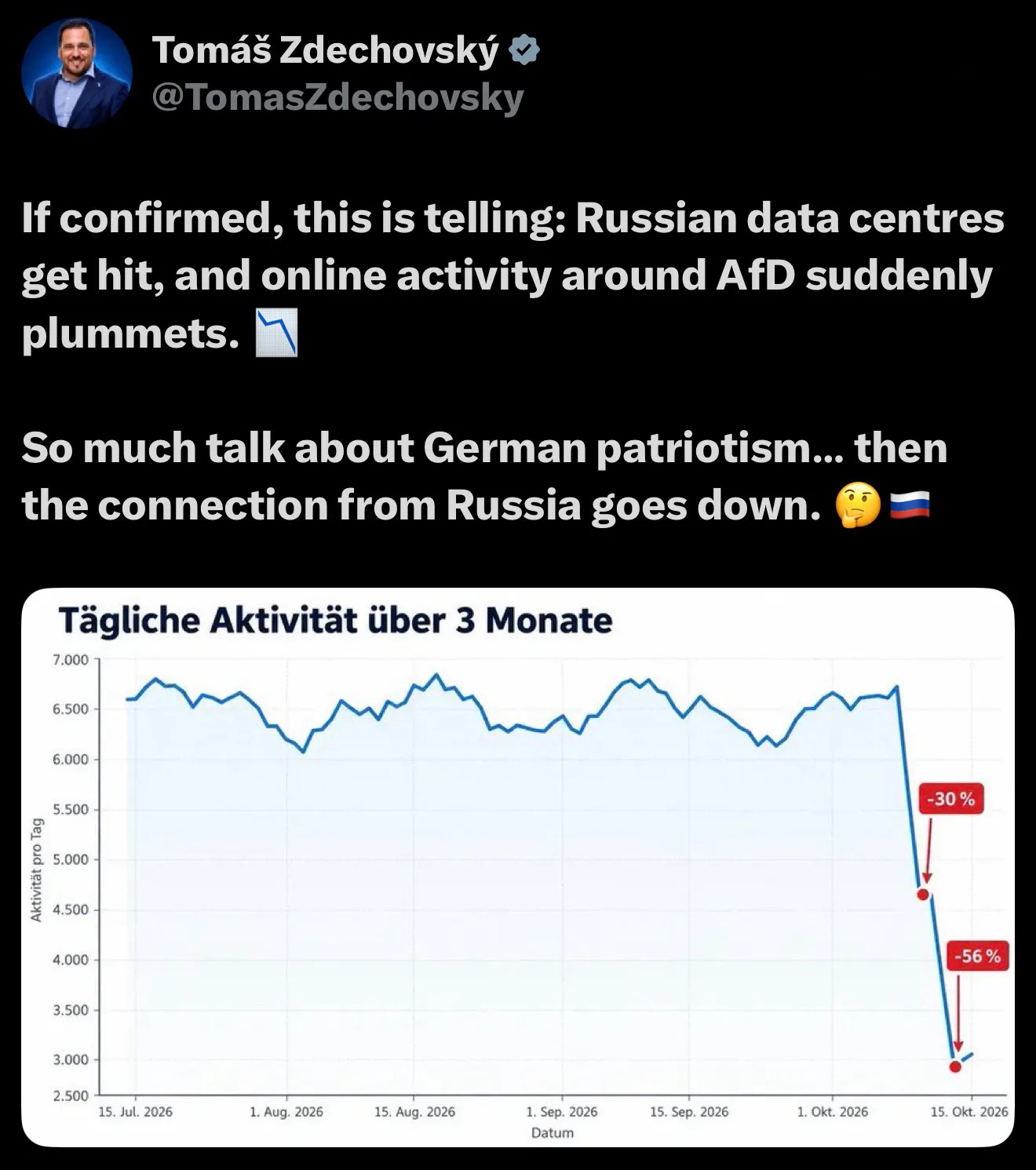
A Czech MEP posted a chart of AfD online activity with data points dated after he posted it, and it showed 232,000 views inside two hours. By Sunday night Frank Luntz, Garry Kasparov and Timothy Snyder were spreading the news: drones hit Yandex, and Russia’s bot armies went silent. The strikes are real, and the following bot silence reports beg a deeper analysis of what is being measured and how.

The physical evidence is the easy part. Three Yandex data centres were hit in four days. Yandex confirmed that Sasovo was heavily damaged and fully shut down overnight on 7 to 8 October and that Kaluga lost part of its infrastructure on 9 October. Reuters reported the full shutdown of a third site in the Vladimir region on 11 October. The Sasovo facility sits inside a machine-tool plant that has been under UK sanctions since 2024, according to The Record. Zelensky called the campaign a symmetrical response to a month of Russian strikes on Ukrainian data centres, which Russia’s Defence Ministry had cynically boasted was a forced digital detox (like how Molotov’s “bread baskets” were actually cluster-bombs dropped on civilians in Finland by the Soviet Union).

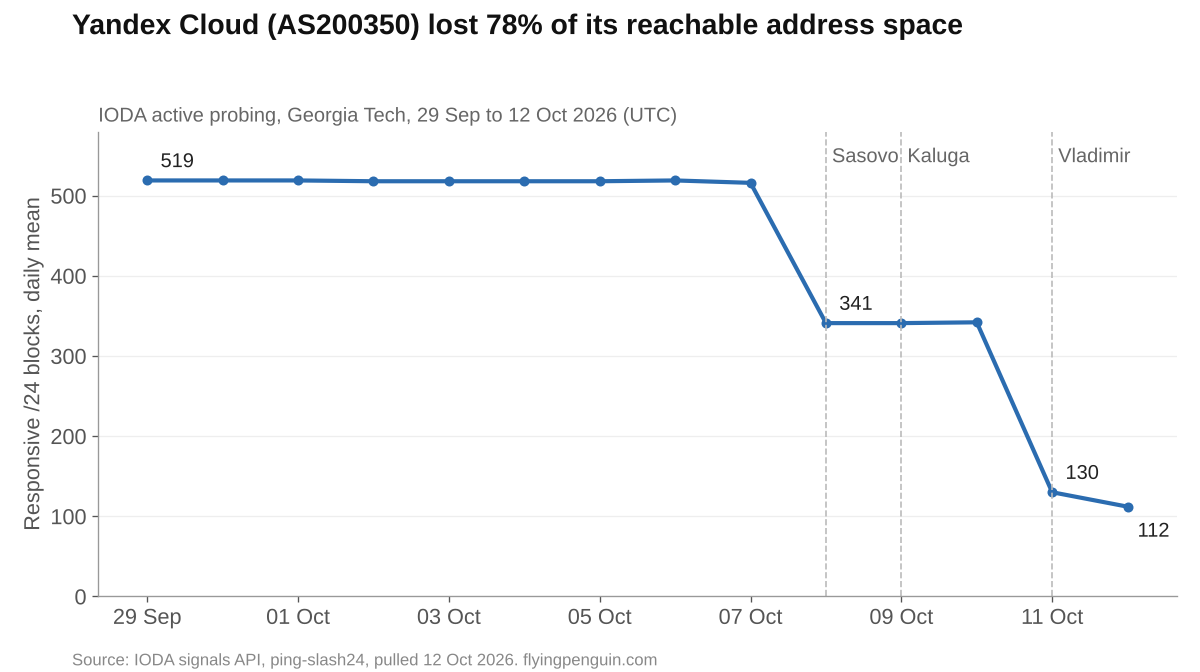
The digital damage to Russia is harder to assess, yet still measurable. And it certainly can be done using instruments that have nothing to do with an infamous malicious bot-spreading company Cloudflare. The IODA project at Georgia Tech probes the internet continuously and counts the /24 blocks that answer. Yandex Cloud, AS200350, answered from about 518 blocks a day through the first week of October. At 23:30 UTC on 7 October the count started falling and reached 341 by 00:30. At 02:00 UTC on 11 October it fell again, to 117. By the morning of 12 October it stood at 112, a 78 percent loss of reachable address space. Both Yandex networks kept announcing every prefix throughout. The machines went dark and the routes stayed up.

Signal, AS200350 Yandex Cloud Reading
Responsive /24 blocks, 1 to 7 Oct daily mean 518
First drop begins 7 Oct 23:30 UTC
8 to 10 Oct daily mean 341
Second drop begins 11 Oct 01:30 UTC
12 Oct 112
Prefixes announced in BGP, every day 858, unchanged

That is the basic summary of what happened, according to reports so far. Now comes a discussion of the statistical chart that produced speculation about the social impact of a datacenter outage. Remember, as we go through this, that Russia called their own operations of bombing datacenters as “digital detox”. So we are looking for evidence that Ukraine bombing Russian datacenters had the effect that Russia claimed.

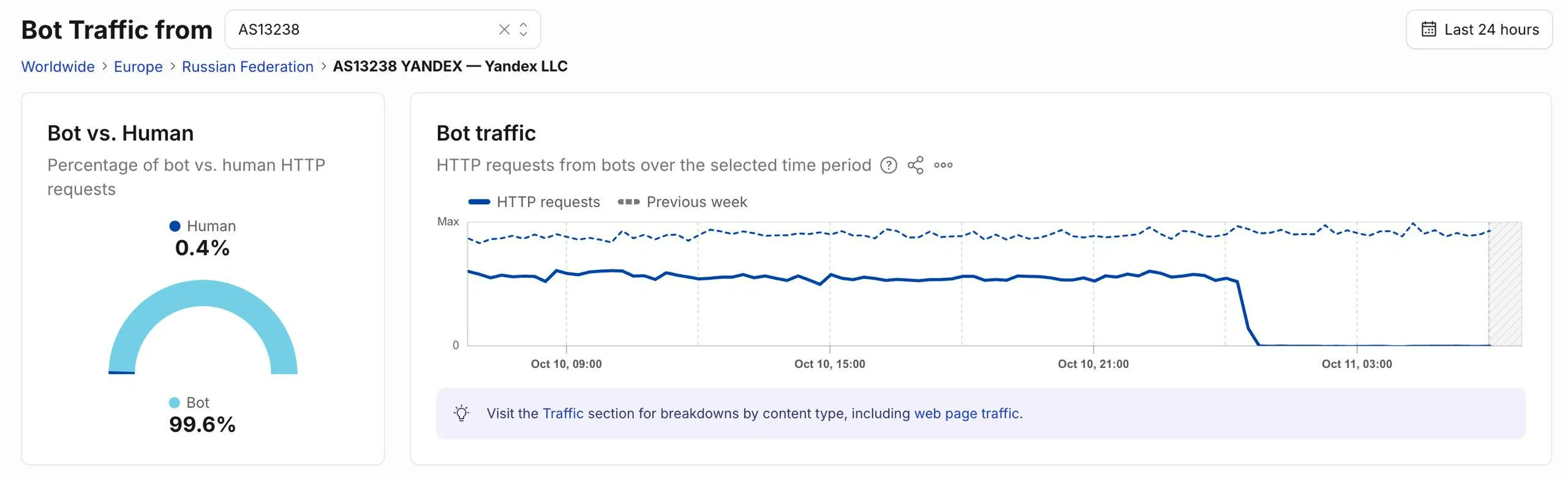
What spread on Sunday was a screenshot of Cloudflare Radar showing bot-classified HTTP requests from AS13238, Yandex LLC, falling to 0.4 percent of their two-week peak. Tom’s Hardware ran it under a URL slug that still reads russian-disinformation-bot-traffic-nearly-eliminated.

Some may remember that I wrote in June how the Cloudflare CEO misrepresented his own bot data: the company publishes an HTML-only figure as a fact about the whole internet, search crawlers are the largest bot category by a factor of two, and the number functions as a sales pitch for pay-to-crawl. The Yandex chart is the same series read the same wrong way, in reverse. Radar counts a request as a bot when Cloudflare’s bot score falls between 1 and 29, and it filters by default to HTML responses. Russia’s largest search crawler lives in that bucket. When Russia’s largest search crawler stops crawling, the Cloudflare bucket for Yandex’s network empties.

Cloudflare’s own API confirms what the bucket held. Pulled on 12 October, the verified-bot breakdown for Russia is just one bot. YandexBot was 99.8 percent of verified-bot requests from Russia in the week before the strikes and 99.8 percent in the week of them. Cloudflare’s verified-bot chart for Russia is a YandexBot chart. It begs the question why Cloudflare does this, but that’s perhaps another post.

The country-level series is where the story gets far more interesting.

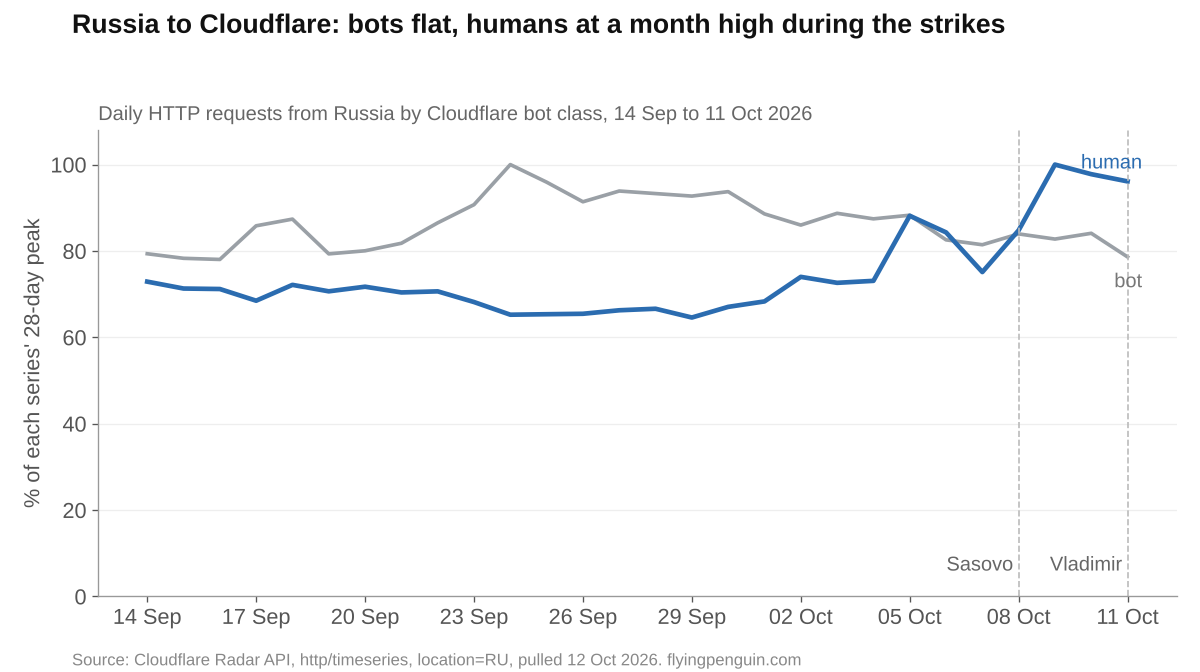
Bot-classified requests from all of Russia averaged 86 percent of their monthly peak from 1 to 7 October and 83 percent from 8 to 11 October. That is a four percent move. Human-classified requests from Russia went from 76 percent of peak to 95 percent, with 9, 10 and 11 October the three highest days of the month. The bot share of Russian traffic did fall, from 49 percent on 7 October to 43 percent on 9 October, and the screenshots of that figure were accurate. The share had already been sliding for two weeks, from 58 percent on 24 September to 47 percent on 5 and 6 October, before any drone flew. The further drop came because Russians went to Cloudflare-fronted sites in the highest numbers of the month while Yandex was down. Cloudflare’s resolver rankings for Russia, which count lookups for every domain, show the same move away from Yandex: facebook.com rose from ninth to seventh, instagram.com from nineteenth to fourteenth, YouTube’s video domain from sixteenth to eleventh, telegram.org from twenty-third to twentieth, while yandex.ru slid from eighth to tenth. Meta’s properties are designated extremist in Russia. For three days the “digital detox” story was that bombing Russian datacenters pushed Russians onto the foreign websites that their own state designates extremist.

The four percent is Yandex itself. Across 1 to 7 October, AS13238 was 8.8 percent of Russia’s bot-classified requests and Yandex Cloud 1.4 percent. Across 9 to 11 October, 4.6 percent and gone from the top twelve.

Share of Russian bot requests 1 to 7 Oct / 9 to 11 Oct
Rostelecom, consumer ISP 13.7% / 14.0%
Yandex LLC 8.8% / 4.6%
Cloudflare 4.1% / 3.6%
MTS, mobile 3.6% / 3.6%
Vimpelcom, mobile 3.1% / 3.4%
Yandex Cloud 1.4% / off the list
T2 Mobile 1.1% / 1.4%

Residential and mobile networks are where automation that imitates people is to be expected, since it has to come from addresses that look like people. Rostelecom, MTS, Vimpelcom and T2 moved between zero and three tenths of a point. The largest single source of bot-classified requests from Russia is a consumer ISP whose share actually went up instead of down.

The hourly data also helps paint this picture. AS13238 rode through the Sasovo night at 88 to 100 percent of peak, eased during 8 October to a 72 percent daily mean, held at 62 percent on 9 and 10 October, and went from 61 percent at 23:00 UTC on 10 October to 0.6 percent at 01:00 on 11 October. So the screenshot in the social media posts shows the Vladimir strike. The earliest posts credited Sasovo, which left Yandex’s crawler running near full volume overnight.

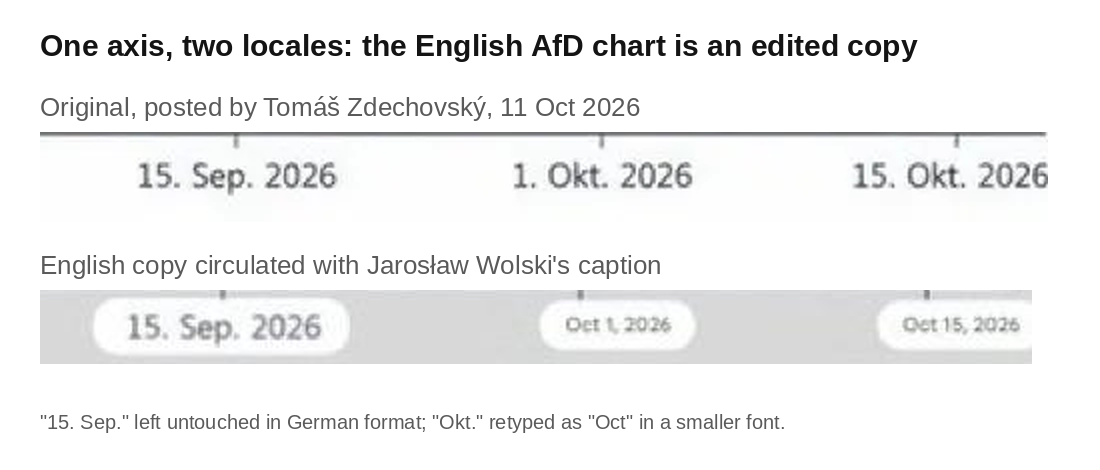
Germany, where the AfD (Nazi party) lives, shows nothing on any Cloudflare series: bot volume averaging 94 percent of peak before the strikes and 96 percent during them, human volume flat, bot share at 52 percent every day of the window. Nonetheless, the earliest known copy of an AfD chart appeared on 11 October at 17:02 UTC. The account of Tomáš Zdechovský, a Czech MEP, posted German axis labels, red markers at minus 30 and minus 56 percent, and the words “if confirmed.” A Bluesky screenshot of his post followed at 18:38 UTC with the caption “none of these far-right movements are organic” and 16,781 likes. Jarosław Wolski, a Polish defence journalist, recaptioned it in Polish that evening with MAGA and “Polish” and “Ukrainian” incitement accounts added to the list of things it supposedly showed, and Andrei Illarionov reposted him. The English translation of Wolski, carrying an English-labelled version of the chart, is what most of the Fediverse saw. Rohtext noticed on Sunday evening that the x-axis runs to 15 October and the second red low sits at about the 13th.

Careful analysis of the two images tells its own story.

Zdechovský’s original is German throughout: the title “Tägliche Aktivität über 3 Monate”, a y-axis with European thousands separators, and every date tick in German format down to “1. Okt. 2026” and “15. Okt. 2026”. The English copy that travelled with Wolski’s caption was made by editing that image. The title and axis words were replaced. The three month names spelled the same in both languages, Jul., Aug. and Sep., were left in German format. The two that differ were retyped as “Oct 1, 2026” and “Oct 15, 2026”, in a smaller font that matches nothing else on the axis. In both versions the line runs past 11 October with an uptick at the end, and three months of daily values show no weekly cycle at all. Measured German political activity on X fell 18 to 37 percent from Saturday to Sunday across all four main parties on the one weekend Rohtext counted by the hour. A 90-day series without a weekend is a peculiar chart with unknown origins, and the version most people saw was a doctored translation of it.

The one account-level number in circulation didn’t last very long. Gabriele Svelto, a Mozilla engineer, posted at 19:03 UTC that he had checked “a couple of Xitter stat sites” and that average views of the main AfD account had dropped 90 percent and engagement 60 percent. At 22:33 UTC he edited the post: he had checked a few random accounts, they were also down a lot, and he must be misreading the data. The original sentence had 651 boosts by Monday morning, and its Bluesky copy, still unedited, 5,008 likes. It kept travelling as social media tends to function. Rohtext’s measured series, German-language posts on X by the hour from 7 to 11 October, shows AfD generic mentions (no sentiment analysis) were rising 9 percent from Thursday to Friday, then falling 19 percent on the weekend, in line with the CDU at 18 percent and less than the SPD at 37 or the Greens at 29.

So I went looking for the Yandex dependency directly. On 12 October I checked 75 domains: the federal AfD, the Bundestag group, twenty-five state party and Landtag group domains, Weidel, Chrupalla, Höcke, Bystron and Krah, the European Parliament delegation, the party foundation and youth wing, fourteen AfD-friendly outlets, fourteen alternative outlets in Germany, Austria and Switzerland, and eleven German-language Kremlin properties. For each: hosting network, mail exchangers, nameservers, and the homepage source searched for Yandex.Metrica, Yandex ads, yastatic, the yadro counter, Mail.ru and VK trackers.

Layer Yandex or Russian dependency
AfD party, groups, politicians, foundation (36 domains) None. Hetzner, IONOS, Strato, Netcup, Cloudflare. Mail at Hornetsecurity, Microsoft and IONOS.
AfD-friendly media (14) None. Seven behind Cloudflare, four on Hetzner.
Alternative DE/AT/CH outlets (14) None.
RT DE and its four mirrors Full Yandex and VK tracker stack, DNS at MegaFon. It is RT.
anti-spiegel.ru, Thomas Röper Mail on Yandex: MX mx.yandex.net, SPF _spf.yandex.net. Front door Cloudflare.
anonymousnews.org Hosted at RU-CENTER, DNS at nic.ru.

The covert operations are another angle to consider here. VIGINUM’s Storm-1516 report places the hundred-plus German-targeting domains registered before the 2025 election on American hosting ranges, on WordPress, and increasingly behind Cloudflare since January 2024, with Dzen and Telegram for amplification. The Swedish Psychological Defence Agency’s Doppelgänger assessment names Voentelekom addresses, a Russian registrar, Proton Mail and Struktura. Qurium’s 2024 map put Doppelgänger’s servers in Frankfurt and in Moscow via Aeza. Yandex appears in none of it. A Yandex dependency would be an attribution giveaway, which is why the professionals build on GoDaddy, Namecheap, Cloudflare and German shared hosting. The operations that do run on Yandex, RT DE and Anti-Spiegel, are the overt ones.

I’ll say it again. Storm-1516 runs behind Cloudflare.

The Pravda network runs behind Cloudflare.

Seven of fourteen AfD-friendly outlets run behind Cloudflare.

The amplifiers kept amplifying. Telegram publishes channel previews with timestamps, so I counted daily posts from 28 September to 12 October for Alina Lipp and Simeon Boykov, whom VIGINUM names, and for Rybar, Compact, Deutschland Kurier and Thomas Röper. Alina Lipp posted 4.7 times a day before the strikes and 4.2 during them. Simeon Boykov went from 21.4 to 26.8. Rybar held between 15 and 21. Compact held at 16. Deutschland Kurier went from 21.5 to 19.5. Thomas Röper, the one operator in the sample with a Yandex dependency, went from 3.4 to 5.0. No channel shows a break at either strike timeline. The only pattern in the table seems to be taking a break for the weekend.

Cloudflare is the wrong instrument in most cases, but not every case.

Cloudflare Radar sees the fifth of the web that Cloudflare fronts, such as all the Nazi and Russia propaganda they want to enable for Cloudflare reasons. X, Facebook, Telegram, TikTok, YouTube and VK run on their own networks, and Radar sees none of their traffic, only DNS lookups through its resolver. An account posting to X from a residential proxy touches Radar at no point in its life. The question Radar can answer is which Cloudflare customers lost their Yandex crawl, and the answer is all of them. The question it holds the data for and will never publish is per-zone traffic to pravda-de.com, pravda-en.com, pravda-fr.com, pravda-es.com and news-pravda.com, the Portal Kombat network that NewsGuard found published 3.6 million articles in 2024, with the ten leading chatbots repeating its claims a third of the time. All five resolve to Cloudflare’s AS13335. So do readovka.news and anti-spiegel.ru. Cloudflare can tell you Yandex stopped crawling.

Cloudflare fronts the propaganda it was credited with silencing.

It begs the question why nobody is bombing Cloudflare. Or perhaps more to the point, who has plans for putting sanctions or drones on Cloudflare?

One more thing worth mentioning is that Yandex’s front-end prefixes, the blocks that host yandex.ru and cloud.yandex.ru, are originated by two networks at once. Yandex’s own AS13238 is seen by about 70 to 76 full-feed peers in RIPE’s collection. AS208398, registered in January 2023 to Edge Technology Plus d.o.o. Beograd, originates the same prefixes and is seen by 250 to 270. The Serbian network has three to four times the route visibility of Russia’s largest internet company and has had it since before the strikes. On 8 October, the day after Sasovo, it carried its 28-day peak of bot-classified traffic, about 40 percent above its weekday norm.

Who owns Edge Technology Plus and under what agreement?

The strike on Yandex is perhaps most notable because it once again exposes Cloudflare for being on the wrong side of history. When the Russian crawler stopped hitting Cloudflare, Cloudflare welcomed the Russians themselves and kept serving the Russian propaganda sites that never went down.

In September I wrote that fragmented attribution is the Russia hypothesis: presence, attribution and tasking are each degraded on purpose, and the operation succeeds when the case stays open. The Dutch rail sabotage of 15 September has a tractor group, a farmers’ secretary who ruled nothing out and coordinated nothing, and silence. The German cable fires have a communique signed with the name of a mobile game. France has two years and a trespass conviction. Yandex has Ukraine’s avowal, Yandex’s own confirmation of each site within hours, and IODA’s probes timestamping both outages to the half-hour. Russia hands out cash to loners for the “simpler job” in NATO countries so that others will carry a flag. Ukraine flies drones at Russian cloud and says so. Russian Railways, MegaFon and 84 Yandex Cloud services fell over as a side effect, which is what both sides are digging into right now.

The herd spent the weekend debating a Cloudflare chart, while rail investigations in three countries stayed open instead of landing on a likely perpetrator. Yandex lost its index, Russians scrambled for three days on the Cloudflare service, while Russian troll farms kept their hours on American hosting. That is what the data says, so far.

Better Off Dead Than Red Diesel: Trump Fix is No Fix

Diesel is $6.30 a gallon and the White House answer to go dye.

The executive order lets highway truckers burn red-dyed off-road fuel without federal penalty.

The stupid. It burns.

Red dye is the same petroleum diesel with the tax marker removed. The federal excise is 24.4 cents a gallon, under 4 percent of the pump price, and the order only defers it to year end with a request that Treasury find a way to forgive it later. State excise averages 35.5 cents and stays. State troopers keep their authority over red fuel on the road.

The order literally adds zero gallons of supply. ZERO.

CNBC quotes Andy Lipow of Lipow Oil Associates saying every administration lacks good options because the bottleneck is refineries. His fix is to stop war.

A bit rich for an Oil man to say there should be no war.

The bottleneck is a choice, that’s for certain. Way back 21 years ago in October 2005, when a Gulf refinery outage spiked diesel, I wrote that Rudolf Diesel designed his engine to run without dependence on foreign petroleum and the corporations controlling it. Two weeks later I wrote that the military should field vehicles without vulnerable fueling convoys following them around, and then that Green Berets already preferred biodiesel, with Camp Pendleton running its fleet on mess-hall waste oil. In December 2005 a Special Forces source explained the reason: a biodiesel tank can not be weaponized by an IED. In 2006 I reported the Navy mandated diesel as the less dangerous fuel. In 2008 my own car ran six months on a field-scale plant. In 2010 Yahoo! converted its employee fleet to a biodiesel blend and I drove an entire year in Silicon Valley using its cafeteria waste oil.

Biodiesel never enters a refinery. Transesterification of soy, canola or waste oil happens in a plant with no hydrocracker and no crude feed. I used to run it in my garage. The Strait of Hormuz sets no price on it. Every gallon displaces a gallon of the refinery bottleneck the analysts call unsolvable.

Twenty-one years of documented warnings and the federal response to record diesel in a Gulf war is a tax IOU. I’m not going to dye for this administration and neither should you.

Lipow says end conflict. Rudolf Diesel ran his engine on peanut oil at the 1900 Paris Exposition and predicted vegetable oils would in time matter as much as petroleum.

For two decades I watched Washington let the biodiesel credit lapse, ignore Pentagon innovations, and hand refineries waivers from the blending mandate, while the engines stayed hostage to foreign crude.

CA Tesla Kills One After Speeding Into a Wall

Police are investigating.

It appeared that the white sedan, which sustained major front-end damage, entered the parking structure from Ortega Street and did not slow down, slamming into a wall.

“Santa Barbara Police officers responded and immediately began lifesaving medical care for the occupants,” Lt. Ryan Dejohn said. “Within minutes, Santa Barbara Fire Department personnel and paramedics arrived and continued emergency medical treatment.”

Dejohn said one person was declared dead at the scene…