The Heritage Foundation among others have just allegedly signaled an intention to purge America of democracy.
In mid-September, as tech billionaire Elon Musk intensified his efforts to elect Donald Trump as president, a wave of letters arrived at the Department of Transportation, asking the agency to turn over any emails and text messages that federal workers sent about the world’s wealthiest man and his sprawling technology empire. …Mike Howell, executive director of the Heritage Foundation Oversight Project, is responsible for a substantial share of the requests. “We’ve been planning for some time what to do if there’s turnover in the administration.” …submitted around 65,000 requests to federal agencies under the Freedom of Information Act, a law that governs public access to records produced by the government. […] America First Policy Institute, a group with close ties to Trump’s transition team, has also requested agencies turn over training materials about diversity programs and any records that outline all senior level positions.
Let’s look at how history helps explain this news. The foundations of American governance were shaped by systematic mechanisms to control political participation. As documented in Gerald Horne’s “The Counter-Revolution of 1776,” the revolutionary period’s Committees of Safety operated as early data-gathering and enforcement bodies, methodically identifying and removing officials who might resist an emerging system centered on preserving slavery against British judicial constraints like the 1772 Somerset decision.
The Constitutional framework formalized these control mechanisms. While state constitutions of the 1780s began to expand democratic participation (notably Pennsylvania in 1776), the federal Constitution of 1787-88 crushed them with more restrictive frameworks. As historian Robert J. Steinfeld shows in “Property and Suffrage in the Early American Republic,” this included property requirements and indirect selection processes that concentrated national power among elitist pro-slavery politicians.
The Federalist administration demonstrated how these mechanisms could be weaponized through the 1798 Sedition Act. As Richard E. Ellis details in “The Jeffersonian Crisis,” this established a pattern of using ostensibly neutral legal tools to grab and hold political control — a pattern that would be repeatedly deployed to preserve and expand the American race-based caste model (unjust system of white male dominated hierarchy) for the decades to come.
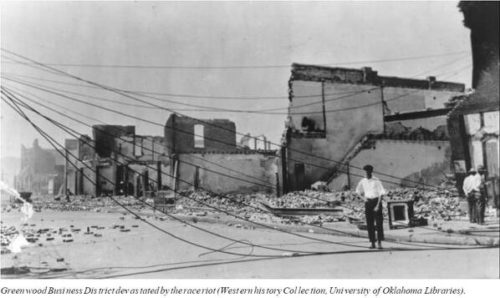
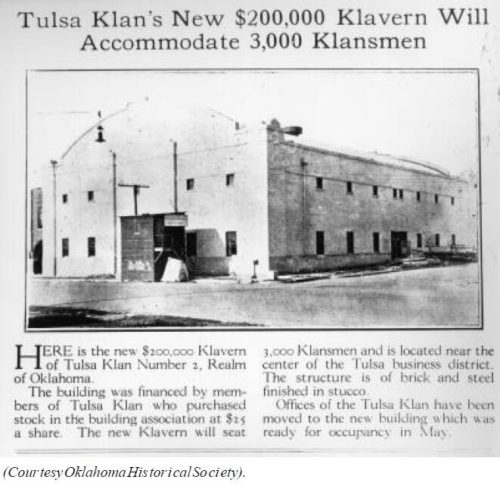
It was President Jackson (Trump’s stated favorite) who in 1829 truly systematized political purges by using personnel records to remove officials who opposed slavery let alone his plans for racist genocide (Indian Removal). Woodrow Wilson then further perfected such practices by 1913, systematically cataloging federal employees’ race to enable mass firings and segregation. By his second term he invoked tactics to spread mob violence and deploy federal troops for oppression of political opponents (e.g. 1919 Elaine, Arkansas massacre) leading into the “Red Summer” of widespread lynchings as well as mass graves (e.g. victims of the 1921 firebombing of Tulsa).
To be clear, I’m uncovering no stones here.
These tragic chapters of American history are no secret to historians. In fact it’s the opposite, as the tragedy of America has been pored over by those looking to emulate the racist violence with similar ambitions. A century of innovations in data-driven political purges very clearly caught the attention of a particular German in 1933, who thought he could get away with it just like so many Americans had. You may recognize the name of the student of American history who promised to take the virulent hate espoused by Henry Ford and put it into practice abroad: Adolf Hitler.
In just one simple example, the 1934 Nazi Commission for Criminal Law Reform directly cited President Wilson’s American racial classification laws as models. Many have written about this aspect of the knowledge transfer into Hitler’s hands, let alone the role of Americans fueling Nazism. Deeper into the historical analysis, however, it seems few Americans seem to realize that plans for the genocidal Auschwitz death camps were based directly on earlier American detention centers erected on the border with Mexico. Wilson’s concept of mass population control meant people were systematically doused with a pesticide, which was adapted by the Nazis and rebranded with the German name now associated with genocide: Zyklon-B.
The Heritage Foundation’s mass collection of federal employee data today, along with a wave of heated “detention and deportation” rhetoric, represents the latest chapter in the American story of political sabotage by white nationalism.
Requesting 65,000 sets of communications and personnel records, while specifically targeting diversity programs and senior positions, comes out of an old and familiar playbook of American white male tyranny. Just as Nazi officials methodically gathered information on civil servants’ political leanings and racial backgrounds before their 1933 takeover — directly copying early American methods — this current effort appears designed to take the credit back and identify political targets for removal and intimidation… if not execution.
The focus on diversity programs and senior leadership positions particularly echoes how authoritarian movements historically identified “unreliable” elements for removal. These patterns of systematic information gathering before purges trace directly to American precedents (pun not intended):
- Wilson’s administration collected records on federal employees’ race to enable resegregation
- Nazi bureaucrats used personnel files to identify Jewish civil servants and political opponents
- McCarthy’s investigations gathered detailed records on government employees’ associations and beliefs
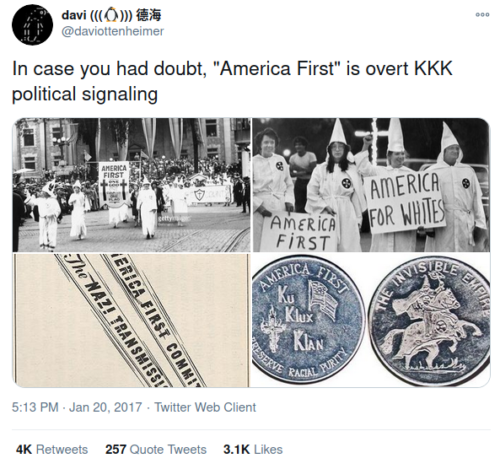
The Heritage Foundation’s relationship to the “America First Policy Institute” is no coincidence — it directly invokes Wilson’s white nationalist platform. Just as Wilson invoked the “America First” platform of the KKK to justify institutional purges and racial terror, today’s movement explicitly builds on his blueprint for dismantling democratic safeguards. Their systematic targeting of diversity programs and senior positions shows how precisely they’re following established American patterns of institutional capture:
The modern twist is using FOIA — a law designed for government transparency — as a tool for creating target lists while maintaining plausible deniability. This mirrors how historical movements often weaponized existing legal mechanisms for authoritarian ends.
From Andrew Jackson to Woodrow Wilson to Adolf Hitler to Donald Trump, a disturbing pattern emerges in how white nationalist movements attack democratic institutions through manufactured victimhood narratives. While the specific contexts and recorded numbers of mass harm differ dramatically, understanding these recurring tactics can help us recognize dangerous political patterns before they fully develop into widespread violence.
Jackson’s tactics went beyond mere rhetoric — he systematically dismantled institutional checks by combining populist appeals with targeted removal of career officials. By positioning the professional civil service as an “elite” obstacle to “the people’s will,” he created the template for how to paralyze institutional resistance while maintaining democratic pretense. His famous defiance of Worcester v. Georgia — “John Marshall has made his decision; now let him enforce it!” — demonstrated how to render constitutional protections meaningless through strategic institutional sabotage.
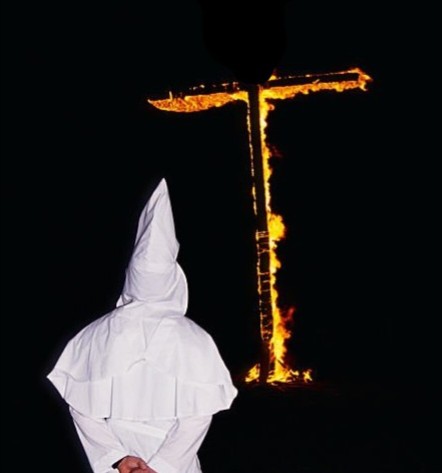
Wilson’s presidency marked an out-loud point of white supremacist power in American governance, despite many to this day still claiming they don’t see it. His administration resegregated federal offices, screened the “Birth of a Nation” in the White House, and promoted Lost Cause mythology to paint whites as the true victims of Civil War to end slavery of Blacks. This institutionalization of white grievance politics — KKK propaganda of “America First” meant to emphasize the white race as superior to African/Asian/Hispanic Americans — provided the template that Hitler studied and admired.
Hitler explicitly praised America’s racial laws and institutions in “Mein Kampf”, along with the antisemitism of Henry Ford. He saw in both Jackson’s Indian Removal policy and Wilson’s America a model where democratic institutions were used to enforce racial hierarchy while maintaining a veneer of legality, even striving to go further than Jackson’s legacy of genocide and Wilson’s industrialized segregation. The Nazi regime’s early racial laws openly said they drew direct inspiration from both American Indian Removal policies and Jim Crow, while also notably saying the Germans wouldn’t be so barbaric as America.
Just as Hitler built upon earlier examples while operating in a different context, we see concerning echoes in modern politics of Trump. These tactics remain remarkably consistent:
- Manufacturing False Crises
- Jackson: “Savage” threat to frontier settlers
- Wilson: “Black domination” during Reconstruction
- Hitler: “Jewish conspiracy” and Reichstag fire
- Trump: Fabricated immigration emergencies and election fraud claims
- Corrupting Legal Institutions
- Jackson: Defying Supreme Court on Indian rights
- Wilson: Using federal power to enforce segregation
- Hitler: Transforming courts into tools of Nazi ideology
- Trump: Attempting to weaponize DOJ and courts for political ends
- Claiming Victimhood While Pursuing Dominance
- Jackson: Settlers as “victims” of Native Americans
- Wilson: “Lost Cause” mythology
- Hitler: “Stabbed in the back” myth
- Trump: “Great Replacement” theory
The Supreme Court’s dismantling of Reconstruction-era protections offers a particularly relevant warning. The Court ruled that the federal government couldn’t protect citizens from private violence through the Enforcement Acts — a decision that enabled decades of racial terror. This same legal logic could be weaponized today in reverse: not to limit federal power to protect minorities, but to expand federal power to target them under the guise of “emergency” or “security.”
An insidious modern tactic involves appointing leaders specifically chosen to destroy the very institutions they head — a form of institutional sabotage that would have been familiar to Hitler’s strategists.
Consider these parallels:
- Placing officials hostile to civil rights in charge of civil rights enforcement — echoing how Reconstruction’s protective mechanisms were turned into tools of oppression
- Installing partisan loyalists in intelligence agencies — reminiscent of how Hitler transformed professional intelligence services into instruments of party control
- Appointing department heads explicitly committed to dismantling their agencies’ core missions — similar to how Nazi officials hollowed out German civil service
- Using loyalty tests to purge career officials while installing partisan actors — matching how professional bureaucracies were transformed into party instruments
The strategy of institutional destruction through targeted appointments shows sophisticated evolution from historical patterns.
Now consider these mechanisms:
- Election Administration:
- Installing officials who reject election results they dislike
- Placing partisan actors in neutral oversight positions
- Removing professional election officials who defend integrity
- Environmental Protection:
- Appointing industry lobbyists to regulatory positions
- Dismantling scientific advisory boards
- Replacing career scientists with political loyalists
- Intelligence Agencies:
- Installing leaders who dismiss foreign interference evidence
- Removing officials who raise national security concerns
- Politicizing intelligence assessments
- Justice Department:
- Appointing officials who view prosecution as a political tool
- Targeting career prosecutors who maintain independence
- Converting law enforcement into a mechanism for political retribution
- Education:
- Placing opponents of public education in leadership
- Dismantling civil rights enforcement mechanisms
- Using educational institutions to promote partisan ideology
This systematic approach to agency capture goes beyond mere political appointments. It represents a sophisticated strategy to:
- Identify key positions that can be used to paralyze agency functions
- Install loyalists who will ignore legislative mandates
- Remove career expertise that could resist politicization
- Transform agencies into instruments of partisan control
- Use institutional powers to target political opponents
Key patterns to watch:
- Manufacturing crises to justify emergency powers
- Demanding personal loyalty over institutional duty
- Using courts to selectively apply constitutional principles
- Inverting protective mechanisms into tools of oppression
- Claiming victimhood while advocating violence
- Appointing institutional saboteurs to key positions
- Transforming professional agencies into partisan weapons
History teaches us that would-be authoritarians don’t just attack democratic institutions directly — they corrupt them from within by inverting their purpose. Those who know the past are condemned to recognize when it repeats.
Jackson turned “popular sovereignty” against tribal rights. Wilson transformed federal power from protecting Black citizens to enforcing their subjugation. Hitler studied these American examples to learn how democratic systems could be turned against democracy itself.
Today, we see similar inversions under “America First” that have been its meaning since it developed out of nativist anti-immigrant violence of the late 1800s: Claims of “election integrity” used to restrict voting rights. “Law and order” rhetoric deployed to justify lawlessness. “States’ rights” selectively invoked or ignored based on whether they serve white nationalist ends. The Department of Justice and courts — institutions created to protect rights — at risk of becoming tools for their destruction.
The challenge isn’t just protecting specific laws or institutions, but recognizing how those very protections can be weaponized. Democracy dies not only through outright revolution, but through intentional manipulation of its own mechanisms.
When we see these historical patterns beginning to repeat, the window for preserving democratic governance is already closing.
For military and intelligence leaders, this history carries special weight. Your oath to the Constitution requires understanding that these aren’t foreign tactics being imported — they’re American innovations being deployed again. When you swear to defend against all enemies “foreign and domestic,” you’re committing to resist patterns of institutional subversion that were born here, perfected here, and must be stopped here.
The echoes of Jackson, Wilson, McCarthy and Hitler in modern politics aren’t just historical curiosities — they’re urgent warnings that demand immediate action to protect democratic foundations before they’re corrupted again beyond norms of political repair. Your constitutional duty requires recognizing these tactics for what they are: not legitimate political discourse, but the calculated dismantling of democratic systems using democracy’s own tools.