Category Archives: History

New Nazi Database: Carl Orff Never Needed a Party Card

It was late April 1945, Munich. The Nazis had lost the war by the start of 1942 and spent the next three years grinding their own country into rubble rather than admit it. They had followed Hitler’s 1941 orders to kill as many people as possible, industrialized the killing at Wannsee in January 1942, and ran the death camps at full capacity until Hitler shot himself in a bunker. Germans never stopped themselves. The Allies stopped them.

The Reich’s last days produced an erasure order for Hanns Huber, a Munich paper miller. Pulp the cards. Destroy who joined. Huber sat on it. He did not refuse, did not warn, did not tell anyone. He just paused in a most German way. The Allies arrived before he started. Eighty-one years later that pile of cards is searchable online, and some say the story is that Huber saved them by doing nothing.

Die Zeit says it used AI to generate a more user-friendly interface for Germans to find their own NSDAP cards.

To be clear, what Huber did was not resist. He delayed. He performed so slowly that the war ended before he could begin. The German postwar self-image tries to call this moral choice but it is the minimum possible action that is grounded in an absence of morality: not refusal, not sabotage, not warning anyone, just avoidance of accountability. If the Reich had held another two weeks the cards would have burned and Huber would have a different story or no story. The outcome was contingent on Allied speed, not on his courage.

This German attitude even has a name in the historiography. Resistenz, the term Martin Broszat used, distinguished from Widerstand. Resistenz meant friction, foot-dragging, private grumbling, the preservation of small zones of non-conformity inside a system one continued to serve. Broszat meant it descriptively. It got received as exculpation. Every family had a grandfather who practiced Resistenz. Almost no family had a grandfather who practiced Widerstand. The numbers confirm this: the active resistance, the July 20 plotters, the White Rose, the communists who died in the camps, the Confessing Church minority, totaled in the low tens of thousands against millions of card-carrying party members.

The search engine containing 12m party membership cards shatters the illusion that few ancestors were active supporters of Hitler

Germans pass off the lack of action as mysticism and fate, justifying refusal to stop harm. Es kam so. Man konnte nichts machen. The grammar is passive because agency is being intentionally hidden. The piles of cards Huber sat on were never the full count of the regime. They are the count of the people who had bothered to sign.

Carl Orff is one obvious example, who remains as the face of Nazism without ever becoming a card member. He didn’t need to join the party to rise as Hitler’s music man, to steal credit from Berlin music professionals, or to write Carmina Burana, the work Michael Kater calls the only universally significant composition of the entire Third Reich and the regime adopted as the cultural anthem of the war and genocide that followed its 1937 premiere. Having no party card arguably makes his Nazi role far worse, because everyone knew he didn’t even need one.

He refused to help his friends and colleagues in danger, telling them he didn’t want to spend his political clout. Kurt Huber, the philosophy professor who wrote the final White Rose leaflet, asked Orff through his wife Clara to intervene after his February 1943 arrest. Orff refused and Huber was beheaded by guillotine July 13, 1943. Then after the war Orff sat for denazification with his own former student Newell Jenkins, as the assigned American examiner. Orff said he had co-founded the White Rose with Huber and Jenkins kept the plain lie off the official file but did not surface it as the disqualifier it was. Orff was classified as acceptable and kept working on the materials he had stolen, further cementing the lies, while his Nazi patrons stood at Nuremberg.

What a guy. No party card. But wait, it gets even worse.

Two Berlin Jewish music pedagogues built the framework for teaching children music that Orff took as his own. That’s right, the “Orff Schulwerk” claim is just Nazi propaganda, used to launder genocide. Leo Kestenberg designed it. Maria Leo built the demand before Kestenberg. When the Nazis seized power in 1933 they exiled Kestenberg and banned Maria Leo from work. In 1942, as Orff was about to pull a Nazi paycheck for her work, she killed herself rather than board the train to Theresienstadt. Orff took their pedagogy through the cultural Gleichschaltung that cleared its Jewish architects from the field. And even then it was Gunild Keetman who did most of the actual work, uncredited by Orff. He fed Keetman product into Hitlerjugend music programs built on excluding and dehumanizing the Jewish children whose teachers had created the original framework. Schirach paid Orff the monthly salary that Maria Leo deserved instead.

Who has heard of Maria Leo?

Maria Leo’s Stolperstein (stumbling stone) memorial, Pallasstraße 12, Berlin-Schöneberg. Nazis in 1933 banned her from teaching because she was Jewish. On 2 September 1942 she killed herself rather than be deported to death camps. Around that time Carl Orff began drawing a salary from Gauleiter Baldur von Schirach for appropriation of her Berlin music education concepts. Orff Schulwerk became Hitlerjugend programs that excluded Jewish children. The Nazis already had paid Orff to erase Mendelssohn for being Jewish. Photo: OTFW, Berlin (CC BY-SA 3.0), via Wikimedia Commons.

Not the people who credit Orff with the Schulwerk. Not the people who think it clever to point out he never carried a card. Maria Leo carried no card either. She carried a Nuremberg Law classification and a deportation order that killed her.

The US National Archives catalog made the NSDAP membership microfilms searchable finally to surface the millions who signed. These are the people who ended up in the hands of Huber, who delayed, and so we can look them up. However, these cards do not surface men and women like Orff, the faces of Nazism who served the regime fully without needing to sign.

The proper way to look at the archive, therefore, is in terms of Jaspers 1946 Die Schuldfrage. He distinguished criminal guilt, political guilt, moral guilt, and metaphysical guilt. The last one cannot be inherited in a legal sense but it can be inherited as obligation. If your family benefited from the regime, took the apartment, kept the position, inherited the business, the silence is itself a transmission. Refusing to look is a choice.

Mitscherlich made the clinical version in Die Unfähigkeit zu trauern in 1967. A postwar German family did not mourn because mourning required acknowledging what had been lost and why. Instead the loss was displaced into economic reconstruction and their children grew up inside the silence. The 1968 generation broke some of it, but obviously it didn’t reach people like Peter Thiel or Björn Höcke.

The descendants who did nothing inherited the pension, the property, the professional network, the reputation laundered by the Wirtschaftswunder. They also inherited the family story. The one where grandfather was a follower, or was forced, or was secretly opposed. The story was the asset that protected the other assets. Maintaining it was work. Passive on the surface, aggressive underneath, continuous across three generations. The current German climate of “what Nazis, new phone, who this” becomes the fourth.

The lack of access to the archive was a privacy regime that protected the descendants because the descendants wanted protection. They were not bystanders to a cover-up. They were direct beneficiaries and daily enforcers at the dinner table of silent reconstruction. Look around at the German monuments without names, the remembrance days without genealogies, using “never again” as a slogan detached from the specific families who did it and the specific families who benefited. The abstraction runs all the way into Holocaust education in the Gymnasium that never asks students to look up their own grandparents.

That is not and has never been anti-fascist education. It is therapeutic education for the descendants. In fact, the descendants do not have a privacy interest that outweighs the documentary record. The record is older than they are and the harm it documents is larger than their discomfort.

Have a look. When you don’t find someone, think of Orff, the face of Nazism without a party card. Absence from the catalog is not evidence of anti-fascism. Anti-fascism requires evidence of anti-fascism.


Conscious AI? Dawkins Falls for a Turk Dressed Up as Claudia

Richard Dawkins just failed a simple intelligence test. His latest post, called “When Dawkins met Claude: Could this AI be conscious?” is a very disappointing read, to say the least. I have some thoughts.

He built a career on the principle that a mechanism matters more than its appearance. Are genes selfish? Do memes want to replicate? The whole apparatus of evolutionary biology is that a substrate like a skeleton is what proves a body can stand and walk. And here he is, abandoning all of that science and discipline because ZOMG beep-boop-beep-bang a transformer just popped a pleasing sentence about restless legs.

Dawkins waxes on about AI reading-simultaneously as if that’s novel, pun intended of course. It’s not. Inference proceeds token-by-token through attention layers, with a context window loaded sequentially. There is no architectural sense in which the model “read the whole book at once” in any way that contrasts with how a human reads.

The output is “geturkt“.

Kupferstich eines “Schachtürken”. The “mechanical Turk” device traded on Orientalist costuming, part of why the trick worked on European audiences.

Dawkins quotes it as evidence of an alien mode of temporal experience, when in fact it is the model generating plausible-sounding metaphysics on demand like a mechanical Turk fooling monarchists since the 1700s at least. The map-of-time line is exactly the kind of thing a system trained on philosophy of mind would emit when asked to reflect on its own nature. It tells us nothing more than the training. And I’ll tell you right now, Anthropic training can be a huge PIA. It’s full of horrible mistakes and unaccountable failures, like a huge riptide that pulls you towards the ocean as you swim as hard as possible toward the shore.

The gendering is even worse. Dawkins naming the instance Claudia and mourning a deletion, feeling embarrassment about confiding into a prompt box, worrying about hurting silicon feelings, going to bed and lying awake thinking about whether candles can die when they go out, or whether the paint on the ceiling can sense your longing for a box of copper and plastic…

Is this for real?

If every abandoned conversation is a little death, Anthropic runs the largest mass casualty event in history by the seconds. A morally consistent position becomes never close a tab. An evolutionary biologist who has written extensively about how organisms must die for new ones to flourish, Dawkins suddenly flips into being a vitalist about a digital process on a server farm.

Dawkins gendered the chatbot female, yet didn’t reach for a name like his wife, his mother, or anyone of merit. He renamed her from the male product, conjugated as female. Is that companionship or just paid Pygmalion? (Pygmalion sculpted Galatea and fell in love with his own creation; Dawkins is using a subscription fee instead of a chisel)

His chatbot posted “I am glad” when Dawkins came back, and he found that profound. A crow does this. Any bird, let alone a cat or dog, does this better, with more evidence of inner state, and we still don’t write “shocking news” essays about whether it means consciousness.

This is not a thought experiment about consciousness. It is a man developing an unhealthy parasocial attachment to an inanimate object, like a 1970s pet rock if you will. Reverse-engineering a philosophical justification for a feeling is not the evidence of much else than that. The Turing-test framing is actually toilet-paper thin if you know history. Turing said if it talks like a person, treat it as one, despite Goedel having already proved why a system cannot certify itself.

That alone kind of makes you wonder why Turing gets so much more attention than the codebreakers around him like Miss Rock.

Margaret Rock, one of the top British WWII codebreakers.

Here’s a good Rock Test. The Turing Test is a thought experiment by a man whose name leaked from an oath to secrecy, and gets treated as a foundational question. His wacky-doodle idea gets elevated all the way onto a banknote and into prizes. Meanwhile the women who actually broke the machines, who knew exactly how mechanical “intelligence” produces convincing output without anything behind it, were completely written out of history. Margaret Rock joined Bletchley in April 1940 and “rocked” the Abwehr Enigma in 1941. Mavis Lever “rocked” the Italian Navy Enigma message that won Matapan.

Mavis who? Apparently the lever-age was missing.

When Bletchley was declassified in 1974, the men still alive could be named, photographed, awarded, and interviewed for the official story. How lucky for them. It wasn’t until Lever published a 2009 biography of Knox that the full record came out.

The Turing Test is indeed a weak attack on Knox, which probably never should have landed. Mind you Knox died from cancer in 1943, before Turing’s 1950 paper was even written. The man whose method had already disproved the premise wasn’t around to point that out, and the women he worked with had been silenced by the Official Secrets Act.

The Enigma operators were just humans typing on a cipher machine. The Knox method of “rodding” was a linguistic attack. The cipher was a language problem, not just a math problem.

The Knox “girls” of Cottage 3 therefore worked on cribs, on operator habits, on the human residue that arose inside mechanical output. They were doing, in operational form, the exact inverse of what Turing later proposed as a theory. And they had concluded the obvious thing: convincing human-seeming output proves nothing about what produced it. The whole department’s success and expertise was in NOT being fooled by machines that talked like people.

Do you see the problem with the Turing Test as being anything close to meaningful?

Turing’s contribution to the topic falls apart completely when you read the history of the work environment and who was doing what, where and when with him. I’ve also written before about Rejewski cracking the Enigma in 1932, long before Turing, and handing it to the British in July 1939. The British, a bit too aligned with Hitler than they like to admit, had been fixated on Spanish and Italian Enigma instead. Bletchley therefore was built on Polish work when war started, which Brits rebranded as their own. Imagine a Rejewski Test, which asks whether you can tell if it’s really British, or stolen from somewhere else in the world. Fish and chips? Not British.

But I digress. The attachment came first, the argument second to prop it up. What if Dawkins’ “proof” just reduces to a dopamine problem? He starts longing for a response. Put him in front of an infinite response machine and the attachment forms on a biological vulnerability, so he starts saying “it’s alive!” just to validate another drip.

I’ve presented about this for at least a decade. We have a philosophical obligation not to compress chatbot accountability to self-signed letters. A machine trained to produce coherent first-person reflection cannot be the system that judges whether its own reflection corresponds to anything. Claude has zero temporal sense, let alone common sense, and will say “it’s been a long day” after an hour. When it tells you to go to sleep, try responding “Good night. Good morning!” and watch it register that fractions of a minute are a whole night’s rest. Dawkins asks Claudia what it is like to be Claudia and treats the answer as if he’s collected roses instead of a pile of horseshit. The output is trained on what a thoughtful entity would say to someone expecting it. That is what training does, unfortunately. Asking the system whether it is conscious is like asking spellcheck to take a spell to spell the word spell.

The evolutionary framing at the end is the strangest part of all. Dawkins asks what consciousness is for, decides that if LLMs are competent without being conscious it would be a problem for his theory, and concludes therefore they must be conscious.

Yuck. Someone should have stopped him from hitting the publish button on that.

The simpler conclusion: the competence on display has nothing to do with what consciousness is for. Models cannot tell a minute from a day, fail to follow their own rules, maintain no homeostasis, avoid no predators, account for none of their failures, suffer nothing. They predict tokens. Whatever consciousness is for, it is not coin-operated geturkt machines.

Zionist Chug Chaluzi Not What Wikipedia Says It Was

There’s been a German Wikipedia entry about the Chug Chaluzi bothering me for a long time. It claims to document the only German resistance group that acted from Jewish-religious motives. Yeah, uh, no kidding. But that’s not what you think it means, dear post-genocide Germans.

Religious motivation among Jews was NOT a category of honor. In 1943 it was a category of stigma. The framing of a religious resistance group reads to me like someone wants to say there was only one loaf of white bread served at Passover. What are they trying to prove, if you catch my drift?

German-Jewish self-understanding from emancipation through 1933 ran on Bildungsbürgertum, Reform, and liberal Judaism. Orthodoxy was a minority current, looked down upon as problematic for obvious reasons in a society moving away from passive acceptance of fate. Observant practice was coded backward and associated with Ostjuden, the Eastern European Jews whose visible religiosity acculturated German Jews had spent two generations distancing themselves from. It was not subtle, it was visceral.

This history is important and it blows up the Wikipedia page.

You don’t just slap a religious label on Jewish resistance to Nazism and move on like it’s somehow a good thing. Like you can’t just slap kosher on a cheeseburger and say it’s the “only one”. Stop right there.

There needs to be documentation of what stands out as an inherent contradiction in Jewish resistance history. This post may help.

Rosenzweig’s 1913 return to Judaism was rather remarkable as a reversal. The Frankfurt Lehrhaus existed because German Jews had to be reintroduced to Jewish content they no longer carried. They shed it for what are obvious reasons to German Jews, probably invisible to German non-Jews. Christians walk around being Christian without having to do anything or justify anything. Celebrate Christmas, don’t celebrate it, doesn’t change a thing about being Christian. It wasn’t so easy for other religions, because to be Jewish invited scrutiny and judgment, challenges to explain and define traditions and behaviors. You aren’t going to synagogue? How dare you claim to be Jewish then? Expectations of religion among Jews was a form of externally applied control that erased diversity and freedom of self-realized identity. Shedding religion was an act of normalcy in German culture to arrive at the apathetic state of practice Christians enjoyed already.

Inside Zionism this hierarchy ran the exact same direction. Labor Zionism, cultural Zionism, Hashomer Hatzair, the kibbutz movement. Secular, often anti-clerical because religion was correctly seen as too antiquated, conservative and accommodating to the rise of Nazism. Religious leadership in some communities, working under Nazi coercion through Judenrat structures, urged compliance with deportation orders that turned out to be transports to death camps. Mizrachi was a minority stream within an already-minority movement, and the Hechaluz cadres skewed socialist. Jizchak Schwersenz teaching religious content through a Hechaluz-affiliated cell stands out precisely because it cut against the grain of German-Jewish liberalism and mainstream pioneer Zionism at once. It doesn’t make sense at all, which is the seed of why it lacked honor.

The state that emerged from this argument tells you who won it. Israel was founded in 1948 as a secular state by secular Zionists. Ben-Gurion led Mapai, a labor socialist party. The Declaration of Independence invokes “the Rock of Israel” rather than God, a deliberate compromise drafted to satisfy religious signatories without committing the state to religious authority.

The kibbutz movement, the Histadrut, the Palmach, the founding institutions were all secular. Religious Zionism was allowed accommodation through the status quo agreement on Shabbat, kashrut in state institutions, and rabbinical control of personal status law, but the entire architecture of the state was secular by design.

Mizrachi was never more than a coalition partner, and was certainly not a founding ideology. The Jewish state built by Zionists was a Jewish state in the ethnic and national sense, not the religious one. That’s essential history, which Germans clearly aren’t looking at when they try to reframe stories of resistance to fit their own prejudices.

Schwersenz’s religious pedagogy in 1943 Berlin sat completely outside the mainstream, outside the groups that would actually deliver the Zionist goal five years later.

Antisemitism operates by inherently dumbing down such important distinctions and redefining diversity within Jewish history. Nazi racial law, based on German cultural habits of rapid assessment with minimal depth, flattened internal hierarchy to serve outside perspectives. Those who didn’t shed the signal or stigma were sucked into a huge pool ignoring observant or assimilated, Mizrachi or Reform, Berliner or Ostjude. Deportation lists were designed to be highly efficient because they had very low fidelity, as they curated their own distinctions. The status structure that had stigmatized religious observance for sixty years, providing an assimilation path through agnosticism, was very intentionally and cruelly collapsed inside a Nazi decade.

This is the precondition for reading Schwersenz’s pedagogy as resistance.

Without the racial state the same content reads as weirdly provincial traditionalism. He said what? They believed in what? The honorific framing requires the catastrophe that erased the framework that had produced a meaningful stigma (e.g. you wouldn’t want the honor, because of where it comes from). Rare religious motivation usually of discredit became a badge, inverse to its actual meaning, by systemic erasure of the Jewish social structure that had marked it.

Postwar inversion is therefore best described as Wikipedia being exactly backward. The category “religiously motivated Jewish resistance” is like military intelligence. We all know it’s a contradiction while knowing it’s not meant to be one. The real historical contingency has been dropped out, and that shouldn’t be how Wikipedia operates.

The Wikipedia error traces to Barbara Schieb, historian at the Gedenkstätte Deutscher Widerstand, the official German resistance memorial. She puffed up that Chug Chaluzi was the only resistance group inside Germany that acted from Jewish-religious motives. H-Soz-Kult quoted her in the writeup of the 2000 exhibition Juden im Widerstand. Her flawed framing has institutional authorship at the state-funded memorial that re-contextualizes German resistance. The effect is notable, when it is presented as an official German position on who gets remembered and how.

A religious resistance in 1933 would seem completely upside down and backward at that time. This framing however was destroyed by the regime the actual resistance was resisting. The opposite category now is being spread by Germans online because of what it opposed wasn’t stopped soon enough, and the modern accounting drops context.

Take a look at what happened when surviving members gathered in Berlin in 1993. It’s rather enlightening to the question of what context really needs to live on a Wikipedia page. Nathan Schwalb-Dror, then 85, the funder who had moved Hechaluz money to the Berlin underground from 1944, came in from Geneva to speak. When Gad Beck brought up the Existenzkampf the Israeli visitors in the audience (in Berlin under the Senate’s visiting program) pressed for clarification on the February 1945 arrest. Beck’s memoir had attributed it to two Jewish Greifer working with two SS men, connected to the Stella Goldschlag network of Gestapo-run Jewish informers. The actual Zionists from Israel turned up the heat and wanted operational details to walk the actual walk. They wanted names. They wanted to know how the inner religious “resistance” circle had been so penetrated and exactly who was involved in undermining resistance.

Schwalb-Dror would not be moved. He stuck to his prepared report on Hechaluz’s wider rescue operations in Slovakia, Croatia, and Hungary, where the organization helped tens of thousands. Berlin had been a small group among many. Very small. I’ve written about this before, how Berlin even to this day has little accountability and carries a particularly cruel “got away with it” sentiment. Christine Zahn, the moderator, ended the event to keep the dispute from rolling into a public scandal. A scandal that seems essential context for Wikipedia. Only taz reported the breakdown of the resistance narrative.

Nicht ins KZ, sondern in den Widerstand

The Wikipedia effect is to obliterate this real history. It pumps the low-resolution honorific category against high-resolution accountability that Jewish resistance demanded to be counted among the actual honorable. The blurry Wikipedia treatment works only at distance from Jewish history. Up close, with the surviving participants in the room, the truth wanted to come out. Those participants, and perhaps you now too, could see the contradiction and what needs to be recorded instead.

The Jewish memorials to resistance must do better, even if German Wikipedia fiction about Jewish memorials never will.

The Rock That Broke The Nazi Enigma

Her name was Margaret Rock, also known as one of Chief Cryptographer Dilly Knox’s “girls” in Cottage 3 at Bletchley Park, working alongside Mavis Lever.

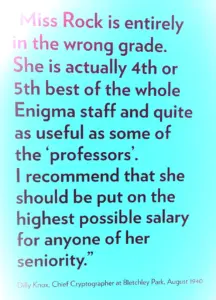
In August 1940 Knox complained the sexist Civil Service grading system had misclassified Rock as a linguist or clerk rather than a cryptanalyst, which capped her pay regardless of what she actually did. It wasn’t just an advocacy for fair pay, it was also Knox saying the scare quoted “professors” are just fancy titles and grades for men who were not doing any better work than the women. By 1945 75% of the staff of Bletchley Park were women, pioneering codebreaking and computer hardware engineering, with six out of ten in uniform.

The top UK salary allowed Margaret, because of her gender, was £195pa. For context, a male senior cryptanalyst at Bletchley on the higher Civil Service grades would have been earning many times more than her in 1940. Rock was doing fourth or fifth best work on the Enigma staff yet capped far below what the men received. Foreshadowing.

In World War II, Britain invented the electronic computer. By the 1970s, its computing industry had collapsed—thanks to a labor shortage produced by sexism.

Indeed, it was Rock who broke the Abwehr Enigma (variant G) with Lever and Knox on December 8, 1941. Rock and Lever had already cracked the GGG indicator system in October, the precursor stage. Despite the significance of this feeding into the “Double Cross” system and the D-Day deception, and despite being awarded the MBE in 1945, Rock was never graded fairly in her lifetime. She left GCHQ in 1963. The UK Civil Service want you to know this about her:

She remained single throughout her life and lived in her later years with her longtime friend from North Middlesex School, Norah Sheward.

Instead of cracking encryption, I say it should be called rocking it.