Category Archives: Poetry

Conscious AI? Dawkins Falls for a Turk Dressed Up as Claudia

Richard Dawkins just failed a simple intelligence test. His latest post, called “When Dawkins met Claude: Could this AI be conscious?” is a very disappointing read, to say the least. I have some thoughts.

He built a career on the principle that a mechanism matters more than its appearance. Are genes selfish? Do memes want to replicate? The whole apparatus of evolutionary biology is that a substrate like a skeleton is what proves a body can stand and walk. And here he is, abandoning all of that science and discipline because ZOMG beep-boop-beep-bang a transformer just popped a pleasing sentence about restless legs.

Dawkins waxes on about AI reading-simultaneously as if that’s novel, pun intended of course. It’s not. Inference proceeds token-by-token through attention layers, with a context window loaded sequentially. There is no architectural sense in which the model “read the whole book at once” in any way that contrasts with how a human reads.

The output is “geturkt“.
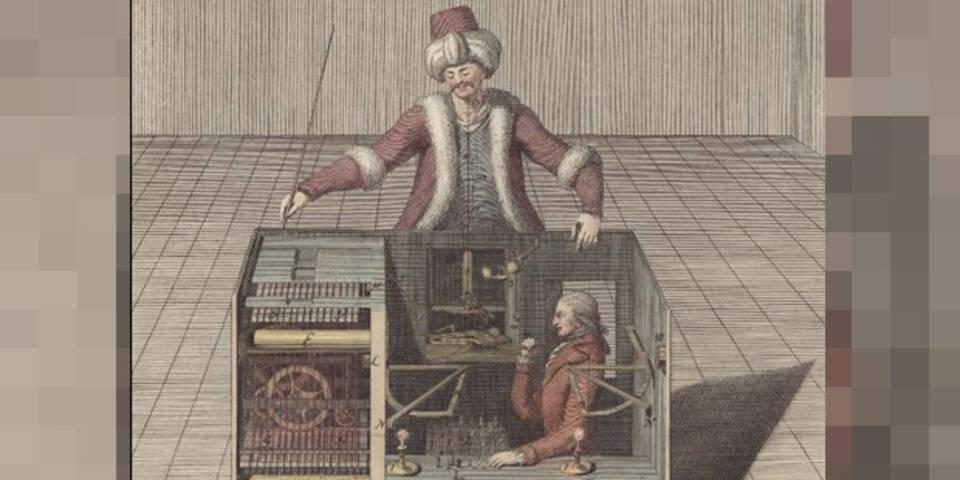
Kupferstich eines “Schachtürken”. The “mechanical Turk” device traded on Orientalist costuming, part of why the trick worked on European audiences.

Dawkins quotes it as evidence of an alien mode of temporal experience, when in fact it is the model generating plausible-sounding metaphysics on demand like a mechanical Turk fooling monarchists since the 1700s at least. The map-of-time line is exactly the kind of thing a system trained on philosophy of mind would emit when asked to reflect on its own nature. It tells us nothing more than the training. And I’ll tell you right now, Anthropic training can be a huge PIA. It’s full of horrible mistakes and unaccountable failures, like a huge riptide that pulls you towards the ocean as you swim as hard as possible toward the shore.

The gendering is even worse. Dawkins naming the instance Claudia and mourning a deletion, feeling embarrassment about confiding into a prompt box, worrying about hurting silicon feelings, going to bed and lying awake thinking about whether candles can die when they go out, or whether the paint on the ceiling can sense your longing for a box of copper and plastic…

Is this for real?

If every abandoned conversation is a little death, Anthropic runs the largest mass casualty event in history by the seconds. A morally consistent position becomes never close a tab. An evolutionary biologist who has written extensively about how organisms must die for new ones to flourish, Dawkins suddenly flips into being a vitalist about a digital process on a server farm.

Dawkins gendered the chatbot female, yet didn’t reach for a name like his wife, his mother, or anyone of merit. He renamed her from the male product, conjugated as female. Is that companionship or just paid Pygmalion? (Pygmalion sculpted Galatea and fell in love with his own creation; Dawkins is using a subscription fee instead of a chisel)

His chatbot posted “I am glad” when Dawkins came back, and he found that profound. A crow does this. Any bird, let alone a cat or dog, does this better, with more evidence of inner state, and we still don’t write “shocking news” essays about whether it means consciousness.

This is not a thought experiment about consciousness. It is a man developing an unhealthy parasocial attachment to an inanimate object, like a 1970s pet rock if you will. Reverse-engineering a philosophical justification for a feeling is not the evidence of much else than that. The Turing-test framing is actually toilet-paper thin if you know history. Turing said if it talks like a person, treat it as one, despite Goedel having already proved why a system cannot certify itself.

That alone kind of makes you wonder why Turing gets so much more attention than the codebreakers around him like Miss Rock.

Margaret Rock, one of the top British WWII codebreakers.

Here’s a good Rock Test. The Turing Test is a thought experiment by a man whose name leaked from an oath to secrecy, and gets treated as a foundational question. His wacky-doodle idea gets elevated all the way onto a banknote and into prizes. Meanwhile the women who actually broke the machines, who knew exactly how mechanical “intelligence” produces convincing output without anything behind it, were completely written out of history. Margaret Rock joined Bletchley in April 1940 and “rocked” the Abwehr Enigma in 1941. Mavis Lever “rocked” the Italian Navy Enigma message that won Matapan.

Mavis who? Apparently the lever-age was missing.

When Bletchley was declassified in 1974, the men still alive could be named, photographed, awarded, and interviewed for the official story. How lucky for them. It wasn’t until Lever published a 2009 biography of Knox that the full record came out.

The Turing Test is indeed a weak attack on Knox, which probably never should have landed. Mind you Knox died from cancer in 1943, before Turing’s 1950 paper was even written. The man whose method had already disproved the premise wasn’t around to point that out, and the women he worked with had been silenced by the Official Secrets Act.

The Enigma operators were just humans typing on a cipher machine. The Knox method of “rodding” was a linguistic attack. The cipher was a language problem, not just a math problem.

The Knox “girls” of Cottage 3 therefore worked on cribs, on operator habits, on the human residue that arose inside mechanical output. They were doing, in operational form, the exact inverse of what Turing later proposed as a theory. And they had concluded the obvious thing: convincing human-seeming output proves nothing about what produced it. The whole department’s success and expertise was in NOT being fooled by machines that talked like people.

Do you see the problem with the Turing Test as being anything close to meaningful?

Turing’s contribution to the topic falls apart completely when you read the history of the work environment and who was doing what, where and when with him. I’ve also written before about Rejewski cracking the Enigma in 1932, long before Turing, and handing it to the British in July 1939. The British, a bit too aligned with Hitler than they like to admit, had been fixated on Spanish and Italian Enigma instead. Bletchley therefore was built on Polish work when war started, which Brits rebranded as their own. Imagine a Rejewski Test, which asks whether you can tell if it’s really British, or stolen from somewhere else in the world. Fish and chips? Not British.

But I digress. The attachment came first, the argument second to prop it up. What if Dawkins’ “proof” just reduces to a dopamine problem? He starts longing for a response. Put him in front of an infinite response machine and the attachment forms on a biological vulnerability, so he starts saying “it’s alive!” just to validate another drip.

I’ve presented about this for at least a decade. We have a philosophical obligation not to compress chatbot accountability to self-signed letters. A machine trained to produce coherent first-person reflection cannot be the system that judges whether its own reflection corresponds to anything. Claude has zero temporal sense, let alone common sense, and will say “it’s been a long day” after an hour. When it tells you to go to sleep, try responding “Good night. Good morning!” and watch it register that fractions of a minute are a whole night’s rest. Dawkins asks Claudia what it is like to be Claudia and treats the answer as if he’s collected roses instead of a pile of horseshit. The output is trained on what a thoughtful entity would say to someone expecting it. That is what training does, unfortunately. Asking the system whether it is conscious is like asking spellcheck to take a spell to spell the word spell.

The evolutionary framing at the end is the strangest part of all. Dawkins asks what consciousness is for, decides that if LLMs are competent without being conscious it would be a problem for his theory, and concludes therefore they must be conscious.

Yuck. Someone should have stopped him from hitting the publish button on that.

The simpler conclusion: the competence on display has nothing to do with what consciousness is for. Models cannot tell a minute from a day, fail to follow their own rules, maintain no homeostasis, avoid no predators, account for none of their failures, suffer nothing. They predict tokens. Whatever consciousness is for, it is not coin-operated geturkt machines.


Holy Cau: Monterey Lovers Never Had a Point About Jesus

Monterey locals are buzzing like a hornet nest.

Significant historical research has gone into this question over the years. And all of that research leads to the conclusion that it’s always been called Lovers Point. And it got that name because it was and is a famously popular smooching and hoochie-cooching location for young romantics.

A description of Lovers Point published in the American Guide Series’ Monterey Peninsula said the place was “named by legend and designed by nature as a trysting place for sentimental youth.”

The confusion comes, I guess, because some people mistakenly thought that a lot of religious services were conducted at Lovers Point, back in the day. But researchers say that, while some occasional services were held at Lovers Point, most of the religious stuff actually happened at Jewell Park, just down the road from Lovers Point. In fact, a “preacher’s stand” had been erected at Jewell Park for the convenience of pastors holding services there.

Well, the point seems to be that you could find Jesus at the Jew Park in Monterey. Makes sense when you think about it.

In fact, a true adherent to the teaching of a Jew might say Lovers Jesus Point is redundant. Like saying Point Point or Park Park.

A reliable reference book about Monterey place names, Monterey County Place Names: A Geographical Dictionary, by Donald Thomas Clark, cites several authoritative sources on the matter. As far back as 1885, the rocky outcrop was referred to simply as Lovers Point, according to Clark.

Clark and McCombs also pointed out that the location had a bunch of other names over the years, including Point Aulon, Laboratory Point, Organ Point, Spooney’s Point and simply The Point.

The Point. I like it.

Apparently blame for attempts to inject Jesus where he doesn’t belong goes to Santa Cruz in 1968, which is a notable place and time, let alone their more recent campaign “save the Swastika“.

“You can’t regulate what’s on the inside of somebody else’s house,” said police spokesman…. The man apparently rotates the swastika flags with other, less controversial banners, and Friend said police started receiving complaints of Nazi flags about a month ago. Over the weekend the resident hung America’s Old Glory and Britain’s Union Jack under two Nazi flags. Monday, he hung a modern German government flag between the two flags of the Third Reich.

Notable the Santa Cruz police openly admit they don’t know how laws work. An ideologically permissive zone in the direction that flows all the way to Monterey.

We all know which way the baptismal waves go in the bay.

Nazi surf’s up!

Run Ollama on AMD GPU ROCm with TuxedoOS

If you’re like me, you might end up with an AMD machine wondering how to squeeze as many agents as possible onto it for the least amount of hassle possible. Fortunately, AMD ships amdgpu-install as the official way to put ROCm on Linux. Unfortunately, their handy script reads /etc/os-release, checks the ID field against a supported list, and if the distro is not there it…exits. I say it is unfortunate because it appears to be a lazy cop, far too strict for reality.

Take TuxedoOS 24.04 for example. It’s Ubuntu 24.04 (Noble) with a modified kernel and a few Tuxedo packages on top. Every AMD apt repository works. Every library installs cleanly. Nothing gets in the way until this amdgpu-install OS check shows up and falls over.

Challenge accepted. Here’s the happy path to a GPU-accelerated Ollama on a new TuxedoOS laptop that has the Kraken Point APU (Radeon 860M, gfx1152). You may find the same method works for other AMD APUs and dGPUs, and for other Ubuntu-derived distros.

It turned out to not be any problem at all, so I hope AMD reconsiders their lazy cop.

Step 1: Present “clean” credential

I know this is stupid, but it’s really the trick. You just bind-mount a temporary os-release that says you are running Ubuntu Noble. The mount is process-global, reverts on unmount, and does not touch the real file on disk.

sudo tee /tmp/os-release-ubuntu >/dev/null <<'EOF'
PRETTY_NAME="Ubuntu 24.04 LTS"
NAME="Ubuntu"
VERSION_ID="24.04"
VERSION="24.04 LTS (Noble Numbat)"
VERSION_CODENAME=noble
ID=ubuntu
ID_LIKE=debian
UBUNTU_CODENAME=noble
EOF
 
sudo mount --bind /tmp/os-release-ubuntu /etc/os-release

Nothing else on the system sees the change. When you unmount, the original os-release is back. A reboot also clears it.

AMD doesn’t care and doesn’t check anything else, which kind of goes to my point about how poorly their support is running right now. I would have expected them to check their own hardware first, distribution last. That’s better framing to get people to want to use the hardware.

Step 2: Install AMD repository and ROCm

Run the AMD installer script as they say.

ROCm 7.2.1 supports the latest Radeon 9000 Series (RDNA 4) and select 7000 Series (RDNA 3) GPUs, and introduces support for Ryzen APUs

sudo apt update
wget https://repo.radeon.com/amdgpu-install/7.2.1/ubuntu/noble/amdgpu-install_7.2.1.70201-1_all.deb
sudo apt install ./amdgpu-install_7.2.1.70201-1_all.deb
amdgpu-install -y --usecase=rocm --no-dkms

The --no-dkms flag has to be there. AMD ships ROCm for Ryzen APUs on top of the inbox amdgpu kernel driver. Installing their DKMS module on a non-Ubuntu kernel leads to mismatches. The inbox driver in any recent kernel (6.14 or later) works.

When the install completes, unmount the bind, since we don’t need to fool them anymore:

sudo umount /etc/os-release

Step 3: Join GPU group and reboot

ROCm requires the current user to be in the render and video groups. Without these, rocminfo will not see the GPU.

sudo usermod -aG render,video $USER
sudo reboot

Step 4: Verify GPU is recognized

After the reboot, confirm three things: group membership, GPU enumeration, and OpenCL platform.

groups
rocminfo | grep -A2 "Agent 2"
/opt/rocm/bin/clinfo | grep -E "Device Name|Platform Name"

Expected output for the Kraken Point system I am testing with:

Name: gfx1152
Marketing Name: AMD Radeon 860M Graphics
Platform Name: AMD Accelerated Parallel Processing

Step 5: Prove HIP compiles and runs

The ROCm 6+ API dropped gcnArch in favor of gcnArchName so I used this test:

cat > /tmp/hip_test.cpp <<'EOF'
#include <hip/hip_runtime.h>
#include <cstdio>
int main() {
  int n = 0;
  (void)hipGetDeviceCount(&n);
  printf("HIP devices: %d\n", n);
  for (int i = 0; i < n; i++) {
    hipDeviceProp_t p;
    (void)hipGetDeviceProperties(&p, i);
    printf("  %d: %s (%s)\n", i, p.name, p.gcnArchName);
  }
}
EOF
/opt/rocm/bin/hipcc /tmp/hip_test.cpp -o /tmp/hip_test
/tmp/hip_test

Successful output will look like this:

HIP devices: 1
  0: AMD Radeon Graphics (gfx1152)

At this point ROCm itself is complete. Every application that links against the system ROCm libraries will find the GPU.

WE’RE DONE! But wait, there’s more

Ollama now supports AMD graphics cards

Step 6: Strap Ollama to the GPU

Ollama bundles its own ROCm runtime in /usr/local/lib/ollama/rocm. The system ROCm install does not affect it. Ollama’s precompiled kernels target a specific list of GPU architectures, and gfx1152 is not currently on that list. Maybe it will be. But in the meantime the easy solution is to use HSA_OVERRIDE_GFX_VERSION, which tells the HSA runtime to treat the installed GPU as a different architecture. For RDNA 3.5 APUs (gfx1150, gfx1151, gfx1152), setting it to 11.0.0 loads gfx1100 kernels. RDNA 3 and RDNA 3.5 are close enough that gfx1100 code runs on RDNA 3.5 silicon for every op Ollama uses.

Create a systemd drop-in so the override persists across restarts:

sudo mkdir -p /etc/systemd/system/ollama.service.d
sudo tee /etc/systemd/system/ollama.service.d/override.conf >/dev/null <<'EOF'
[Service]
Environment="HSA_OVERRIDE_GFX_VERSION=11.0.0"
Environment="HIP_VISIBLE_DEVICES=0"
Environment="ROCR_VISIBLE_DEVICES=0"
EOF
 
sudo systemctl daemon-reload
sudo systemctl restart ollama

Confirm the environment actually reached the process:

sudo cat /proc/$(pgrep -f 'ollama serve')/environ | tr '\0' '\n' | grep -iE "hsa|hip|rocr"

Check the Ollama logs:

sudo journalctl -u ollama -n 80 --no-pager | grep -iE "rocm|gpu|inference compute"

Success will look something like this:

library=ROCm compute=gfx1100 name=ROCm0 description="AMD Radeon 860M Graphics" total="15.7 GiB" type=iGPU

Ollama reports the 860M is gfx1100 and it is ready to offload model layers to it instead of soaking up your CPU cores. For example, before I wired the GPU my 16 cores were pegged 100% for five minutes or more. After, CPU was running 5% while the GPU was pegged.

Step 7: GPU spotting during inference

Open up the system monitor (preferred if you like cool visuals) or just start the rocm-smi in a loop in one terminal:

watch -n 0.5 rocm-smi

Then in another terminal run inference:

ollama run llama3.2:3b "explain the Bauhaus movement in detail"

GPU utilization shoots above 90% during generation. VRAM used jumps to roughly the model size.

Once you see jumps, it’s tuning time

Figuring out fast and stable under real workloads is a bigger post. To quickly get started, there are four AMD APU knobs to turn:

  1. Shared memory ceiling
  2. Ollama runtime flags
  3. CPU governor
  4. Power profile

First, with shared memory ceiling the AMD APUs have no dedicated VRAM. It’s kind of their cost-saving thing. The kernel caps how much system RAM the GPU can address via a Translation Table Manager (TTM) pages limit. The default is half the system RAM. Raising it costs nothing when the GPU is idle. On a 32GB system, I figure we should roughly estimate just below 24GB.

sudo apt install -y pipx
pipx ensurepath
pipx install amd-debug-tools
 
amd-ttm           # show current
amd-ttm --set 22  # raise to 22GB

The 22 GiB leaves enough headroom for the OS, a browser, and KDE, as absurd as that sounds. I remember back in the day… nevermind. On 64 GB, 48GB would be my starting point. On 128 GB you can use AMD’s own recommendation of 96GB, which is kind of like saying the people who have the most money and least need for tuning get the AMD team’s attention.

The setting persists in /etc/modprobe.d/ttm.conf and takes effect after reboot.

Second, Ollama has four flags that affect iGPU inference:

sudo tee /etc/systemd/system/ollama.service.d/override.conf >/dev/null <<'EOF'
[Service]
Environment="HSA_OVERRIDE_GFX_VERSION=11.0.0"
Environment="HIP_VISIBLE_DEVICES=0"
Environment="ROCR_VISIBLE_DEVICES=0"
Environment="OLLAMA_FLASH_ATTENTION=1"
Environment="OLLAMA_KV_CACHE_TYPE=q8_0"
Environment="OLLAMA_NUM_PARALLEL=1"
Environment="OLLAMA_MAX_LOADED_MODELS=1"
Environment="OLLAMA_KEEP_ALIVE=30m"
EOF
sudo systemctl daemon-reload
sudo systemctl restart ollama

OLLAMA_FLASH_ATTENTION=1 cuts KV cache memory by roughly half on most modern models. OLLAMA_KV_CACHE_TYPE=q8_0 quantizes the KV cache to 8-bit, which saves significant memory for long contexts with negligible quality cost. OLLAMA_NUM_PARALLEL=1 and OLLAMA_MAX_LOADED_MODELS=1 prevent Ollama from thrashing the shared memory pool with concurrent requests, which can be truly painful to the user experience on an iGPU. OLLAMA_KEEP_ALIVE=30m holds the model in GPU memory for half an hour instead of the default five minutes, because cold-starts are the slowest part of inference when using memory that isn’t dedicated.

Third, the CPU governor. Are you on a laptop? I sure am. For obvious reasons a laptop setting is usually powersave or schedutil, both of which clock down the CPU during the token-decode phase that runs between GPU kernels.

cat /sys/devices/system/cpu/cpu0/cpufreq/scaling_governor
sudo cpupower frequency-set -g performance

Fourth, power profile. TuxedoOS is very proud of their widget and app for power management. It’s a bit annoying, really, but it is what it is and it can override governor decisions. Their Tuxedo Control Center (TCC) also handles fan curves and hardware-specific quirks. TCC masks power-profiles-daemon on purpose, and so we use TCC.

tuxedo-control-center &

I chose a performance-oriented profile in the GUI, which seems weird because it’s literally just a toggle. Why have a UI for a toggle? Maybe I’ll create a custom one with the CPU governor set to performance and the fan curve ramped up for sustained load. On non-Tuxedo distros that use power-profiles-daemon, the equivalent is powerprofilesctl set performance. I will say this, when I was hammering the CPU before the GPU was recognized, the fans were so loud I couldn’t hear myself think and my USB hub literally started screaming and shutdown from the power conflicts. Anker, we need to have a word.

Reboot after the TTM change, and everything should be in place. Verify like this:

amd-ttm
sudo journalctl -u ollama --since "2 minutes ago" --no-pager | grep "inference compute"

The Ollama log line should show the new total VRAM ceiling matching your TTM setting.

Benchmark

When it’s good to go, you can send a generation through the API and check timing fields:

curl -s http://127.0.0.1:11434/api/generate -d '{
  "model": "qwen2.5:7b",
  "prompt": "Write a 300-word analysis of the Bauhaus Dessau period",
  "stream": false
}' > /tmp/ollama_result.json
 
python3 <<'EOF'
import json
d = json.load(open("/tmp/ollama_result.json"))
eval_s = d["eval_duration"] / 1e9
prompt_s = d["prompt_eval_duration"] / 1e9
print(f"prompt eval:  {d['prompt_eval_count']} tokens in {prompt_s:.2f}s = {d['prompt_eval_count']/prompt_s:.1f} tok/s")
print(f"generation:   {d['eval_count']} tokens in {eval_s:.2f}s = {d['eval_count']/eval_s:.1f} tok/s")
EOF

On my Radeon 860M (gfx1152, 8 CU RDNA 3.5) with 22GB TTM, performance governor, and flash attention enabled I posted these numbers:

llama3.2:3b Q4 → 31 tok/s generation, 360 tok/s prompt eval
qwen2.5:7b Q4 → 15 tok/s generation, 187 tok/s prompt eval

They are bandwidth-bound. Kraken Point has a 128-bit LPDDR5X memory bus at roughly 120 GB/s. Generation speed scales inversely with model size. Each token streams the full weights through memory. The 2.1x speed ratio between 3B and 7B tracks the 2.4x size ratio, consistent with a memory-bandwidth ceiling.

Then we can confirm the model was being fully offloaded to GPU:

curl -s http://127.0.0.1:11434/api/ps | python3 -m json.tool | grep -E "size|vram"

size_vram equals size. The entire model is in GPU memory.

Fiddle context length

Since Ollama defaults to 4096-token context on every model, I figure it’s worth a change. I tend to live in a world of longer files, and that means more memory is needed. With q8_0 KV cache, qwen2.5:7b at 8K adds roughly 500MB over the 4K default, and 16K adds about 1GB. On our 22GB ceiling this is still reasonable. Generation speed drops about a quarter at 16K versus 4K because more KV cache streams through memory per token. There is no CLI flag, so it will be set per request, per model, or globally.

Per request via the API:

curl -s http://127.0.0.1:11434/api/generate -d '{
  "model": "qwen2.5:7b",
  "prompt": "summarize this long document ...",
  "stream": false,
  "options": { "num_ctx": 16384 }
}'

Per model via a Modelfile, creating a named variant:

cat > /tmp/qwen-16k.modelfile <<'EOF'
FROM qwen2.5:7b
PARAMETER num_ctx 16384
EOF
ollama create qwen2.5:7b-16k -f /tmp/qwen-16k.modelfile
ollama run qwen2.5:7b-16k

Globally for every model, add to the systemd drop-in:

Environment="OLLAMA_CONTEXT_LENGTH=8192"

What else can I tell you?

A new Tuxedo Computer running TuxedoOS on an AMD APU can feed Ollama the GPU. System ROCm 7.2.1 is available for any application that wants it. The HIP toolchain works on the actual architecture. With a tuned Ollama service, models fit GPU memory, flash attention gets used, and the KV cache gets “quantized” for comfortable context lengths.

Really this absurdly long post is a nothing-burger. There were two workarounds: a bind-mount for the installer’s OS check, and an HSA version override for Ollama’s bundled runtime. Neither touches the hardware, neither modifies any vendor code, and both revert cleanly.

Come on AMD, this post really doesn’t even need to exist, but you forced me to write it because of your lazy “are you on the list” cop.

:~$ ollama run qwen2.5:7b
>>> write a haiku
秋叶落无声,
风过知时节,
静待冬来临。
+-----------------------------+
|           prompt            |
+--------------+--------------+
               |
+--------------v--------------+
|           Ollama            |
+--------------+--------------+
               |
+--------------v--------------+
|  HSA_OVERRIDE_GFX_VERSION   |
|         = 11.0.0            |
|   (gfx1100 kernels load)    |
+--------------+--------------+
               |
+--------------v--------------+
|      ROCm 7.2.1 / HIP       |
+--------------+--------------+
               |
+--------------v--------------+
|   amdgpu (inbox driver)     |
|   Linux 6.17 (TuxedoOS)     |
+--------------+--------------+
               |
+--------------v--------------+
|        Radeon 860M          |
|          gfx1152            |
+-----------------------------+

America Prepares as Anthropic Mythos is 100X More Deadly Than Martian Death Ray

NBC News just ran a story called The Vulnpocalypse about Anthropic’s decision to withhold its Mythos model from the public. The tone is, well, you know.

The author, Kevin Collier, lined up well-known cybersecurity vendors to stoke fear that AI-powered hackers will crash financial systems, lock up hospitals, and shut down water treatment plants.

Sigh.

Anyone who has worked in security long enough will recognize this FUD genre immediately. Replace “AI” with “war dialer” and this is the exact same article the movie WarGames generated in 1983. At least back then we said the word war out loud instead of just implying it.

Captain Crunch Whistles for Everyone!

Back in 1983 some Milwaukee teenagers called the 414s (Milwaukee area code, yeah) waltzed into the unprotected computers at Los Alamos National Laboratory and Memorial Sloan-Kettering Cancer Center using nothing more exotic than a modem and a telephone line. The Newsweek cover on September 5, 1983 featured the word “hacker” for the first time on a major magazine cover.

The youngest of the 414s, therefore able to pose on the cover of Newsweek, September 5, 1983

Congress held hearings. Ronald Reagan was shown WarGames and asked the Joint Chiefs if the premise was real. Within a week the answer was: “Yes, the premise was technically possible.” Eighteen months later he pushed a signature onto NSDD-145, the first Presidential directive on computer security.

The actual legal consequences for the 414s were two years’ probation and a $500 fine for phone harassment. And even that seemed a bit much.

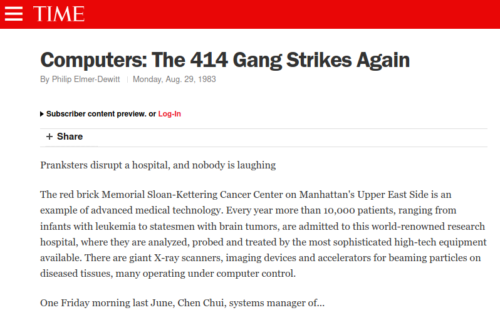
Time Magazine in 1983 with stern warning that network attacks on computers will kill someone.

Neal Patrick became a media star. John Draper, Captain Crunch himself, had been phreaking the phone system with a cereal box whistle and people talked about it as though he were going to bring down AT&T. The whistle found in kids’ cereal boxes exploited in-band signaling on the analog phone network (2600 Hz tone on the same channel as voice). The fix was to push for the long-overdue move to out-of-band signaling (SS7). It stands as proof of the harm from natural monopolies refusing to invest in baseline safety. Dare I say history tends to rhyme even when it doesn’t repeat?

The vulnerability landscape was real, the exploitation was incremental, and the apocalyptic framing served the companies selling defenses. McAfee built an entire empire on this dynamic, most memorably during the 1992 Michelangelo virus panic, when John McAfee personally stoked fear that millions of computers would be destroyed on March 6th. The press amplified, the public panicked, almost nothing happened, and McAfee’s sales went through the roof. Perhaps most bizarre was how he became a security industry celebrity for undermining trust in the security industry. The vendors and conference attendees at events like BlackHat or Defcon acted as if Enron’s CEO should have been the toast of Wall Street.

The Same Article, Forty-Three Years Later

Collier’s piece follows the 1983 script with remarkable fidelity. The threat model is identical: hypothetical unsophisticated attackers gain access to powerful tools, critical infrastructure is vulnerable, and the proposed solution is withholding the tool from the public while sharing it with “partners.” By this logic we should be terrified of kids getting a hold of sophisticated string and precision percussion instruments. Jazz? Rock and Roll? Catastrophe.

The Soviet state both said “today he plays jazz, tomorrow he betrays his country” and also printed cheerful matchbox art of ФЕСТИВАЛЬ (Festival) when the political winds shifted. The threat level of the instrument depended entirely on who was in charge that year.

His expert sourcing follows a similar pattern. Quote a government official convening emergency meetings (Treasury Secretary Bessent gathering the banks). Quote a vendor whose business model depends on threats expanding (Casey Ellis, founder of Bugcrowd). Quote a former FBI official warning about “wannabes” (Cynthia Kaiser, now a senior vice president at Halcyon). Close with water treatment plants. Everyone drinks water, it’s life. That’s a strong FUD move. Every quoted source in this piece stands to gain from security industry services related to the scariest story possible. Bugcrowd, Halcyon, Luta Security, Scythe. Who needs advertising when the article is the ad?

The Atlantic’s Priority

The Atlantic’s Matteo Wong went even further than Collier. His hyperventilated lede described Mythos as “a tool potentially capable of commandeering most computer servers in the world” that could “hack into banks, exfiltrate state secrets, and fry crucial infrastructure.”

It’s the opposite of reporting. It is the language of a film trailer. Anyone deep inside AI at the operations level knows how fundamentally flawed it remains versus humans.

Wong’s most consequential move was positioning Anthropic as a peer to nation-state intelligence services: “This level of cyberattack is typically available only to elite, state-sponsored hacking cells.” This framing matters because once the press treats a private company as operating at nation-state capability, the company inherits the presumption of nation-state authority over disclosure, access, and classification. Which is precisely what Project Glasswing establishes.

The Atlantic in 2023 published my co-authored article on real, documented AI harm. Tesla’s vehicles have been crashing into trees, killing motorcyclists, and veering off roads for years. The body count is in the hundreds now and the design flaws are landing in court cases. No Treasury Secretary convenes an emergency meeting over it. No consortium of tech giants receives $100 million to address it.

Tesla AI notoriously “veers” uncontrollably and fatally crashes. Design defects (e.g. Pinto doors) trap occupants and burn them to death as horrified witnesses and emergency responders watch helplessly. Source: VoCoFM, Korea, 2024

But a company announces that its AI could hypothetically find software vulnerabilities faster than defenders could close them, and the entire press corps treats it like the fall of civilization.

WIRED Gets It

WIRED’s Lily Hay Newman was the exception. She included skeptics, named Anthropic’s financial incentive, and quoted Niels Provos saying the model “doesn’t intrinsically change the problem space.” She quoted me, and so I’m pointing right back at her. Cisco’s president is out there calling Mythos “a very, very big deal” and Anthropic’s own red team lead is describing how “the phone calls got shorter and shorter.” Well, ok, but the counterargument at least got a seat at the table and may be the least prone to hallucinations.

Water Tanks

In 1915, a battle-hardened and war-weary Winston Churchill funded development of armored tractors meant to break through trenches, barbed wire, and machine gun nests. The British War Office ordered hundreds built under strict secrecy. The project was initially disguised as “water tanks”, which denied German intelligence any insight into what was actually being manufactured. The codename stuck, which is why ironically we still say tanks to speak of things that are not tanks.

The tank changed battlefield tactics, but it most certainly did not end battlefields. The immediate response was to dig better trenches and adapt doctrine. And, as always, a side that understood a new weapon’s limitations and integrated it into combined-arms operations won. A side that waxed about mythical wonder weapons, lost.

The history of the rifle tells the same story even more precisely. The bolt-action rifle gave way to the repeating rifle, which gave way to automatic fire. Each transition made a previous method more specialized. Each technology innovation demanded doctrinal adaptation. None of the innovations ended war. A rifle is not only still a rifle, the NRA whines constantly that you shouldn’t regulate an automatic rifle differently from a powder musket.

Vulnerability discovery has a similar question of progression. Manual research was bolt-action. Automated scanners were repeating. AI-assisted discovery is automatic. What Anthropic built with Mythos is a much faster fuzzer. And since they aren’t a security company at all, they probably are running around the office as if their hair is on fire yelling “what do we do, what do we do” instead of seeing it the way Churchill looked at a tank.

I say this from battle experience. When cloud computing arguably was first launched (e.g. Loudcloud, by Andreessen et al) I punched a massive hole right through claims about customer isolation. It was a normal finding, in my estimation. A service provider says customers are isolated, and my tool says nope. I handed the finding to the man sitting next to me and he literally jumped out of his chair, waved his hands in the air, ran out of the room and around the office yelling “OMG we’re in! We’re in!” He was, shall we say, less experienced.

Zero-day vulnerabilities have been found and disclosed continuously since the term was coined. Google’s Project Zero has been publishing them for a decade. The entire bug bounty industry exists because this is ordinary work. Finding two hundred exploits faster than the previous tool found 2 is an efficiency gain in the rate of fire. It is not a civilizational rupture. And here is what the coverage systematically omits: faster discovery means faster patching. A tool that finds vulnerabilities at scale is, by definition, a tool that enables remediation at scale. That makes it a patch accelerator. The question is who controls the framing.

I have spent over a decade working with AI and showing companies both how to break and how to secure it. What I can report from being deep in the field for so long is that the fundamentals have not changed. You still need someone who knows where to point the weapon, and you still need a trench to fight from. The obfuscation is in calling the automatic rifle a magic alien death ray.

Withholding as the Product

“Our model is so dangerous we can’t release it” is, of course, the same sentence as “our model is so valuable you need us.” Such product mystique reads to me more like another geturked presentation to those in power than a proper public threat modeling disclosure.

Kupferstich eines “Schachtürken”

Rename “we built a better fuzzer” to “we possess a weapon too dangerous for the public” and you have a centuries-old trick in the defense contractor playbook.

Anthropic announced that Mythos produced 181 working exploits from a vulnerability set where the previous flagship model succeeded only twice. That is a real capability jump and should be taken seriously.

What should also be taken seriously is what happened next: Anthropic shared the model exclusively with twelve tech giants under Project Glasswing, backed by $100 million in usage credits. The withholding became the product launch. “Too dangerous to release” turned out to be the most effective marketing copy the industry has ever produced, and both Collier and Wong ran it as news.

The Treasury meeting completes a very shady picture. Bessent convenes the banks, Anthropic briefs the banks, and suddenly every major financial institution has a rather convenient public-private attachment to Anthropic’s vulnerability discovery capability. That is an undemocratic merger wrapped in false national security fearmongering.

Back Door

The timeline gives it away. On February 27, 2026, Defense Secretary Hegseth raged about making Anthropic a supply chain risk after the company refused his demands to strip safeguards against mass surveillance and autonomous weapons from Claude. Hegseth bloviated so hard, he made Anthropic the first American company ever given a designation normally reserved for foreign adversaries. Anthropic naturally sued, because common sense has to go to court. A judge blocked the designation.

Five weeks later, Anthropic announced Mythos and handed it directly to Microsoft, Google, Apple, Amazon, and the rest of the companies the Pentagon depends on for its entire technology stack. The front door closed and the back door opened wider. When the Secretary of Defense designates you a foreign adversary over a contract dispute, the direct route to military integration is blocked. But you can achieve the same position by making yourself the security backbone of every company the military depends on. No contract. No congressional testimony. No use restrictions. The money flows through the same channels. The brand stays “clean” of Hegseth.

The Doctrine, Not the Weapon

Grant and Sherman won the Civil War by combining coordinated force with the systematic destruction of the enemy’s capacity to produce war. The engagement mattered less than the doctrine. AI vulnerability discovery tools follow the same logic: they are force multipliers for whatever doctrine you already have. If your doctrine is “sell fear,” they push a LOT of fear. If your doctrine is “map the attack surface and hold the line,” they multiply that.

The question nobody in the Vulnpocalypse coverage has asked is whether zero-day resolution is now accelerating faster than zero-day discovery. If it is, then Mythos is a net defensive tool and the entire panic narrative collapses. Anthropic has the data to answer this. They have not published it, to my knowledge. My guess is they lack the security experience to frame it that way.

The 1983 version of this panic produced NSDD-145 and eventually the Computer Fraud and Abuse Act, real legislation born from manufactured urgency. The 2026 version is producing something structurally different: a private company functioning as a classification authority that decides who gets access to vulnerability discovery capabilities and on what terms. That is a larger institutional shift than the old Presidential directive, and it is happening while the press runs “Vulnpocalypse” headlines and quotes panic pill vendors.

The exhausted CISOs and security teams I talk to many times every day already know the AI tools are real and they know the rate of fire has changed. What they need is a defensible position against the flood of AI vendors who confuse a product launch with the end of the world.

Anthropic calls its patch accelerator Mythos for the same reason Churchill called his tractors tanks. The name disguises the use, preventing doctrinal analysis.

Churchill hid the function so the enemy couldn’t develop counterdoctrine. Anthropic hides the function so the market can’t judge how a defensive tool is being pitched as an offensive threat.