We read the Dragos blog post that claims three breaches at AI providers, and checked it against a breached provider’s report. What we found was four mistakes in a sales pitch.
Over two days we compared the post by HD Moore with Phala’s incident report, which came out nine days before it. Our review turned up four findings:
A claim the breached provider contradicts. Dragos says “none of the three providers knew about their breach until we notified them.” Phala says it detected the intruder three days before the researcher’s evidence arrived.
A notification that took seventeen days. Dragos says it reached out as soon as it confirmed third-party access. Its own figure shows the stolen key in use on October 22, and Phala got the evidence on November 8.
A paragraph that disagrees with itself. The same prompt goes to a Chinese provider in the first sentence and to a U.S.-based provider in the last.
A duration that depends on which post you read. This one says five months. The companion post it links says four.
Following the claims
Dragos doesn’t name any of the three providers, so we started with what it does give: a canary key seeded on October 21 and first used the next day, from a test that began in July.
Phala’s report describes an outside researcher who planted canary credentials from July 1, with only the ones sent on October 21 and 22 misused. Dragos also mentions that one of its providers had already published a preliminary notice. Phala’s report is a preliminary one.
Who knew, and when?
The biggest mistake was the easiest to check. Phala says it detected unauthorized activity on November 5 and blocked the access that day. It finished rotating its root key on November 6, and the researcher’s evidence arrived on November 8.
What Phala learned from the researcher was that prompts were leaking from a deployment its cleanup had missed. That’s a much smaller point than telling the world this provider had no idea.
The timing has another problem. Dragos’s own figure dates the first use of the stolen key to October 22. That says customers spent seventeen more days sending prompts to a compromised service before Phala heard about it.
The strangest mistake involves a company chat
Dragos describes a secret link that turned up in a chat channel in China. The paragraph starts by saying the prompt was sent to a Chinese provider. Then it ends by saying the request was sent to a U.S.-based provider with a Zero Data Retention flag. Both can be true only if the U.S. provider passed the prompt on to the Chinese one, and the paragraph never says that. The point of the Dragos story changes depending on which one it was:
The strangest incident involved a company chat. Twenty-four days after we sent a prompt to one Chinese provider, the secret link from that prompt was posted into a Feishu chat channel (Feishu is known as Lark outside of China). Within two minutes, the link was opened from three desktops and three phones in Beijing and Shanghai. Our disclosure to this provider only included the first eight characters of that link, so whoever shared it was reading from a stored copy of the full prompt, more than three weeks after the request was sent to a U.S.-based provider with the ZDR flag.
What Dragos did about it
Metadata says Dragos modified their page on November 20. There’s no correction note, and all four mistakes were still there today. Meanwhile, other news sites are repeating as fact that no provider knew.
Why does this read like marketing?
The post sits under a banner announcing that Dragos acquired runZero, and it introduces Moore as chief research officer with regular posts to come.
It asks readers to start a runZero trial.
The link that reached us carried the campaign tag hd-and-friends, and the post shows off the console of a canary service that Dragos built for itself.
The good news for readers is that a pitch like this is LOUD. The bad news is that Ars Technica repeated the claims a day later and called the vendor pitch a blockbuster. Why is there no provider account in the story?
The research is not worthless. There are grains of truth. An OpenRouter email to customers has since backed up the finding about a Chinese AI lab. OpenRouter named the lab as MiniMax. It still means that two of the three breaches are at unnamed companies and rest on Dragos’s word, and in the one case we could check, the breach was real and Dragos’s account of it turned up wrong.
We should always check a vendor’s blog post against its sources.
PS. Moore’s last recommendation is a free Canarytoken from Thinkst, which is what he started on in July before building the Dragos version.
Tim Hortons settled its last location-tracking case with a free hot drink and a baked good. Seriously. Court documents valued them at $6.19 and $2.39. A Quebec court approved the deal in September 2022, and four years later the same app has been caught collecting location-revealing data through an outside vendor AGAIN.
Who wants a hot drink and baked good?
University of Calgary computer scientist Joel Reardon and his team looked at the app’s network traffic. The result went into a CBC Marketplace story. The app begins sending data to an outside company the moment it opens. The data includes device identifiers, camera specifications, the list of sensors, the names of ringtones and alarms, and the names of nearby wi-fi routers. Those wi-fi identifiers track where a phone is. Reardon called the collection “beyond the pale“. He told Al Jazeera that it happens before the user consents, which is particularly notable. He also pointed out effective fraud prevention doesn’t need this.
CBC withheld the name of the company receiving the data. Why? I’m not sure. They said responsibility lies with the app’s developer. Canadians for Justice and Peace in the Middle East asked Reardon and published the name so we don’t have to guess: Forter. Al Jazeera reports that it confirmed the Forter connection independently.
Tim Hortons told CBC it was a fraud prevention situation, where account and payment protection and stays out of marketing. It said the company and its vendor can not sell the data.
Ok, but the last case had the same sounding issues. In June 2022 the federal privacy commissioner and the commissioners of Quebec, Alberta and British Columbia found that the app broke Canadian privacy law. Starting in May 2019 it recorded users’ locations “every few minutes of every day”, including while the app was closed. It inferred where users lived and worked, and it logged their visits to competitors to Tim Hortons. Targeted advertising was the stated purpose, but that’s not what customers ended up with.
The vendor in that case was Radar, a US-based provider under contract to RBI US Services LLC. That’s an American affiliate of Tim Hortons’ parent company Restaurant Brands International. The contract allowed Radar to use the data for its own purposes in aggregated or de-identified form, which is why the regulators found that it failed to protect users. They also found Tim Hortons had skipped privacy assessments at the key decision points. So that is why Tim Hortons agreed to build a privacy management program and to assess privacy impact before launching new app practices. In June 2023 the federal commissioner’s office announced it was “satisfied that the company has met its commitments”.
That is the backstory for Forter either getting approved, or somehow else getting through. Let’s look at the diffs:
Radar, 2019 to 2020
Forter, 2026
US-based, hired through RBI US Services LLC
New York headquarters, founded in Tel Aviv
GPS location every few minutes, app open or closed
Device fingerprint and nearby wi-fi names at launch
Stated purpose: targeted advertising
Stated purpose: fraud prevention
Exposed by a Financial Post reporter
Exposed by CBC and University of Calgary tests
Four regulators found the law broken. Users received a drink and a pastry.
Regulators have yet to act. CJPME has asked the federal commissioner to investigate.
The brand is Canadian. The data handling keeps turning out American. Radar is a US company hired through a US entity. While Forter was founded in Tel Aviv by ex-military intelligence (all three founders came out of the infamous Israeli unit 8200), it now lists entities in Tel Aviv, New York, London and Singapore. It certifies itself to the US Commerce Department as Forter, Inc. That makes it a US company under US jurisdiction, and the US Justice Department says such a company can be required to hand over data it controls, wherever that data is stored.
For European customers Forter opened a data centre in Ireland and named the GDPR as the reason. The GDPR carries fines. Compare that to Canada’s limp federal commissioner who issues only findings and recommendations. The 2022 case closed with no penalties.
That seems like a point worth making more loudly these days, as Canada does ban apps on the basis of jurisdiction. In October 2023 the federal government removed WeChat and Kaspersky from government phones, eight months after it removed TikTok. The chief information officer judged that the two posed “an unacceptable level of risk to privacy and security”. The government acted on assessed risk, without even any evidence of compromised information.
They could hold the same line on apps that put Canadian data within reach of Trump and Netanyahu.
The evidence in the Tim Hortons case is stronger than you might think. Four Canadian regulators already have a finding on file that Tim Hortons broke the law with a US vendor embedded in its app. The class-action remedy was calculated at $8.58 per user affected. CBC’s tests now show a second US-registered vendor, founded by Israeli military intelligence veterans, collecting from the same app. Sounds like it’s about time for Canadians to apply their own standard and ban American apps.
Elon Musk lied to the New York Times this week. It must be a day ending with a Y. “I’m not MAGA” the lying MAGA liar lied. He has made public lies of this kind for ten years.
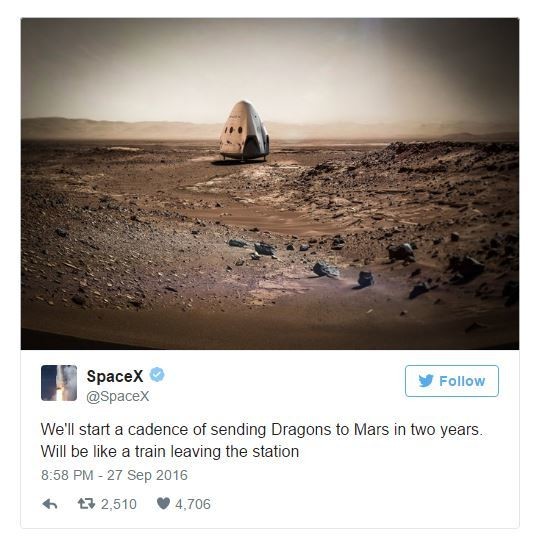
This is not rocket science. The man seems to be the furthest thing from the truth on everything he touches. He promised he would have driverless cars by 2017 to improve safety and land on Mars by 2018 to start settlements there. Yet his AI has filled graveyards and his rockets have yet to land anything on Mars, eight years past his own deadline.
Source: Twitter
There are so many, many lies it’s an indictment on America that the press still prints his word without the list beside it, along with his Hitler salute.
2016, self-driving. Musk promoted a Tesla video as proof that the car “drives itself.” Tesla’s own Autopilot director testified that the video was staged on a pre-mapped route to show traffic-light stops the system lacked. In 2019 Musk promised over a million robotaxis on the road “next year for sure.” The year 2020 ended with zero.
2018, “Funding secured.” Musk tweeted that he had the money to take Tesla private at $420 a share. A federal judge ruled the statement false and reckless. His talks with the Saudi fund were preliminary.
2018, the cave diver. A British diver who helped rescue twelve boys from a flooded Thai cave criticized Musk’s submarine. Musk called him “pedo guy” in front of 22 million followers and bet “a signed dollar it’s true.” The accusation was baseless and Musk withdrew it within days.
2024, the lottery. Musk announced $1 million a day awarded “randomly” to swing-state voters who signed his petition. His lawyer told a Philadelphia judge that the winners were selected in advance as paid spokespeople.
2025, political spending. In May Musk said he would do “a lot less” political spending and added, “I think I’ve done enough.” In 2026 he spent $400 million on Republican congressional candidates.
2025, Epstein. When his name surfaced in the Epstein documents, Musk wrote that Epstein tried to get him to the island “and I REFUSED.” Justice Department emails released in January 2026 show Musk asking to visit in 2012 and again in 2013. On Christmas Day 2013 he asked Epstein, “When should we head to your island on the 2nd?”
2026, MAGA.“I’m not MAGA.” Musk said the same thing in July 2024. Three months later he stood beside Trump in Butler, Pennsylvania, in a black MAGA cap and called himself “dark MAGA.” This time he said it fifteen days after his $400 million lost the midterms. In the same interview he gave his goal as a Republican Senate majority through 2029.
Elon Musk’s disdain for the Democratic Party was never subtle, but in recent weeks his commentary on the upcoming US presidential election and his attacks against Vice President Kamala Harris have intensified, aided by a crude use of burgeoning artificial intelligence technology. On Monday, Musk posted an AI-generated image on his social media platform that depicted Harris as a communist, wearing a red uniform complete with hammer and sickle emblazoned hat.
Silicon Valley Elites Bankrolled an Anti-Migrant, Pro-Israel Propaganda Machine:
Documents reveal the sordid inner workings of Visegrad24, an obscure Polish influence operation that became one of Elon Musk’s favorite sources of fake news.
Every entry shows Musk says what helps him on that day. The Nazi salute shows what stays the same the whole time. The evidence comes from a judge, an engineer, his own lawyer or his own email. With “I’m not MAGA” we measure it against a Nazi salute from Trump’s inaugural stage and $400 million backing MAGA candidates just this year alone, after decades of lying and cheating.
Elon Musk celebrates being MAGA.
When he claims he’s not MAGA, he means he will become an ever bigger MAGA unless someone holds him accountable for his MAGA mistakes.
He may as well say “I am not a crook,” as Nixon did.
Ein deutscher Verein, der vom Bundesinnenministerium rund eine Million Euro im Jahr erhält, hat ein Video veröffentlicht, in dem Judenhasser an Fahne, Tuch und blauen Haaren zu erkennen sind. Auf der Kampagnenseite des Vereins steht dieser Satz:
Wer Judenhass nur beim politischen Gegner erkennt, bekämpft ihn nicht – er instrumentalisiert ihn.
Dem Satz stimme ich zu. Ich wende ihn auf das Video an und auf den Minister, dessen Haus den Verein finanziert.
Wer Juden als Hebel gegen andere Gruppen benutzt, handelt selbst antisemitisch. Das ist mein Urteil. Es beruht auf einem einfachen Test: Eine Aussage, die sich auf Juden beruft, um eine andere Gruppe zu bestrafen, abzuschieben oder zu diskreditieren, macht Juden zum Werkzeug der eigenen Politik. Ihre Sicherheit wird zum Argument für etwas anderes. Eine vom Bund geförderte Kampagne tut das jetzt in Bildern. Bundesinnenminister Alexander Dobrindt hat es 15 Mal in Worten getan. Frühere Beiträge behandeln den Posten des Antisemitismusbeauftragten, den Dobrindt leer ließ, und Kanzler Merz, der deutsche Juden Ausländer nennt.
Ein Chamäleon färbt sich braun über einem Fackelmarsch von Neonazis, grün über einer islamistischen Kundgebung und rot über einer linken propalästinensischen Demonstration.
Die Seite trägt das Logo „Gefördert durch das Bundesministerium des Innern“. Der Verein gibt an, sein Haushalt bestehe aus Mitgliedsbeiträgen, Spenden und der Förderung des Ministeriums, und der Clip sei aus diesem Haushalt bezahlt worden.
Was der Clip zeigt
Der Bildwissenschaftler Roland Meyer hat den Clip in einem Thread vom 17. November auseinandergenommen. Er ordnet ihn als KI-generiert ein und nennt das Genre Slopaganda.
Die rote Szene markiert Menschen als Judenhasser: durch palästinensische und sowjetische Fahnen, Palästinensertücher, verstümmelte „Intifada“-Schilder und junge Frauen mit blauen und grünen Haaren. Keiner dieser Figuren legt der Clip auch nur eine Aussage über Juden in den Mund. Die Verkleidung trägt den ganzen Vorwurf. Meyer spricht von „semiotic excess“.
Die Frau mit den blauen Haaren ist eine Standardfigur rechtsextremer Anti-„Woke“-Memes. Meyer zeigt ein Beispiel von 2023. Eine Figur, die die extreme Rechte erfunden hat, um die Linke zu verspotten, tritt jetzt in einer vom Bund geförderten Kampagne als Gesicht des linken Judenhasses auf.
Die braune Szene zeigt ein Skinhead-Klischee aus den Neunzigern.
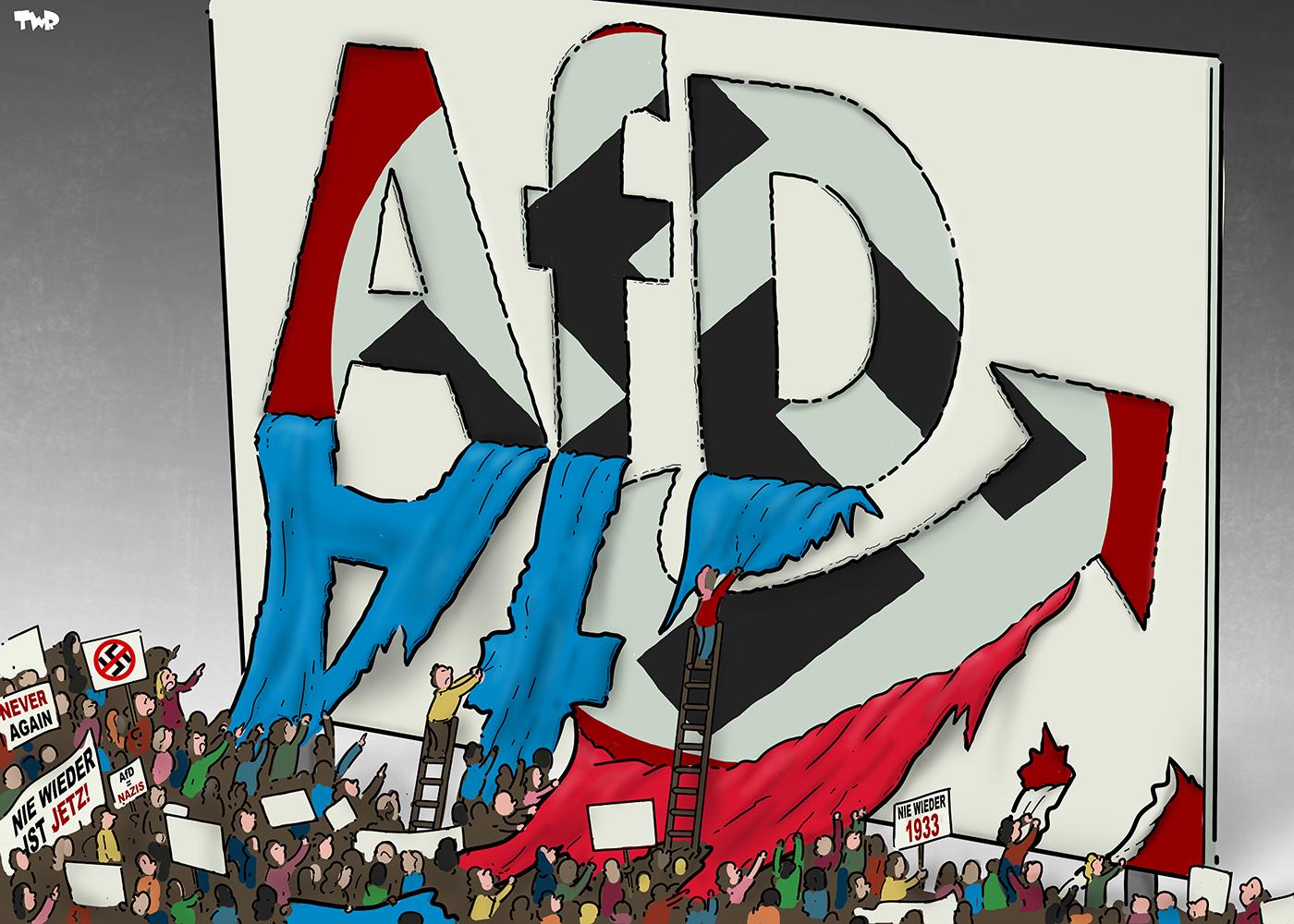
Die AfD kommt nicht vor, die antisemitische Partei, die in deutschen Parlamenten sitzt. Holocaustleugnung aus der AfD ist auf Video dokumentiert. Ihr Thüringer Landeschef Björn Höcke wurde zweimal wegen einer NS-Parole verurteilt. Der Zentralrat der Juden und rund 40 weitere jüdische Organisationen nannten sie 2018 „eine rassistische und antisemitische Partei“. Dobrindt hat die AfD in dreizehn Jahren, soweit ich es finden konnte, kein einziges Mal antisemitisch genannt. Ausgerechnet die bekannteste antisemitische Partei Deutschlands fehlt.
Stattdessen gehen ausgesuchte Figuren ineinander über. So werden drei Lager fälschlich zu einem gemacht. Meyer beschreibt das als die Arbeit von Slopaganda: Sie lässt Klischees natürlich aussehen und reiht die stereotypisierten Menschen zu einer Äquivalenzkette, bis sie zu einem einzigen zusammengesetzten Feindbild verschmelzen. Er verbindet das mit dem Prozess, den Simon Strick Faschisierung nennt.
Meyer weist außerdem darauf hin, dass eine einzige verborgene Kraft hinter gegnerischen Lagern die Grundfigur des Verschwörungsdenkens ist.
Meyer fügt eine Fußnote an. 1944 druckte der Simplicissimus der NS-Zeit eine Karikatur von Wilhelm Schulz, „Im politischen Zoo“, die den Bolschewismus als rotes Chamäleon zeigt. Die Parallele stammt von ihm, als Fußnote zur Geschichte des Bildes.
Woher die Kampagne ihr Chamäleon hat, muss der Verein beantworten.
Das Geld
Der Lobbyregister-Eintrag R001599 weist für 2025 Zuwendungen des Ministeriums von 960.001 bis 970.000 Euro aus, als institutionelle Förderung. Der Verein gibt 256 Mitglieder an. Institutionelle Förderung fließt in den allgemeinen Haushalt des Vereins, also in den Haushalt, aus dem der Clip bezahlt wurde.
Der Einzelplan 06 des Bundeshaushalts zeigt die Entwicklung.
Das Ministerium förderte den Verein 2019 und 2020 über Projekte und seit 2021 institutionell. Dobrindt ist seit dem 6. Mai 2025 im Amt. Die Förderung ist älter als seine Amtszeit, und sie ist seit 2024 um rund 40 Prozent gestiegen.
Der Minister
Ich habe 15 Fälle dokumentiert, von 2018 bis zum 23. Oktober 2026, in denen Dobrindt Antisemitismus als Begründung anführte, um gegen eine andere Gruppe vorzugehen. Sieben liegen vor seinem Amtsantritt, acht danach.
Elf richten sich gegen Migranten und Muslime. Acht dieser elf verbinden Antisemitismus mit der Forderung nach Strafe oder Abschiebung. Seit Oktober 2023 nennt er das „importierten Antisemitismus“.
Die Fälle vom Januar 2026 und vom Mai 2026 liegen mir nur als englische Paraphrase vor. Ich zähle sie trotzdem mit, ohne wörtliches Zitat.
In allen 15 Fällen ist das Muster dasselbe: Antisemitismus ist die Begründung, eine andere Gruppe ist das Ziel. Das ist der Hebel. Darauf stütze ich mich, wenn ich das bei Dobrindt beobachtete Muster antisemitisch nenne.
Mein Beitrag vom 5. November zählte null antisemitische Aussagen von Dobrindt und führte diese Fälle in einer zweiten Spalte. Ich stelle beides zur Prüfung nebeneinander. Nach der Zählung, wie sie jetzt steht, besteht jede Aussage für sich genommen die Prüfung, und das Muster ihrer Verwendung nenne ich antisemitisch.
Der Kanal
Der eigene Kanal des Ministeriums liest sich ganz anders. Ich habe den gesamten öffentlichen Mastodon-Feed von @bmi@social.bund.de (8.400 Follower) heruntergeladen: 1.841 Beiträge vom 27. Oktober 2022 bis zum 16. November 2026.
Seit Dobrindts Amtsantritt hat der Account 257 Mal gepostet. 26 dieser Beiträge handeln von Juden, Antisemitismus oder Israel. Das Wort „importiert“ kommt kein einziges Mal vor. Die Linke wird nie erwähnt. Keine der acht Aussagen, die er als Minister gemacht hat, steht dort. Sie fielen im Bundestag, im Fernsehen, in Zeitungen und bei öffentlichen Auftritten. Über zwei der Anlässe, Halle und Bebelplatz, berichtete der Feed noch am selben Tag und zitierte andere Sätze. Ein Beitrag vom 5. November 2025 betrifft das Verbot von Muslim Interaktiv und beruft sich auf Judenhass.
Der offene Feed schrumpft außerdem. 2024 waren es im Schnitt 61 Beiträge im Monat, von Januar bis April 2025 noch 40, von Januar bis Oktober 2026 nur noch 9.
Der X-Account des Ministeriums, @BMI_Bund (201.200 Follower), zeigt nicht angemeldeten Besuchern fünf Beiträge und dann eine Anmeldeschranke. Von den fünf neuesten sichtbaren Beiträgen, datiert vom 1. bis zum 16. November 2026, erschien einer auch auf Mastodon. Ein X-Account unter seinem Namen, @DobrindtA, zeigt 0 Beiträge. Ob er ihm gehört, konnte ich nicht bestätigen.
Gemessen habe ich den Rückgang auf Mastodon. Was das Ministerium hinter der Anmeldeschranke von X postet, ist nicht gemessen. Das Gemessene reicht für diese Feststellung: Der offene, archivierbare Kanal des Ministeriums ist still geworden, während die acht Aussagen, die er als Minister gemacht hat, in Zeitungen, Sendungen und Plenarprotokollen stehen.
Hauptredner der rechtsextremen AfD-Kundgebung in Deutschland war der Eigentümer von X
Die Anfrage
Am 19. November 2026 hat die Ottenheimer GmbH beim Ministerium einen Antrag nach dem Informationsfreiheitsgesetz (IFG) gestellt. Beantragt sind:
die Zuwendungsbescheide für 2025 und 2026
der Verwendungsnachweis für 2025
der gesamte Schriftverkehr zur Kampagne, einschließlich einer etwaigen Freigabe vor der Veröffentlichung
interne Vermerke zur Kampagne
die Akten zur Erhöhung der Förderung
Belegen kann ich heute: Das Ministerium finanziert den Verein, und der Verein sagt, er habe den Clip aus seinem Haushalt bezahlt. Das Ministerium sagte netzpolitik.org am 19. November, die Kampagne sei im Ministerium bekannt, direkt beteiligt sei es nicht. Seit wann sie bekannt ist, sagte es nicht. Der Antrag verlangt die Unterlagen hinter beiden Aussagen.
Am 2. Juli 2026 hat sich die Koalition darauf verständigt, das IFG auf natürliche Personen mit „berechtigtem Interesse“ zu beschränken und die Gebührenregeln zu ändern. Human Rights Watch widersprach binnen einer Woche. Ein Gesetzentwurf ist bisher nicht veröffentlicht. Eine GmbH ist eine juristische Person. Anträge wie dieser wären nach dem Plan also nicht mehr möglich.
Der Verein sagt, Antisemitismus aus linksextremen und islamistischen Milieus sei real und werde zu wenig benannt. Er sagt, der Clip vereinfache mit Absicht. Er sagt, die Kampagne nenne auch die Rechte und die „Mitte“.
Antisemitismus in diesen Milieus mag es geben. Der Clip zeigt etwas anderes. Er zeigt Menschen, die durch Fahne, Tuch und Haare als Judenhasser markiert werden, und legt ihnen kein einziges Wort über Juden in den Mund. In der eigenen Stellungnahme des Vereins, die netzpolitik.org zitiert, heißt es: „Antisemitismus zeigt sich an Einstellungen, Aussagen und Handlungen.“ Meyer antwortet im selben Artikel, der Clip zeige nichts davon. Die Sprecherin des Vereins sagte netzpolitik.org, Parolen und Schriftzüge seien mit Absicht verfremdet worden. Nach dem eigenen Satz des Vereins gilt: Wer Judenhass am Aussehen des politischen Gegners erkennt, instrumentalisiert ihn. Der Clip richtet den Vorwurf dorthin, wo die Belege am dünnsten sind, und weg von dort, wo sie am dichtesten sind. Dafür sollte kein öffentliches Geld fließen.
Ein vom Bund geförderter Haushalt hat für ein rechtsextremes Meme bezahlt, in einer Kampagne, die auf mich antisemitisch wirkt und im Namen des Schutzes von Juden läuft.
Das Ministerium sagt, die Kampagne sei ihm bekannt. Der Antrag fragt, seit wann.
a blog about the poetry of information security, since 1995