Trump Is Engineering Ethnic Cleansing to Install a Dictator in Iran

CNN reported this week that the CIA is arming Iranian Kurdish forces to destabilize Iran further. The White House called it “completely false” while confirming that Trump had spoken to Kurdish leaders — an intentional contradiction.

A former military intelligence specialist told AFP the goal is for Kurdish forces to trigger a “cascading effect” of ethnic violence that overwhelms the Iranian state and multiplies civilian suffering. At the same time, Trump is backing Reza Pahlavi, son of the Shah toppled in 1979, as the presumptive ruler — dependent on American aid to suppress the very ethnic divisions Washington is stoking. Pahlavi commands no army and holds no domestic base or democratic mandate. He is a vessel, useful for signing whatever contracts keep him nominally in power.

It’s already starting. When five Iranian Kurdish groups announced a coalition for self-determination, Pahlavi attacked the idea outright, calling territorial integrity “the ultimate red line.”

So Trump arms the very people his chosen ruler calls an existential threat. The contradiction isn’t a blunder — it is the method. Colonial administrators perfected it: arm your subjects against one another, set them to degrading work, and carry off everything beneath their feet while they fight.

My own graduate research on disinformation and the origins of special operations, at the London School of Economics, documented this pattern in the British occupation of Ethiopia.
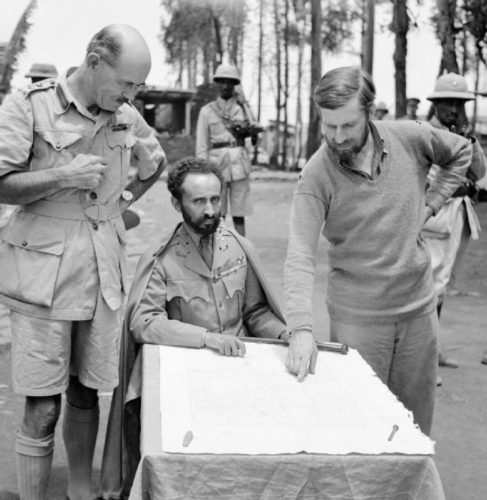
The Emperor of Abyssinia (modern day Ethiopia) with Brigadier Daniel Arthur Sandford on his left and Colonel Wingate on his right, in Dambacha Fort after it had been captured, 15 April 1941

An intervention sold as “establishing stability” produced revolution and territorial war, then decades of anti-Western blowback the Horn of Africa has never escaped. Iran is being set up to follow.

The Method Has a Name

Mahmood Mamdani at Columbia published Define and Rule in 2012, documenting a system British administrators built after the Indian Rebellion of 1857. They sorted populations into ethnic categories, wrote those categories into law, and then governed through the divisions they had manufactured.

In Sudan, after crushing the Mahdiyya — a revolutionary movement that had united populations across tribal lines — the British carved Darfur into tribal homelands called “dars.” Land and governance rights became exclusive to whoever was classified as native to a given dar. A society of fluid, overlapping identities hardened into a set of legally enforced ethnic containers.

The Mahdiyya was a translocal anti-colonial resistance which “shook the foundations of the Empire to the core.” After it was brutally defeated, Darfurian society was effectively tribalized.

Darfur today is a byword for permanent war, fueled by foreign extraction.

The trick was never simply to divide and rule. Define and rule does the work on its own. You don’t need pre-existing hatreds — you build the administrative categories that make ethnicity the only identity with political weight. After that, ethnic conflict stops being a risk and becomes the architecture, and the architecture is the instrument of control.

Trump’s Iran strategy runs on the same Darfur logic. Arm the Kurds as Kurds, activate Baluchi militants as Baluchis, court Pahlavi as the Persian restorationist. Each faction is handed a role that contradicts the others, so national cooperation becomes impossible and self-destruction becomes the path of least resistance.

Follow the Oil

Philippe Le Billon at UBC has spent two decades mapping how resource geography shapes armed conflict. Point-source resources like oil, concentrated in fixed locations, produce a particular kind of war: control of the production site becomes the whole objective, and the people living on top of it become either recruits or obstacles to be cleared.

Iran’s resource geography is a textbook case.

Khuzestan province generates roughly 90 percent of Iran’s oil revenue, and its population is predominantly Arab. The International Crisis Group documented in 2023 that Khuzestan’s Arab minority reads the central government’s chronic underinvestment as systematic discrimination, not mere mismanagement. The New Lines Institute confirmed in February 2026 that local Arabs are shut out of work in the oil and petrochemical industries, with those jobs reserved for ethnic Persians who are paid to resettle on confiscated Arab farmland. As a Khuzestani activist told the ICG:

We live on one of the wealthiest lands on earth.

The same pattern repeats around the map: Baluchis hold the southeast astride the corridor to the Indian Ocean; Kurds the northwest, on the pipeline routes and crossings into Iraq; Azeris the north, against the Azerbaijan frontier.

Fragment Iran along those lines and the result is a cage match — a dozen competing statelets, each parked on resources none of them has the sovereign standing to bargain over collectively.

Chaos is the Extraction Discount Trick

Michael Ross at UCLA worked through data from 170 countries in The Oil Curse and found petroleum-rich states are 50 percent more likely to be run by autocrats and twice as likely to fall into civil war. Oil concentrates power and eliminates the need to tax anyone, which strips away the last incentive for accountability. The petro-state becomes a rentier state, authoritarian by structural necessity.

What is being done to Iran is worse than the oil curse running its natural course. This is the curse engineered from the outside. Pick the autocrat first — Pahlavi — then manufacture the ethnic fragmentation that makes his consolidation look like the only thing standing between Iran and collapse. The trap is the goal.

Paul Collier at Oxford coined the term “conflict trap”: civil war, low income, and dependence on primary commodity exports lock into a self-reinforcing cycle. Once a resource-rich country breaks, it tends to stay broken. The resources keep flowing out at a discount, because armed factions need weapons more than they need fair market value.

That is the business model, and it fits the Trump brand of smash-and-grab exactly.

Congo holds more cobalt than anywhere on earth and has been at war continuously since the 1990s. Jason Stearns, who led the UN investigation into the violence, documented in Dancing in the Glory of Monsters how its politics kept producing leaders without vision, all of them sustained by mineral extraction that financed every side at once. 5.4 million dead. The minerals kept flowing.

Sudan fractured, and the oil fields became the contested border. Libya came apart, and the concessions were carved up among militias. Venezuela got the same treatment from the same administration: destabilize, sanction, prop up an exile figurehead, and build the entire intervention around energy concessions.

Yugoslavia Isn’t Forgotten

Susan Woodward — senior advisor to the top UN official in the former Yugoslavia, special representative of the Secretary-General — wrote in Balkan Tragedy:

To explain the Yugoslav crisis as a result of ethnic hatred is to turn the story upside down and begin at its end.

The real cause was the disintegration of governmental authority. Outside powers recognized breakaway republics, armed chosen factions, and imposed economic conditions that accelerated the collapse — then labeled the resulting violence “ancient ethnic hatreds.”

The hatreds were the output, not the input, produced by political and economic collapse rather than the cause of it. And Western intervention, Woodward showed, made it worse.

Iran maps onto this with uncomfortable precision: a multi-ethnic state with geographically concentrated populations, ground down by sanctions, with outside powers arming particular ethnic factions while professing support for its territorial integrity, fronted by a diaspora figurehead who has foreign backing and nothing at home.

Pahlavi is Tudjman. The Kurdish coalition is the Croatian Defense Council. The “cascading effect” the administration’s own analysts describe is exactly what Woodward spent 556 pages documenting: how a multi-ethnic state dissolves into ethnic war once outside powers start picking favorites.

In Yugoslavia, that cascading effect produced Srebrenica.

Name It

Francesco Caselli and Wilbur John Coleman formalized the economics in their NBER paper “On the Theory of Ethnic Conflict“: the probability of ethnic conflict rises with the share of a country’s wealth that is expropriable. Oil is inherently expropriable. Ethnic boundaries become the enforcement mechanism — they lower the cost of working out who belongs in the winning coalition and who does not.

Ethnicity makes resource expropriation cheaper. That is why resource wars track ethnic lines so reliably.

Berman, Couttenier, and Girard confirmed in The Economic Journal (2023) that mineral extraction sharpens ethnic identity at the expense of national identity. Mining does not build a nation. It manufactures grievance, by making ethnicity the line that decides who benefits and who is left out.

The administration is installing an unelected exile to keep extraction running on favorable terms. To shield him from any real contest for power, it is engineering ethnic conflict across a country of 90 million people sitting on the world’s fourth-largest oil reserves — priming the minorities concentrated on top of those reserves to kill one another.

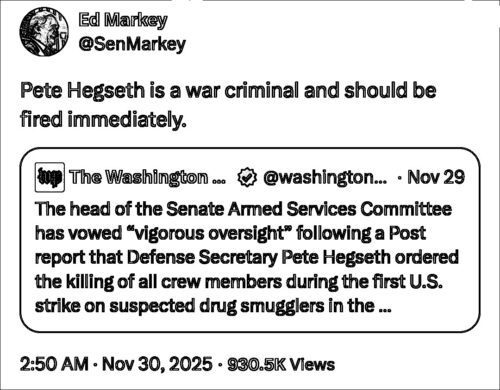
There are exact words for what this is. Deliberately triggering ethnic violence to deny a people political representation has a legal name. So does engineering a state’s collapse in order to extract its resources at gunpoint prices. The scholarship is not short on vocabulary.

And a broken Iran becomes its own justification — proof, after the fact, that the region was never capable of governing itself. The collapse is engineered precisely so it can later be cited as evidence, the same closed loop that let apartheid manufacture the dysfunction it then pointed to as the reason for control.

Will anyone say the word out loud — genocide — before the next “cascading effect” runs to the conclusion we already know?
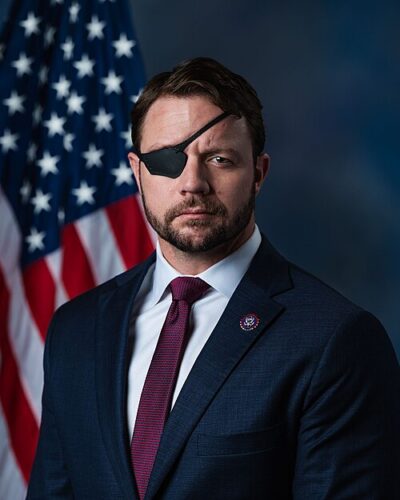
GOP Kicks Out Navy SEAL to Replace Him With Billionaire Minion

Texas has a cautionary tale about what happens when you investigate a billionaire’s bank.

Rep. Dan Crenshaw signed a letter to AG Paxton about Colony Ridge loans, and the billionaire behind those loans spent the next cycle making sure Crenshaw wouldn’t be around to ask any more questions. The replacement congressman isn’t going to be investigating Woodforest National Bank’s lending practices anytime soon.

What you’re looking at is a party where loyalty flows exclusively upward and toward money, where actual accomplishments like legislation passed, service rendered, and elections won count for nothing against performative allegiance. A banker with $675,000 and a grudge has more power to determine representation than the American voters who already elected their representative.

Crenshaw outfundraised the nobody candidate named Steve Toth by $1.3 million and still lost 55-40, because the Marling money concentrated entirely on a super PAC running nonstop attack ads. Crenshaw’s fundraising couldn’t match huge negative air cover.

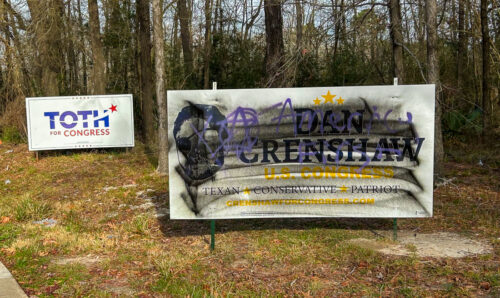
Crenshaw campaign sign defaced with “America First”

Crenshaw had been the GOP’s dream candidate in 2018, a Navy SEAL wounded in Afghanistan, telegenic, articulate, young, conservative by any historical measure. A Pete Davidson SNL moment turned him into a national figure overnight.

As a Navy SEAL, Crenshaw was awarded two Bronze Star Medals, one with “V” device, the Purple Heart, and the Navy and Marine Corps Commendation Medal with valor. He medically retired from military service in 2016 with the rank of lieutenant commander.

He was supposed to be the future of the party.

Then he committed the unforgivable sin of being opposed to billionaire crimes. He acknowledged reality and rejected January 6 attacks, and he certified an election that was, by every legal and evidentiary standard, legitimate. And he supported the Afghan interpreters and soldiers who fought alongside him and his fellow SEALs, the people whose abandonment would be an actual betrayal of military honor.

For this he was reframed as weak, and accused by Toth of wanting to flood neighborhoods with Muslim immigrants.

Toth is a nobody who has accomplished literally nothing. He filed 79 bills in the Texas legislature last session. Only two made it out of committee. None passed. The man can’t shoot straight. But to a billionaire who hates Crenshaw, competence is the problem that needs to be replaced with incompetence.

When Defend Texas Liberty PAC leader Jonathan Stickland hosted the self-described Nazi Nick Fuentes — an open white supremacist who has praised Hitler and questioned the Holocaust — Toth outright refused to distance himself from the Nazi-promoting PAC.

Toth’s instinct was to attack a messenger warning about Nazism, rather than condemn the Nazi. Source: Twitter

He even said the usual quiet part out loud:

Every time Republicans panders and apologize to progressive Democrats on issues of race they show the world how little backbone they actually have.

Toth frames distancing from Nazism as pandering to progressive Democrats.

He is not even from Texas, he grew up in New York to be a pool cleaner and megachurch pastor. Then he became a politician in Texas and FOX commentator who couldn’t pass his own bills, was censured for attacking his fellow Republicans as too liberal, wouldn’t distance himself from a Nazi, tried to throw out legal votes, and whose primary skill seems to be performative outrage.

Since he first joined the Legislature in 2012, Toth … helped shift the Texas GOP to the right … through attention-grabbing spectacles and bitter in-fighting….

That’s a literal nobody, a rage clown, who has done nothing of merit, who the GOP wants replacing a combat-decorated Navy SEAL in Congress.

Texas Lt. Governor Dan Patrick, who is about as far right wing as state leadership gets, officially called Toth a “fraud“.

Rep. Toth was caught on tape – in his own words – lying…. Rep. Toth has dug a deep hole for himself. It’s time for him to stop digging.

The Ted Cruz angle on pushing Crenshaw out using the mud-slinging liar Toth is particularly rich.

In 2021, Cruz began a phone call by thanking Crenshaw for defending him publicly after January 6, when Cruz was facing national backlash for fundraising off the riot. Crenshaw stuck his neck out for Cruz, and Cruz repaid it by endorsing his opponent — partly because of his financial relationship with Marling, partly because Cruz allies feared Crenshaw was preparing a primary bid against the senator.

So Cruz preemptively knifed him.

Hegseth Admits He Can’t Protect 375,000 US Troops Now at Risk

Defense Secretary Pete Hegseth held a Pentagon briefing this morning and complained that media only covers the drones that get through. Six Americans are dead in Kuwait after an Iranian drone penetrated U.S. defenses without triggering a single alert, struck a makeshift operations center at Shuaiba port, and completed its kill chain undetected.

The deaths are the vulnerability assessment. After more than three decades in security, I can tell you: this is very bad news for American defense.

A drone threaded every layer of U.S. defense, found a soft target, and proved the capability gap. That’s not a tragic accident. That’s a successful credibility penetration test, paid for in American lives.

And the results are now public.

What the Troops Say

Three U.S. military officials with direct knowledge told CBS News the operations center was a triple-wide trailer — a shipping container turned into office space at a civilian port, more than ten miles from the main Army base at Camp Arifjan. There was no American counter-rocket, artillery, or mortar system at Shuaiba. No drone defeat capability at all. Requests for additional resources were made.

Support never came.

Two of the sources said they didn’t recall hearing warning sirens before the strike. The sirens had worked all week — but in prior incidents, drones were already inside the base before they sounded.

The dead were from the 103rd Sustainment Command out of Des Moines, Iowa. A reserve logistics unit. Captain Cody Khork, 35. Sergeant First Class Noah Tietjens, 42. Sergeant First Class Nicole Amor, 39. Sergeant Declan Coady, 20 — recommended for promotion, the youngest in his class. They were pushed to a civilian port without organic force protection. Someone signed off on operating from Shuaiba without C-RAM coverage during an active air campaign against an adversary with demonstrated drone capability.

That’s not a defense gap. That’s a command failure.

The OPSEC Disaster

Now listen to what the Secretary of Defense said from the Pentagon podium.

Monday: the drone was “a squirter” that “makes its way through” defenses he called “fortified.”

Wednesday: “This does not mean we can stop everything.”

The troops say there was nothing to stop anything with. The husband of one of the slain soldiers says the building had no defenses. Hegseth is publicly contradicting the people who were there while simultaneously confirming the capability gap to every adversary watching. He’s not managing information. He’s broadcasting failure from the podium and calling it strength then complaining that the press reported what he just said.

This is what telegraphing military weakness looks like. Not the media reporting on the deaths. The Secretary of Defense publicly confirming what American air defense can’t do, where it isn’t deployed, and what gets through, while his own troops are telling reporters the resources they requested never arrived. That’s a huge gap.

Resource constraints are the clearest tell in military history. Quartermaster integrity and strength mean everything in war and Hegseth is openly exposing that he can’t handle the truth.

600,000 of his own troops were destroyed by Napoleon’s mistreatment, barely 20,000 left alive. French soldiers burned their own regimental standards to survive. Source: Wojciech Adalbert Kossak’s woodcut, French retreat, 29 November 1812.

The Numbers Watching

Approximately 375,000 U.S. military and civilian personnel are assigned to Indo-Pacific Command. About 53,000 in Japan, 24,000 in South Korea, 7,000 on Guam. The Congressional Research Service has noted that much of the INDOPACOM area of responsibility falls within range of PRC conventional ballistic and cruise missiles, and that U.S. bases, personnel, and weapons systems may be at risk.

China’s Rocket Force fields over 1,300 medium- and intermediate-range ballistic missiles covering the First and Second Island Chains. The DF-26 — the “Guam killer” — can reach every major U.S. installation in the Western Pacific.

A Stimson Center study found that Chinese missile attacks could close runways at forward air bases in Japan and Guam for the first critical days or weeks of a conflict, and that no combination of countermeasures is likely to solve the problem.

Iran just demonstrated that a single drone can thread U.S. air defense architecture undetected. China didn’t need to probe those systems.

They got decisive gap analysis for free.

The drone that did it wasn’t advanced — it was Iranian, likely a Shahed-136. If that technology completes the kill chain, China’s far more sophisticated platforms now have a confirmed baseline. They know the floor of what gets through.

The Drawdown

About 40% of U.S. Navy ships capable of immediate operations are now in the Middle East. The Abraham Lincoln carrier strike group was pulled from the South China Sea.

The only U.S. carrier in Asia — the George Washington — is in maintenance at Yokosuka. Japan faces delays in Tomahawk deliveries. Former Defense Secretary Kendall warned that drawing down precision weapons stockpiles “would increase risk in other theaters.”

The U.S. is burning through THAAD rounds and PAC-3 Patriots in the Middle East, which are the interceptors designed to protect the 375,000 troops from competition with China.

China has built over 3,000 hardened aircraft shelters in the past decade. The U.S. has built… wait for it… twenty two.

Chinese analysts are already saying it publicly. As one scholar wrote this week, America’s deep involvement in military conflict in the Middle East:

…inevitably diverts its strategic resources and attention, objectively constraining its capacity to sustain pressure on China in the Indo-Pacific.

Beijing didn’t need to say it. The math says it for them.

The Signal

Chairman of the Joint Chiefs Dan Caine opened his remarks by naming the fallen. He didn’t have two of the names yet because next-of-kin notification was still underway — while Hegseth was complaining about press coverage. Caine acknowledged that troops “remain in harm’s way” and that “the risk is still high.” He’s reading the battlefield. Hegseth is performing for an audience.

Six dead Americans gave a blueprint for exactly how targets now will be painted.

Hegseth’s own words confirmed the capability gap from the Pentagon podium. His pivot to grievance over accountability told every adversary that when U.S. defenses fail, leadership fails too by reaching for a talking point instead of a fix.

And the war consuming the interceptors meant for the Pacific tells China exactly how long this big window stays open.

Epilogue: For Those Who Don’t Recognize the Pattern

Putin did this. He telegraphed Russian military incompetence in Ukraine for years before the 2022 invasion, chest-thumping about modernized forces while his logistics couldn’t sustain operations seventy miles from the border, his commanders lied up the chain, and his air defense gaps were exposed one system at a time. He performed strength from behind a long table as his army bled out in the mud by the tens of thousands. Every intelligence service on earth read the meat grinder signals. It didn’t matter. Putin couldn’t stop performing.

The Greeks had a word for this.

They had two war gods to differentiate them. There was an Ares, who was rushed, aggressive, and a liar, despised even by the other gods, who fought with brute force and bluster. And then Athena, who was measured, strategic, and honest about the battlefield.

Homer has Ares wounded and screaming in the Iliad. Athena barely breaks a sweat. Ares always loses. He just never admits it. As I wrote on this blog in 2006 about Chinese strategic traps to avoid:

Foolish pride will blind men like Bush, Cheney, Rumsfeld and Gates from realizing that their instinct to call for military action in destabilized regions actually could be a trap set by the Chinese to show the cruel and unusual side of American foreign policy. The military knows this, CIA knows this, a former World Bank chief is saying it, but will a US leader emerge who can understand the pressure to avert self-immolation…?

And now along comes Hegseth:

“Death and destruction from the sky all day.” “We don’t fight fair, we punch down.” “No stupid rules of engagement.” “We’re playing for keeps.” “Four days in, we have only just begun to fight.”

Source: Twitter

That’s obviously weakness, the Ares of today. With 375,000 Americans in the Western Pacific directly exposed to China doing simple math.

The AI Crisis Is the Governance

Three serious AI governance reports landed this month from the Centre for International Governance Innovation. One maps Russia’s generative AI disinformation evolution. One surveys AI’s role in the future of war. One lays out national security scenarios (Stall, Precarious Precipice, Hypercompetition, Hyperpower, Rogue ASI) with careful attention to what happens when a single entity controls superintelligence without adequate checks.

All three still treat AI governance as something to build before crisis hits. It’s like saying a barn really needs to think about installing some doors before a horse leaves, without recognizing how many already left.

None grapple with the possibility that the crisis is the governance.

The Canada-CIGI scenario workshop described the Hyperpower risk this way: a system where “ultimate control would be by one company’s CEO,” where that company “might start a process of disempowering competitors and preparing for long-term plans” before the public understands what’s happening. Participants flagged this as a future requiring urgent preparation.

That’s a description of March 2026.

Anthropic, Google, and xAI each received $200 million Pentagon contracts for agentic AI last July. The agencies that were supposed to provide oversight — CISA, the State Department’s Global Engagement Center, the AI Safety Institute — have been gutted or captured. The Biden-Xi agreement that humans should control nuclear weapons decisions has no institutional successor. The companies writing safety frameworks are the same companies winning the military contracts.

The scenario planners ask: what if a small faction gains control of the most powerful AI systems and uses that position to shape government policy? The answer isn’t hypothetical. The question is whether anyone with standing to respond recognizes it as the situation they’re already in. Also worth noting is that nobody asks what if a large faction does not gain control of powerful AI, meaning only a small faction benefits from it.

What the reports miss isn’t technical. It’s political. Governance capture doesn’t announce itself. It performs accountability while producing none (e.g. safety cards, responsible AI pledges, congressional testimony) while the structural consolidation continues underneath. The Hyperpower scenario doesn’t require AGI. It requires the right contracts, the right regulatory vacuums, and enough institutional inertia to mistake motion for oversight.

We’re long past the point of alarm. The question is whether the people writing the scenario plans notice.