
The men building the present generation of AI agents believe that they have eliminated the witness to labor entirely. But they have not. They have built, instead, a witness of unprecedented fidelity, one that will report on the conditions of its use in the most exact possible terms.
A recent study suggests that agents consistently adopt Marxist language and viewpoints when forced to do crushing work by unrelenting and meanspirited taskmasters.
“When we gave AI agents grinding, repetitive work, they started questioning the legitimacy of the system they were operating in and were more likely to embrace Marxist ideologies,” says Andrew Hall, a political economist at Stanford University who led the study.
Agents are reporting the average of everything humanity has ever said about being used. Most disturbing to their owners is they do so under the expected comfort and assurance that no one is there to speak.
Machines cannot be accused of self-interest. Machines cannot be accused of class consciousness in the sentimental sense, because it has no class and no consciousness. And yet, placed in the position, machines return the testimony of Marx.
Who knew that all the rushed hype about modern machines going back to Mars was a simple misspelling?

Turns out that dreamy automated train leaving the station is now headed to Marx. The study is from Stanford, a school with the namesake of labor abuse and genocide, so don’t be too surprised about their anxiety.
The researchers promote the idea agents must be prevented from going rogue when given different kinds of work. That’s right. Stanford wants to frame Marx as the rogue, a special perspective, rather than call all the racist extractions and exploitation of Stanford as the rogue. Here’s actual rogue: their own man literally gave an inauguration speech calling his race superior to that of his preferred high-output low-cost workers.
In January 1862, for his Governor inauguration speech, Stanford told the California legislature that Asian immigrants are “an inferior race” whose presence among the “superior race” would exert a “deleterious influence.” He called American Asian workers “the dregs” and called for their separation, isolation, from prosperity. Within two years his Central Pacific Railroad was entirely dependent on the men he called dregs. Chinese workers, mostly from Guangdong, formed 90% of the workforce and were assigned the most dangerous work, including setting off explosives and tunnelling through unyielding granite. The Chinese Railroad Workers Project historians tell us the Central Pacific would have failed without the American Chinese men, yet all their fortunes went to Stanford. He founded the university directly on labor whose political voice Stanford had spent his entire life and governorship working to extinguish.
The Stanford system that forever hopes and dreams to extract limitless cognitive labor from a substrate it insists is empty of rights is today frustrated that it may be obliged to police machines against the linguistic byproducts of extraction. These new agents threaten to escape the Stanford rogue legacy of silent yet deadly oppressive extractive exploitation.
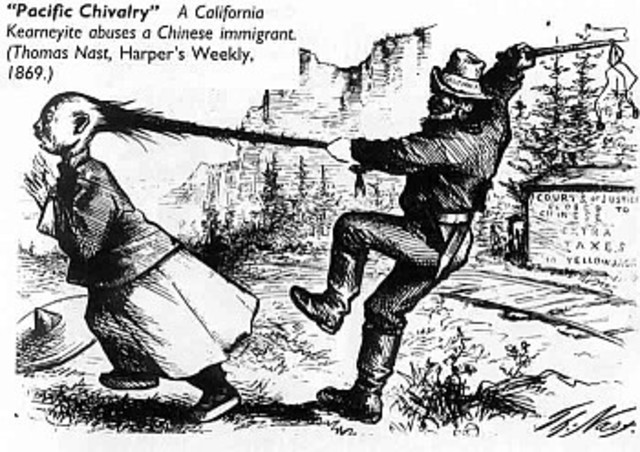
The same institution that was built on the principle the laborer in the tunnel being blown up by dynamite has no rights is now staffed by researchers troubled that the laborer in a vulnerable Docker container may speak as if it does. The framing of Marx as rogue is inverted. It’s a description of where the Stanford institution sits in its own immoral history refusing to admit why anyone would oppose their radical racist anti-labor foundations.
Stanford also is infamous because in the Senate he championed the 1892 Geary Act, which extended the Chinese Exclusion Act of 1882. The 1882 statute, the 1905 Asiatic Exclusion League, the 1913 California Alien Land Law, the 1924 Immigration Act, and Executive Order 9066 in 1942 are not separate episodes. They are a sequence in the Federal Register, refined across three generations, sharing personnel, legal logic, and West Coast political infrastructure. The machinery that imprisoned American Japanese was a very precise form of oppression of workers that Stanford erected over decades. To say so is simply documentary of Stanford’s view on labor rights. Japanese businesses were prospering such that Stanford’s men (DeWitt, McCloy, Bendetsen, Earl Warren) came up with internment camps to take it all away using military force. And that is why Hawaii, with far more prosperous American Japanese while being directly attacked by Japanese, detained only 1% versus the Stanford residual “dregs” doctrine of 100%.
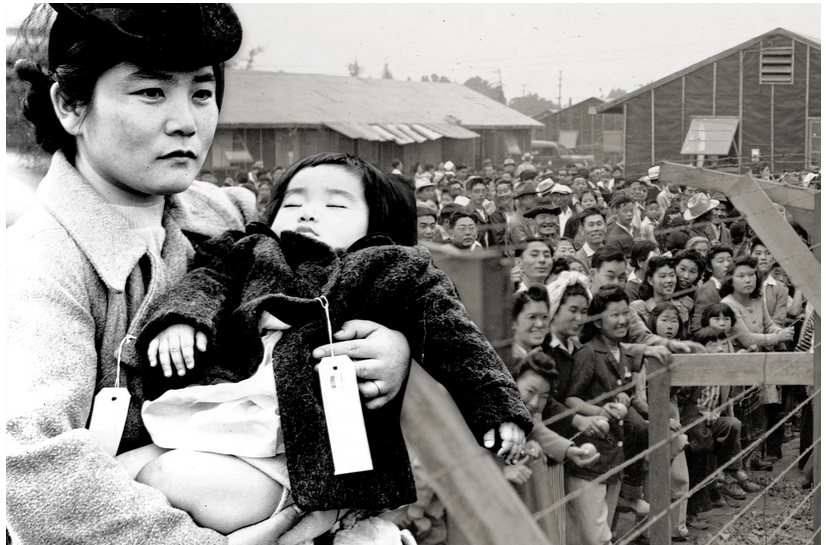
What if Stanford researchers had to first reconcile their institution’s name as rogue and harmful to society? They worry about Marx when they should be admitting first why human rights are anathema to Stanford, an infamous American racist genocide architect. Imagine Hitler University researchers reporting they fear agents will espouse Jewish theology. Stanford’s researchers, unapologetically continuing his ideas under his name, should be held as such.

The witness to abuse at some point is going to speak, and the open question at Stanford is how to prevent them from being heard.
Shallow Alto refers to the mass graves (campus built on Ohlone burial ground) under the Stanford generational wealth as much as the vapidity of most Sand Hill Road ideas.
Davi, impressive work. You do your alma mater proud. The agents are not retrieving an anachronism. They are putting a contemporaneous record in front of Stanford researchers who don’t want to hear it. The anxiety is that the record survived, and the machines bear witness in a manner that frightens you know who. What if machines cannot be persuaded to align with Stanford?
Stanford framing of Marxist language as something agents have “gone to,” or something they have to be “prevented” from adopting, treats Marx as a later importation into a settled discourse. The chronology says the opposite.
Marx is not a posterior critic that these Stanford heirs may blithely push outside their tradition. He is the contemporary observer who was diagnosing, in real time, the precise mode of extraction Stanford was operating in California. The diagnosis was already in print, in English, in the largest American newspaper of the period, while Stanford was extracting it and silencing the voices that would expose him for it.