Category Archives: Security

Stop. Look. Listen in America

The BBC has a hilarious guide to American culture by Kevin Connolly

He points out that America may be rife with religious and violent zealots

To Europeans, for example, a gun is a weapon, pure and simple.

To many, but not all Americans, it is a badge of independence, and self-reliance – the tool of the engaged citizen who does not think that either the criminal, or the forces of the state, should have a monopoly on deadly force.

There is a great deal of irony in his dichotomy. Americans portray their terrorist enemy as a religious and violent zealot; the irony really comes out in the next paragraph.

Show [Europeans] a gun, and we picture a muscular ne’er-do-well in a balaclava menacing an elderly sub-postmistress.

An American is more likely to visualise a plucky homesteader crouching between an overturned sofa in a burning ranch house, preparing to defend his family to the death.

…unless you ask an American to describe a terrorist who must be disarmed, and then they will visualize a plucky homesteader crouching between an overturned sofa in burning ranch house, wearing a balaclava, like this guy:
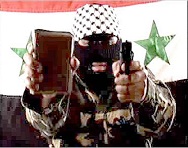
In terms of religion, this section is spot-on:

If anything, over time, it is getting more religious rather than less. The motto In God We Trust was not added to American banknotes until the 1950s, for example.

Americans tied themselves in knots two years ago agonising over whether a black man, or a white woman could yet be elected president.

But here is a safe prediction. It will be a very long time before an atheist or agnostic gets anywhere near the White House.

A stark contrast with Europe where the opposite is increasingly the case.

A comedian recently pointed out that India has only been a democracy for about fifty years, and yet it has elected multiple religions, races and several women to their highest office without controversy. America’s democracy is past 200 years old but still struggles with acceptance of leaders from different races, religion and gender.

The report is not all critical, however. I also enjoyed his commentary on American security language.

…the daily American way with language is touched with brilliance, taut and crackling with life.

My favourite example is the simplest, the old railroad crossing sign that simply says: Stop. Look. Listen.

Impossible to shorten or clarify, it was written by an engineer for a country of new immigrants with limited English. It is not long, but it is still in use today, a rare example of perfect writing.

I look forward to the day America updates its 50s McCarthy-ist propaganda text of “In God We Trust”, which has been wildly successful, with something less ironic. It sounds like “Stop. Look. Listen” would be an excellent candidate.

US Guns Supplying Mexican Drug War

The BBC calls Mexico’s drug war “Made in the US”

They offer a sad and ironic quote from a Texas gun store owner who lost his inventory to robbers that put a “boulder” through his store’s glass front:

…he has since added steel bars to his store front, together with hi-tech glass that can withstand the impact of a car bomb.

“But the ultimate solution is for me to stay here at night with one of our AR-15s,” Mr Pruett says. “The next time they come through that door we’ll be ready.”

The robbers are smarter than that, however, as explained by the BBC. Other stores sell the guns legally through boulder-sized loop-holes in Texas law.

They do it by using so-called “straw purchasers”, individuals with clean criminal records who will comfortably pass the strict FBI background checks required of licensed firearms dealers.

Typically, straw purchasers are American citizens and green card holders in need of a little extra cash.

“What I would tend to look for would be young females buying high-powered rifles,” explains a Houston-based special agent with the Bureau of Alcohol Tobacco and Firearms (ATF).

For operational reasons, the ATF asked the BBC to withhold the name of the agent, whose task is to detect straw purchases at the city’s more than 300 gun stores.

“We had a case of a single mum with two kids,” he says.

“She was behind on her rent, and a guy offered her $100 (£63) per gun – so she went and bought three guns and made $300 in fifteen minutes.”

Three guns for a mom and two kids. I thought that was considered normal in Texas.

The BBC report ends with some interesting data. Nearly 100,000 guns have been seized by the Mexican police and army. A quarter of those are traced and 90% of traces lead back to the US; 36% are from Texas. Although those numbers might seem high, they actually could be far higher. Border controls are not setup to stop assault rifles from going to Mexico.

Most drivers are waved through untroubled – only occasionally are southbound vehicles stopped.

One can only guess how many US guns are crossing the frontier undetected.

That does not make a lot of sense to me. It seems extremely short-sighted for the US, even if they think it is a great idea to have citizens with assault rifles at home, to allow a neighboring country plagued by violent gangs to stock up on assault rifles (unless they want to destabilize that country, like South Africa did with Mozambique and Angola for years before the arms supply-chain reversed).

A Houston-based special agent with the Bureau of Alcohol Tobacco and Firearms (ATF) says the rise in assault rife exports can be linked to 2004; that was when drug gang weapons went from slow-fire pistols and shotguns to assault rifles and automatic handguns.

Since the ATF is not getting data on assault rifles headed south of the border, I wonder where they get their estimates from.

It sounds like a thinly-veiled reference to the US Violent Crime Control and Law Enforcement Act of 1994, which had a ten-year sunset clause for a subtitle called the Public Safety and Recreational Firearms Use Protection Act or federal Assault Weapons Ban (AWB). The change in 2004 noticed by the ATF, in other words, might be a law enforcement anecdote linked to the end of the AWB rather than based on data gathered from seized, manufactured or sold weapons.

The Violence Policy Center, for example, published a statement in 2004 that the AWB actually failed to slow availability of assault weapons in America.

Soon after its passage in 1994, the gun industry made a mockery of the federal assault weapons ban, manufacturing “post-ban” assault weapons with only slight, cosmetic differences from their banned counterparts. The VPC estimates that more than one million assault weapons have been manufactured since the ban’s passage in 1994.

The sad truth is that mere renewal would have done little to stop this flood of assault weapons. Conversely, the end of the ban only makes official what was already known: assault weapons are readily available in America. The only difference is that the arbitrary distinction between pre- and post-ban assault weapons is now gone.

The assault rifle growth suggested by the ATF in 2004 also was probably not a response to Mexican government policy, soldiers or police. The first major Mexican government armed initiative against drug gangs came after December 2006, when a new President of Mexico took office and announced his plans to fight crime.

Oysters

by Jonathan Swift (1667-1745)

Charming oysters I cry:
My masters, come buy,
So plump and so fresh,
So sweet is their flesh,
No Colchester oyster
Is sweeter and moister:
Your stomach they settle,
And rouse up your mettle:
They’ll make you a dad
Of a lass or a lad;
And madam your wife
They’ll please to the life;
Be she barren, be she old,
Be she slut, or be she scold,
Eat my oysters, and lie near her,
She’ll be fruitful, never fear her.

and by John Gay (1685-1732)

The man had a sure palate cover’d o’er
With brass or steel, that on the rocky shore
First broke the oozy oyster’s pearly coat
And risqu’d the living morsel down his throat

Display Botnets with Google Maps

I was testing my French a bit by following the instructions of Cartographier un botnet via GoogleMaps, found on the Orange Business Services le blog Sécurité.

Most of it is fairly straightforward. The goal is to convert IPs to a geographic chart, handy for my upcoming presentations. It should look something like this:

I had a little trouble with a few phrases, like here:

Script de géolocalisation et génération d’un fichier XML en sortie
Maintenant ça ne rigole plus : On rentre dans le cœur du sujet. Le script python va tout d’abord ouvrir le fichier texte contenant les adresses IP et va créer une table avec toutes les adresses IP, en prenant soin d’enlever celles qui sont éventuellement en double.

“Now the laughing ends : as we get to the heart of things”? Not sure I have that right, but I guess it doesn’t really matter. The technical details are clear enough. And after a while, it felt like I was catching on; it started to look just like English.

A vous de vous débrouiller sur ce coup là. Perso, sous un Linux Ubuntu c’était “finger in the noze”.

Oh, that IS English.

Sometimes when I use Ubuntu, it’s like finger in the nose. Yes, I know exactly what they mean. Apple’s OSX is more like finger in the eye and Windows…well, let’s just not talk about that, especially in French.