
Jason Zengerle’s new Tucker Carlson biography is titled Hated by All the Right People. The book treats a “struggle” to be hated as Carlson’s personal brand—a story of grievance and ambition. It’s actually the operating manual for authoritarian consolidation, and Zengerle apparently never recognizes he’s describing Mein Kampf for 2026.
The Numbers
Trump’s approval sits at 39-42%, net approval around -13 to -19. Among independents: 29%. Majorities disapprove of nearly every major policy.
Hitler’s numbers during consolidation were remarkably similar. July 1932—the last genuinely competitive election—the Nazi party got 37.3%. Even March 1933, with 50,000 brownshirts “monitoring” the vote, produced only 43.9%.
Neither man consolidated power with majority support. Both did it anyway. Being unpopular fueled their destruction of the state.
A contemporaneous State Department analysis noted that Hitler maintained control through “mass propaganda, backed by the energetic activity of the ‘Brown Shirts’, and with the tacit acquiescence of the Reichswehr.” Not popularity. Force plus institutional capitulation. Just like Truth Social and ICE today. Not a coincidence.
The Mein Kampf Return
Zengerle frames Carlson’s trajectory as psychology: Stewart destroyed him on Crossfire, Tucker felt betrayed, and “bitterness” explains his later radicalism.
This is biography as evasion. The pattern is structural:
Hitler: Failed putsch, then prison, then a lunatic manifesto reframing defeat as persecution, then return as more radical… takes over democracy and destroys it.
Trump: Lost 2020 and whined endlessly of a “Stolen election” mythology, then January 6th and returns more radical… takes over democracy and destroys it.
Carlson: Destroyed by Stewart and fired from CNN, he returns via Fox and then his own network, openly admiring Orbán and Putin. Now he “operates as a political actor, maybe even more than a media actor”
The pattern: Legitimate defeat doesn’t teach adjustment. It teaches that legitimate competition is rigged, which justifies abandoning it entirely.
“Hated by All the Right People” isn’t a brand. It’s the rationalization that transforms every fair loss into proof the system must be captured and destroyed, punishing everyone.
The Selection Mechanism
Being hated isn’t as much about personal grievance as it’s treated as qualification for authoritarian power. If you’re willing to do things decent people reject, you’ve proven your loyalty. The hatred is a token, a credential.
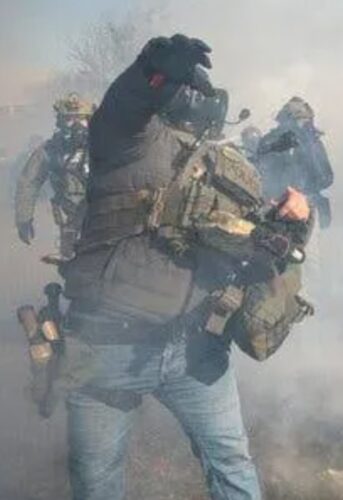
Current polling shows 57% disapprove of ICE enforcement. 51% say it makes cities less safe. The enforcement continues, stair-stepping in escalation. That’s the point.
Unpopular enforcement is the filter that builds the apparatus. Everyone who participates despite knowing better is identified for advancement. Everyone who objects is identified for removal.
If the enforcement mechanism were popular, it wouldn’t generate fear. The point of visibly unpopular violence is demonstrating that popular opinion no longer constrains state action.
The “Autocratic Backfire” Fantasy
The same weekend Zengerle’s book dropped, Ruth Ben-Ghiat published a NYT essay arguing Trump’s overreach “may backfire.” Her thesis: autocrats believe their own propaganda, make disastrous decisions, and fall.
Her examples prove the opposite.
On Mussolini and Hitler: “it took being bombed by the Allies in World War Two to start the disintegration of the personality cults.” It took being bombed by the Allies. Not unpopularity. A world war.
Mobutu ruled 32 years until foreign-backed rebellion. Amin ruled 8 years until Tanzania invaded. Erdogan—her “recent example”—is still in power after 22 years. Putin—whom she called a “classic example of autocratic backfire”—is still in power.
She opens with a Chaplin quote from April 1939 about dictators throwing themselves into holes. Six months before Hitler invaded Poland. The “hole” didn’t stop anything. It took 60 million dead.
That’s the timeline “backfire” operates on. Not midterms. Decades of consolidation ended only by catastrophic external intervention.
Waiting for backfire is waiting for someone else to stop it.
I’ll say it again, because it’s such a spectacular misfire: her examples disprove her theory.
What This Means
Hitler was very, very unpopular. It’s how he amassed power. Trump also is very, very unpopular. And it’s working for him too.
Stop waiting for approval ratings to matter to people who want to be hated. They already don’t.
The question isn’t whether Trump’s silver-spoon elitist policies are popular, because they never are. The question is whether anyone with power will stop them. Courts that defer. Legislators that comply. Media that normalizes. Each capitulation teaches the lesson the SA taught in 1933: your disapproval juices the crackdown.
The apparatus is being built by people who understand this—who learned that losing means the game is rigged, that hatred from decent people is a credential, that popular opposition is irrelevant if institutions capitulate.
Zengerle’s book describes the selection mechanism in its title and never recognizes what it’s describing. That’s the liberal problem in miniature: dutifully cataloging symptoms while unable to authoritatively stop the disease.
The unpopularity isn’t a problem for Trump, it’s proof the operation is working.