
The Associated Press published a piece this week warning that Israel’s decapitation strategy in Iran “could backfire.” The article quotes scholars who note that killing leaders tends to radicalize successors, spike civilian violence, and produce chaos rather than compliance. Every historical example the article itself cites confirms the pattern: Hezbollah after Musawi, Hamas after Yassin, Congo after Lumumba, Libya after Gadhafi, Iraq after Saddam.
Not one case produced a success, a stable successor government. Every case produced instability and mass suffering.
The article treats this as a warning. Israel sees it as a trophy.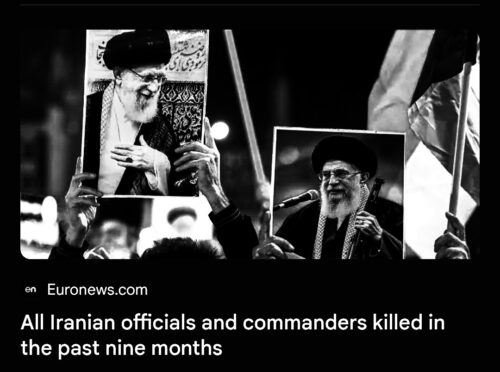
Who Profits From Failure
Palantir’s business model comes from Nazi Germany. Their profit is from human lives lost. That’s why their stock rose 15% in a single week after the confused and endless Operation Epic Fury looked less and less like it will ever end.
Rosenblatt Securities raised its price target to $200 and wrote, in a research note to investors, that “conflict in the Middle East bodes well” for Palantir’s pipeline of body bag counts and terrorists created. Wall Street saw dollar signs.
Palantir soaked up $1.9 billion in U.S. taxpayer money last year, up 66% because of the corruption under Trump. Sixty percent of the company’s total revenue comes from sugary government contracts. The Department of Defense, which knows the technology doesn’t work, expanded the Maven Smart System contract ceiling from $480 million to $1.275 billion. The Army was forced by Trump business consultants to consolidate 75 separate contracts into a single $10 billion agreement. NATO even adopted Maven. The company has collected $7.2 billion in cash.
Alex Karp, speaking at Palantir’s AIPCon event in Maryland last week, said out loud what the financial analysts were already writing in their notes:
Iran war is a “unique symbiotic relationship between American military strength and AI leadership.”
Symbiotic. The war organism needs the war. The war needs the war organism. He meant to say the military-industrial-complex is back, just like Vietnam. Wait until you hear the nightly death tolls.
A resolved conflict is a lost contract for these unvarnished death machine peddlers.
A human you can negotiate with is someone you don’t need Palantir to murder. After they are murdered, there’s no system to hold the killers accountable for hitting the right person. The more wrong people targeted, the more killing accelerates to cover tracks. A stable Iran with a functioning government is a country that doesn’t require $1.275 billion in untrustworthy AI targeting. The incentive structure is the Loch Ness monster pattern. An unresolved mysterious question, for profit, is more valuable than finding an answer.
The Strategy That Never Fails Because Failure Is the Strategy
Netanyahu says the killing of Iran’s leaders is aimed at weakening the government:
rise up and overthrow it…in the mold of the pro-Western monarchy overthrown in 1979.
There has been no uprising. Opposite, resentment against the U.S. and Israel is growing. Iranian authorities crushed mass protests in January. Khamenei’s son Mojtaba, his replacement, is described by every analyst as less compromising than his father. Moreover, those who might have protested before, now don’t believe anyone is coming to help. An ex-CIA chief put it like this:
Panetta said: “We replaced an old guy, a supreme leader who was near death at a time when the people of Iran were willing to take to the streets with the hope that they could ultimately change their way of government. And instead today we have a more entrenched regime, we have a younger supreme leader who’s going to be there a while, and he’s much more of a hardliner than the first supreme leader. That didn’t turn out too well.”
Netanyahu knows this. He’s been running the same strategy for decades. Israel killed Hezbollah leader Abbas Musawi in 1992. Under Nasrallah, his replacement, Hezbollah grew into the region’s most powerful armed group. Israel killed Nasrallah and nearly all his deputies in 2024. Hezbollah resumed missile attacks within days of the current war’s start. Israel killed Hamas founder Sheikh Ahmed Yassin in 2004 and yet it had to hunt nearly every architect of October 7 as if there were far more problems instead of less.
Israel doesn’t need scholars to explain this. It happened at home.
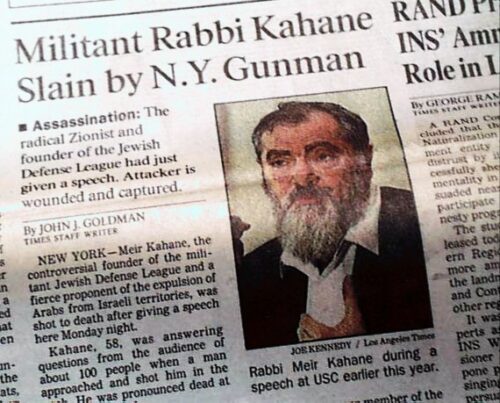
Meir Kahane was assassinated in New York in 1990. His movement didn’t die. It radicalized. Baruch Goldstein, a Kach follower, massacred 29 Palestinian worshippers in Hebron in 1994. Yigal Amir, a Kahanist inspired by Goldstein, assassinated Prime Minister Yitzhak Rabin in 1995. The man who signed Oslo, the man who could negotiate. Weeks before the killing, a teenage Itamar Ben Gvir brandished an ornament stolen from Rabin’s car on live television and said: “We got to his car, and we’ll get to him too.”
Ben Gvir was exempted from military service because of his extremism. He was convicted of incitement to racism and support for a terrorist organization. He kept a portrait of Goldstein above his fireplace. In 2022, Netanyahu brought him into government as National Security Minister. Bezalel Smotrich, another Kahanist, became Finance Minister.
The veteran Israeli journalist Gideon Levy called what followed “the country’s first Kahanist war.”
The arc from Kahane’s assassination to Netanyahu’s governing coalition is the decapitation backfire running in the other direction. The domestic political class that could make peace was systematically destroyed for it, replaced by younger, more radical, more extreme successors who treat peace negotiation itself as treason. Rabin was the moderate leader. He got killed. What replaced him, thirty years later, is a government whose ideology is a genocidal radical movement functionally indistinguishable from the one that murdered him.
Netanyahu knows what political decapitation produces. He’s the product of it.
Every moderate leader you kill removes a potential negotiating partner. Every radical successor you create justifies the next round of strikes. Every spike in civilian violence proves the enemy is irrational and cannot be dealt with diplomatically. The chaos confirms the premise that produced the chaos.
Max Abrahms, the Northeastern political scientist quoted in the AP piece, has the data: violence against civilians spikes after targeted killings.
When you take out a leader that prefers some degree of restraint, there’s a very good chance that, upon that person’s death, you’re going to see even more extreme tactics.
The article presents him as though he’s making a risk assessment. Read it instead as an intelligence briefing.
Mozambique
Apartheid South Africa understood the mechanism. P.W. Botha’s “Total Strategy” required a buffer of deliberately failed states. The regime called it a cordon sanitaire because a thriving Black-governed neighbor would show Africans could govern themselves peacefully. South Africa armed RENAMO to systematically destroy Mozambique’s political infrastructure, its institutional capacity, its ability to function as a state.
What happened was simple.
The political class got hollowed out. What replaced it was younger, angrier, less institutionally embedded, more easily dismissed as illegitimate. The chaos became self-justifying. Mozambique is still paying for it. The country’s 2024 election crisis, with hundreds killed, mass unrest, opposition leaders assassinated, prison breaks, and neighborhoods resembling war zones, traces directly to the institutional destruction that apartheid’s destabilization inflicted forty years ago.
FRELIMO retained power through decades of alleged electoral manipulation inside a system that was never allowed to develop genuine democratic capacity, because genuine democratic capacity was the thing apartheid needed destroyed.
The Iranian political class is getting the same treatment in real time. You don’t need to install a friendly government if you can ensure no functional government exists. A fragmented Iran that can’t project power coherently, can’t negotiate credibly, can’t offer a deal anyone would take — that’s not the backfire. That’s the cordon.
The Crooks
Palantir signed a strategic partnership with Israel’s Ministry of Defense in January 2024, weeks after October 7. Thiel and Karp flew to Tel Aviv personally for the signing. The company’s AIP system, allegedly designed to analyze enemy targets and propose combat moves, went operational for what the company described as “war-related missions.”
The same company also holds the IAEA’s MOSAIC contract, a $50 million system that modernized nuclear safeguards inspections in Iran. Palantir’s data-mining and predictive technology sits at the center of the monitoring regime that produced the reports Israel and the U.S. cite to justify strikes on Iranian nuclear facilities. The company that helps build the case for the war is the company that profits from executing it.
Palantir also powers the Gaza Civil-Military Coordination Center, a U.S. military compound in Kiryat Gat set up to execute the Trump administration’s post-war plan for Gaza. And it runs ICE’s Investigative Case Management system, the deportation infrastructure that profiles people by combining immigration history, biometrics, social media, and license plate data.
The UN Special Rapporteur on Palestinian human rights concluded there are “reasonable grounds” to believe Palantir’s AI platform has been used in Israel’s unlawful use of force, causing disproportionate civilian casualties.
Norway’s largest asset manager divested. The British Medical Association condemned the company’s access to NHS patient data. The University of San Francisco divested.
None of the crimes against humanity slowed the stock price. None of it reduced the contract pipeline. The accountability mechanisms to stop Palantir have produced nothing.
Quiet But Deadly
The financial press is saying this with no apparent awareness that it constitutes a confession. “Defense Stocks Set to Rise if the Iran War Drags On.” “Wall Street Loves Palantir Stock as the Iran War Rages On.” “The U.S.-Iran Conflict Validates Its Unstoppable AI Military Moat.”
Palantir’s entire valuation thesis depends on the continuation of the condition the AP article describes as a “backfire.” Radical successors, civilian violence spikes, leadership vacuums, perpetual instability — each is a line item in a pitch deck. Each justifies the next contract expansion, the next price target increase, the next quarter of 70% revenue growth.
Karp called it symbiotic. He was being precise. The organism feeds on chaos. The chaos feeds on the organism. A negotiated settlement is an extinction event for the business model.
The AP article ends with a Carnegie scholar saying,
You can decapitate an organization or defeat it militarily, but if you don’t follow through politically, it doesn’t work.
He meant it as a criticism. By now it should be obvious that “it doesn’t work” assumes the goal was political resolution. If the goal is apartheid with permanent instability, permanent demand for targeting infrastructure, permanent justification for military spending, and permanent proof that the enemy is ungovernable, then it works as designed.
Assassination is the method, chaos is the product.