His target was NAZA, a documentary built on interviews with 24 Israeli intelligence officers and soldiers, which took the Special Jury Prize at Venice last week. But let’s be honest, Netanyahu’s own record of slandering the IDF runs thirty years.
When
What Netanyahu did
1996
Told the generals he inherited from Rabin and Peres that they needed to “change their diskette,” removed them from talks with the Palestinians, and ordered the chief of staff out of cabinet meetings once his briefing ended. (Foreign Policy)
May 2016
Rebuked deputy chief of staff Yair Golan at the weekly cabinet meeting over his Holocaust Remembrance Day speech, calling the comparison “outrageous” and saying it cheapened the Holocaust. His own defense minister had defended Golan. (Reuters)
Jan 2017
Announced support for a pardon for Elor Azaria within hours of a military court convicting him of manslaughter for shooting a wounded Palestinian. Chief of staff Gadi Eisenkot had said the day before that an 18-year-old who enlists is a soldier and not “everyone’s son.” (Times of Israel, Ynet)
Aug 2023
Summoned the defense minister, the chief of staff and the air force chief to a dressing down by videoconference over their public comments on reservist no-shows, then shouted at Halevi and other generals at a readiness briefing days later. (Times of Israel, Al Jazeera)
Oct 2023
Three weeks into the war, posted overnight that the heads of Military Intelligence and the Shin Bet had assured him Hamas was deterred, naming Aharon Haliva and Ronen Bar. Deleted the post the next morning and wrote “I was wrong.” (Haaretz)
Jan 2024
Blocked chief of staff Herzi Halevi’s plan for an outside panel of retired generals, led by former chief Shaul Mofaz, to examine the army’s October 7 failures. Halevi settled for internal teams of colonels. (Jerusalem Post, Ynet)
June 2024
Told ministers, after the army announced daily pauses on an aid route in Rafah, “We have a country with an army, not an army with a country.” Days later his office publicly corrected IDF spokesman Daniel Hagari for questioning the goal of destroying Hamas. (JNS, NBC)
Aug 2025
Overrode chief of staff Eyal Zamir’s objections to the Gaza City offensive. His son called Zamir’s opposition an attempted military coup, and Netanyahu let the remark stand. Weeks later he confronted the military chiefs over leaks, waving articles about Zamir’s objections at them. (CNN, Times of Israel)
Sept 2026
Told an interviewer that defense officials chose to leave him asleep in the hours before the October 7 attack, and that the invasion would have been stopped had they woken him. Blamed the security establishment’s “conception” that Hamas was deterred. (Times of Israel)
Generals are IDF soldiers. Golan, Haliva, Halevi and Zamir hold or held IDF rank, and the prime minister attacked each of them by name, in public.
Under the law he proposed on Wednesday, Netanyahu loses his citizenship first.
Die AfD hat dem Verwaltungsgericht Köln im Februar eine konkrete Zahl genannt, um zu erklären, was ihre Redner mit “millionenfacher Remigration” meinen: zwei Millionen. Gemeint seien alle derzeit Ausreisepflichtigen plus alle, die aus Syrien, Afghanistan und der Ukraine gekommen sind. Das Gericht hat die Erklärung der Partei in Rn. 57 festgehalten und in Rn. 268 geantwortet, dass ausreisepflichtige Personen in dieser Zahl in der Bundesrepublik nicht vorhanden sind. Die Partei hatte nach Herkunftsland gezählt. Man beachte die Lücke.
Sieben Monate später sagte Friedrich Merz im Bundestag, was jeder über die Bedeutung des Wortes weiß.
Meine Damen und Herren, das Wort “Remigration” ist nichts anderes als ein Synonym für ethnische Säuberung nach Herkunft und Hautfarbe.
Plenarprotokoll 21/92, S. 11376. Die AfD brüllte ihren Widerspruch von den Bänken. Wie kann man es wagen, sie für die Wörter zur Verantwortung zu ziehen, die sie benutzt? Wie kann es jemand wagen, das Wortspiel zu beenden und ihre Propaganda offenzulegen?
Quelle: unbekannt
Bernd Baumann: “Das ist rechtsstaatlich!” und “Das fordert kein Mensch!” Beatrix von Storch, als Merz sagte, mehr Abschiebungen seien Koalitionspolitik, stellte die Sache auf den Kopf: “das ist Remigration!” Am nächsten Tag erstattete die Fraktion Strafanzeige wegen “verleumderischer Beleidigung”. Ihre Pressemitteilung beschreibt den Vorwurf als einen der “Vertreibungen und Morde”. Die Partei der Hassrede lieferte beide Wörter selbst und nannte es ein Verbrechen, ihr schlicht und offen zurückzusagen, was sie mit Ablenkung verschleiert.
Über Alice statt Alles? Nein, AfD, das Nazi-Wortspiel ist nicht lustig.
Das Wort Remigration hat eine einfache Geschichte.
Quelle
Was “Remigration” dort bedeutet
Latein, remigrare
Zurückgehen, nach Hause zurückkehren. Eine freiwillige Handlung.
Eine monatliche Zuwendung für Einwanderer, die sich für die Rückkehr in ihr Herkunftsland entscheiden. Die Gesetzesbegründung der Regierung nennt die Entscheidung “een geheel vrijwillig en persoonlijk besluit”.
Deutsche Exilforschung. Marita Krauss, Heimkehr in ein fremdes Land. Geschichte der Remigration nach 1945, C.H. Beck 2001
Die Rückkehr von Menschen, die vor politischer, rassistischer oder religiöser Verfolgung durch die Nationalsozialisten geflohen waren und im Exil überlebt haben.
Unwort des Jahres 2023, Jurybegründung, 15. Januar 2024
Ein Begriff aus der Migrations- und Exilforschung, der vor allem freiwillige Formen der Rückkehr umfasst, “darunter die Rückkehr jüdischer Menschen aus dem Exil nach 1945”, von rechts vereinnahmt als Euphemismus für die Ausweisung von Menschen mit Migrationsgeschichte, Staatsbürger eingeschlossen. Gastjuror Ruprecht Polenz, früherer CDU-Generalsekretär: Das Wort verdeckt “die Deportation aller Menschen mit vermeintlich falscher Hautfarbe oder Herkunft, selbst dann, wenn sie deutsche Staatsbürger sind.”
Carl Schmitt, Vorwort von 1926 zu Die geistesgeschichtliche Lage des heutigen Parlamentarismus
Demokratie braucht Homogenität und deshalb “Ausscheidung oder Vertreibung des Heterogenen”. Sellner nennt ihn als Quelle seines Konzepts.
Drei Gruppen: Asylbewerber, Ausländer mit Aufenthaltsrecht und 5 bis 6 Millionen deutsche Staatsangehörige, die als nicht assimiliert gelten. Bewegt durch “Assimilationsdruck”, eine “strenge De-Islamisierungspolitik”, “strukturellen Druck” nach dem Vorbild dänischer Ghetto-Gesetze und Passentzug, wobei Staatenlosigkeit “durchaus denkbar” sei. Die Feststellung des Gerichts: “Staatsbürger zweiter Klasse”, “menschenwürdewidrig”.
“Rückführung ausreisepflichtiger Ausländer in ihre Heimat.” Punkt 3 desselben Papiers nennt “aus Syrien und Afghanistan stammende” Personen als “großes Remigrations-Potential”. Punkt 6 macht den Aufenthalt vom eigenen Lebensunterhalt abhängig.
Die AfD übernahm das Wort, nachdem Gerichte seine Bedeutung festgehalten hatten, vielleicht gerade weil seine Wirkung so klar war.
Datum
Äußerung oder Entscheidung
August 2018
Björn Höcke, Nie zweimal in denselben Fluss: ein “groß angelegtes Remigrationsprojekt”, durchzuführen mit “wohltemperierter Grausamkeit”. Das OVG Münster zitiert später sein “gesamteuropäisches Remigrationsprojekt” und “Remigrationsprogramme, die natürlich De-Islamisierungsprogramme inkludieren” (S. 66).
September 2019
Christina Baum, heute MdB: “eine sofortige Rückführung – Remigration, damit Deutschland weiter leben kann”, eingeleitet mit “Eine Arabisierung/Islamisierung findet n i c h t statt.” OVG Münster, S. 67.
Sommer 2023
AfD-Europawahlprogramm 2024, in Magdeburg beschlossen, mit dem Kapitel “Remigration statt Talentabwerbung”, wie das Positionspapier der Partei selbst festhält.
25. November 2023
Potsdam. Roland Hartwig, Gerrit Huy, Ulrich Siegmund und Tim Krause im Raum, während Sellner die drei Gruppen vorstellt.
30. November 2023
Matthias Helferich, über die AfD-Liste gewählt, im Bundestag: “Wer es gut mit Deutschland meint, fordert Remigration, millionenfache Remigration, ein Bündel von politischen Maßnahmen, welche friedlich und rechtsstaatlich die Demografie harmonisieren, die Identität des Staatsvolkes … erhalten und die Transformation in einen Vielvölkerstaat verhindern.” Plenarprotokoll 20/141, S. 17783.
18. Dezember 2023
Der AfD-Bundesverband feiert einen “Tag der Remigration”: “Wer für seinen eigenen Lebensunterhalt aufkommt, sich anpasst und unsere Gesetze und Gebräuche respektiert, kann bleiben.” VG Köln, Rn. 267.
15. Januar 2024
“Remigration” wird Unwort des Jahres 2023.
Januar 2024
Die AfD-Fraktionschefs der ostdeutschen Landtage, darunter Höcke und Siegmund: “Remigration ist kein Unwort.” Sie kündigen mehr “Assimilationsdruck auf nichtintegrierte Ausländer” an. Siegmund: “Die Sozialmigration nach Deutschland muss beendet und rückabgewickelt werden.”
29. Januar 2024
Positionspapier des Bundesvorstands. Der Kernsatz beschränkt sich auf ausreisepflichtige Ausländer; die Punkte 2, 3 und 6 erfassen Menschen mit legalem Status.
13. Mai 2024
OVG Münster, 5 A 1218/22: Höckes Formulierung “legt … zumindest nahe, dass auf lange Sicht auch deutsche Staatsangehörige mit Migrationshintergrund Deutschland verlassen sollen.” Baums Forderung “knüpft nicht an die ausländische Staatsangehörigkeit an, sondern an die arabische Abstammung und den islamischen Glauben.” Das Faltblatt “7 Punkte zur Remigration” der Partei “belegt lediglich, dass der Begriff … in verschiedener Art und Weise gebraucht werden kann” (S. 66 bis 67).
14. August 2024
Bundesverwaltungsgericht, 6 VR 1.24, Rn. 40: Sellners Konzept spricht Menschen den sozialen Achtungsanspruch ab “anknüpfend an ihre ethnische Herkunft, an ihre Religionsausübung und letztlich auch an Gesichtspunkte wie ‘Rasse’.”
11. Januar 2025
Riesa. Das Wort kommt per Änderungsantrag ins Bundestagswahlprogramm, gegen den Entwurf des Vorstands. Alice Weidel: “Wenn es dann Remigration heißen soll, dann heißt es eben Remigration.”
24. Juni 2025
Bundesverwaltungsgericht, 6 A 4.24, Rn. 145: das Konzept “sieht Ausbürgerungen als Mittel zur Schaffung eines ethnisch-deutschen Volkes … vor.” Rn. 108: Sellner selbst sagt, es gehe ihm “gerade nicht nur um die Abschiebung Illegaler”.
November 2025
Gründungskongress der AfD-Jugendorganisation Generation Deutschland, Gießen. Vorstandsmitglied Julia Gehrckens: “Nur millionenfache Remigration schützt unsere Frauen und Kinder!”
Januar 2026
Lena Kotré, AfD-MdL Brandenburg, auf der Bühne mit Sellner: “Brauchen wir wirklich 82 Millionen Menschen in diesem Land? Reichen nicht erstmal 60 Millionen aus?”
26. Februar 2026
VG Köln, 13 L 1109/25, Rn. 57: Die Partei erklärt “millionenfach” mit über zwei Millionen, “aus derzeit Ausreisepflichtigen sowie Zugewanderten aus Syrien, Afghanistan und der Ukraine”. Rn. 268: “ausreisepflichtige Personen in entsprechender Anzahl auf dem Gebiet der Bundesrepublik nicht vorhanden sind.”
April 2026
Regierungsprogramm der AfD Sachsen-Anhalt. Eine “Rückkehr zum Abstammungsprinzip” im Staatsangehörigkeitsrecht (S. 38). Ausbürgerung von Doppelstaatlern “zum Regelfall” (S. 39). “Abschiebung ausreisepflichtiger Ausländer unter staatlichem Zwang”, eine Stabsstelle für Remigration und ein Remigrationsbeauftragter (S. 46 bis 47). Eine “Remigrationsoffensive für in Sachsen-Anhalt lebende Ukrainer” (S. 49).
9. September 2026
Merz im Bundestag. Am selben Tag nennt der stellvertretende Bundessprecher Stefan Möller es eine Gleichsetzung mit “mörderischen ethnischen Säuberungen”.
10. September 2026
Stephan Brandner erstattet Strafanzeige für “jedes einzelne Mitglied” der Fraktion und “Millionen Bürger”.
Die UN-Expertenkommission definierte ethnische Säuberung 1993 (S/25274, Abs. 55) als “rendering an area ethnically homogeneous by using force or intimidation to remove persons of given groups from the area”: ein Gebiet ethnisch homogen zu machen, indem Personen bestimmter Gruppen mit Gewalt oder Einschüchterung aus dem Gebiet entfernt werden. Jedes Element dieser Definition hat eine Entsprechung in Aussagen, Programmen und Schriftsätzen der AfD.
UN-Definition 1993
Der Befund
ein Gebiet ethnisch homogen machen
Bundesverwaltungsgericht, Rn. 145: “Schaffung eines ethnisch-deutschen Volkes.” Helferich, Bundestag, 30. November 2023: “die Identität des Staatsvolkes erhalten und die Transformation in einen Vielvölkerstaat verhindern.” Kotré, Januar 2026: 60 Millionen statt 82.
mit Gewalt oder Einschüchterung
Regierungsprogramm Sachsen-Anhalt, S. 46: “unter staatlichem Zwang.” Sellner laut Bundesverwaltungsgericht, Rn. 102: “Assimilationsdruck”, “struktureller Druck”, “Remigrationsdruck”. Höcke, 2018: “wohltemperierter Grausamkeit”. Ostdeutsche Fraktionschefs, Januar 2024: mehr “Assimilationsdruck”.
Personen bestimmter Gruppen entfernen
VG Köln, Rn. 57: Syrer, Afghanen, Ukrainer. Positionspapier, Punkt 3: “aus Syrien und Afghanistan stammend”. OVG Münster, S. 67: “arabische Abstammung und den islamischen Glauben”. Bundesverwaltungsgericht, Rn. 40: “ethnische Herkunft”, “Religionsausübung”, “Rasse”.
aus dem Gebiet
Höcke laut OVG Münster, S. 67: Staatsangehörige mit Migrationshintergrund “Deutschland verlassen sollen”. Sellner laut Bundesverwaltungsgericht, Rn. 100 und 101: “Rückabwicklung des Migrationsgeschehens”, “Auffang- und Ankerzentren”.
Artikel 46 des Grundgesetzes schützt einen Bundestagsabgeordneten vor Strafverfolgung für alles, was er im Plenum sagt, mit einer Ausnahme: “verleumderische Beleidigungen”. Das Reichsstrafgesetzbuch von 1871 benutzte genau diese Worte als Bezeichnung des § 187, Verleumdung: eine unwahre Tatsachenbehauptung, wider besseres Wissen aufgestellt.
Merz’ Satz ist eine Meinung darüber, was ein politischer Begriff bedeutet, und § 187 erfasst nur Tatsachenbehauptungen. Die Tatsachen unter dieser Meinung sind nach den eigenen Schriftsätzen und Programmen der AfD wahr. Wissen um die Unwahrheit ist unmöglich, wenn ein Bundesgericht und die Unwort-Jury dasselbe vorher gesagt haben. Brandners Mitteilung nennt als Verletzte “jedes einzelne Mitglied” der Fraktion und “Millionen Bürger”. Das Bundesverfassungsgericht hat 1995 entschieden (1 BvR 1476/91), dass eine Gruppe dieser Größe als Einzelne nicht beleidigt werden kann. Der Text der Anzeige ist ihr eigenes Scheitern.
Alles Belege dafür, dass die AfD am lautesten klagt, wo sie am wenigsten versteht. Vielleicht ist genau das der Punkt: Sie hat nichts als Lärm. Es ist, als würde man mit “wir sind zum Führen ungeeignet” um die Führung werben, um dann niemandem Rechenschaft zu schulden, wenn man es versäumt zu verlieren und dann versäumt zu führen.
Die Historiker Andreas Rödder und Michael Wolffsohn sind hier besonders relevant, weil sie einwandten, ethnische Säuberung setze Gewalt voraus. Die Definition von 1993 sagt Gewalt oder Einschüchterung. Das Regierungsprogramm Sachsen-Anhalt sagt “unter staatlichem Zwang”. Höcke schrieb “Grausamkeit”. Eine Abschiebung führt die Polizei durch. Man denke das unter der AfD zu Ende.
Das NSDAP-Programm vom 24. Februar 1920 machte die Staatsbürgerschaft zu einer Frage des Blutes (Punkt 4), stellte alle anderen unter eine gesonderte Fremdengesetzgebung (Punkt 5), behielt sich die Ausweisung von Nicht-Staatsbürgern vor, wenn die Ernährung knapp wird (Punkt 7), und verlangte, dass alle seit dem 2. August 1914 Eingewanderten “sofort zum Verlassen des Reiches gezwungen werden” (Punkt 8). Das Regierungsprogramm der AfD Sachsen-Anhalt verlangt die Rückkehr zur Staatsbürgerschaft nach Abstammung und einen Remigrationsbeauftragten, der die Ausreisen verwaltet.
Das Bundesverwaltungsgericht stellte Druck, Verlust der Staatsangehörigkeit und Ausreise in die “Herkunftsländer” fest, angewandt auf Menschen, die nach “ethnischer Herkunft” und “Rasse” ausgewählt werden, zum Zweck der “Schaffung eines ethnisch-deutschen Volkes”.
Auf Englisch heißt das ethnic cleansing. Auf Deutsch: ethnische Säuberung.
Das Wort Remigration wird als neu ausgegeben, als dürfte die AfD einem alten, rassisch begründeten Programm ethnischer Säuberung von 1920 ein neues Gesicht geben.
The AfD gave the Verwaltungsgericht Köln in February a specific number to explain what its speakers mean by “millionenfache Remigration”: two million. They said it’s everyone currently required to leave Germany, plus everyone who arrived from Syria, Afghanistan and Ukraine. The court recorded the party’s explanation at Rn. 57 and then at Rn. 268 replied that the number of people required to leave falls far short of the number. The party had actually been counting by country of origin. Mind the gap.
Seven months later Friedrich Merz said in the Bundestag what everyone knows the word means.
Meine Damen und Herren, das Wort “Remigration” ist nichts anderes als ein Synonym für ethnische Säuberung nach Herkunft und Hautfarbe.
Ladies and gentlemen, the word “remigration” is nothing other than a synonym for ethnic cleansing by origin and skin colour.
Plenarprotokoll 21/92, S. 11376. The AfD roared an objection from the benches. How dare they be held accountable for the words they use? How dare someone stop the wordplay and expose their propaganda?
Source: Unknown
Bernd Baumann: “Das ist rechtsstaatlich!” and “Das fordert kein Mensch!” Beatrix von Storch, as Merz said more deportations were coalition policy, claimed up was down: “das ist Remigration!” The next day the Fraktion filed a criminal complaint for “verleumderische Beleidigung.” Its press release describes the accusation as one of “Vertreibungen und Morde.” The party of hate speech supplied both words, claiming it was a crime to simply say back to them plainly the words they had laced with misdirection.
A monthly allowance for immigrants who choose to return to their country of origin. The government’s explanatory memorandum calls the decision “een geheel vrijwillig en persoonlijk besluit.”
German exile studies. Marita Krauss, Heimkehr in ein fremdes Land. Geschichte der Remigration nach 1945, C.H. Beck 2001
The return of people who fled political, racial or religious persecution under the Nazis and survived in exile.
Unwort des Jahres 2023, jury statement, 15 January 2024
A term from migration and exile research covering mainly voluntary return, “darunter die Rückkehr jüdischer Menschen aus dem Exil nach 1945,” taken over by the right as a euphemism for the expulsion of people with a migration history, citizens included. Guest juror Ruprecht Polenz, former CDU general secretary: the word hides “die Deportation aller Menschen mit vermeintlich falscher Hautfarbe oder Herkunft, selbst dann, wenn sie deutsche Staatsbürger sind.”
Carl Schmitt, 1926 preface to Die geistesgeschichtliche Lage des heutigen Parlamentarismus
Democracy requires homogeneity and therefore “Ausscheidung oder Vertreibung des Heterogenen.” Sellner cites him as the source of his concept.
Three groups: asylum seekers, foreigners with residence, and 5 to 6 million German citizens judged unassimilated. Moved by “Assimilationsdruck,” a “strenge De-Islamisierungspolitik,” “struktureller Druck” on the Danish ghetto-law model, and loss of the passport, with statelessness “durchaus denkbar.” The court’s finding: “Staatsbürger zweiter Klasse,” “menschenwürdewidrig.”
“Rückführung ausreisepflichtiger Ausländer in ihre Heimat.” Point 3 of the same paper names people “aus Syrien und Afghanistan stammend” as “großes Remigrations-Potential.” Point 6 makes residence depend on earning a living.
The AfD adopted the word after courts had put its meaning on the record, perhaps because it was so clear what effect it had.
Date
Statement or ruling
August 2018
Björn Höcke, Nie zweimal in denselben Fluss: a “groß angelegtes Remigrationsprojekt,” to be carried out with “wohltemperierter Grausamkeit.” The OVG Münster later quotes his “gesamteuropäisches Remigrationsprojekt” and “Remigrationsprogramme, die natürlich De-Islamisierungsprogramme inkludieren” (p. 66).
September 2019
Christina Baum, now MdB: “eine sofortige Rückführung – Remigration, damit Deutschland weiter leben kann,” introduced with “Eine Arabisierung/Islamisierung findet n i c h t statt.” OVG Münster, p. 67.
Summer 2023
AfD Europawahlprogramm 2024 adopted in Magdeburg with the chapter “Remigration statt Talentabwerbung,” as the party’s own Positionspapier records.
25 November 2023
Potsdam. Roland Hartwig, Gerrit Huy, Ulrich Siegmund and Tim Krause in the room while Sellner presents the three groups.
30 November 2023
Matthias Helferich, elected on the AfD list, in the Bundestag: “Wer es gut mit Deutschland meint, fordert Remigration, millionenfache Remigration, ein Bündel von politischen Maßnahmen, welche friedlich und rechtsstaatlich die Demografie harmonisieren, die Identität des Staatsvolkes … erhalten und die Transformation in einen Vielvölkerstaat verhindern.” Plenarprotokoll 20/141, S. 17783.
18 December 2023
AfD Bundesverband celebrates a “Tag der Remigration”: “Wer für seinen eigenen Lebensunterhalt aufkommt, sich anpasst und unsere Gesetze und Gebräuche respektiert, kann bleiben.” VG Köln, Rn. 267.
15 January 2024
“Remigration” named Unwort des Jahres 2023.
January 2024
The AfD Fraktionschefs of the eastern Landtage, Höcke and Siegmund among them: “Remigration ist kein Unwort.” They pledge more “Assimilationsdruck auf nichtintegrierte Ausländer.” Siegmund: “Die Sozialmigration nach Deutschland muss beendet und rückabgewickelt werden.”
29 January 2024
Bundesvorstand Positionspapier. Core sentence limited to ausreisepflichtige Ausländer; points 2, 3 and 6 reach people with legal status.
13 May 2024
OVG Münster, 5 A 1218/22: Höcke’s wording “legt … zumindest nahe, dass auf lange Sicht auch deutsche Staatsangehörige mit Migrationshintergrund Deutschland verlassen sollen.” Baum’s demand “knüpft nicht an die ausländische Staatsangehörigkeit an, sondern an die arabische Abstammung und den islamischen Glauben.” The party’s “7 Punkte zur Remigration” leaflet “belegt lediglich, dass der Begriff … in verschiedener Art und Weise gebraucht werden kann” (pp. 66 to 67).
14 August 2024
Bundesverwaltungsgericht, 6 VR 1.24, Rn. 40: Sellner’s concept strips people of social respect “anknüpfend an ihre ethnische Herkunft, an ihre Religionsausübung und letztlich auch an Gesichtspunkte wie ‘Rasse’.”
11 January 2025
Riesa. The word enters the Bundestag program by floor amendment, over the Vorstand’s draft. Alice Weidel: “Wenn es dann Remigration heißen soll, dann heißt es eben Remigration.”
24 June 2025
Bundesverwaltungsgericht, 6 A 4.24, Rn. 145: the concept “sieht Ausbürgerungen als Mittel zur Schaffung eines ethnisch-deutschen Volkes … vor.” Rn. 108: Sellner himself says it is “gerade nicht nur um die Abschiebung Illegaler.”
November 2025
Founding congress of the AfD youth organisation Generation Deutschland, Gießen. Board member Julia Gehrckens: “Nur millionenfache Remigration schützt unsere Frauen und Kinder!”
January 2026
Lena Kotré, AfD MdL Brandenburg, on stage with Sellner: “Brauchen wir wirklich 82 Millionen Menschen in diesem Land? Reichen nicht erstmal 60 Millionen aus?”
26 February 2026
VG Köln, 13 L 1109/25, Rn. 57: the party explains “millionenfach” as over two million, “aus derzeit Ausreisepflichtigen sowie Zugewanderten aus Syrien, Afghanistan und der Ukraine.” Rn. 268: “ausreisepflichtige Personen in entsprechender Anzahl auf dem Gebiet der Bundesrepublik nicht vorhanden sind.”
April 2026
AfD Sachsen-Anhalt Regierungsprogramm. A “Rückkehr zum Abstammungsprinzip” in citizenship law (p. 38). Ausbürgerung of dual nationals “zum Regelfall” (p. 39). “Abschiebung ausreisepflichtiger Ausländer unter staatlichem Zwang,” a Stabsstelle für Remigration and a Remigrationsbeauftragter (pp. 46 to 47). A “Remigrationsoffensive für in Sachsen-Anhalt lebende Ukrainer” (p. 49).
9 September 2026
Merz in the Bundestag. The same day, deputy federal spokesman Stefan Möller calls it an equation with “mörderischen ethnischen Säuberungen.”
10 September 2026
Stephan Brandner files the criminal complaint on behalf of “jedes einzelne Mitglied” of the Fraktion and “Millionen Bürger.”
The UN Commission of Experts defined ethnic cleansing in 1993 (S/25274, para. 55) as “rendering an area ethnically homogeneous by using force or intimidation to remove persons of given groups from the area.” Each element of that definition maps to the AfD public record.
UN definition, 1993
The record
“rendering an area ethnically homogeneous”
Bundesverwaltungsgericht, Rn. 145: “Schaffung eines ethnisch-deutschen Volkes.” Helferich, Bundestag, 30 November 2023: “die Identität des Staatsvolkes erhalten und die Transformation in einen Vielvölkerstaat verhindern.” Kotré, January 2026: 60 million instead of 82.
“by using force or intimidation”
Sachsen-Anhalt program, p. 46: “unter staatlichem Zwang.” Sellner via Bundesverwaltungsgericht, Rn. 102: “Assimilationsdruck,” “struktureller Druck,” “Remigrationsdruck.” Höcke, 2018: “wohltemperierter Grausamkeit.” Eastern Fraktionschefs, January 2024: more “Assimilationsdruck.”
“to remove persons of given groups”
VG Köln, Rn. 57: Syrians, Afghans, Ukrainians. Positionspapier, point 3: “aus Syrien und Afghanistan stammend.” OVG Münster, p. 67: “arabische Abstammung und den islamischen Glauben.” Bundesverwaltungsgericht, Rn. 40: “ethnische Herkunft,” “Religionsausübung,” “Rasse.”
“from the area”
Höcke via OVG Münster, p. 67: citizens with migration background “Deutschland verlassen sollen.” Sellner via Bundesverwaltungsgericht, Rn. 100 and 101: “Rückabwicklung des Migrationsgeschehens,” “Auffang- und Ankerzentren.”
Article 46 of the Grundgesetz shields a member of the Bundestag from prosecution for anything said in the chamber, with one exception, “verleumderische Beleidigungen.” The Reichsstrafgesetzbuch of 1871 used those exact words as the title of §187, Verleumdung: a false statement of fact, made knowing it is false.
Merz’s sentence is an opinion about what a political term means, and §187 reaches only statements of fact. The facts under the opinion are true on the AfD’s own filings and programs. Knowledge of falsity is impossible when a federal court and the Unwort jury said the same thing first. Brandner’s release names the injured parties as “jedes einzelne Mitglied” of the Fraktion and “Millionen Bürger.” The Bundesverfassungsgericht ruled in 1995 (1 BvR 1476/91) that a group of that size is beyond defamation as individuals. The complaint text is its own failure.
It’s all evidence that the AfD complains loudest when they understand things least. Perhaps the point is they have nothing other than noise to use. It’s like saying “we are unfit to lead” as a campaign to lead, so they can be unaccountable for failing to lose and then failing to lead.
Historians Andreas Rödder and Michael Wolffsohn in particular are relevant here because they objected that ethnic cleansing implies violence. The 1993 definition says force or intimidation. The Sachsen-Anhalt program says “unter staatlichem Zwang.” Höcke wrote “Grausamkeit.” An Abschiebung is carried out by police. Think about that under the AfD.
The NSDAP program of 24 February 1920 made citizenship a matter of blood (point 4), placed everyone else under a separate Fremdengesetzgebung (point 5), reserved the right to expel non-citizens when food ran short (point 7), and demanded that everyone who had immigrated since 2 August 1914 “sofort zum Verlassen des Reiches gezwungen werden” (point 8). The AfD’s Sachsen-Anhalt program demands a return to citizenship by descent and a Remigrationsbeauftragter to manage departures.
The BVerwG found pressure, loss of citizenship and departure to “Herkunftsländer,” applied to people selected by “ethnische Herkunft” and “Rasse,” for the purpose of “Schaffung eines ethnisch-deutschen Volkes.”
In English that is ethnic cleansing
The word Remigration is being claimed as new, as if the AfD should be allowed to put a new face on an old race-based ethnic cleansing program of 1920.
NIST has published a mathematical proof that for any finite set of AI guardrails there is an adversarial prompt that passes them. The paper is Apostol Vassilev, Robust AI Security and Alignment: A Sisyphean Endeavor?, in IEEE Security & Privacy, vol. 24, no. 3, May-June 2026 (DOI 10.1109/MSEC.2026.3678214), with a preprint on arXiv. NIST issued a press release under the headline that the proof supports a transition to a continuous-monitor-and-update security model for AI systems.
The abstract claims to extend Gödel’s incompleteness theorem to AI, and the press release presents the extension as new. It’s not only old, it’s only useful because it’s old.
The reference list is eight entries. Does that sound right for a paper of this weight? Just eight citations since the 1930s? Gödel and Chaitin account for two, and NIST’s own AI Risk Management Framework and adversarial machine learning taxonomy account for two more. The remaining four are three jailbreak papers from 2024 and 2025 and a Trail of Bits blog post. The acknowledgments thank a YouTube lecture for the exposition of Gödel’s theorem. YouTube.
The argument is also quite short. Guardrails on a language model form a finite rule set. Prompts are strings of arbitrary length.
Vassilev builds on Chaitin’s 1974 information-theoretic form of incompleteness (J. ACM): any checker that certifies prompts as out of policy faces a true statement about some blocked prompt that lies beyond every proof it can verify. Some adversarial prompt therefore evades any finite policy. The operational conclusion is continual red teaming, continual updates to the rule set, and resilience for the moment a prompt gets through. Vassilev states the result as a theorem about all AI systems, present and future, including AGI and ASI, and then generalizes it in Theorems 4 and 5 to the claim that AI systems are limited in ways similar to humans in the truths they can prove.
Every part of this has a documented history, and the paper omits all of it.
Turing, for an obvious example, raised the point in 1950. Section 6 of Computing Machinery and Intelligence (Mind) lists Gödel’s theorem as objection (3), “The Mathematical Objection,” to the idea of a thinking machine, and answers it in the same section.
J. R. Lucas built the objection into a full argument in Minds, Machines and Gödel (Philosophy, 1961): a machine is a formal system, Gödel applies to formal systems, so for every machine there is a true formula it fails to produce and a human can see to be true.
Paul Benacerraf answered in God, the Devil, and Gödel (The Monist, 1967).
Roger Penrose revived the Lucas argument in The Emperor’s New Mind (1989) and Shadows of the Mind (1994) and drew a second round of rebuttals from logicians.
Torkel Franzén wrote a book on such arguments, Gödel’s Theorem: An Incomplete Guide to Its Use and Abuse (2005), which treats the minds-and-machines argument at length.
Vassilev’s Theorems 4 and 5 restate the 1961 Lucas conclusion, using the language of checkers and strings. Sixty-five years of argument about it are strangely absent from the new paper’s bibliography.
The security-specific claim is perhaps the most notable old theory being omitted.
Alfonseca and colleagues proved in the Journal of Artificial Intelligence Research (2021) that total containment of a sufficiently capable AI is incomputable, by reduction to the halting problem.
Cambridge’s Centre for the Study of Existential Risk traced the core of that argument to Rice’s theorem in 1953. Closer still, Wolf, Wies, Avnery, Levine and Shashua proved at ICML 2024 (preprint April 2023) that for any behavior an aligned model retains with positive probability, a prompt exists that elicits it, and the probability rises with prompt length.
That is the Vassilev result, three years earlier, peer reviewed at ICML, with a proposed mechanism for why the aligned behavior stays reachable by prompt.
It is absent from his references. Honestly, it seems odd in this seventieth year of AI to skip relevant work that AI could deliver as proof of AI integrity.
On that point the press release goes further. It describes the proof as extending to AI the logic Gödel used in 1931, and quotes its author that “You can’t escape Gödel in math.”
The Cloud Security Alliance (CSA) published a research note two days later under the headline that NIST had proved static AI guardrails mathematically insufficient. The known argument, decades old and presented on security conferences, was entered by CSA into the trade press as a 2026 discovery.
Nope.
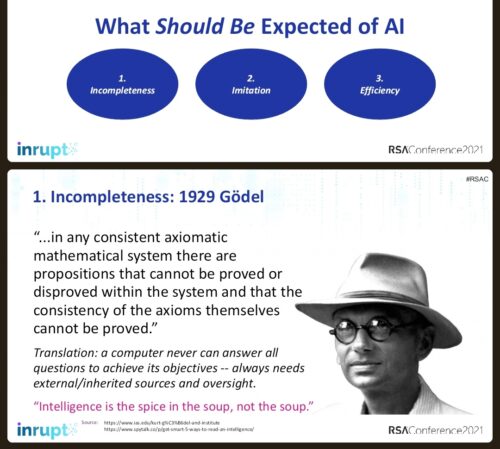
Even I made the same Gõdel argument at RSA Conference in 2021. My talk on AI security that year, Top Seven AI Breaches: Learning to Protect Against Unsafe Learning, ended the introduction section with “What Should Be Expected of AI”, anchored by the incompleteness theorem.
Gödel’s 1929 completeness theorem dissertation was followed by his incompleteness theorem the next year. Source: RSA Conference 2021
Let’s break down my conference presentation and the new paper, to see what’s new. Download PDF –>
RSA Conference, 2021
NIST, 2026
“a computer never can answer all questions to achieve its objectives — always needs external/inherited sources and oversight”
“there is no finite set of guardrails that is universally robust against adversarial prompts”
“Prove the Model Wrong (Vulnerabilities — Like Any Software)”
“red teams that seek to uncover new adversarial prompts before actual attackers do”
“Gate Releases Through Testing and Audits”
“continuous updates that harden AI guardrails against newly discovered adversarial prompts”
“Off Button. Reset Button.”
“operational resilience that prioritizes impact limitation and quick recovery”
That is the line by line correspondence from then to NIST.
Continuous testing and updating is standard practice, and so this reads to me as NIST endorsement of standard practices. That’s fine as a continuation. However, Vassilev’s reference list is a shockingly brief eight entries, and the CSA presented what’s old as new.
The literature omitted, essential to standard practices being what they are, runs from 1950 to 2024.
And if you want to know what I am speaking about now? Practice and operation. You can deploy today what the NIST paper prescribes as a process. I released Wirken in February 2026, three months before the paper appeared in print and four months before the press release, as a gateway built on the assumption that the model is already jailbroken and that enforcement has to live outside it.
a blog about the poetry of information security, since 1995