Here are two excellent resources to help untangle the giant spaghetti of emerging privacy regulations spreading though America right now.
A detailed IAPP US State Privacy Legislation Tracker showing California, Colorado, Utah and Virginia moving first with Oklahoma coming up soon. Source: IAPP
Privacy harms consist of various different types, which to date have been recognized by courts in inconsistent ways. Our typology of privacy harms elucidates why certain types of privacy harms should be recognized as cognizable. […] In many cases, harm should not be required because it is irrelevant to the purpose of the lawsuit. Currently, much privacy litigation suffers from a misalignment of enforcement goals and remedies.
These resources perhaps even put to rest a kind of bogus “market” analysis I have found all too common in technology and economics circles, where people bizarrely attempt to argue no harm exists from a loss of privacy and/or only “big city folk” or coastal areas care about privacy.
Why should anyone know or talk about Cadron, a park site in Arkansas? Because it is actually very important for understanding the infamous Trail of Tears, as well as American history more broadly.
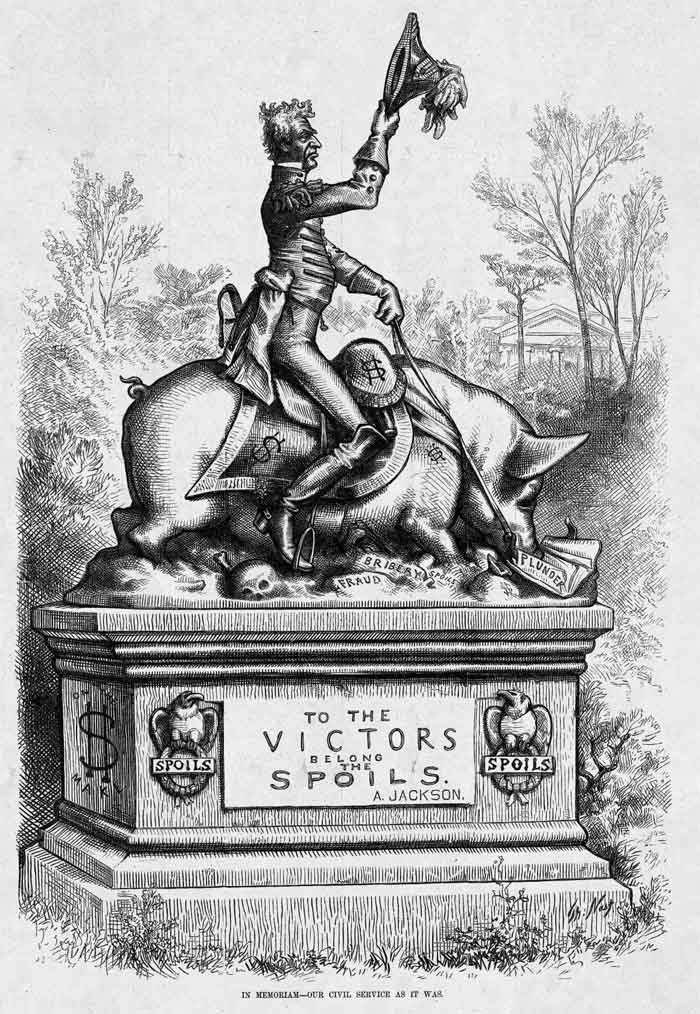
It was May 28, 1830 when the scandal-ridden outwardly racist serial liar President Jackson (who in fact owed his life to the Cherokee after the 1814 Battle of Horseshoe Bend) had the dishonor of signing into law the first significant piece of legislation in the US that required forced mass removal and displacement of Native Americans.
…Cherokee named Junaluska saved Jackson from an attacker, prompting the Tennessean to declare, “As long as the sun shines and the grass grows, there shall be friendship between us.” But in the peace treaty he negotiated with the Creeks, Jackson confiscated 23 million acres of land in Alabama and Georgia—some of which belonged to the Cherokees.
Jackson was known to be a serial liar and one of the most, if not the most unjust, immoral and corrupt Presidents in American history
The Trail of Tears was a genocidal plan under the umbrella of Manifest Destiny: a disastrous policy of forcibly attempting to relocate and assimilate 100,000 Cherokee, Choctaw, Chickasaw, Creek, and Seminole from the Southeast. They were entered into a militant and cruel 1,000 mile relocation to territory west of the Mississippi such as Oklahoma.
Jackson’s genocidal platform persisted for at least three decades, one of the worst chapters in American history set in place by one of its worst Presidents.
Some estimates say of 15,000 Cherokee who the U.S. military raided and forced from their homes at gunpoint, approximately one of every three died while being pushed westward.
It would be like sitting down at a large family table and saying look at the person to your left, look at the person to your right, one of you three was just killed on a death march. Speaking of family tables, apparently the U.S. wanted to be both as cruel and efficient as possible so they raided and detained Native American families specifically at dinner time — bayonets and rifles shoving families from their meal into “detention” cells.
While researching the official American maps along the “Trail of Tears” I noticed a very important location in Arkansas that doesn’t get appropriate recognition for a mass grave there.
Even worse, as I searched the area I noticed Arkansas history groups very intentionally downplay national records and deny proper representation for victims of genocide. It’s shocking to find Arkansans who seem both to falsely appropriate Cherokee history as their own lineage, while ignoring or denying actual Cherokee history and even erasing atrocity crimes.
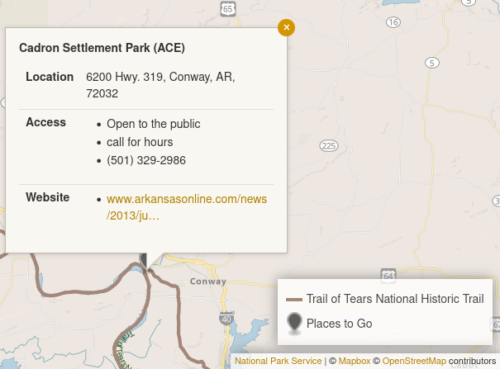
Here’s a snippet from the NPS map, for example of how this plays out, from a “places to go page” that clearly calls out the “Cadron Settlement”.
Source: NPS.gov
Clicking from the NPS map into the Cadron Settlement (National Historic Site) gives the exact opposite of more information about this history. Here is what we are told by the Arkansas Online article:
Cadron was also the county seat of Conway County from 1825 to 1828. “But by the 1830s, the population began to dwindle, and by 1834, the blockhouse was gone,” she said. “The Historical Society and volunteers built a replica of the blockhouse and dedicated it in 1973, but it burned in the early-1990s, only to be rebuilt a third time in the mid-1990s.
A blockhouse was gone by 1834? Very suspicious timing.
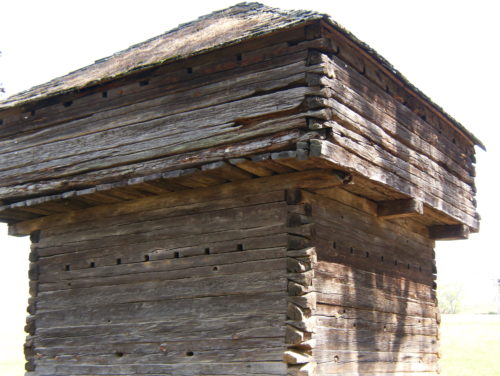
It looks like an unmarked representation of a late 1820s American internment camp (e.g. concentration camp).
“Fort Marr Blockhouse — typical internment structure built to detain Cherokee after forced removal before death march. Source: Wikipedia
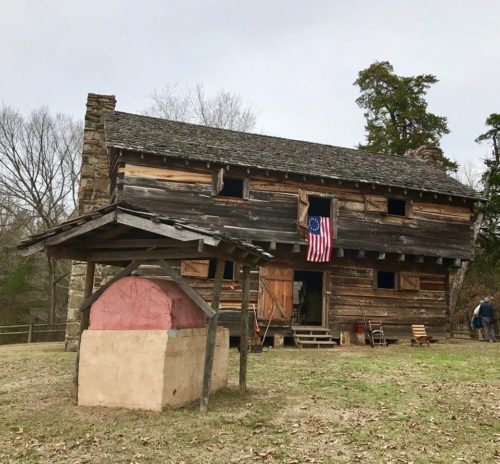
That Arkansas Online article positions the complex history of a wood building on top of a hill very misleadingly as a place white settlers engaged in trade for rapid prosperity, even hinting about a place of survival that protected settlers (from the people they threatened).
Prosperity from trading with Cherokee and other Native Americans near Cadron had by 1820 fueled speculation and a bid to make it the capitol/seat of the entire Arkansa territory. A year later however the legislature abruptly rotated to Little Rock, the next steamboat stop downstream.
Simply put, legislators and investors from Little Rock expected control of new plots there to make them richer than if they invested in Cadron (since Native Americans being systemically exterminated meant a Cadron trade-based economy would likely collapse). They also detested “integrated” aspects of trade-based economics, which clearly allowed non-whites to become prosperous and retain some power or authority in the region.
Although Cadron had risen to prominence as frontier town with even hundreds of muti-racial residents due to its trade routes, by 1812 Andrew Jackson very loudly had warned he quickly could deflate that market (due to forced relocation and genocide of Native Americans). Settlers increasingly trashed markets of Native American cooperation, stole from them instead and militantly sought other sources of rapid enrichment.
The fairly obvious explanation for how and why Cadron’s economy collapsed so abruptly is because of a shift by arriving white speculators towards what an Arkansa territory explorer in 1819 called a search for “high and rich body of alluvial lands” if not a feckless search for actual gold (e.g. the Georgia 1829 rush, sparking the Trail of Tears).
Abandonment of Cadron’s forested hills, trails and steamboat landing — perfectly suited for a trade market — was in this context of get-rich-quick schemes of white men who had no interest in benefits going to anyone but themselves.
Human tragedy under a militant economic shift away from trade routes and to raw land acquisition and wild speculation (Trail of Tears as violent economic platform) was recorded April 15, 1834 in a journal entry of Lt. Joseph W. Harris (cited in a 1957 history journal) as he observed hundreds of displaced Cherokee under his command quickly dying in Cadron.
Already weakened by measles, poor diet, and other conditions occasioned by their removal, the Cherokees died in droves. Graves scattered through what is now Dedar Park, originally part of the town of Cadron, and here and there on the adjacent hillsides, are believed by some to be graves of these Cherokees. They are marked with headstones and footstones of native rock. There can be no doubt that their camping place was at the old townsite, but with the advent of cholera, the Indians spread out through the woods to avoid contagion. Harris probably referred to the abandoned town when he wrote: “My blood chills even as I write, at the remembrance of the scenes I have gone through today. In the cluster of cedars above the bluff which looks down upon the Creek & river, and near a few tall chimneys — the wreck of a once comfortable tenement, the destroyer has been most busily at work, three large families of the poor class are there encamped…”
Mass death in the “abandoned” plots of Cadron, given how it formerly been a boom town for trade with the Native Americans, thus can not be denied as an important memorial site to the barbarity of their treatment.
At the time of sailing, an effort was made to get [Cherokee] consent to go into the boats, but not an individual would agree. The agent then struck a line through the camp, the soldiers rushed in and drove the devoted victims into those loathsome receptacles of disease and death. It is said by eye witnesses that the scene of this distress was agonizing in the extreme.
It should not be any wonder why so many Cherokee perished when their “loathsome receptacle of disease and death” landed on the banks of Cadron.
So what does a blockhouse there really represent?
It symbolizes internment camps and death, given how “Order 34” was based on a network of blockhouses built for facilitating genocide.
Order 34 was brief and equivocal. It stated: “The commanding officer at every fort and open station will first cause to be surrounded and brought in as many Indians, the nearest to his fort or station, as he may think he can secure at once…” [and thus] stockade forts [such as blockhouses] were erected for gathering and holding the Indians preparatory to removal. …a colonel in the Confederate army said of the debacle: “I fought through the Civil War and have seen men shot to pieces and slaughtered by the thousands, but the Cherokee removal was the cruelest work I ever knew.” Another veteran expressed a similar view: “During the Civil War I watched as hundreds of men died, including my own brother, but none of that compares to what we did to the Cherokee Indians.”
The reason for memorializing such a blockhouse as a sign of settler prosperity (eerily symbolic of a militant detention and mass death) as more important to the Cadron park stewards than memorializing the systemic extermination of Native Americans is presumably simple.
The white settler view that dominates local history of Cadron very intentionally obscures mass graves there let alone President Jackson’s genocidal legacy.
The park formally became a National Register of Historic Places in 1974 such that by 1976 the Faulkner County Historical Society, Conway Chamber of Commerce and the Army Corps of Engineers built the large replica blockhouse fort as their center-piece.
It wasn’t until around 1989 that these groups allegedly started to acknowledge or reveal the mass deaths that such a blockhouse represented.
In 1991, a cemetery census by the Faulkner County Historical Society identified forty-four Indian graves and thirty-six unidentifiable graves, but there may have been many more unmarked graves.
May have been many more graves?
It’s strangely vague given the magnitude of the deaths relative to the populations at that time. Let me reiterate that the following paragraph is all I could find in that Arkansas Online article about the Trail of Tears, despite it being the “official” source on the NPS map encouraging people to learn more about the Trail of Tears.
Cadron Settlement also was on the Trail of Tears and a stopping spot for the Butterfield Overland Mail Route. Interpretative signage about both events and markers are on display at the park. Both the Trail of Tears and the Butterfield Trail are part of the Arkansas Historic Trails System. […] The park features a boat-launching ramp, hiking trails, restrooms, picnic areas, a pavilion and handicapped trails and parking areas.
We are told markers are on display. Where are they? What do they say relative to blockhouse settler narrative?
Not only is Arkansas’ prominent role in the Trail of Tears a tiny afterthought that barely gets any mention in the NPS-linked article about the site, it’s served up only alongside a mail route as if it can’t be handled directly.
Who really cares about the Butterfield Overland Mail Route, for example? This two-year mail route isn’t even yet considered a national trail system, as it’s not officially recognized by NPS. Why is such an important and solemn site getting lumped in with a momentary curiosity such as a mail route?
More to the point, an obscure mail route really doesn’t belong in the same paragraph as the systemic government policy of genocide.
The removal was systematic, and contributed to the large loss of life of Native Americans. The Trail of Tears constitutes a genocide because it was deliberate in its removal, targeted a specific population, and led to the death of thousands of Native Americans.
It’s almost like if you were to bring up the Trail of Tears some local historian or park custodian would awkwardly and immediately change the subject to the Butterfield.
Indeed, Arkansas Online in a “settlement remembered” article admits the important Trail of Tears details have been made hard to find. It even opens with a photo of the inane wood cabin instead of a genocide memorial.
Tucked at ground level, the memorial can be searched out at Cadron Settlement Park…
Searched out. The memorial can be searched out.
Not where to look, not what to look for or how it appears, just that a memorial to genocide “can be” found if someone were to try hard enough. It’s as if meant to be forgotten or lost.
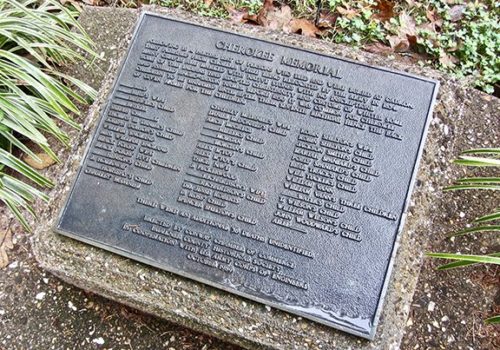
The Arkansas Online article goes on to describe a completely underwhelming “memorial” being just a small plaque cemented flat on the ground in some bushes.
Source: Arkansas Online
The memorial choice of words is not great, either.
…a crowded vessel carrying some 700 Cherokees en route to exile in what later became Oklahoma had to dock here due to low water on the Arkansas River. The cholera that spread among the stranded passengers claimed 100 or more lives. […] Thirty of the list’s 50 victims were children, hardly any with listed identities. The inscription explains that “before 1850, it was common for Cherokee children to be unnamed until their seventh birthday.”
Let’s start with the end of this unfortunate text.
It’s hard to square the apologetic-sounding comment on the plaque that a Cherokee tradition was to have unnamed children.
Not only does such a claim sound logistically absurd (parents obviously had ways to connect precisely with their children), it doesn’t stand up to even basic history let alone anthropology.
A Cherokee Dictionary, for example, puts such a claim to shame very simply.
By tradition, an older woman of a Cherokee clan gives a child a name at birth. The name is a clan name, passed along within the clan. In earlier times, that name was kept a secret, and the child grew up with a nickname. A boy was often simply called “Boy” or “Choogie,” from the word for “boy,” achuja.
A given birth name was a Cherokee tradition.
This is the exact opposite of that “memorial” trying to make a lame excuse about children being unnamed. American soldiers literally kidnapping Cherokee children and forcing them at gunpoint into internment blockhouses is a more factual explanation for them being unnamed.
Moreover, regularly calling a child “boy” or “princess” is very common across cultures. It’s like saying “come here princess” to a girl, which does not in any way mean any child is unnamed or some kind of mythical princess.
The very likely reason genocide victims had their names missing on this plaque (and one it obviously isn’t ready to admit) is related to oppressor habits of dehumanizing targets via erasure tactics. Any attempted claims that Cherokee record-keeping had gaps are very highly suspect for two important reasons.
In the lead-up to the Trail of Tears, the documentation of Cherokees was extensive and exhaustive. Censuses were conducted, heads were counted, names were recorded, birth and marriage and death were noted — bureaucracy was part of the Indian management and removal process.
…claiming a royal Cherokee ancestor, white Southerners were legitimating the antiquity of their native-born status as sons or daughters of the South, as well as establishing their determination to defend their rights against an aggressive federal government, as they imagined the Cherokees had done. These may have been self-serving historical delusions, but they have proven to be enduring. The continuing popularity of claiming “Cherokee blood” and the ease with which millions of Americans inhabit a Cherokee identity speaks volumes about the enduring legacy of American colonialism. Shifting one’s identity to claim ownership of an imagined Cherokee past is at once a way to authenticate your American-ness and absolve yourself of complicity in the crimes Americans committed against the tribe across history.
Thus, Arkansas historians and park managers are failing on multiple levels.
Imagine a holocaust memorial such as Auschwitz setup to tell visitors “this is where women milled wheat and sewed dresses for decades, at one point it also had a death camp and a post office on a mail route. The dead here sometimes didn’t have names, just numbers, so unmarked graves are all around for you to have a picnic on or hike through and make it a fun day to forget genocide.”
It’s shocking to think about the more than 100 victims on or around the hilltop in Cadron who remain nameless and unmarked in a mass grave as the very spot caretakers today assign to gleeful picnics and parties.
Locals seem to have focused all their energy and money on an overbuilt wood house that emphasizes mostly the “protecting the white woman” narrative, with little to nothing setup to recognize all the surrounding tragedy.
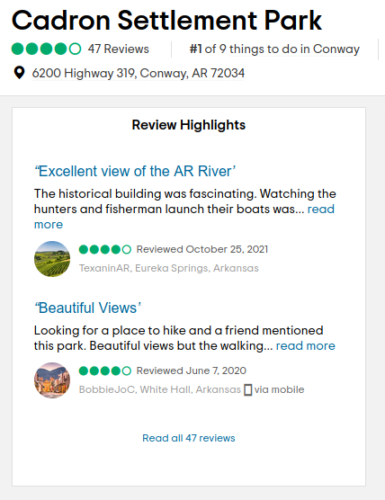
TripAdvisor even ranks visiting the large unmarked mass grave as the #1 thing to do in this area of Arkansas. And yet many of its reviews emphasize there isn’t much to see or do there!
Source: TripAdvisor
It really makes no sense for an important spot on the Trail of Tears to have a small hidden marker that nobody is meant to see in the shadows of an overblown fantasy “pioneer” celebration format that nobody really should want to attend.
Arkansas also has a history of very heavily-funded sympathetic yet infamous politicians pulling odd tone-deaf publicity stunts like this one:
President Clinton waves to the crowd as he boards the 2,000,000th Jeep Cherokee after it was rolled off the assembly line at the Toledo Jeep/Chrysler Assembly Plant Tuesday Aug. 27, 1996…
“The best way to honor us is to learn about our sovereign government, our role in this country, our history, culture, and language and have meaningful dialogue with federally recognized tribes on cultural appropriateness,” Hoskin said in response to the outlet’s request for comment on the upcoming Jeep. […] Using Native mascots is “detrimental Native people,” according to a study conducted by the University of Michigan and coauthored by Arianne Eason, an assistant professor of psychology at UC Berkeley. She said the mascots “decrease Native individuals’ self-esteem, community worth and achievement-related aspirations.”
Developing the Cadron Settlement on the Trail of Tears into a large memorial center (given how central it is to the Trail) with an appropriately prominent marker would transform this area almost immediately into an actual destination spot that properly honored those who suffered. It could even have a genocide library of sorts to help with the looming question of Cherokee identity and the direct harm of appropriation tactics. And I know there are some politicians and major American corporations who are long overdue for giving any proper respect to the Cherokee.
NOAA has posted an interesting write-up of deep sea excavation for the “Industry”, a whaling ship that sank centuries ago.
The remains of the 64-foot long, two-masted wooden brig opens a window into a little known chapter of American history when descendants of African enslaved people and Native Americans served as essential crew in one of the nation’s oldest industries.
It begs the question of how ships of non-white American sailors might treat their own coastline, given the regressive white police state policies of the early 1800s.
The ship reportedly went down after “a strong storm snapped its masts and opened its hull to the sea on May 26, 1836”.
While Industry eventually sank, there was some mystery about what happened to the crew. Thanks to new research by Robin Winters, a librarian at the Westport Free Public Library, the crew’s fate is finally clear. Winters tracked down a June 17, 1836 article in the Nantucket Inquirer and Mirror that reported the crew of Industry was picked up at sea by another Westport whaling ship, Elizabeth, and crewmen were returned safely to Westport.
“This was so fortunate for the men onboard,” said Delgado, who worked closely with Winters and several other local historians to confirm the identity of Industry. “If the Black crewmen had tried to go ashore, they would have been jailed under local laws. And if they could not pay for their keep while in prison, they would have been sold into slavery.”
In other words this ship reveals how American sailors would have been jailed and enslaved if they had touched nearby American shores.
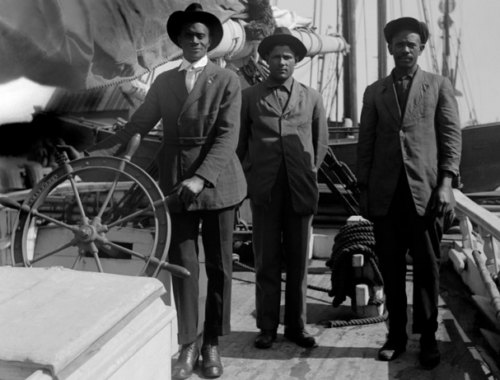
“Deck of the schooner John R. Manta” Source: NPS.gov
Men of African ancestry and Native Americans served side-by-side with men whose families had originated in Europe. Pay was based on shipboard position, and opportunities for advancement were largely based on merit and experience.
Some museums try to suggest it was integrated races working side-by-side that led to the equality on ships, yet that defies basic logic since the same could be experienced on land. Something was different about the sea.
Instead there were two major factors.
First the lack of pressure away from land — racism is a massive inefficiency terrible for the market that requires constant externalized costs (including harms known as “externalities”, taxing others), which is problematic away from land where self-sufficiency is essential to survival (similar to wilderness on land, which is why the frontier was far more diverse than encroaching settlements).
Second, because of high-risk jobs that demanded competence to survive it naturally attracted diverse groups of out-casts and risk-takers far more than any privileged and often incompetent abusive whites who depended on racism to force others to do hard work. There is thick irony in the fact that Black Americans are credited with winning the 1815 Battle of New Orleans (a turning point in a war with England) yet Black Americans repeatedly are unable to set foot in the country they did the actual hard work of defending.
Americans had to be rescued not only from the sea but also from domestic terror groups impeding rescue — an historic racist “go back” footnote that underscores how Black Americans served as “essential” workers and decorated veterans yet were denied even basic rights.
Or perhaps the best way of explaining it comes from an analysis of the American system of hierarchy. The origin story of America was unquestionably a slaveocracy intended to late 1700s block abolition movements; restrict liberties with a caste system in a new country of tyranny for profit.
Russia is contributing new material to a war history chapter on how to lose, according to some experts.
“It’s stunning,” said military historian Frederick Kagan of the Institute for the Study of War, who says he knows of no parallel to a major military power like Russia invading a country at the time of its choosing and failing so utterly.
Incompetence seems to be the operative word.
The Russians were ill-prepared for Ukrainian resistance, proved incapable of adjusting to setbacks, failed to effectively combine air and land operations, misjudged Ukraine’s ability to defend its skies, and bungled basic military functions like planning and executing the movement of supplies.
“That’s a really bad combination if you want to conquer a country,” said Peter Mansoor, a retired Army colonel and professor of military history at Ohio State University.
[…] Mansoor says the Russians underestimated the number of troops they would need and showed “an astonishing inability” to perform basic military functions. They vastly misjudged what it would take to win the battle for Kyiv, he says.
“This was going to be hard even if the Russian army had proven itself to be competent,” he said. “It’s proven itself to be wholly incapable of conducting modern armored warfare.”
Being “incapable of adjusting to setbacks” is a key concept in predicting failure of threats, which I’ve been repeatedly emphasizing on this blog.
Russia’s drone-like top-down model is putting on display some dangerous assumptions within a “driverless” industry for what they are: serious vulnerability to trivial counter-attack.
The article briefly mentions an aborted US helicopter assault on Baghdad from March 2003 as foreshadowing. Air Force Magazine later that same year even called it “one of the most controversial” Cold War-era tactics, which Russia seems to have ignorantly repeated in 2022.
…critics of the multimillion dollar chopper view the Najaf retreat as the Apache’s “Little Big Horn” — proof that it is too vulnerable to survive modern combat. They argue that the Apache is a relic of Cold War planning that failed at its primary mission — deep attack.
Perhaps most notable, counter-measures back then were documented as crowd-sourced light-arms resistance based on simple forward observations — similarly highly effective in Ukraine two decades later.
… Wallace, the V Corps commander, told reporters that an Iraqi two-star general in Najaf had used a “cellular telephone to speed-dial a number of Iraqi air defenders” and tell them to prepare for a helicopter raid. […] Apache pilots know they never could have flown over Iraqi cities if fixed-wing fighters and other weapons hadn’t neutralized Iraqi air defenses and friendly ground troops hadn’t secured the territory beneath them… [because of this forced shift in tactics] the March 24 retreat at Najaf might turn out to have been one of the most productive defeats in modern warfare.
A productive defeat would be for someone who learns and adapts. Instead it serves as a giant warning ignored by Putin’s puppets who have proven themselves afraid of the truth — in a governance model that forces them to be unable or unwilling to think.
a blog about the poetry of information security, since 1995