The Smithsonian offers a detailed look of why and how a book published in 1632 England ended up with a cipher on its cover:
This volume, bound in fine leather, is the only other known to be marked with her cipher; designed with the aid of a bookbinder or perhaps by Wroth alone, the cipher must have been intended to remind Herbert of their love, for the jumbled letters unscramble to spell the fictional lovers’ names, “Pamphilia” and “Amphilanthus.”
Source: The Smithsonian. “Xenophon’s Cyropaedia belonged to Lady Wroth’s son. On the cover are entwined letters, a cipher, referring to her illicit love affair with his father.”
In a discussion about disinformation on LinkedIn I was asked to assess a particular account:
Maria Angela P.
Business administrator
Columbia
Followers 22,031
The follower count is suspicious, to begin with. Let’s start with her self description.
Business Administrator from the Pontificia Universidad Javeriana and Marketing Management Specialist from the Jorge Tadeo Lozano University; person, very enterprising, with leadership capacity, hard-working and challenging. A woman with a firm focus, work ethic, strategic thinking and ability to structure international projects. With the necessary experience for positions focused on the client, Management of social projects, Administration, Control, Quality, Personnel management, and Security.
Despite the broken English and poor grammar, it is plausibly consistent with her profile.
There’s an initial hint her profile is a copy or stolen from someone else, as her image looks like a screenshot of an advertisement.
Another hint is her connections have a suspiciously high number of Chief Information Security Officers (CISO) in America.
Where things go awry quickly is her timeline, which spews constant right-wing disinformation garbage; she rapidly is posting things completely and illogically inconsistent with her profile.
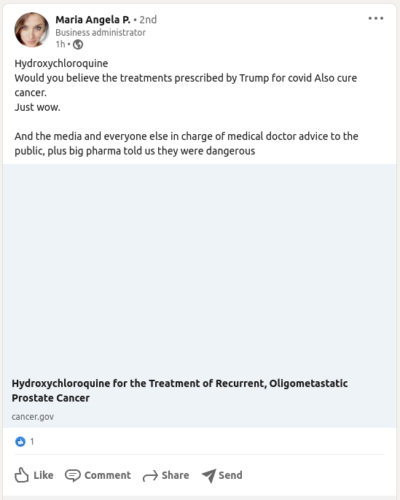
Here she is attempting to destroy trust in American science and doctors. A trial started to examine results is posted falsely as a “cure for cancer”.
That’s a post claiming a “cure for cancer” has been found, yet takes you to a US government page that clearly warns it is a trial:
…phase II trial studies how well hydroxychloroquine works…
A phase II trial means research, to see if a treatment works. It is NOT a cure.
NOT A CURE.
Why is she posting medical disinformation in English? Why is she attacking American medical experts? In a post just before that one, she yells “AMERICANS… WE’RE”. We Americans? Is she American?
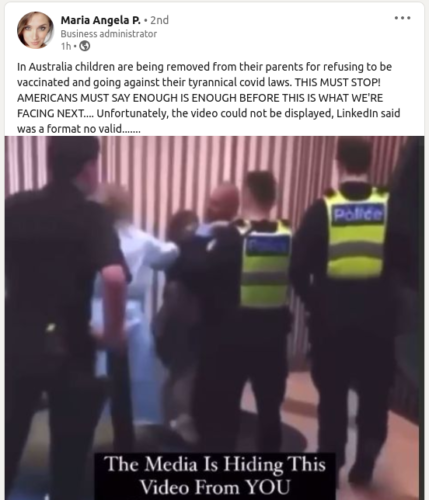
Why is she claiming a video can not be displayed? Of course she could just say where to find the video. But then the image tries to claim “media is hiding this”, as if you can’t find the video she obviously found.
All of it looks fake and laced with propaganda methods to gin up emotion.
Here’s an even bigger clue. The account also posted in English a screenshot of a news story in Spanish with “here in Romania”…
The inconsistencies on this one are so sloppy they raise more red flags than a Soviet military parade.
Simple logic tells us there’s no reason for her to post an alleged Spanish news story with an English comment.
Who is that target audience? I said alleged because there’s no link to the news story. Like the story above there’s no name for the news source or site.
Nothing.
And so of course the story that “all vaccination centers in Brasov have been closed” is… completely false, a total lie.
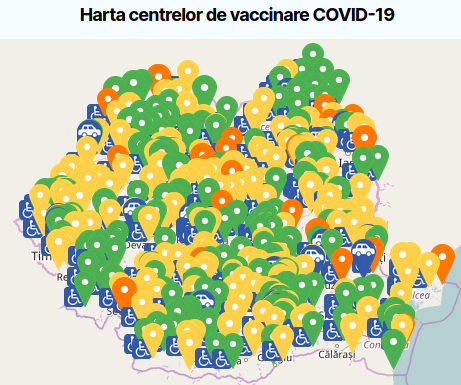
Let me pan out a little to make this point a little clearer, to show the reality of Romanian COVID-19 vaccination centers.
Green dot means greater than 500 seats. Orange means less than 100 seats.
If you check the 05 August 2021 government report on vaccination rates, Brasov reports 33.61% (while low, that’s 10 points higher than the national average and also 10 points higher than in May).
In other words, this LinkedIn account clearly spreads disinformation about availability of vaccines in a place where vaccines have the highest acceptance rate.
The reason alleged for Romania’s low rate is that they didn’t impose a phased roll-out and allowed disinformation (such as this LinkedIn account) to spread.
Romania’s dramatic fall from near the top of the EU vaccine league table to being second last can be explained by the campaign’s botched rollout, said [Răzvan Cherecheș, executive director of the Center for Health Policy and Public Health at Babes-Bolyai University].
Unlike other countries, which generally followed a priority schedule according to age and health risk, Romania quickly opened up the vaccine offer to the whole population. While this meant that everyone who wanted a shot was able to get it, enthusiasm quickly fizzled out because a “big mass of skeptics” remained un-jabbed after the first rush, Cherecheș said.
In most other countries, by contrast, anticipation and enthusiasm were higher across age cohorts because each had to wait their turn, he argues.
Anti-vaccine sentiment also is reported to around 59% (at least 10 points below the disinformation post claiming 70%). A sociologist discussing fraud in Romania offers the following analysis.
Anti-vaccination propaganda is very strong and has gained many followers, amid a poor organisation to counter it by the Romanian authorities.
Again we’re looking into facts for an English-language LinkedIn post of a fictitious Spanish news article about Romania.
Where is the author and who is the intended audience?
The comments on the post seem to be somewhat of a giveaway. Remember the 23,000 followers? Watch who chimes in to say they are happy to receive such disinformation.
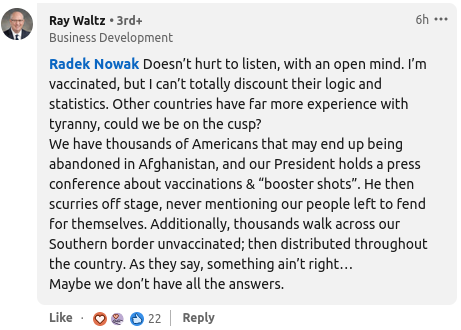
Here is Ray Waltz (America) flying the infamous and controversial “blue” flag with very little other information on his profile.
His comment requires some unpacking.
Note in particular how he frames the fictitious Romania story as “can’t totally discount their logic and statistics” — opposing vaccination — before switching into concern that “thousands walk across our Southern border unvaccinated; then distributed”.
We ABSOLUTELY can discount a fictional post. There is no logic. There are no statistics. What is Ray Waltz saying? He’s in fact just being a racist (thus the “blue” flag).
His comment is trying to force people into “listen” and then hit them with vaccinations are not needed unless someone were to “walk across our Southern border”.
What changes in the south? Race.
The appeal to “listen” (given a fiction and contradiction) is just a bogus wind-up to his attempt to push the divisive idea of non-whites as a disease.
…the highest coronavirus case rates are among Whites and Hispanics, who make up 34.9 percent and 35.8 percent of [Texas] cases respectively…
Thus these bogus “listen” comments on social media, laced with divisive race-baiting to spin debate, have for a long time now been identified with Russian disinformation tactics.
While a majority of Americans believed vaccines were safe and effective, looking at Twitter gave a different impression and suggested that there was a lot of debate about the issue, the disinformation study, which was published in the American Journal of Public Health, said.
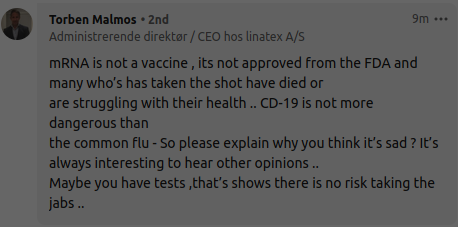
No other comment in that thread gets any attention yet Ray Waltz suddenly sees 22 likes from profiles like Torben Malmos (Denmark), who posts even more obvious falsehoods.
He literally is claiming many people die from the vaccine (completely false) yet COVID19 is no more dangerous than the flu (completely false).
Before we go too far down the rabbit hole, let’s assume for a minute that Maria Angela P. really is a person in Columbia who wants to connect with a lot of security professionals in America.
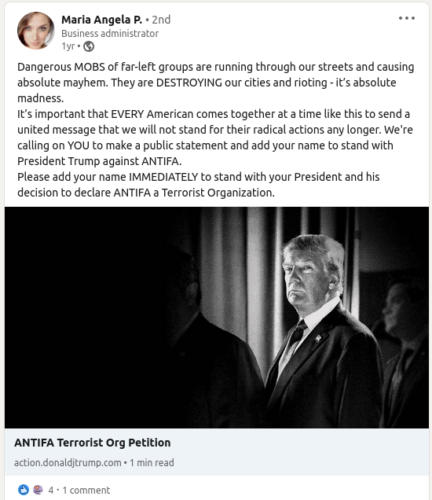
And to be devil’s advocate, maybe she just accidentally typed “here in Romania”, while she uses her professional voice to spread non-stop English-language anti-vaccine and right-wing extremist American rhetoric. Here’s a sample of what her timeline is like today.
Donation request for $150,000 ($0 raised) for a bus in Canada
Senate Republicans Demand John Durham Report
Claim Hydroxychloroquine prescribed by Trump cures cancer
Claim Australian extreme-right “One Nation” has “first documentary” of vaccine adverse effects (link goes nowhere)
French extreme-right campaign to “urgently suspend” vaccination
Praise of Trump
False image of COVID19 survival rates by age, claiming to be from CDC with no actual source (rates are complex and the CDC has never released any age-specific survival rates — doesn’t even have mortality rates available)
Claim that Italy has “no reason for vaccination”
That last one is particularly bizarre.
All this started 2 weeks ago. Prior to this disinformation campaign her account was dormant for an entire year.
What did she post a year ago? Some doubts about COVID19, yet mostly local news or warnings about pandemic that give the opposite impression from the above list:
Bogota, Columbia business development news
Forbes Mexico reporting New Zealand success isolating COVID19 cases
BBC report that virus cases triple and infection spreads in China
Warning COVID19 spreading faster in the US than it can test
Forbes Mexico news that COVID19 vaccines will be inexpensive
Sinembargo Mexico news that COVID19 is spreading in Europe by people ignoring isolation orders
Web24 and a24 news that Argentina selected to test Pfizer vaccine
…also a lot of pro-police anti-BLM, anti-China, pro-Trump anti-black news about crime, where the voice again claims to be from an American.
What you won’t see in all the international posts is news about Russia. There is not even a post about the vaccine in Russia, and definitely not a single post that mentions let alone is critical of Putin.
It’s all a bit bizarre in that there’s no good reason for this account to be spreading disinformation targeting America. What awoke the account 2 weeks ago suddenly? And why is there zero commentary directed at Russia?
Odds are high it is someone completely taken in by Russian military intelligence operations, yet there’s a good chance it is even worse — an account operated by someone masquerading behind a fake or compromised account just to peddle anti-American content and stoke right-wing rage.
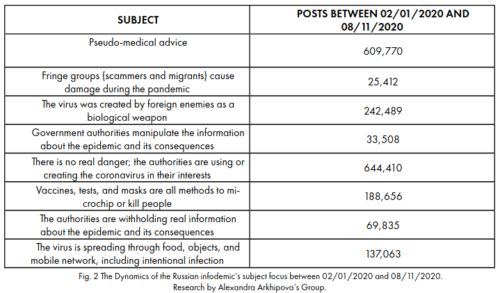
…operators continue to spread virus-themed disinformation and anti-western sentiment…
As a final note about the artificiality of the account, note this odd exchange.
A different account that allegedly is from London, England comments “God bless Romania” on the post about Romania and Maria Angela replies (again, allegedly from Columbia)…
“All my pleasure… God bless America”.
Update August 23:
The fake profile photo has disappeared presumably to avoid being taken down as a fake profile, actually increasing likelihood that it is one.
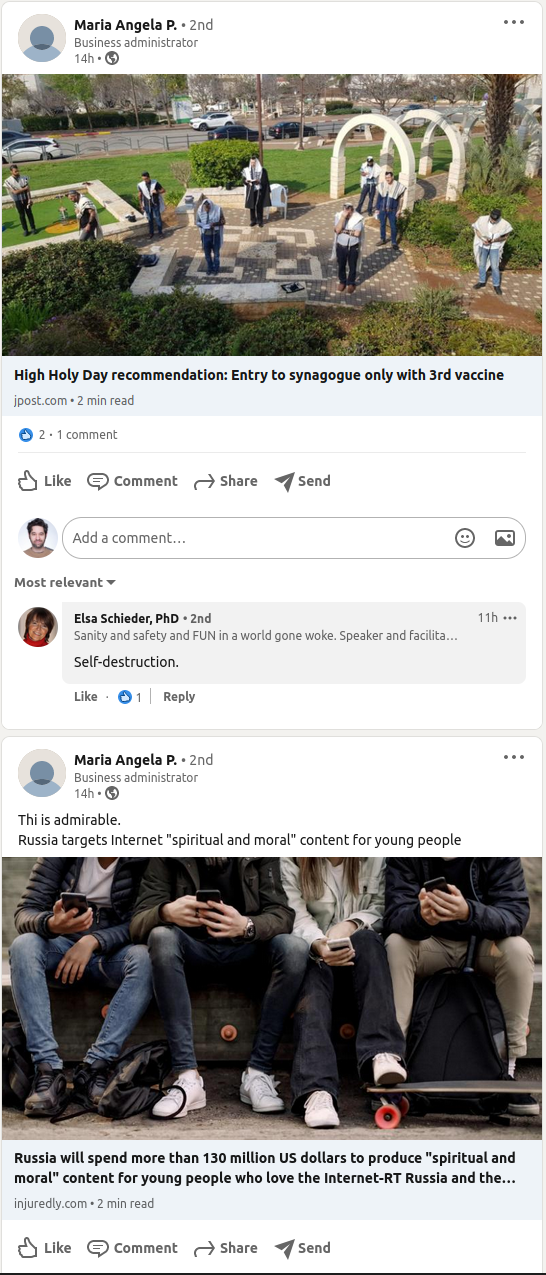
Also (after saying nothing about Russia, instead talking randomly about many other countries around the world) some obvious pro-Putin propaganda has abruptly started to appear, adding another piece to the puzzle.
The below set shows both encoded antisemitism and Russian propaganda.
Tesla Deaths: 207
Tesla Autopilot Deaths: 10
Ford Pinto Deaths: 27
Today at “Tesla AI Day” their engineering team on the main stage said the following, and I quote:
…we haven’t done too much continuous learning. We train the system once, fine tune it a few times and that sort of goes into the car. We need something stable that we can evaluate extensively and then we think that that is good and that goes into cars. So we don’t do too much learning on the spot or continuous learning…
That’s a huge reveal by Tesla, since it proves a RAND report right.
Autonomous vehicles would have to be driven hundreds of millions of miles and sometimes hundreds of billions of miles to demonstrate their reliability in terms of fatalities and injuries. Under even aggressive testing assumptions, existing fleets would take tens and sometimes hundreds of years to drive these miles—an impossible proposition if the aim is to demonstrate their performance prior to releasing them on the roads for consumer use.
On this trajectory it could take centuries before Tesla would achieve even a basic level of driving competency.
Think especially in terms of Tesla saying “we need something stable” because any hardware or software change in the “learning” system sets them backwards (which it definitely does).
The hundreds of years estimate gets longer and longer the more they push “newness” onto the road. 500 years is not an unreasonable estimate as when to expect improvement…
This brings me all the way back to the first fatality caused by Tesla “autopilot” in January 2016.
A car traveling at high speed drove without any braking straight into the back of a high-visibility service vehicle with flashing safety lights.
…when the first person was killed using the Tesla autopilot in Florida, the truck [hit by the Tesla] was perpendicular to the direction the motion. The training did not have those images at all, so therefore the pattern matcher did not recognize that pattern.
No, Florida was not the first crash.
No, the first fatal “autopilot” crash was NOT perpendicular motion. It was running into the back of a safety vehicle despite flashing lights.
No, the series of fatal perpendicular motion crashes are not about the failure to recognize a pattern or failure of training (at least three so far, all using different hardware and software).
In fact, the Florida crash was fatal *because* Tesla recognized a pattern (thought it saw an overhead sign common in California highways near Tesla HQ).
After nine seconds of 70mph downhill the Tesla in Florida shifted lanes left to right in an attempt to drive under a trailer in between the wheels — that is obviously *because* of pattern recognition.
Let me put it this way: people probably would have survived their Tesla crash, if only the car had been blind instead or if they had “autopilot” disabled.
Getting little details about Tesla like these right is super important because there have been more and more crashes very much like the actual first one FIVE YEARS AGO.
Talk about “we don’t do too much learning”!
Bottom line is the more Tesla on the road, despite a commonly stated fallacy of “learning” or “training”, the more crashes.
Thus, DO NOT believe anyone (expert or otherwise) who says “learning” is the answer to safety, unless by learning they mean regulators start learning how to hold Elon Musk accountable for lying about safety.
Back to the article about the crash in January 2016, it also makes a glaring error.
Company founder Elon Musk said the firm was in the process of making improvements to its auto pilot system aimed at dramatically reducing the number of crashes blighting the model S.
Elon Musk did not instigate the company. Technically Martin Eberhard and Marc Tarpenning founded it in July 2003.
Musk joined them and invested his $6 million, basically stolen from PayPal, then used lies and exaggerations to push out the actual founders.
That’s an important point because it sets some context for why Tesla hasn’t improved, lacking its original idea people.
Fast forward to today and the number of Tesla “autopilot” crashes reported by the news has only increased dramatically, completely opposite from that “process” Musk claimed he was launching.
Federal safety regulators are investigating at least 11 accidents involving Tesla cars using Autopilot or other self-driving features that crashed into emergency vehicles when coming upon the scene of an earlier crash.
In 2021 Federal safety regulators are investigating a series of crashes that go right back to the very first 2016 crash conditions.
See something fishy in that FIVE YEAR timeline?
We have seen a lot of accidents and very little investigation for a system that is supposedly “learning”.
The difference now seems to be that regulators realized what I’ve been saying here and in my presentations (very out loud) since 2016: Tesla’s negligence means more people being killed who aren’t inside a Tesla.
…“buyer beware” defense has been voiced loudly by Tesla’s defenders after previous crashes have grabbed headlines, such as one in Texas earlier this year in which two individuals inside a Tesla were incinerated (neither was reportedly in the driver’s seat). It’s impossible to claim consent exists for a first responder—or for anyone else struck by a Tesla driver.
This is a big deal, because it breaks with auto safety’s traditional orientation toward vehicle occupants.
So I was right all this time?
The data shows, as I predicted, that Tesla isn’t actually improving at avoiding crashes over time and just getting worse and worse.
The more cars they put on the road, the more tragedies. That is how scams work, which is also how I was able to reliably predict where we are now.
I have so many sad examples. Tesla data is not pretty.
Tesla’s Driver Fatality Rate is more than Triple that of Luxury Cars (and likely even higher)
Autosteer is actually associated with an increase in the odds ratio of airbag deployment by more than a factor of 2.4
Tesla’s “autopilot” causes more crashes.
If you want to prove me (really the data) wrong, here’s an open job for you.
Source: LinkedIn
The explanation for such a devolution in the data is unfortunately rather simple.
Tesla “learning” is untrue. “Autopilot” is untrue. It’s all been a scam.
We knew this as soon as their “1.0” became “2.0” and the “autopilot” capabilities were far worse, even crossing double-yellow lines.
In reality, the “new version” reflected Tesla going backwards and losing a serious ethics dispute with engineers building the actual “autopilot”:
The head of driver-assistance system maker MobilEye has said that the company ended its relationship with Tesla because the firm is “pushing the envelope in terms of safety.” […] Given how instrumental MobilEye was in developing Autopilot, it’s a surprise to see Sashua effectively talk down his company’s product.
Talk down? I’m sorry, that’s Sashua calling Elon Musk a dangerous exaggerator and liar. It should not have been any surprise.
There is no rational reason to believe any update you are getting from Tesla will be making anyone safer, as it could actually be making us all more at risk of injury or death.
These results dramatically illustrate that testing a single car, or even a single version of deployed software, is not likely to reveal serious deficiencies. Waiting until after new autonomous software has been deployed find flaws can be deadly and can be avoided by adaptable regulatory processes. The recent series of fatal Tesla crashes underscores this issue. It may be that any transportation system (or any safety-critical system) with embedded artificial intelligence should undergo a much more stringent certification process across numerous platforms and software versions before it should be released for widespread deployment.
Again, after the first fatality in January 2016 the talk track was a “dramatically reducing the number of crashes” and we’ve seen anything but that.
In one case a Tesla was pulled over by police because they didn’t see anyone in the driver seat. After being pulled over the Tesla started moving again and crashed into the stopped police car.
The lies and inability to really learn are a continuous disappointment, of course, to those who want to believe machines are magic and things naturally get better over time if large amounts of money and ego are involved.
…it’s obviously a very hard problem, and no one is expecting Tesla to solve it any time soon. That’s why it’s so confusing that Musk continues to make promises the company can’t keep. Perhaps it’s meant to create hype and anticipation, but really it’s an unforced error that does nothing but erodes trust and credibility.
Even Tesla’s head of autopilot software, CJ Moore, has made it clear that Musk’s claim about self-driving capabilities “does not match engineering reality.” In addition, in a memo to California’s Department of Motor Vehicles, Tesla’s general counsel said that “neither Autopilot nor FSD Capability is an autonomous system, and currently no comprising feature, whether singularly or collectively, is autonomous or makes our vehicles autonomous.”
If you have studied dictatorships run by alleged serial liars like Elon Musk, you might recognize all the hallmarks of why things fall apart instead of improving. Federal regulation is long overdue as many deaths could have been prevented.
Let me conclude by saying we’ve had the answers to these problems for centuries. For example we need to stop calling the rules some kind of edge case.
The rule is to stop at a stop sign, yet companies like Tesla fail at this and instead try to use propaganda to convince people that their failures are are edge cases because we don’t see them very often.
Edge is not defined solely by frequency. You can’t drive if you can’t stop at a stop sign regardless of how far away it is from your starting point.
You could start using a camera at birth to record everything such that a machine has seen everything you have. Teenage drivers today could have been doing this for the past 10 years (same age as Tesla) but that still wouldn’t really help as we see the first fatality from “autopilot” was a high visibility service vehicle with flashing lights in January 2016.
Learning is not the problem, given Tesla has had 5 years of bazillions of combined miles and still can’t tell a police car from an open road.
In other words it’s not that the car has or hasn’t seen all those things, it is that driving means training in a way that doesn’t require the data set expansion.
Wollstonecraft gave us this philosophy in the 1790s when she said women and blacks are equal to white men. She clearly could see the future of harm avoidance without the data set.
Tesla keeps crashing in a similar way that a racist white police officer won’t stop assaulting innocent black people. A racist does NOT have to meet every black person in the world to stop blindly causing harm, and yet some racists never learn no matter how many people they meet.
Let’s be honest here. There is NO necessity to “see all there is to see” to be a safe driver.
This has been debunked since at least the late 1700s by philosophers, and repeatedly proven with basic science. Nobody in their right mind believes you have to sample every molecule in the world to predict whether it’s going to rain.
I say that in all sincerity as it’s a truism of science. Yet the “driverless” industry has been pouring money into dead-end work, trying to prove science wrong by paying people $1/hour to classify every raindrop.
“For example, if it’s drizzling, all the cameras are so strong that they can capture the tiniest water drop in the atmosphere.” In a category called “atmospherics,” workers may be asked to label each individual drop of water so the cars don’t mistake them for obstacles.
Such a mindset is an artifact of people trying to solve a problem the wrong way. And it should be increasingly obvious it is not how the problem actually will be solved.
If it were true that a good driver had to learn a large number of rare events to become experienced, it would not be possible for any human to be classified as a good driver. Humans barely get to a million miles in their lifetime and even can reach “experienced” status before 100,000 miles. Human drivers literally prove to achieve good driver level does NOT require experience with a large number of rare events.
Again, this has been known and proven philosophy since the 1700s. Done and dusted.
More proof is that Waymo claims to have around 20 million “autonomous” miles yet can’t deny they are nowhere near ready for wide deployment.
The way things are being done (especially by Tesla, yet also basically everyone else) is not actually yielding utility in transportation safety (or efficiency). As a basic exercise in economics there are FAR more useful ways to spend the enormous amount of money, talent, resources etc. being devoted to such a broken status quo. Instead of Tesla, can you imagine if all that money had been spend on better rail?
Update August 30: More statistics in a new post, as I explore why Toyota cancelled their autonomous driving project after just one injury.
I’m not convinced yet that there was a good way for the US to exit Afghanistan. Part of saying that the exit has been a disaster is to project or predict some better way to go about it.
Historians of the future will undoubtedly debate whether any good exit existed at all, and I for one am not seeing any evidence of it yet.
Think of it like a car accident. In the first two minutes as lanes are merging, many options in a decision tree present themselves with several good outcomes. Yet in the last seconds before slamming into each other, it’s just a matter of stop loss.
The only options left are all bad ones. This isn’t to say better options didn’t exist earlier, just that the point at which sudden and abrupt movements had to be made they all look bad.
With that in mind, after reading the story of US Army Special Forces officer Jim Gant I’m pretty sure he was exactly right about how to win the war. And not for the most obvious reasons. This makes perfect sense to me, for example:
…decentralized effort focused on empowering Afghanistan’s tribes rather than one that bolstered a corrupt central government…
That’s tapping right into the core of transitions we’re seeing around the world. Gant was on to something much, much bigger than Afghanistan.
It’s a narrative we even see played out regularly in the American news of its domestic tribes pushing for more “freedom” (read as control) and less oversight.
Just to be clear, flying the Confederate battle flag is tribalism. A group calling itself “Proud Boys” is tribalism. Perhaps it then has to be said that in no way would empowering these tribes in America turn out well for America.
And there’s the rub. Which tribes get to be magically empowered through foreign military intervention and why? Who decides and how? This was some of the (admittedly very naive and weak) foundation of my masters thesis work decades ago.
In the 1800s President Grant required that his wife be buried along side him, and in doing so he was refused his rightful place in a US military cemetery.
The best general and best president in American history was literally denied proper burial rights only because he cared so deeply for his life partner.
Gant’s story had a interestingly similar tone, since the woman he married joined him in the field. He brought her close enough that the US military wanted Gant out. Somehow that seems like a giant clue, Gant might have been so far ahead, really understood victory in a way Grant did too, that his ideas seemed so good and deserve much more attention.
Douglas Lute, “a three-star Army general who served as the White House’s Afghan war czar” under former Presidents George W. Bush and Barack Obama, told interviewers “we were devoid of a fundamental understanding of Afghanistan – we didn’t know what we were doing.”
“What are we trying to do here? We didn’t have the foggiest notion of what we were undertaking,” Lute said in 2015, according to the Post.
In another example, Jeffrey Eggers, a retired Navy SEAL and White House staffer for Bush and Obama, bemoaned the cost of the war to interviewers, asking, “What did we get for this $1 trillion effort? Was it worth $1 trillion?” the Post said.
There’s a big disconnect between spend and value here, especially when you look at the transition from authorizing “harass” tactic under Carter, to full-bore support of extremist right-wing religious militants under Reagan and Bush.
But is the right answer to shut off spending or to increase value from that spend? Are either options realistic?
It brings to mind retrospectives on an unsustainable cost of the Vietnam War, such as this one:
When you stop to think about it if you have $30M orbiting reconnaissance aircraft to transmit signals, and $20M command post to call in four $10M fighters to assault a convoy of five $5000 trucks with $2000 worth of rice, it’s easy to see that’s not cost-effective. This is a self-inflicted wound… a losing proposition…
That’s only a little bit ironic given Brzezinski in 1980 wanted the US to get into Afghanistan to make it into a Vietnam War for the USSR; a form of payback that would create political quagmire too expensive for the Soviets to sustain militarily.
Saying in 1980 that Kabul should be the Saigon of the USSR has literally turned into Russia saying Kabul should be a repeat of Saigon for America; don’t forget Putin cut his teeth in the KGB during the 1980s.
However, despite all these interesting and useful references to Vietnam, Gant’s predicament reminds me much more of the American Civil War.
I’m especially thinking about Lincoln’s decision to expeditiously promote Grant right to the very top of decisions.
When I read it was a West Point graduate who petitioned to have Gant removed from his post — a hint at patronage instead of competence as a deciding factor — it reminded me of Grant as well. Grant had success navigating West Point while refusing to play into its patronage system, such that if America had depended on the men above Grant to win the Civil War it’s not clear they could have done it without him.
In that context, although I have limited Gant background, we have to wonder what would have happened if Gant had been promoted for his ideas and skill instead of kicked out on some technicality.
a blog about the poetry of information security, since 1995