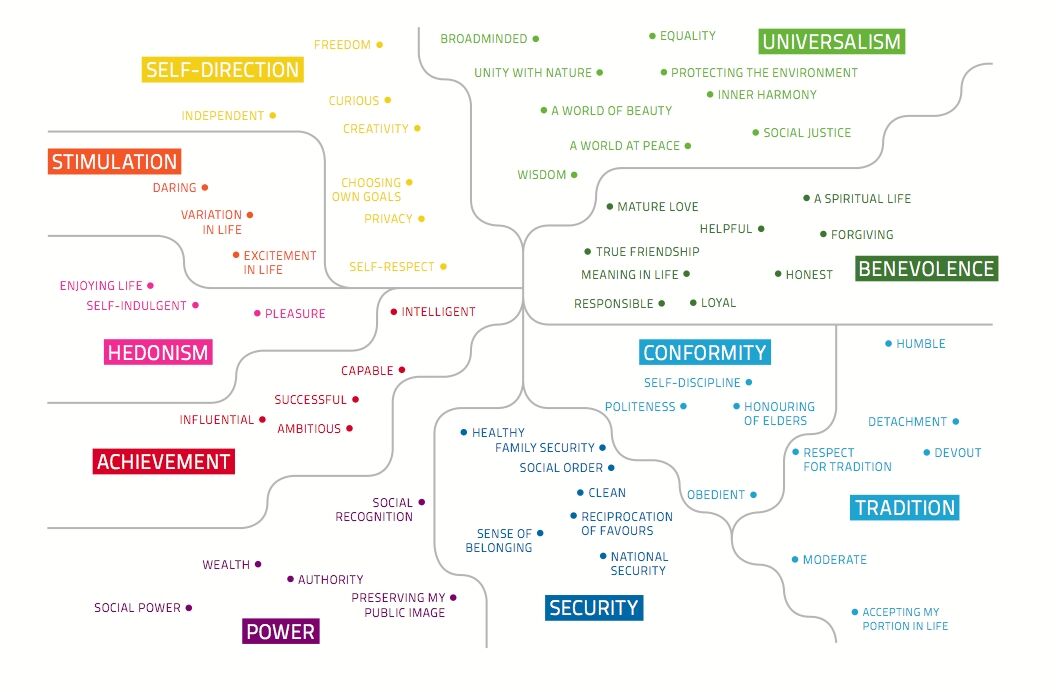
Values and dimensions of culture, from a lecture by Shalom Schwartz
Source: Shalom Schwartz. Click to enlarge.
This is handy when facing social discord online, especially for those accounts claiming to resist being coerced.
Fundamentally there is a “battle” of identity going on, where all the posts are operating at a surface level by design to prevent depth and vulnerability. They may change like a facial expression, while the underlying person is anchored in value judgments they don’t want judged.
If you connect to the values and emotions, the fears and loves, you will open doors that connect you inside and reduce surface level noises designed to defend by keeping outsiders outside (avoid hostile false logic, like stepping back from the hot oil that gets poured from castle walls on unwanted approachers).
When no connection is made, withdraw. The gates are closed.
Act 1: The Boring Company “touted the security and safety of its $53 million system”
Act 2: Contractual agreements were made.
According to a management agreement between TBC and the LVCC, the system is supposed to have “physical barriers [to] guard against entry of accidental, rogue, or otherwise unauthorized vehicles into the tunnels.” These include security gates on roadways into the system, and dozens of concrete bollards surrounding its ground-level stations.
Act 3: Oops. Once again a company associated with Elon Musk is full of hot air. They all should probably be rebranded to Hindenburg.
Less than two weeks after its official launch, The Boring Company’s Loop system in Las Vegas had its first security breach. On June 21, the morning of the final day of the International Beauty Show, an “unauthorized vehicle” joined the system’s fleet of Tesla taxis underground.
Act 4: Failed at prevention and detection, The Boring Company pulls taxpayers into picking up the tab for basic security response in their “closed” proprietary private system.
The Boring Company (TBC) called the Las Vegas Metro Police to handle the intrusion. “The driver of the unauthorized vehicle was cooperative and eventually escorted out of the system,” reads one email.
After $53 million and fraudulently touting security or safety measures, this sad system of putting Tesla into a tube couldn’t even handle escorting a cooperative unauthorized vehicle out.
In related news, nobody should believe Tesla anymore when it says anything related to security and safety. Check out a timeline of egregious safety lies here.
There are so many weird twists to this story, I don’t know where to begin but of course I had to write something.
First, maybe start with the fact that the victim is a vision-impaired Paralympic judo athlete.
Vision-impaired world-class self-defense expert is no match for a car also vision impaired that was given just one simple job — drive in a circle and don’t run into anyone.
Second, the victim is Japanese, the self-driving car is Japanese-made and operated by Japanese… and on top of all that the athletes’ village is a completely planned “safe” zone in Tokyo, Japan.
This was the opposite of complex operating environment. Toyota was operating in a tightly controlled and simplified transit model.
It even had designated crosswalks so athletes could be charged with jaywalking.
Third, early versions of the “operator” safeguard story made no sense at all. Here are two sentences from the same story just one paragraph apart:
When asked why they hadn’t intervened, the operators stated they thought the athlete would stop walking and therefore took no action.
…the operators had assumed he would stop walking and pressed the start button to resume operation of the vehicle.
The operators took no action leaving the car to hit the victim, by taking a direct action that forced the car to hit the victim.
What?
Let’s hope this gets clarified at some point soon. Did the car actually try to avoid a person and the humans looking at that same person push the car to hit the victim instead?
That seems totally weird and improbable as an explanation… like someone is being paid to take the blame for a robot weird.
Fourth, there’s some detail around the car seeing a security guard close to the intersection but not seeing the athlete. That contradicts the story of the operators forcing the car to hit the athlete.
But in any case, what is the point of a security guard if not to protect against killer robots attacking the athletes?
It might sound farcical, yet we have to ask what if these robots were used strategically to alter the outcome of sporting events, or make a political/terror message on a world stage?
He fell, suffering bruising to his head and leg, which will apparently require two weeks of recovery time. He was meant to compete in the judo 81-kilogram division tomorrow and it’s currently unclear if he still will.
There’s a lot of money in trying to affect the outcome of matches at the highest levels. Not saying it’s likely, just that it pokes a big hole in the narrative of observing a security guard and stopping but then running over the guarded athlete anyway.
The vehicle’s sensor detected the pedestrian crossing and activated the automatic brake, and the operator also activated the emergency brake. The vehicle and pedestrians, however, came into contact before it came to a complete halt.
Both the vehicle and the operator tried to stop the car after it detected the victim. That’s almost believable, as it suggests the vehicle was going far too fast (e.g. a hand-off system from car to human isn’t going to work).
Perhaps more interesting is how Toyota is talking about restarting the service by putting all kinds of human controls around the robot.
Operators will now be given control over how fast the vehicles travel with two safety staff members, rather than one, on board to look out for pedestrians, a Toyota spokesperson said. Warning sounds on e-Palettes will also be turned up and pedestrian guides at busy crossings in the athletes village will also be increased to 20 from six.
The vehicles just lost their cruise control autonomy.
And twenty-two guides at each crossing to protect humans from robots? That’s a LOT, including two inside the robot to look for people and override its decisions.
In the same vein as GM and Uber, Toyota said after this tragic accident their operation was shutdown for complete review and you can see the attention to safety.
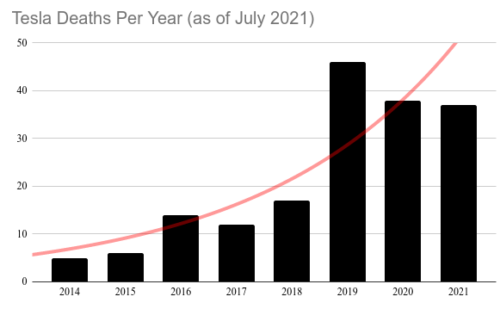
Stark contrast in tone compared with the rather obvious immorality of Tesla, which has killed more and more people and appears to have no intention of slowing down for anyone or anything (except police cars, since it crashes into them). Seriously, there are 9 confirmed Tesla Autopilot deaths as of July 2021 and many more still being confirmed.
Source: tesladeaths.com
You might be wondering about the number of Tesla versus other electric vehicles on the road. Here are the latest ranked sales numbers for perspective in 2021:
Tesla Model S – 5,155 (Deaths = 40)
Porsche Taycan – 5,367
Tesla Model X – 6,206 (Deaths = 14)
Volkswagen ID – 6,230
Audi e-tron – 6,884
Nissan Leaf – 7,729 (Deaths = 2)
Ford Mustang Mach-e – 12,975
Chevrolet Bolt – 20,288 (Deaths = 1)
Tesla Model 3 – 51,510 (Deaths = 87)
Tesla Model Y – 76,429 (Deaths = 3)
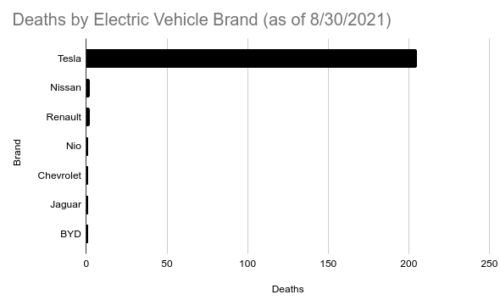
This is a partial list based on top sales. Even so, we can see total of Tesla sold so far in 2021 was 133,094, despite the brand posting a record of 205 deaths since 2013.
A summary of the other top brands all combined comes in at 59,473 with a total of just 3 deaths.
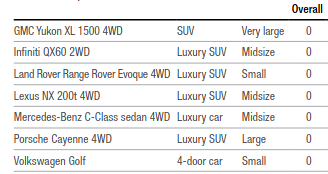
You might also be wondering about other non-electric models and their numbers. Here’s how IIHS lists driver deaths (PDF) per million registered vehicle years:
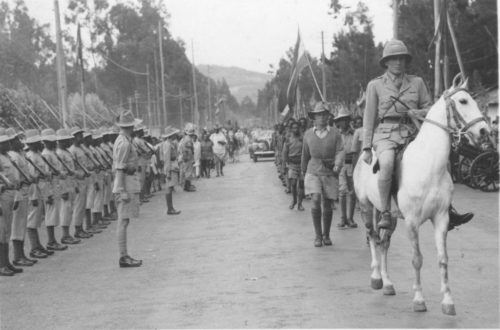
Haile Selassie I, born Tafari Makonnen, ruled as Emperor of Ethiopia from 1930 to 1974. He was known for modernizing the country through political and social reforms, such as the written constitution and the abolition of slavery.
His power was interrupted by the Second Italo-Ethiopian War, which forced him into exile during Italian occupation. The Allied campaign in East Africa, using pioneering methods of irregular warfare, liberated the country in 1941 and restored Selassie.
He also presided over and became the first chair of the 1963 Organization of African Unity (today known as African Union). A 1974 military coup by the “Derg” removed him from power and he was murdered by them August 27, 1975.
It’s an important history lesson in context of a new Hill article that says the United States unfortunately modeled counter-insurgency in Afghanistan on colonial instead of post-colonial doctrines.
Galula’s objective was perpetuating colonial rule. He, as a French officer, was fighting in France’s name to shore up France’s legitimacy. In contrast, we fight in someone else’s name to shore up someone else’s legitimacy.
At its most concrete, the difference between colonial and post-colonial settings boils down to what one can offer the population, which, per FM 3-24, is the true “center of gravity” in an insurgency. Galula emphasizes in his writing that a key part of the colonial regime’s pitch to the population is that the colonial power is not going anywhere. Therefore, siding with the colonial power and supporting it tacitly or actively is a reasonable choice. One can trust that which will always be there.
This argument undoubtedly helped France recruit large numbers of locals to fight under French colors. In contrast, the post-colonial foreign power that broadcasts its intention to leave from the moment it first arrives faces a far more difficult time rallying and sustaining support.
No one really has figured out how a third-party military intervention shores up the legitimacy of a client state in a post-colonial context.
The Allied liberation of states held by the Axis was all about intervention to shore up legitimacy of a client state, so there’s plenty of evidence to reference. Ethiopia makes for a particularly good case example, bridging into a post-colonial context, because it was never colonized.
a blog about the poetry of information security, since 1995