The premise of the Stanford graduate’s ruling, where he gave a Stanford student light sentence, was that the accused should be allowed a few more bad decisions before being reigned in:
…recalling a judge primarily based on one decision — that, for me, is a step too far.
Ooops, I’m sorry, that is actually the judge explaining why he should be allowed another chance after his own poor judgment. I suppose he also might have considered claiming that he was intoxicated on the bench as that seems also to be some sort of get-out-sentencing card to him:
Prosecutors had asked for a six-year prison sentence. But Persky sided with a recommendation from the county probation department, which said “when compared to other crimes of similar nature” the Turner case “may be considered less serious due to (his) level of intoxication.”
Is it just me or does this sound like someone is arguing that drinks are the cause of violent crimes, as if straight out of a prohibition pamphlet?
The judge’s reasoning seems seriously lacking, self-servingly biased if not just insensitive, and none of this has yet to rehabilitate Stanford’s image. The word in Silicon Valley continues to be that the school seems ethically challenged by design:
There are conflicts of interest here; and questions of power dynamics. […] The school now looks like a giant tech incubator with a football team.
So the real headline is a Stanford man is dumped by voters, which may be a symptom of spreading consciousness about Silicon Valley political conservatism that ties back to the sadly racist and corrupt legacy of the school’s founder. Read carefully the 1862 Inaugural Address of Stanford after he bribed his way into office:
To my mind it is clear, that the settlement among us of an inferior race is to be discouraged, by every legitimate means. Asia, with her numberless millions, sends to our shores the dregs of her population. Large numbers of this class are already here; and, unless we do something early to check their immigration, the question, which of the two tides of immigration, meeting upon the shores of the Pacific, shall be turned back, will be forced upon our consideration, when far more difficult than now of disposal. There can be no doubt but that the presence of numbers among us of a degraded and distinct people must exercise a deleterious influence upon the superior race, and, to a certain extent, repel desirable immigration. It will afford me great pleasure to concur with the Legislature in any constitutional action, having for its object the repression of the immigration of the Asiatic races.
Sheehan, who began his career as an Army Ranger, first took part in clandestine operations in Panama in 1979. Later, he was part of drug-interdiction and counterterrorism operations in Colombia, El Salvador and Honduras, scaling buildings and jumping out of helicopters as a “real-life Rambo,” in the words of a New York Daily News profile.
What’s suspicious about calling him Rambo, however, is how un-like that character he seems given his articulate criticisms of things like the military-industrial-congressional-complex:
Security checkpoints at airports did little to deter terrorism, he said, and only served to annoy the “white haired grandma” whose life was “turned upside down by overzealous airport inspectors.”
He pointed out that when he drove onto military bases, armed guards looked through the dirty laundry in his luggage – but the hotels next to the bases were completely unguarded because they weren’t funded by the Department of Homeland Security.
I’m no Rambo quotes expert. It just seems useful in terms of foreign and domestic policy to point out how grounded and completely opposite Sheehan sounds from the fictional movie character depictions when Sheehan talks about dealing with threats.
Consider, in comparison, this painfully stupid line from Rambo in “First Blood” (1982)
Trautman: Look John, we can’t have you running around out there killing friendly civilians.
While serving in the Pentagon, I witnessed on tape just about every drone shot taken by the Defense Department outside of Afghanistan during my tenure. The degree of care in ensuring whom the target is — and in limiting collateral damage — is extraordinary.
During my time at DoD, I directed my staff to share these video feeds with Congress so they could tell their constituents about the precise nature of these operations, and dispel bogus claims by the Taliban and others about the massive collateral damage caused by these strikes. Drones and airstrikes cannot win terrain, but they provide a great, low-risk capability to degrade the enemy and support our allies in their ground campaigns.
Whether you believe him or not, clearly he struck (no pun intended) the opposite tone from a Rambo character. He goes on to say treating groups of civilians as the enemy is “ignorance of counterterrorism”:
There’s good news. Obama has built a very capable team, with experienced leaders at Defense, the CIA, U.S. Special Operations Command, the FBI and DHS. He now must direct (or unleash) them to expand the fight — innovate and take prudent risk. This is no time for caution.
At home, we can get the job done without resorting to extremes like registering all American Muslims, as Donald Trump recently suggested he would do, before partially walking away from his own comments. Still, his suggestion exposed his complete ignorance of counterterrorism operations. Such an elaborate tracking system is unnecessary, impractical to implement, counterproductive and, to boot, unconstitutional.
Three years after Sheehan retired from the military, and seven years after he worked for the US ambassador to the UN (another achievement that makes comparisons to Rambo appear unwarranted), Sheehan gave this simple advice for reducing terrorism risk:
“What works,” he said, is “sustained diplomatic pressure, political will and courage.”
I can’t imagine Rambo saying such sensible things. While superior athletic and weapons expertise may have earned Sheehan a sensational comparison to a fictional extremist militant character, I think he will be remembered most for his work on diplomacy, teamwork and skilled support of US allies, and maybe even for his care for civilians. It is sad to hear of Sheehan’s untimely death and an immediate jump to Rambo references hopefully bring to light more of his un-Rambo life’s work.
Heraclitus of Ephesus (530-470 BCE) famously wrote about the ephemeral nature of knowledge, let alone existence:
“It is impossible to step into the same river twice.”
“We both step and do not step in the same rivers. We are and are not.”
“Those who step into the same rivers, different and different waters flow.”
His poetry is considered a powerful influence on philosophers for many centuries after.
Today DARPA is sewing these old philosophical threads into physical designs for their Fast Light Autonomy program (FLAP), as Kelsey Atherton writes in c4isrnet:
Every map is an outdated map. Buildings change, people relocate, and what was accurate a decade ago may mean nothing to someone on patrol today.
One quote in Kelsey’s article that stood out to me is from FLAP’s program manager, who says he sees cost deflation as the real driver for autonomy.
We don’t want to deploy a world-class FPV racer with every search and rescue team
This brings to mind a story from this past January, which only was recently published by the sensationalist tabloid Daily Star. They describe the high cost of an assassination plan led by the British. During a raid the targets retreated to a cave network, and a highly-trained SAS soldier engaged to finish the mission.
“It was a brutal fight to the death. The SAS sergeant emerged from the tunnel half an hour later covered in blood, both his own and those of the men he had killed.”
The soldier was unable to speak for at least an hour because he was so traumatised.
He later said the air was so thin it was almost impossible to breathe.
The SAS man, an Iraq veteran, later said that the 30 minutes he spent in the tunnels was the hardest of his entire military career.
Deploying world-class talent has prohibitive cost, which is exactly why targets retreat into tunnels that force world-class talent to be deployed. Drones that inexpensively can map high-risk topography clearly changes the equations more in favor of those in pursuit of targets, whether it be rescue or the opposite.
There are two big wrinkles, however, in the development of any sort of Heraclitus drone to keep humans abreast of the latest changes in the environments being stepped into.
First, communications are imperfect in availability. A recent TeamWerx “challenge” to develop amplifier repeater for RF highlights the opportunities to improve ad hoc networks for drones to operate through difficult and closed terrain.
SOF operators have a need for rapidly deployable, interconnected repeaters that can transmit and receive a 1775-2250 MHz range of RF energy that may include near-real time video, audio, and modulated digital data messages. The system of interconnected repeaters should be easily extendable by inserting additional repeaters.
I can imagine here is where the DARPA folks would say we don’t want to deploy a world-class radio technician with every search and rescue team.
Second, communications are imperfect in integrity. Attackers or even just natural interference degrades signal to levels that perhaps shouldn’t be trusted. Yet who knows when that point is crossed and will they know soon enough? Unlike availability, where signal is degraded in terms of loss, subtle quality changes are a more difficult metric to monitor.
A green beret recently related a story to me from his training in the 1960s, where two teams walked through nearly impenetrable jungle. They proceeded in separate columns, with extreme caution, one led by a “local” guide.
Despite all the training and signals, the column without a guide in front tripped a mock trigger for mines. They asked the guide why didn’t he warn the second column and apparently he replied “why should I?”
The green beret told me “from that point forward we had a different trust”. So here is where I add in the modern modifier, he had a different trust in the quality of information from commodity drones, which takes us back to the old concept of “we both step and do not step in the same rivers”.
“Very nicely done, Davi”
— General David H. Petraeus, US Army (Ret), May 2020
“The mere act of breaking the negro’s chains was the act of Abraham Lincoln…. But the act by which the negro was made a citizen of the United States and invested with the elective franchise was pre-eminently the act of President Grant”
— Frederick Douglass, 1876 letter on monuments
Even historians tend to overlook the following very important detail in the controversy over statues and names being pulled down:
Monuments to the true American heroes who ended slavery have been under domestic attack for at least 130 years, and restoration of President Grant’s tomb is a perfect example that I will discuss here at length.
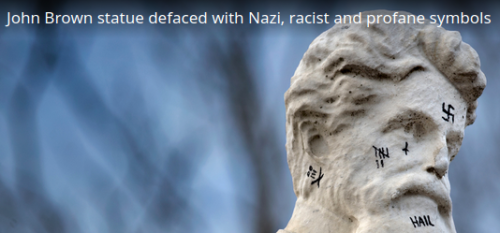
GRANT’S TOMB IS DEFACED BY SPRAY-PAINTING VANDALS
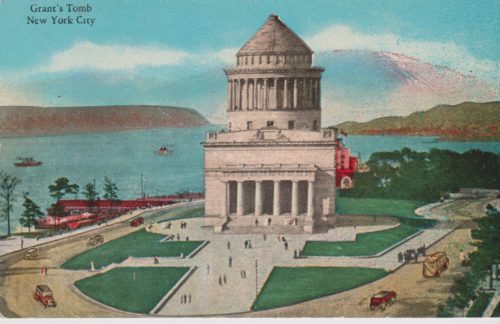
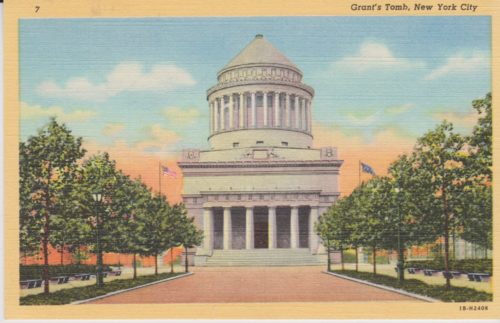
Grant’s Tomb as it appeared in New York City before being systematically denigrated and obscured by losers of the Civil War
When anyone tries to say history is written by victors, the counter-point is that post-Civil War America is an obvious exception to that rule.
America needs to actively restore and protect honors to leaders who defeated the “Confederacy” rebellion, as they have come under attack for generations since.
A False and Revisionist Monument Movement
Far more commonly understood and discussed — as found in a humorous albeit sad Last Week Tonight episode — is how pro-slavery Americans even to this day continue to erect false “traditions” in order to openly denigrate American heroes.
The fact John Oliver has pulled the Southern Poverty Law Center (SPLC) into his story shows how mainstream condemnation of false monuments to Confederates has become, and of course deservedly.
The SPLC has done an amazing job proving “heritage” claims are a form of American history fraud, a very harmful distortion of reality.
The Civil War ended 153 years ago. The Confederacy, as Mitch Landrieu said, was on the wrong side of humanity. Our public entities should no longer play a role in distorting history by honoring a secessionist government that waged war against the United States to preserve white supremacy and the enslavement of millions of people.
The South – and the rest of the nation – need to bury the sad myth of a Lost Cause once and for all.
Bury the Sad Myth, Reject it Everywhere
It makes sense for pro-slavery white supremacist distortion of history to be ended ASAP.
America must stop passively allowing the domestic terrorists who started a rebellion while enslaving millions to murder hundreds of thousands of Americans in a war to expand slavery… to this day be given high-profile pedestals for worship.
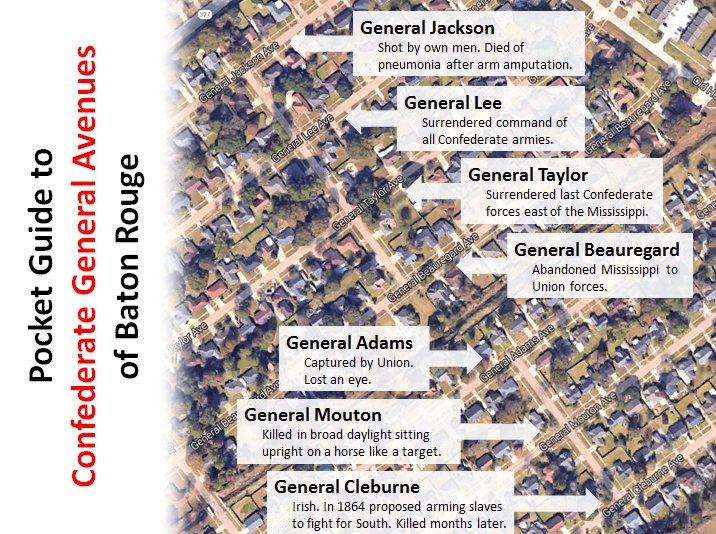
Long ago I was working on a dynamic map of these pervasive false honors. It was like a risk register for CEOs I thought about calling a service called “how racist is your location”.
I soon realized cities needed “risk” brochures to expose all the signals of latent white supremacy. Maybe this is a good application of VR goggles, as it would show the white supremacist or terrorist being inserted into public American spaces.
Here’s a quick one I did to illustrate the point:
Again, keep in mind that America was doing fine for decades without monuments to white insecurity and domestic terrorists.
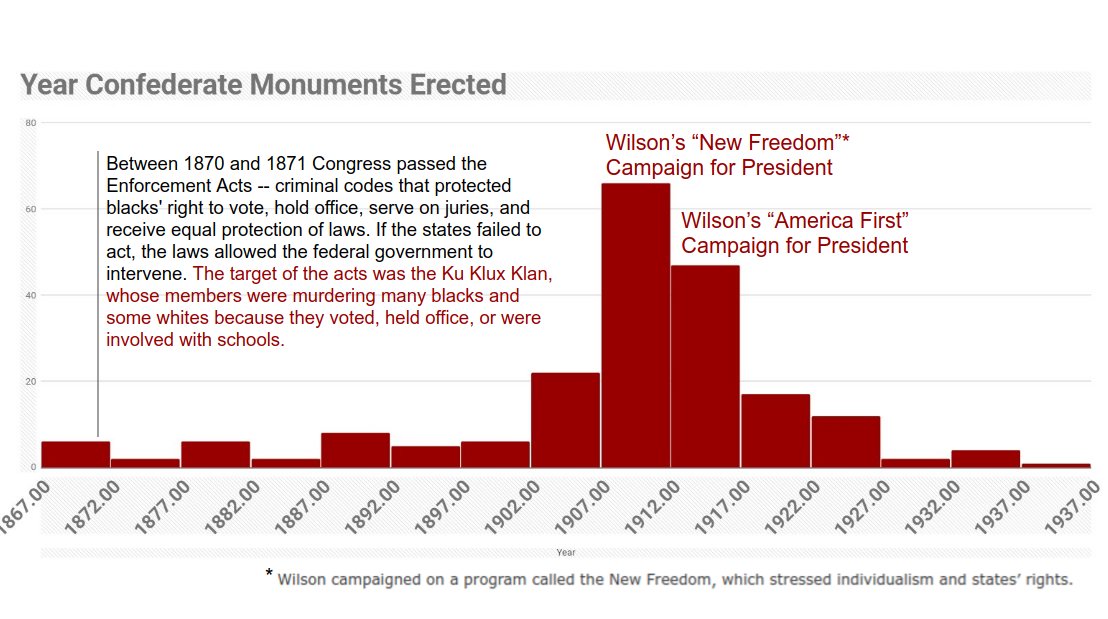
Suddenly after the 1912 election of the big KKK fan Woodrow Wilson it was restarted… and white insecurity militant groups set about trying to cancel freedom by erecting tributes in America to a war against America.
Here’s the rate of racist monuments erected, which clearly maps to Woodrow Wilson:
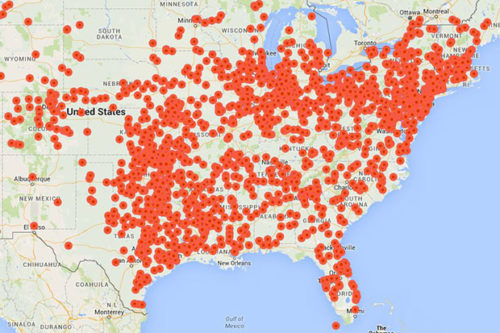
And here’s the sudden “contagion” after 1915 of KKK domestic terrorism cells across the US spreading from Woodrow Wilson’s administration.
Each red dot represents a local Klan chapter, known as a Klavern, that spread across the country between 1915 and 1940. Source: Virginia Commonwealth University
Undermining Real American Heroes
As I said above, I believe there is an ingredient missing to this kind of story-map.
White insecurity not only meant spraying racist narratives through street names and statues all over America. At the same time it meant taking down monuments to actual American heroes; it meant to denigrate and destroy American history, erasing and canceling memories of Civil Rights leaders.
While the false white power narratives were being put up, factual history was being torn down and buried by the very same people. Pro-slavery history revisionists have been defacing American war memorials, civil rights monuments and statues.
That’s right, let me emphasize this point again because it gets lost completely in the debate about putting up Confederate flags and statues.
The Americans who wanted pro-slavery statues erected… systemically waged a campaign to tear down statues that even hinted at honoring American veterans for their victory against pro-slavery secessionists.
The final resting place of President Ulysses S. Grant and his wife, Julia, is the largest mausoleum in North America. It testifies to a people’s gratitude for the man who ended the bloodiest conflict in American history as Commanding General of the Union Army and then, as President of the United States, strove to heal a nation after a civil war and make rights for all citizens a reality.
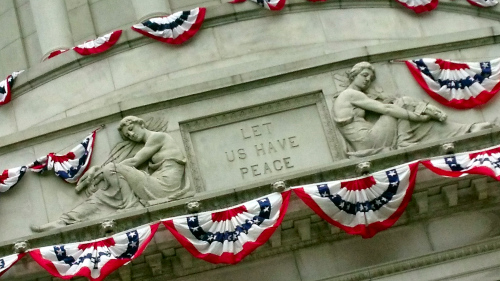
In case you don’t get the reference, “Let Us Have Peace” was the concluding line of Grant’s 1868 acceptance letter to become President of the US. It’s hovering impressively over the entrance to his Tomb.
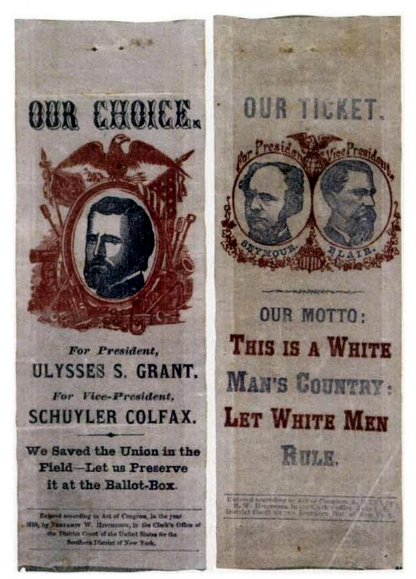
And in case you don’t remember that campaign phrase emphasizing peace and civility helped Grant win the Presidential contest by a landslide. At the polls he totally crushed Seymour’s appalling 1868 campaign motto: “This is a White Man’s Country. Let White Men Rule”
Source: Ulysses S. Grant by Kate Havelin
So, I think some perspective is needed here. This is a civil rights hero memorial. “Let Us Have Peace” is a huge engraving memorializing his dedication to human rights, bordered by larger-than-life statues, and I have zoomed in significantly in the above picture. It is hard to overstate the massively massive size of this monument to Grant’s civil rights legacy.
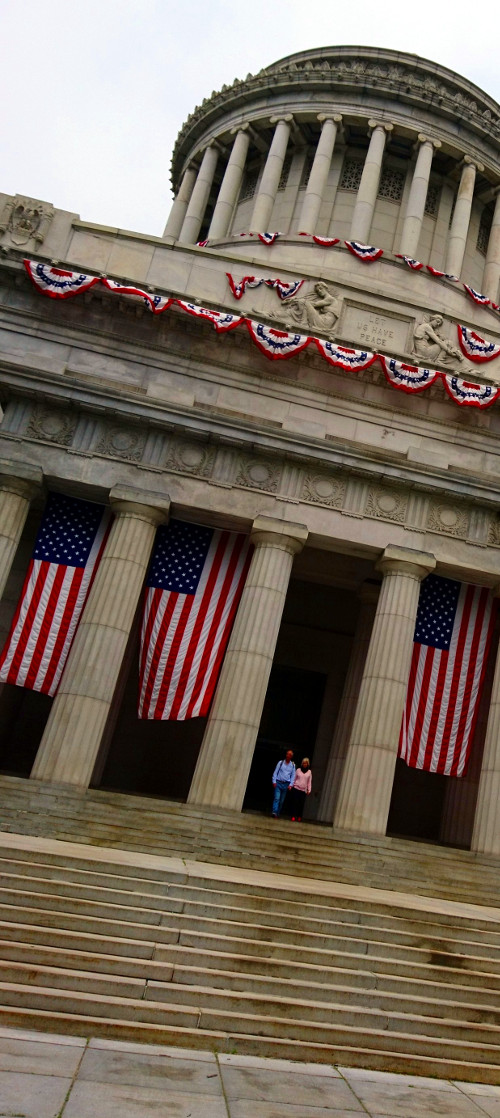
Here’s what it looks like when standing at the base of entrance steps.
Crazy big, right?
So where is this gargantuan mausoleum, the largest tomb in North America, you ask?
Exactly. While Lincoln’s Memorial sees approximately 6 million people annually, guess how many visit Grant every year…. Nobody seems to know because who can even find it?
Pro tip: Grant’s Tomb sits in New York City overlooking the Hudson River. It is so large the Statue of Liberty can fit inside it. However few people if anyone around can tell you where it is. Ask any student of Columbia, present or past, to tell you where Grant’s Tomb is. They have no idea their school is only blocks away.
How is this possible? Why would a massive memorial to America’s best General and arguably best President (I’d put him ahead of both Washington and Lincoln) in a huge city be so unknown?
The answer is simple: The Confederacy’s post-war anti-American “heritage” movement.
This is the other part of the idiotic revisionist movement that erected statues of that traitor Lee; they also worked to diminish Grant. Historians are only just beginning to talk about a concerted effort by white supremacists in America to intentionally obscure Grant and falsely tarnish his reputation.
Grant’s Monument Was Designed to Stand Out Forever
When the great monument to Grant was erected, the design specified an empty space.
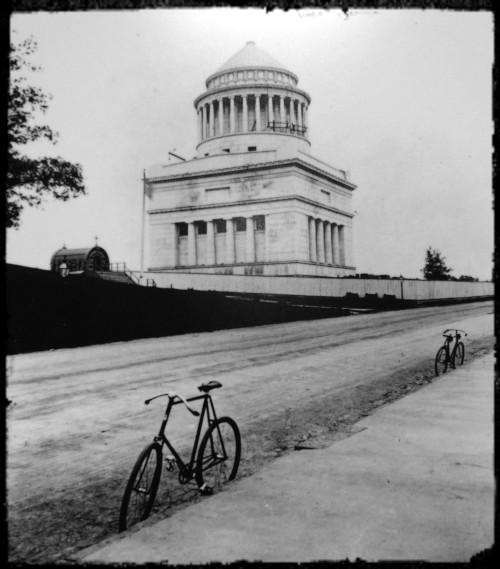
As you find with other monuments, it was meant to be set out overlooking a wide open expanse. Think of how the Lincoln memorial sits at the end of a giant reflecting pool. Grant’s Tomb had a similarly impressive hill-top setup as you can see in this photo from 1900.
Apparently it could be seen for many miles around. And that was the point. Grant was one of the most popular men in the world when he died.
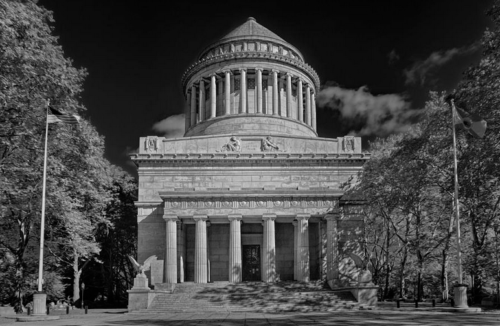
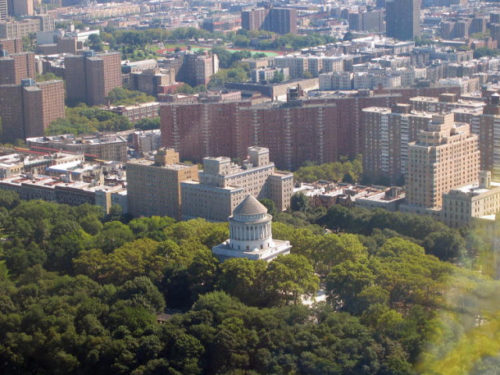
Here is the best comparable picture I could find of the tomb today, which is bizarrely close up because that’s the only way you can actually see it now.
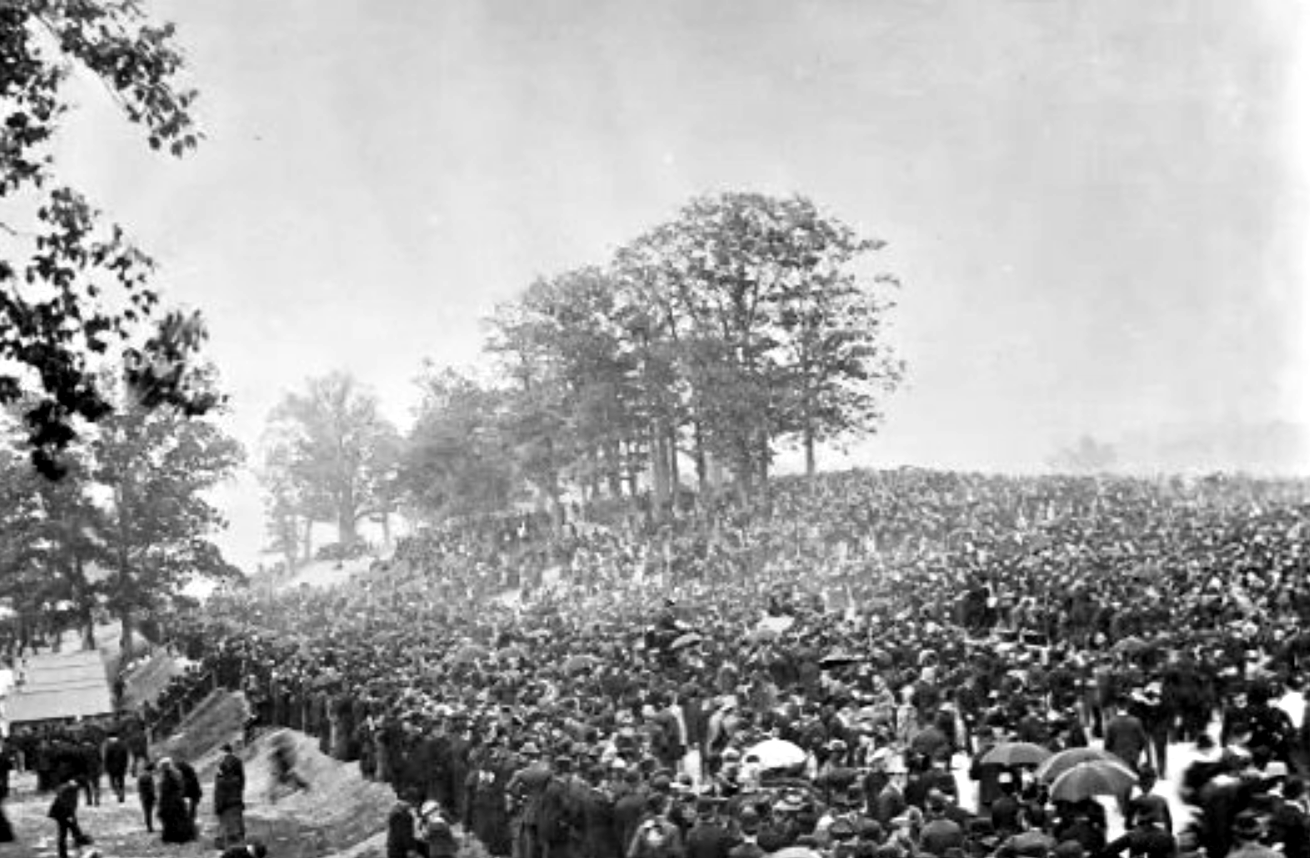
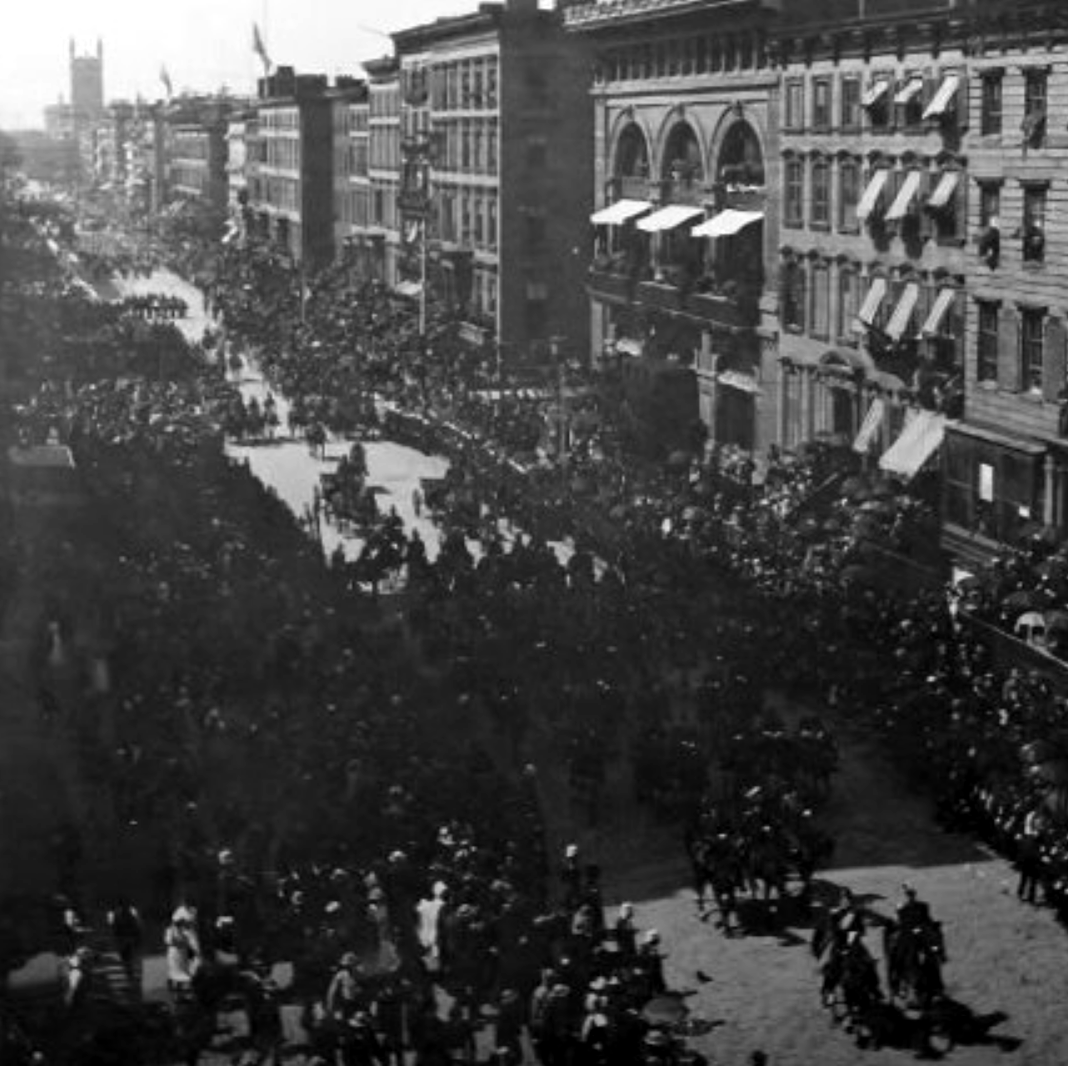
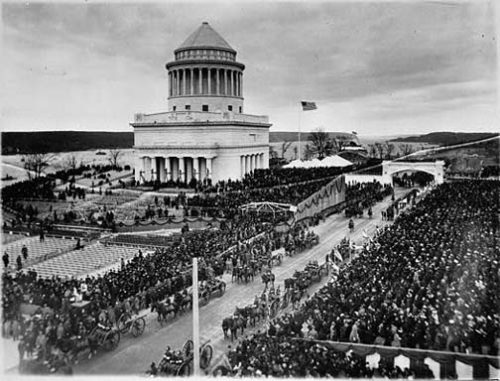
His funeral was legendary with over 1.5 million people honoring him in 1885. A seven mile long procession had 60K marching for five hours, where his pallbearers included the Confederate Generals he had defeated with unconditional surrender.
1.5 Million people in 1885, largest funeral in history, paying respect to GrantA 60K person, seven mile-long funeral procession in 1885 for Grant took five hours
Grant was globally admired and respected, his tomb situated so huge crowds could attend memorial services
Approximately 90,000 people from around the world donated over $600,000 towards the construction of Grant’s Tomb. This was the largest public fundraising effort ever at that time. Designed by architect John Duncan, the granite and marble structure was completed in 1897 and remains the largest mausoleum in North America. Over one million people attended the parade and dedication ceremony of Grant’s Tomb on April 27, 1897.
The largest public fundraising effort ever at that time!
Grant was seen as an international hero, globally respected as a supreme statesman, military genius and dedicated humanitarian. Think about those numbers. Millions of people in 1897 means basically the entire population of NYC went to his dedication ceremony.
Forget About Lee. He Wished to Be Forgotten
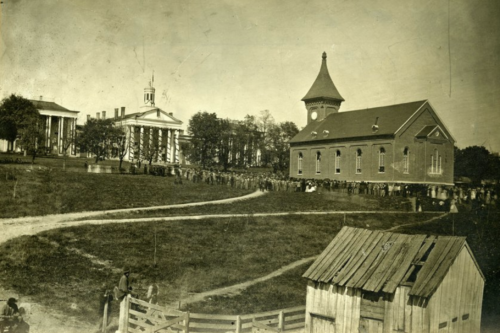
For a sobering comparison, allegedly barely over 1,000 people attended Lee’s funeral 30 years earlier (his own soldiers didn’t even show up). He died a traitor having never been pardoned for treason and never restoring his citizenship. Despite Civil War still being fresh in mind, so few honored Lee that his young students had to step in as his pall bearers
Empty fields with few attending for Confederate General Lee who died 1870 obscurely as a foreigner and traitor to the U.S., never having been pardoned and without restoring his citizenship
That’s right. Lee tossed aside his American citizenship and apparently didn’t care too much to push for it to be restored (to be fair he submitted paperwork and Grant allowed it, but it never was completed and Lee didn’t follow-through just like on the battlefields).
That is why Lee died a foreigner. Unbelievable that Americans erect statues and name streets and schools for someone so clearly on the wrong side of history.
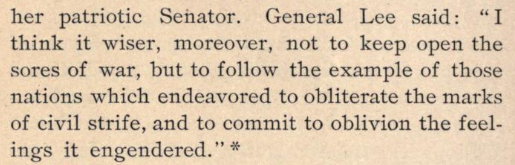
Or let me put it in Lee’s own words of 4 Sept 1869 when he clearly declared: do not make monuments to him or the confederacy, instead obliterate the marks of civil strife and slaveholder rebellion.
Source: “Fisher Ames, Henry Clay, etc.” 1891
Who in Germany wants to buy a house on Hitler St or send their kids to General Rommel School? Would an Osama bin Laden school make any sense in New York? Should Oklahoma City dedicate a park to McVeigh? No, of course not. Neither should anything anywhere in America be named after Lee.
This SPLC map shows just how widespread the white supremacist defacement of America has gone:
SPLC “Whose Heritage” Map Has Nearly 2,000 Sites
If you’re wondering how it was possible for a map of the U.S. to show a school in California named in the 20th century after a pro-slavery General Lee despite Lee himself in 1869 saying don’t do that… the school ended up wondering the same thing.
In the wake of the deadly Charleston, South Carolina church shooting of black congregation members last year, the Long Beach Unified School District (LBUSD) Board of Education created a committee tasked with recommending school names to replace that of Robert E. Lee Elementary School—named after Confederate war hero [sic] Robert E. Lee. The shooter’s proud display of the Confederate flag online only served to fuel a public outcry in the city.
“War hero” Lee? That’s so wrong. See the problem? What kind of hero can’t even find pall bearers?
If it were me I would have suggested renaming the school after U.S. war hero and President Grant, naturally. Alas instead the school went with a local hero who helped migrant farm workers: it’s now named Nieto Herrera.
Anyway back to the monumental issues with Grants Tomb. Around 1935, given the rise of fascism in the US as well as around the world, suddenly trees were planted surrounding Grant’s Tomb in direct contradiction of a design meant to maintain visual prominence.
And you can guess what happened next.
Civil War Losers Have Been Rewriting History
Imagine being the person who wants to plant trees up close and around the Statue of Liberty such that nobody would see it anymore unless standing at her feet. That’s what someone was trying to do to the largest mausoleum in America.
This is how white supremacists have desecrated the memorial to the greatest American General in history; a heroic man who pioneered civil rights, justice and environmentalism.
Such a plan to bury the memorial in defiance of its design should have been inconceivable, immediately cancelled as disrespectful. And yet Grant’s Tomb has been shamefully and completely hidden as if America would rather ignore its most important leader in military and civil rights history… while it erected twisted memorials to the butchers and rapists of black women who waged their war on America to perpetuate slavery.
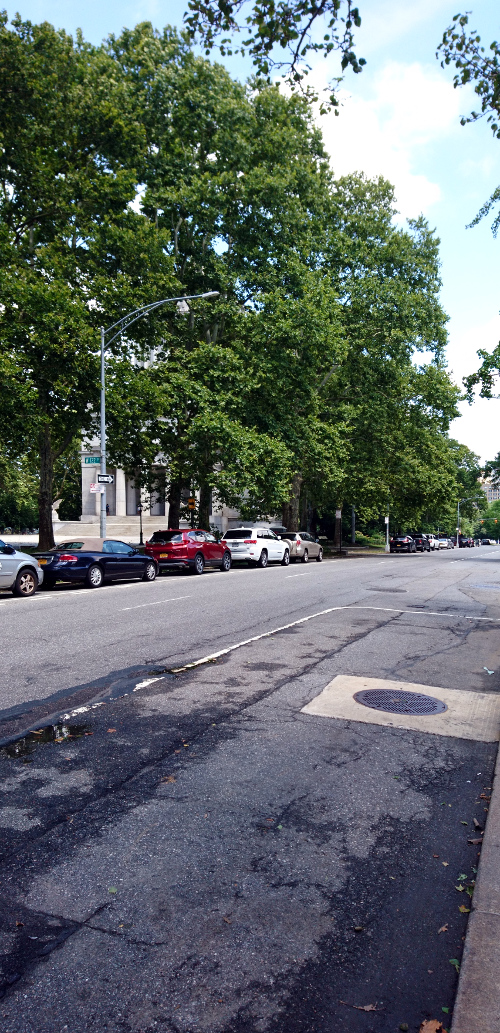
This massive monument doesn’t even have crosswalks or lights to allow pedestrians to legally reach it! Aside from one added to facilitate walking from the tomb to the gift shop (forced by a long campaign arguing it put disabled veterans at risk), visitors have to violate a historically racist law to reach the island in a sea of trees and asphalt.
NYC Administrative Code Title 34, Section 4-04, Subsection (b) (2) No pedestrian shall cross any roadway at an intersection except within a cross-walk.
As I said at the start of this post, monuments to American heroes were being greatly diminished by the Confederate “distorting history” crowd who worked hard to shamelessly erect statues to honor America’s enemies.
Lee literally asked that no monuments be made to him, and Americans dishonored his wishes in an attempt to keep civil strife alive. Grant’s tomb specified no obstructions to the view, and Americans dishonored him as well in an attempt to obscure his message of peace and civility.
So the next time you see a loser-Lee monument of slavery and patronage, ask yourself where can you see the nearest monument to the victorious civil-rights anti-corruption champion Grant.
Now, to be fair to the people who were fiddling with history in the 1930s, they considered themselves reformers.
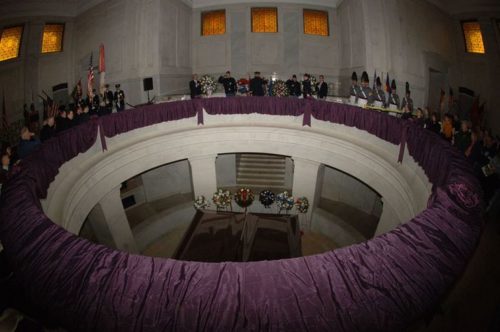
If the yellow glass looks odd next to the traditional memorial purple sash, that’s because the yellow glass was another strange and late modification to the design.
The Tiffany Company had donated purple glass in 1913. Then someone in 1939 decided they would give away Tiffany color works (nobody knows where the glass went, presumably to friends and family of those who replaced it?) and brought instead gloomy mismatched yellow glass.
Ring of busts
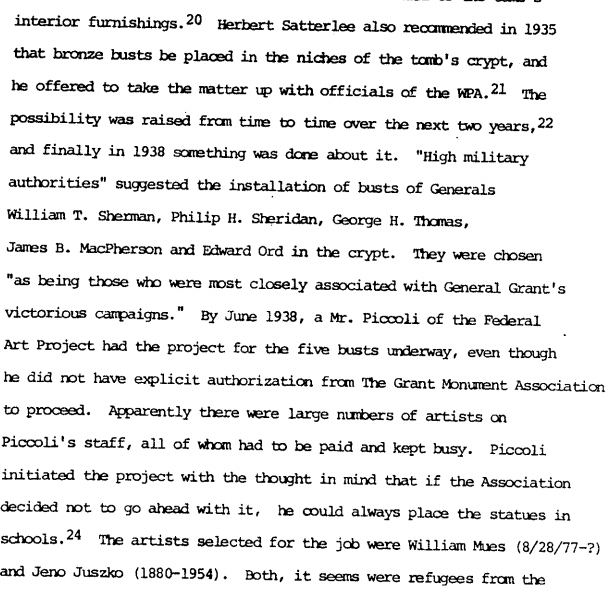
Perhaps most notable, besides that inexcusable obfuscation line of trees, is a ring of military busts installed in 1938, staring inward and distracting from the sarcophagi.
The busts perhaps were an attempt to emulate Les Invalides in Paris, built in 1861, where Napoleon rests in a massive quartzite sarcophagus surrounded by 12 female statues representing his military campaigns.
So here’s the thing. If we’re being charitable, a Napoleonic bust theme could mean the trees planted at the same time were meant to be tiny and manicured like Les Invalides. In some weird twist of history, people wanted Grant’s resting place to look more like Napoleon’s by adding trees and busts.
Trees
We coincidentally see that during the period that unjust historians were trying to tarnish Grant’s civil rights legacy, and falsely color his war-time accomplishments, trees strangely were allowed to grow out-of-control into a thick curtain.
Trees obviously were never meant to obscure the site
Is it really coincidence, though, even if the trees were meant to be maintained low and manicured to emulate Napoleon’s tomb?
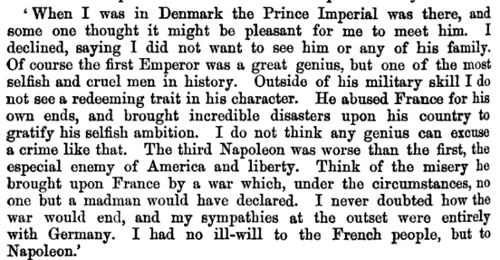
Grant even famously urged invasion of Mexico at the end of the Civil War and said “You see Napoleon in Mexico was really a part, and and active part, of the rebellion. His army was as much opposed to us as that of [pro-slavery General] Kirby Smith…I was for fighting Napoleon. There never was a more just cause for war than what Napoleon gave us.”
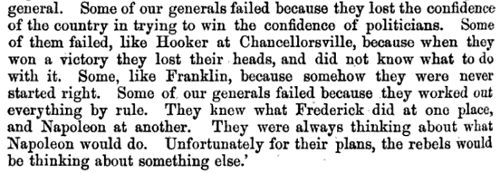
Even more to the point, the 1938 “renovations” to Grant’s tomb played up his military career and all but diminished civil rights legacy. Yet Grant thought when US Generals he knew emulated Napoleon they became examples of failure.
In other words, it’s a travesty of history for someone in 1938 to try and redesign Grant’s tomb to emulate Napoleon, a man and legacy he despised. It is even worse that someone in 1938 would plant the seeds of trees that, in direct opposition to the design of Grant’s tomb to be observed from far away, make it nearly impossible to see a building that so many people around the world have invested in to honor a great American hero.
Restoration plan:
Anyone caught claiming that Confederate statues should remain standing or maintained because “heritage” should be conscripted to serve a two week minimum term doing restoration and preservation work on Grant’s tomb.
It is past time to cut trees down. Chop them entirely, or at least bring down to proper respectful height that doesn’t obscure the monument from getting the attention it deserves.
Crosswalks and traffic calming patterns. At least four
I also think the busts should removed and located in a separate observation gallery. Use the original designs for reference.
And while we’re at it can we get the obnoxious “shiny boots” Lee mural removed as well? It makes no sense to have Lee as a late addition, standing above the tomb. We don’t put Hitler above Eisenhower’s memorial. Move these murals away along with the busts into a separate viewing area. I suppose that whole story will have to wait for another post, another day.
Do we need to start a campaign to do this? Come on America, honor your real heritage and get rid of all the white supremacist attempts to erase it. Nobody wanted to do a TV show about Grant because he was a normal modest american guy who did genuinely great things, no drama. He deserves better than to be ignored.
Update April 2019:
Two people were “arrested Monday by UNC police, accused of vandalizing the Unsung Founders Memorial” to slaves with racist graffiti.
a blog about the poetry of information security, since 1995