
Just 10 hours after the Pearl Harbor bombing of 7 December 1941, Japanese invaded the Philippines and ran into Captain Nieves Fernandez.
…she used her long knife to silently kill Japanese soldiers during the occupation of Leyte Island…. She commanded 110 native who killed more than 200 Japanese with knifes and shotguns made from sections of gas pipe.
Have you heard of her before? DC put a fictional Amazon on newsstands in October 1941. Six weeks later Japan invaded the Philippines, and a schoolteacher on Leyte became the real one.
American wire services carried her photograph in November 1944, demonstrating her silent kill technique on a soldier who volunteered as the practice target. The Japanese had already made her famous the hard way.
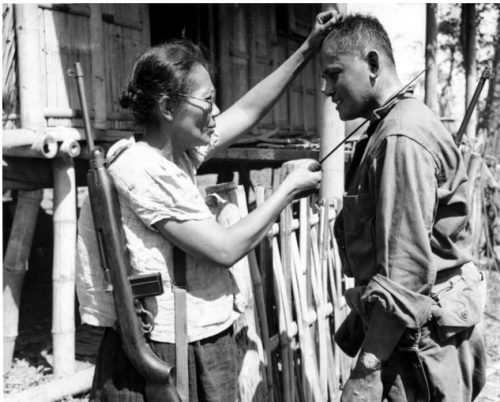
The American propaganda machine in 1941 was well aware that the promotion of successful and strong women was essential to winning the war against fascism.
The question is the sequence. All Star Comics #8 carried Wonder Woman onto newsstands on 25 October 1941, copyright filed with the Library of Congress on 21 October. Japan landed in the Philippines six weeks later. The fiction came first. The fact then exceeded it. Fernandez commanded 110 fighters armed with knives and shotguns built from gas pipe, and the occupiers put a price on her head. A character invented to sell truth and justice never had to deliver either. The schoolteacher delivered both.
This deceptively idyllic island turned notoriously dangerous for the invading Japanese troops due to… Fernandez.
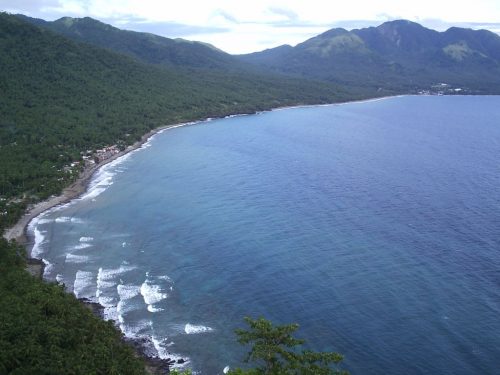
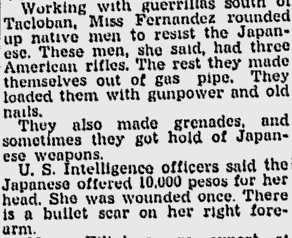
Why would the Japanese amplify her story widely? They thought it would help stop her, by putting a massive bounty on her head.
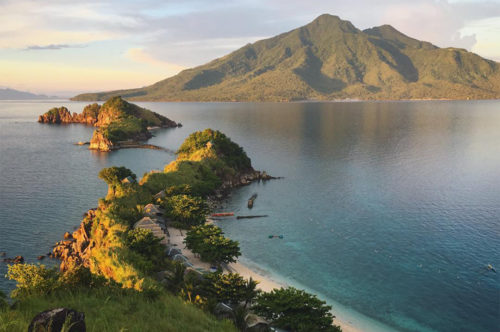
Again, just to emphasize what an average view of Tacloban, Leyte looks like relative to the “origin” story of the comic book character:
The character’s paper trail runs through 1940, when publisher M.C. Gaines hired psychologist William Moulton Marston to answer a moral panic over comics, and Marston answered it with a female superhero. His draft of “Suprema, the Wonder Woman” reached the publisher in early 1941. Jill Lepore documented the sources in The Secret History of Wonder Woman: suffragist chain imagery familiar to artist Harry Peter from his years alongside feminist illustrators, the Sanger family through Olive Byrne, and Marston’s own lie detector refiled as a golden lasso.
The January 1942 cover date on Sensation Comics #1 misleads. Golden Age cover dates ran months ahead of the newsstand. Her actual debut issue was on sale before Pearl Harbor.
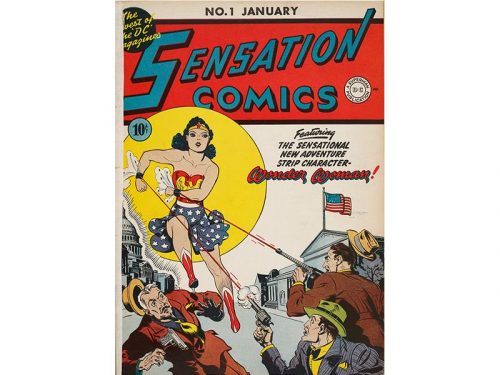
Marston built a white immortal from a Greek island that does not exist and credited nobody. Fernandez was a Filipina schoolteacher on an island the war made famous. The propaganda machine that understood the value of a strong woman in 1941 never connected its invention to the genuine article of 1944, and the genuine article never got a cover.
Update September 2020:
In a weird twist to the above real history a new film Wonder Woman 1984 has the American heroine battle an evil villain based on a real-life American con-man whose name rhymes with cancerous-lump:
Enter Maxwell Lord, a self-made mogul-slash-guru played as a sort of insidious mix of ’80s icons…. “Max is a dream-seller…. It’s this character who encompasses a component of the era which is, you know, ‘Get whatever want, however you can. You’re entitled to it!’ And at any cost, ultimately, which represents a huge part of our culture and this kind of unabashed — it’s greed, It’s f—ing greed, of course. But it’s also about ‘How do you be your best self? How do you win?’ So he’s definitely the face of that version of success.”
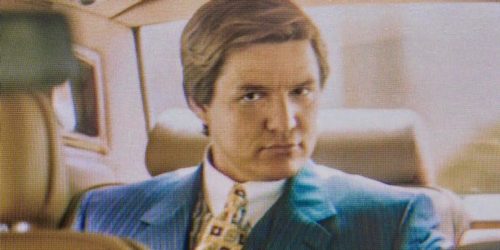
Definitely a missed opportunity to cast Wonder Woman as a someone more like Fernandez who battles the racism and misogyny endemic to fascism, far more relevant and real than this basic corruption and greed narrative.
Update May 2021:
A new book called War and Resistance in the Philippines: 1942-1945, by historian James Kelly Morningstar, gives much more context to the significance of this guerrilla story, even suggesting it “brought down Japan”:
Filipino guerrillas waged a war that denied Japan its strategic goals, altered U.S. grand strategy and helped transform America’s greatest military defeat into Japan’s greatest military disaster. Their fight also laid the foundation for a free and independent nation vital to the post-war order.