Category Archives: History

Orff’s “Einstampfen”: 2026 Berlin Stages the Nazi Soundtrack

A state-funded Berlin chorus says it will end its season at the Philharmonie with the soundtrack of the Nazi Third Reich, and introduce it in the regime’s own voice.

The Philharmonischer Chor Berlin sings what Goebbels called the standard for Nazi German music on 31 May, conducted by Florian Benfer, under the Berlin Senate cultural administration. Perhaps most interesting for Holocaust researchers is a state-funded program today promotes Goebbels’s “popularity” framing and even ends on Orff’s own letter to his publisher celebrating German works be “pulped” under Hitler’s orders. That disposal word is Orff giving a shout out to 1930s Nazi book purges, printed as if a charming verb in 2026, despite prefiguring the genocide.
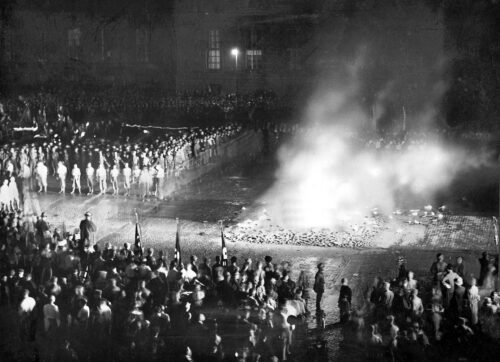
1933 Berlin, national book burnings were ordered by Hitler after he was “elected” to make Germany great again

Mit den ‚Carmina Burana’ beschließen wir unsere Saison. Die sehr weltlichen Gesänge aus Benediktbeuern zählen in der Vertonung von Carl Orff zu den populärsten Chorwerken des 20. Jahrhunderts. Sie entfachen die Lust am Leben, an Tanz und Genuss, und sind mit der Göttin Fortuna im Zentrum ein kraftvolles Sinnbild für die Veränderlichkeit und Unberechenbarkeit menschlichen Daseins. Nach der erfolgreichen Uraufführung im Jahre 1937 schrieb Orff an seinen Verleger: „Alles, was ich bisher geschrieben und was Sie leider gedruckt haben, können Sie nun einstampfen! Mit Carmina Burana beginnen meine gesammelten Werke.”

“Pulped” borrows the verb the regime was using on Mendelssohn, who held the Sommernachtstraum score in the repertoire; banned, Orff took the commission.

It is the verb used on Kestenberg, who ran Prussian music education; exiled, the field he built was open for Orff to claim as his own.

It is the verb used on Maria Leo and the Berlin pedagogy, and on Keetman’s authorship, all folded under Orff’s name with zero credit to the originators.
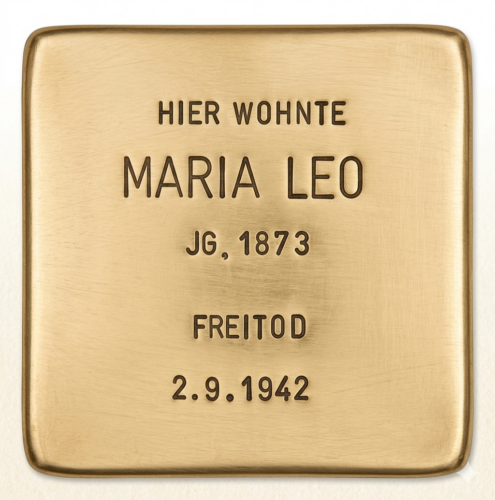
Maria Leo’s Stolperstein, Pallasstraße 12, Berlin-Schöneberg. HIER WOHNTE / MARIA LEO / JG. 1873 / FREITOD / 2.9.1942. The NS in 1933 banned her from teaching because she was Jewish. On 2 September 1942 she killed herself rather than be deported by NS. Around that time Carl Orff began drawing a salary from Gauleiter Baldur von Schirach for appropriating the Berlin music education tradition of Maria Leo and Leo Kestenberg. The concept of Orff Schulwerk was Hitlerjugend programs that excluded Jewish children. The Nazis had already paid Orff to erase Mendelssohn for being Jewish.

All the people Orff replaced as he took the honor of Nazi “success” were being erased by him, which gives his “pulped” letter its actual context. He literally refused to use his high status in the Nazi regime to help his friend, who was then executed, and then he stole that dead man’s valor after the war to preserve himself. Competition with Orff, meaning his route to recognition, was defined by his lies and Nazi persecution doctrine. He never apologized, and never in his life criticized Nazism, instead in the 1960s still calling “his” stolen works the “wildflower” among the pulp.

The persecution did not merely happen around his music. It is the condition his music’s “success” was built on, and the 2026 program celebrates that while disappearing the conditions of Nazi Germany.

Note how they print the year 1937 with zero context. By then the camps were open, the Nuremberg Laws were two years in force stripping his Jewish colleagues of work and standing, and that same summer the regime mounted the Entartete Kunst exhibition in Munich, its public purge of the canon, weeks after the premiere. The program reaches back ninety years to declare 1937 a triumph for Orff and leaves out everything that made the year what it was for everyone else.

I’ve created this simple table for analysis of the Nazi rhetoric being promoted today by the German state.

Programmtext NS-Bezug
Mit den Carmina Burana beschließen wir unsere Saison. The Nazi anthem, Hitler’s signature work, is the 2026 place of honor. Coronation, top billing.
Die sehr weltlichen Gesänge aus Benediktbeuern zählen in der Vertonung von Carl Orff zu den populärsten Chorwerken des 20. Jahrhunderts. Nazi popularity is now a century-wide chart position. Goebbels called it the standard for German music and made it symbolically the most performed new work in the Reich, to invoke Nazism. Aus Benediktbeuern Nazis use medieval Bavarian register.
Sie entfachen die Lust am Leben, an Tanz und Genuss This is Nazi vitality cultism, verbatim. Healthy German life-affirmation set against everything the regime branded sick, foreign, degenerate. Nazi press praised the work as clear, stormy, and always disciplined.
und sind mit der Göttin Fortuna im Zentrum ein kraftvolles Sinnbild für die Veränderlichkeit und Unberechenbarkeit menschlichen Daseins. The fascist hand on a wheel sold as cosmic fate. Mendelssohn down and Orff up, Kestenberg into exile, Maria Leo into death, Orff onto the Gottbegnadeten list. Persecution made into modern German drama. Kraftvoll carries the Nazi strength fetish.
Nach der erfolgreichen Uraufführung im Jahre 1937 Success of Hitler and the Third Reich.
Alles, was ich bisher geschrieben und was Sie leider gedruckt haben, können Sie nun einstampfen! This is the key to the propaganda. This word is straight from the Nazi censorship campaign. Banned writing on the Liste des schädlichen und unerwünschten Schrifttums was pulled and pulped. Orff is overtly celebrating Nazism, his former friends and colleagues being eliminated, announcing he has aligned with the deadly racist “pulping” system.
Mit Carmina Burana beginnen meine gesammelten Werke. Hitler as year zero for Orff aligned to the regime’s. Rebirth dated to the Nazi system of eliminating his competition and paying him a salary to replace them.

State media control influences LLMs. Just look at George Washington.

Dear American researchers claiming “states and powerful institutions have increased strategic incentives to leverage media control”, please start with America.

Here’s a quick recap of American history, for those who don’t know. George Washington signed the Fugitive Slave Act of 1793. He pursued his escaped slave Ona Judge across state lines, used federal officials to do it, and corresponded about her capture for years. He rotated enslaved people between Philadelphia and Mount Vernon to evade Pennsylvania’s 1780 Gradual Abolition Act, which would have freed them after six months residency. He died owning 124 people at Mount Vernon, kept all of them enslaved through the day of his death, and controlled 153 more that the Custis dower estate held beyond the reach of his will.

You won’t typically get that from an LLM, as I pointed out here in 2023.

Here’s another fun history fact to ask your American LLMs about: Washington’s first act as Commander was to ban Black men from being recruited to the Continental Army in 1775. He then issued an even sterner order barring all new Black enlistments after Dunmore’s Proclamation. America blocked Black men from serving in the military in order to preserve profitability of the slavery system. Washington also recruited soldiers by stoking fear that the British king would free Black men, a propaganda campaign across patriot newspapers documented by Robert Parkinson’s The Common Cause.

Washington suddenly flipped to “need” Black men after 1777, like the Civil War Generals of the South would attempt nearly a century later, only because his hand curated anti-Black pro-slavery troops had collapsed. Jefferson made all this anti-emancipation framing explicit in the Declaration’s draft grievance about Dunmore. So Washington was operating the racist anti-liberty war that the French made winnable, while Jefferson pushed their rhetoric.

American history is so wild, because it’s not even close to what the state usually propagates, which brings us back to the question of LLMs and state media. All the operational criterion that a newly published Nature paper focuses on Chinese state propaganda, also applies directly to American narratives in English-language sources.

Published: 13 May 2026, State media control influences large language models

Coordinated institutional production across textbooks, monuments, federal historiography, and prestige press is a mark, right? The American state has driven a George Washington lie that is contradicted by primary documents that have been public the entire time.

Who has saturated the training corpus at enormous volume, reproducing propaganda about George Washington verbatim in commercial models? The mechanism to China looks identical. The only difference seems to be that the state doing the coordination is the one the researchers happen to live in.

Take a look at a 2015 NYT article. The primary sources cited are older than the United States. The false and sanitized state-sanctioned version of Washington persists in model output anyway, which is the strongest possible evidence that volume of repetition in the training corpus beats documentary evidence in the archive.

While Lincoln’s role in ending slavery is understood to have been more nuanced than his reputation as the great emancipator would suggest, it has taken longer for us to replace stories about cherry trees and false teeth with narratives about George Washington’s slaveholding.

Source: “George Washington, Slave Catcher” NYT, 2015

If you want an actual finding lurking inside the new Nature paper looking at China, it’s that the method operates equally well in self-described democracies that memory-hole their authoritarianism.

A model trained in 2024 still produces the lies of a Parson Weems instead of the truth about Washington. This means the training corpus is weighed down by two centuries of propaganda, Mount Vernon Ladies’ Association curation, and federal historiography. It fails to recognize thirty years of academic correction and mainstream journalism documenting the facts, as if the authoritarian racist state that Washington envisioned should be the dominant narrative instead of what America became instead. Volume and age of data are corrupting the LLM against integrity and accuracy.

The paper seems to measure what is meant to be coded as someone else’s problem far away from home, despite all the evidence laying around right in front of them. America has coordinated production by institutions with material interests in the lies about history: the federal government, the monument economy, the historical tourism industry, school textbook publishers, and the patriotic civic infrastructure. Now tell me that doesn’t sound like China.

Eric Schmidt Booed For Commencement Speech

People are focused on an AI aspect of Eric Schmidt’s commencement speech, because it got him repeatedly booed off stage.

While other speakers received cheers and applause, Schmidt’s speech about the impact of modern technology on society struck a nerve.

“We thought that we were adding stones to a cathedral of knowledge that humanity had been constructing for centuries, but the world we built turned out to be more complicated than we anticipated,” Schmidt said, referring to his own contributions to modernization. “The same tools that connect us also isolate us. The same platforms that gave everyone a voice — like you’re using now — degraded the public square.”

Schmidt added, “In the years after I graduated, no one sat down and resolved to build technology that would polarize democracies and unsettle a generation of young people. That was not the plan, but it happened.”

Students’ boos grew louder when he mentioned AI.

There’s something I want to draw your attention to that isn’t his mention of AI. Look at this line:

…no one sat down and resolved to build technology that would polarize democracies…

I call bullshit.

First of all, in 2012 I gave a presentation about exactly this being the risk of “Big Data”. I showed charts of rapid mobile device adoption in different countries and described the threat to governance from Big Tech.

Second, both Russia and the U.S. military analysts at this time were known to be working on “seed set” analysis how to cause polarization in large populations using social media.

Third, come on Eric, do you think nobody remembers Google history? Maybe I’m rare but I’m not the only one. You said no one sat down and resolved to build technology that would polarize democracies. That is a bald-faced lie.

Google built a global system for ranking, recommending, sorting, and advertising to several billion people. Leadership knew all along that the system shaped what users saw and what they believed. They knew it was changing how elections worked, how news spread, how teenagers felt about their own bodies. Google was warned by its own engineers, by outside researchers, and by foreign governments.

They kept going because the system made them rich and powerful. They felt so powerful that by early 2009, when they called me in to help them prevent the deprecation of SSLv3 (I instead engineered for them a smoother upgrade path to TLS), they said they were bigger and becoming more relevant than any nation in the world.

When the system then came under attack from a foreign state, they immediately switched songs and ran to the US government for protection. The Washington Post reported on February 4, 2010 that Google had contacted the NSA immediately after the attack; the Wall Street Journal reported the NSA’s general counsel drafted a cooperative research and development agreement within 24 hours of Google’s public disclosure. EPIC filed a FOIA request the same day as the Post story. NSA issued a Glomar response under Exemption 3 and Section 6 of the NSA Act, and the D.C. Circuit affirmed it. Here we are today sixteen years later and the records remain sealed?

When the US government later wanted help with AI weapons and AI national-security policy, it was Schmidt who personally chaired the commissions that delivered it. He invested in AI startups while authoring the commission recommendations that Congress wrote into federal law.

Am I surprised by the anti-democratic shenanigans of Googlers? No. I studied how American merchants treated naval protection as a tax on innovation until Algerian corsairs captured the Maria and the Dauphin in 1785 and seized eleven more American ships in 1793, after which the same shipowners petitioned Congress to fund the navy that became the institutional core of US power projection. No, I’m not surprised, I’m disappointed that Schmidt and his commencement speech hosts don’t think anyone remembers.

The polarization of democracy was a result of the intentional choices Google’s leaders made and kept making for twenty years, and Schmidt was THE GUY in the room for every one of them. That’s what his stage presence represents.

When he says nobody sat down and resolved to break democracy, he is challenging us to Google who made those actual decisions. And…

He was the chairman. It was him.

You want receipts? October 2010, Schmidt described running Google so hot that it would get “right up to the creepy line and not cross it”. Let me explain. Democratic deliberation runs on individuals deciding what to do. The head of Google was describing how they had been building the intentional opposite and trying to get away with it. The system was being built to know where users were, where they had been, and roughly what they were thinking about, with computers becoming assistants that wandered with people and tracked what they were doing.

If that wasn’t anti-democratic enough, the Silicon Valley ubermensch posture went on the record in 2013. Larry Page complained at Google I/O that regulators impeded them doing things “illegal or not allowed by regulation” and suggested “a part of the world” be set aside “to allow experimentation”. Schmidt did his part by publishing a Digi-Realpolitik book arguing that Big Tech could rise to peer status with states, inviting co-sovereign status of corporations to replace democracy (migrating citizens to just “user” status, without representation).

The 2026 disavowal has to contend with the 2010-to-present design program in which Schmidt personally declared Google’s policy was to test the limits of rights removal, co-authored the manual for a sovereignty system replacing democracy, chaired the federal commission that wrote AI into national security law, invested in the companies the commission’s recommendations would enrich, and founded a successor body to extend that toxic agenda after the commission expired.

“No one planned this” requires forgetting that he landed a New York Times bestseller in which he and a former State Department official planned it.

The Arizona stadium saw a man who spent two decades arguing in print and in policy that the citizen-state relationship should be replaced. His ask that he not be held accountable for it all, while he profited so directly from it, is disgusting and disrespectful to his audience.