From an early age, Massoud adored poetry. After all, Afghanistan is the land of poetry and mysticism. He listened to a young Masood Khalili recite poems on Radio Afghanistan; the two ultimately established a lifelong friendship. Khalili went on to become the Afghan ambassador to Spain, while Massoud entered the military arena. Poetry, though, was always present in Massoud’s life; he typically kept at least one poetry book on his person at all times, and he read poems to his soldiers.
Keeping a poetry book “at all times” to “read poems to his soldiers…” is a line straight out of the American Civil War.
Although, since it says he was a student of the American Revolution, I wonder if he carried the poetry of Phillis Wheatley who penned these deep thoughts in 1772:
No more, America, in mournful strain,
Of wrongs and grievance unredressed complain;
No longer shall thou dread the iron chain
Which wanton Tyranny, with lawless hand,
Had made, and with it meant t’ enslave the land.
She obviously was way ahead of her time and a true revolutionary hero, who nobody in America ever hears about.
During the peak of her writing career, she wrote a well-received poem praising the appointment of George Washington as the commander of the Continental Army. However, she believed that slavery was the issue that prevented the colonists from achieving true heroism.
And yet, despite her hopes and optimism for a better outcome, the American dollar bill honors a man who fought to preserve and expand slavery. Food for thought when contemplating the importance of poets during revolutionary times.
This “investment” story is even worse than I first thought:
First the founders say this about using all the money for their “launch”.
Currently available plant proteins don’t pull their weight when it comes to competing with animal-based products on taste…
Second, they say $27m is needed to create a complete plant-based protein with… wait for it…
…neutral taste, odor and color…
So they don’t like the taste of plants. And they obviously don’t know how to cook.
This giant infusion of cash is for eliminating taste from plants in order to “charge a premium for it versus some other plant protein sources”.
That reads to me as someone artificially controlling taste of plants as a business model.
You have to pay them to remove everything from food, so you can pay them to put food-like appearance back into food.
It’s basically rent seeking for food.
And it’s immoral. Why not just send that $27m towards feeding people who are hungry today, instead of taking plants and making them artificially more expensive?
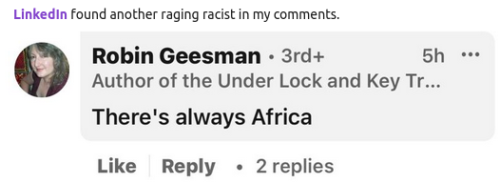
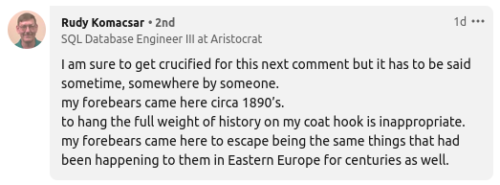
A white woman posts a racist comment on LinkedIn. The target of the attack posts the comment in plain view for review, as his profile is experiencing a lot of harassment and hate speech.
Source: LinkedIn
Such obvious hate speech as a violation of the site terms and is reported as such. What happens next?
To be clear here, any student of basic history knows the racism this comment is delivering.
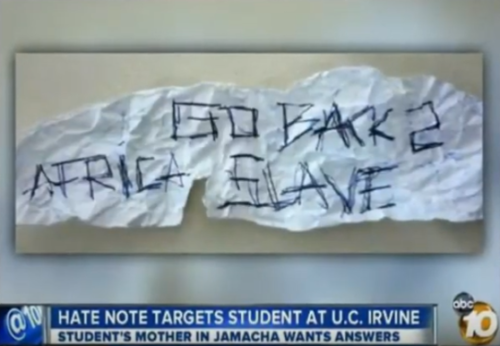
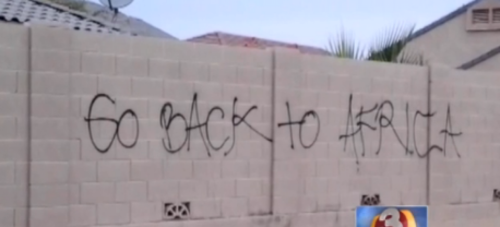
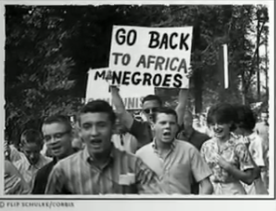
Such a “go back” attack method, even one masked as “there’s always X physical location” is unquestionable hate speech. It fails the most basic test.
Probable Cause Found Against Duval Circuit Judge… accused of telling his staff attorney in a private conversation that African Americans should get back on a ship and go back to Africa.
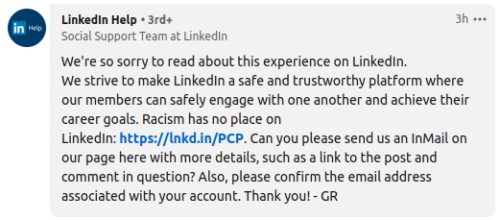
The comment isn’t removed, however. Instead a “GR” operating the LinkedIn Help account responds publicly to the target of the attack with a comment saying “Racism has no place on LinkedIn”.
GR appears also to be asking for help, as if the post and comment are in doubt or they can’t discover on their own with the already provided details.
I find this a strange response since it takes me less than a minute to find the original post and the comment.
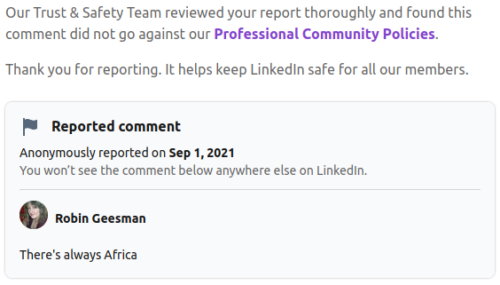
Then as a test of the GR claim, and to confirm what others already have stated (they filed a report and were denied) I file a report of racism and immediately get this response from LinkedIn.
How can LinkedIn not rule as such? This “go to” attack has no value other than incitement and harm, obviously used as targeted harassment by a white woman.
Let’s now take a closer look at the account sending this racist attack.
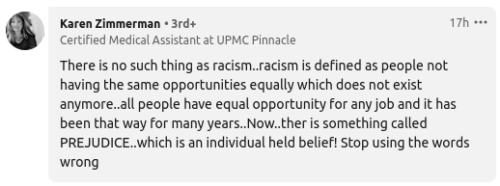
She “likes” a tone-deaf and racist comment one day prior, fraudulently claiming “There is no such thing as racism”
Saying there is no racism is like someone saying they are happy to ignore the racism because THEY don’t benefit from ending racism. It’s an incredibly selfish and hateful perspective, a form of extreme “individualism”, based on falsehoods that cruelly disregard the well-documented pain and suffering of others.
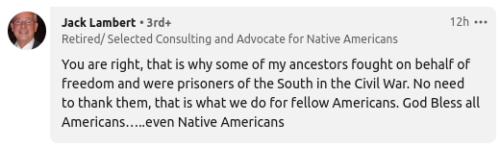
She also “likes” a comment that white people had ancestors who were “prisoners of the South in the Civil War” claiming “no need to thank them, that is what we do for fellow Americans”
That’s some deeply encoded racism.
I’ll unpack it here simply. A white man posts that if your ancestors were slaves, don’t ask for anything (reparations) because you should (like him) accept bondage under tyranny as a form of service/servitude to “fellow Americans”.
See the problem?
And the line “even Native Americans” could be considered American is especially bizarre given the offending account purports to be a retired “Advocate for Native Americans”.
With advocates like these, who needs enemies?
She also “likes” an obviously fraudulent comment that white people who had the privilege and choice to immigrate to America are somehow an equivalent to people violently forced into slavery.
It literally starts by trying to paint white immigrants as the real victims in America because they might be crucified for saying something incredibly stupid as though it “has to be said”.
This comment also peddles the racist trope that whites have no responsibility for the systemic racism they benefit from by ignoring.
We could go on and on, yet it’s safe to say if you post a racist comment denigrating blacks this Robin Geesman account will be ready to pile on before posting her own racist opinion.
Her comment is far more clumsy and obvious than the other racists, but it appears that she had been liking all the racism as a kind of wind-up before posting her own over-the-top racism.
This is in effect what a mob of white racists looks like, collectively attacking a LinkedIn profile within LinkedIn.
Perhaps most insightful, however, is that her profile otherwise is being filled with lots of generic themes of respect for others. It reminds me how Nazis would talk up the need for respect and order while practicing the exact opposite — constant destruction of respect and order.
Obviously she intends her stream of constant pleas for safe spaces only towards people she thinks look like her, as if black people must not be allowed to participate, have a voice or otherwise make her feel uncomfortable.
Some of her most recent “likes”:
NO AMOUNT OF MONEY CAN COMPENSATE FOR A TOXIC WORK ENVIRONMENT
Could it be that #politicians want us at each other’s throats? Could it be they’re afraid to admit that a majority of citizens, on the right and left, have lost faith in the system? Could it be they’d rather we fight amongst ourselves than challenge entrenched power structures? Crazy questions, I know … but you gotta wonder.
It’s okay to have an opinion. It’s okay to disagree with someone’s opinion. It’s not okay to humiliate them because they don’t think the same way you do. Show some respect. Society needs more of that.
Any “go back to X” comment is a gross violation of her own “liked” principles here, as she tried to humiliate someone based on race after they said something she disagreed with.
She showed zero respect.
The cognitive blindness is palpable. And to top it all off, it is no surprise that alongside her “safe space” memes comes a lot of military and police worship as well.
To put it another way, we see here a pretty obviously racist profile on LinkedIn. It confirms an obvious racist comment and its likes of other racist comments are all consistent with a “professional” presence of entering other people’s space to be racist without consequence.
LinkedIn claims to prohibit racism yet formally disagrees with removing it when obvious racism is flagged; they easily can be found protecting white insecurity groups sending racist harassment messages in a “professional” space, but why?
Not only is the robot that drives Facebook (and other platforms) biased in favor of inflammatory content, but the company has clumsily intervened to bias it further.
Food for thought, given that LinkeIn under the Microsoft umbrella formally announced joining the voluntary EU code on hate speech:
Microsoft-owned LinkedIn has committed to doing more to quickly purge illegal hate speech from its platform in the European Union by formally signing up to a self-regulatory initiative that seeks to tackle the issue through a voluntary Code of Conduct.
In statement today, the European Commission announced that the professional social network has joined the EU’s Code of Conduct on Countering Illegal Hate Speech Online, with justice commissioner, Didier Reynders, welcoming LinkedIn’s (albeit tardy) participation, and adding in a statement that the code “is and will remain an important tool in the fight against hate speech, including within the framework established by digital services legislation”.
Indeed, the head of trust and safety at LinkedIn (Paul Rockwell) publicly “describes the company as explicitly ‘anti-racist'”.
An extremely well-written and insightful analysis piece in The Cut has this buried lede:
Simply put, the law is not some neutral force for social good.
I highly recommend reading the whole thing.
In brief, if you think of coding machines in the same way that the laws are a means of coding human behavior, then “neutral force” arguments become more obviously specious.
We follow the codes written for right/wrong behavior, machines follow codes written for right/wrong operation. In both cases, the political fight over definitions of right/wrong is inherent to the system.
It’s also a good explanation why the Department of Justice was created by President Grant after Civil War as a means to fight the KKK. Think of it like code-review for safety at the federal level.
a blog about the poetry of information security, since 1995