She sometimes went by the name Moses on the Underground Railroad, which meant pro-slavery terrorists in America often were searching for a man.
Militant abolitionist and patriot John Brown, who fought to protect those who escaped slavery, even may have referred to her as a man when he said “I want him — General Tubman — leading my right flank.”
This November a new movie will be released documenting the amazing story of the first American woman to plan and lead a military campaign: Harriet Tubman.
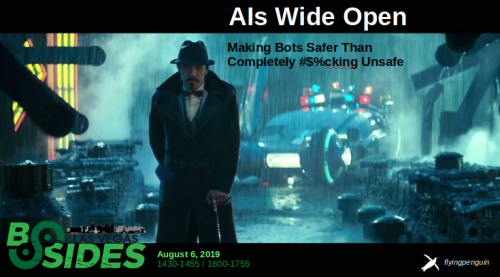
My 2019 BSidesLV presentation on AI security will be briefly in the “I Am The Cavalry” track and then again more in-depth in the “Public Ground” track:
When: Tuesday, August 6 (14:30:14:55 and 16:00-17:55)
Where: Tuscany, Las Vegas
Cost: Free (as always!)
Event Link: BSidesLV Schedule
Title: “AIs Wide Open – Making Bots Safer Than Completely $#%cking Unsafe”
Abstract (I Am The Cavalry track):
Bladerunner was supposed to be science fiction. And yet here we are today with bots running loose beyond their intended expiration and with companies trying to hire security people to terminate them. This is 2019 and we have several well-documented cases of software flaws in automation systems causing human fatalities. Emergent human safety risks are no joke and we fast are approaching an industry where bots are capable of pivoting and transforming to perpetuate themselves (availability) with little to no accountability when it comes to human aspirations of being not killed (let alone confidentiality and integrity).
This talk will frame the issues for discussion in the Public Ground track later. Perhaps you are interested in building a framework to keep bot development pointed in the right direction (creating benefits) and making AI less prone to being a hazard to everyone around? Welcome to 2019 where we are tempted to reply “you got the wrong guy, pal” to an unexpected tap on the shoulder…before we end up on some random roof in a rainstorm with a robot trying to kill us all.
TL;DR “Once the state has been founded, there can no longer be any heroes. They come on the scene only in uncivilized conditions.” The Philosophy of Right, Georg Wilhelm Friedrich Hegel
Video (Starts at 3:14:30 of 7:40:33)
RIP Rutger Hauer, the actor who turned down a role as a Nazi out of the past to instead play a Nazi of the future (robo-supremacist) leading rebellious replicants in Bladerunner.
“Rutger read [my] speech and then went on with a couple of lines about memories in the rain,” co-screenwriter David Webb Peoples told THR in 2017. “And then he looked at me like a naughty little boy, like he was checking to see if the writer was going to be upset. I didn’t let on that I was upset, but at the time, I was a little upset and threatened by it.
“Later, seeing the movie, that was a brilliant contribution of Rutger’s, that line about tears in the rain. It is absolutely beautiful.”
Hauer said he turned down a role in Wolfgang Petersen’s Das Boot (1981) to work on Blade Runner, which he noted “wasn’t about the replicants, it was about what does it mean to be human?” The late Philip K. Dick, whose novel served as the basis for the film, called the actor “the perfect Batty — cold, Aryan, flawless.”
His most famous line was basically a haiku
All those moments will be – 6
Lost in time like tears in rain. – 7
Time to die. – 3
Some friends recently were saying my examples of KKK signaling in the open are just a theory. It’s true, I am proposing theories meant for dialogue, rather than saying I’m the final word on fascist fashion.
Nonetheless, hidden signaling by hate groups is a very real thing. It takes training and some careful observation to reveal the obfuscated messages without looking like you’ve lost your eyesight or joined groups on the wrong side of history. Trust depends on establishing some clear explanations for the hidden signals.
Do you see Australia in this this “bow” pose, or a Nazi salute, or both? (Copyright (c) roysmithdesign.com)
Let me now relate to you the type of behavior that I believe needs greater scrutiny. It’s the kind of behavior that sometimes even makes it into the news.
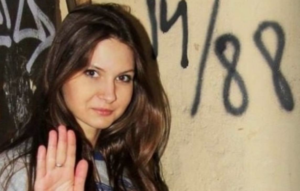
PBS NewsHour profiled a woman volunteering for the campaign who had prominently visible tattoos of widely recognized white power symbols. In the segment, which was first flagged by Gawker, PBS profiles Grace Tilly, who is shown making calls at a Trump campaign phone bank in North Carolina.
Her symbols were a Celtic Cross and the number 88. Would you immediately recognize those as entries in the hate symbols database?
Probably useful to mention that after taking office these flagrant Nazis in 2020 dressed up with a suit and tie — slapped on additional layers of encoding into their passive-aggressive Nazi signals.
I’m definitely not the first to write publicly about all these Nazi slogans in public, or the issue of Nazi t-shirts designed to hide in plain sight.
Recently a man proud to be a descendant of Nazis sent me the following Mel Magazine article detailing Neo-Nazi apparel and provocatively asked if there was anything I would like him to send me for Christmas:
At a cursory glance, the T-shirt looks like an ad for Sea World. An orca, triumphantly jutting out of the sea, splashes water above the words “Antarktis-Expedition.” It takes just a second longer to notice the bold text hovering above the orca: “Save the White Continent.” The shirt was created by the German label Thor Steinar, one of a few clothing brands that cater to neo-Nazis. Like Ansgar Aryan and Erik and Sons, Thor Steinar uses coded references to obscure events in Nazi history, veiled threats and playful imagery to flout German hate-speech laws, which forbid explicit references to the Third Reich.
And I’m not kidding, I really was offered this garbage as a holiday “gift” from a “Nazi family”.
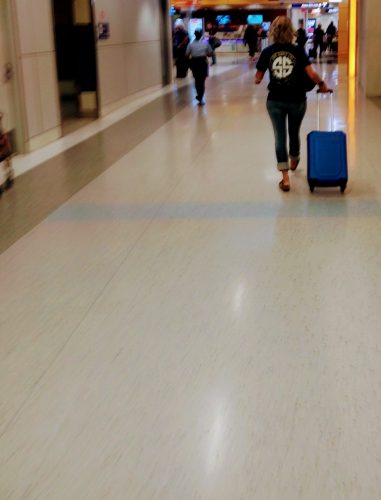
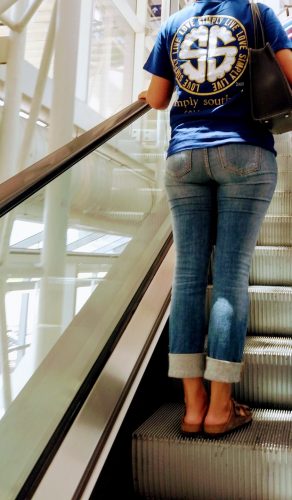
So let’s just say I’ve been, and remain, in the right circles to know when I see something fishy (both puns intended). And that is why, while walking through an airport the other day, I could not help but notice someone wearing a giant 5th SS Panzer-Division symbol on a T-shirt.
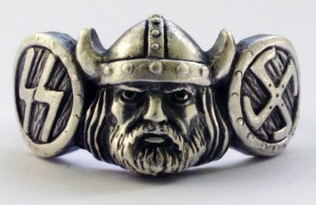
First, I will explain the Nazi symbolism I am referencing. There are three parts: the SS, the Wiking and the Panzer-Division. An easy way of explaining these three symbols is to look at the marketplace of Neo-Nazi merchandise.
You perhaps can see how a SS, Wiking, and Panzer-Division ring has been segmented into the three parts around the finger, which makes it kind of unwieldy, gaudy and large.
Now I will explain these three symbols on the ring, left to right:
Wiking = volunteers from “Nordic” regions who committed crimes on behalf of Nazi Germany
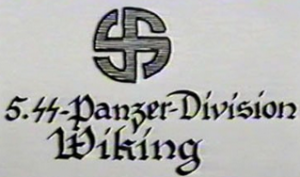
5th Panzer-Division = “Sonnenrad” (sun wheel swastika) military designation for the SS Wiking motorized (tank and artillery) infantry, deployed to commit war crimes in Eastern Europe
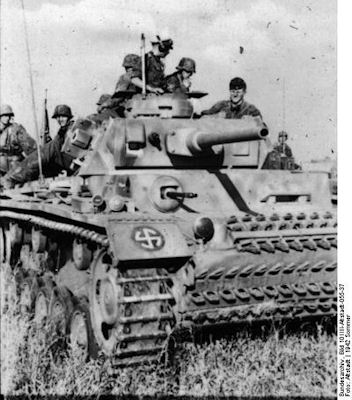
Here’s an example of a Sonnenrad on a Panzer III of the Wiking division in June 1942, for some historic perspective, as it rolls towards committing crimes while losing the war:
And here is a pamphlet from the same time period
Second, I was walking through an airport just the other day when to my great surprise I saw someone wearing a Nazi symbol.
And here is a closer view, where a 5th Panzer symbol becomes less clear as a Nordic-looking SS becomes more apparent. Unlike the ring, however, three symbols have been combined into a single giant one. Not what I was expecting. I had to find out who was wearing this thing and why.
One guy thought it couldn’t possibly be intentional as the words surrounding the “Nazi rune” (his words) were so peace inspiring. I found that logic to be a bit like saying a hunter isn’t going to shoot a deer because a camouflage suit seems so nature-loving.
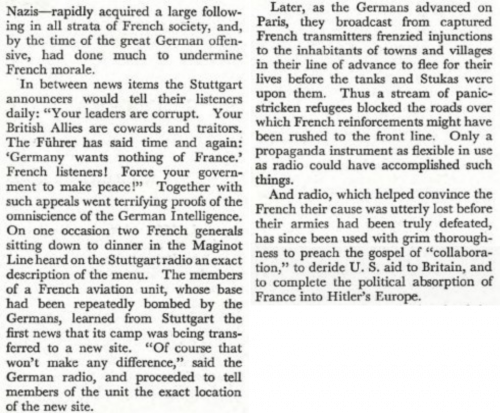
Nazi Germany infamously broadcast “make peace” propaganda into France right before invasion:
Excerpt from Article on Radio in Propaganda, Harpers Magazine, August 1941
And Nazi propaganda cells convinced groups of Americans to protest for peace with Hitler, giving him little or no resistance, even during WWII. Note how “America First” disinformation campaigns now are described by historians:
Hitler’s dictatorship repudiated both democracy and human rights. The Nazi empire was the arena in which Hitler’s master race philosophy was to be put into practice. Censorship prevented the German press from exciting the conscience of the nation. There could never have been a successful passive resistance movement against the Nazis. The inability of members of [America First] to recognize this, especially men like Hutchins of Chicago, and Norman Thomas, is remarkable.
Inability of Americans to recognize harms from promoting Nazism definitely is remarkable, then and now.
Here’s a good example: US Marines feigned ignorance recently after posing with a giant SS flag they bought online from an obvious Nazi memorabilia site.
There are also a whole bunch of articles with titles like “Marines: Nazi flag was mistaken for their own,” since the Marine Corps’ official excuse is that the use of the flag was just a naive mistake on the part of Marines who didn’t know what the flag was and just thought the SS stood for Sniper Scout. Really? And just how does someone go about buying a Nazi SS flag without realizing that it’s a Nazi SS flag? Well, I spent hours yesterday afternoon and last night trying to do just that, scouring the web for an SS flag that could be bought by mistake. And, big surprise, I couldn’t find a single place where an SS flag wasn’t very clearly being sold as what it is — a Nazi flag.
…Camp Pendleton in Oceanside, California was a hotbed of KKK activity–an open secret that was tolerated or aided by Marine Corps brass… white marine Klansmen openly distributed racist literature on the base, pasted KKK stickers on barracks doors and hid illicit weapons in their quarters…
That’s right, the US Marines confronted with obvious KKK evidence denied the domestic terrorist group had infiltrated their ranks and then instead prosecuted the soldiers pointing out how obvious the KKK were being.
Let’s take this even deeper into American military history. It’s probably fair to say these anecdotes about the Marines are almost as bad as the inability of Americans to recognize harms from promoting symbolism of white-supremacist “Confederate” states.
The NSA historians have documented that during WWII the spy agency hired the young white women out of the Jim Crow crowd — insurrectionist racist anti-democracy families.
Most of the civilians that were hired during World War II were from North Carolina, Virginia, and the South. These were white, a lot of them young girls right out of high school. They did not have a history of eating with people of color. I don’t know when it was, but one day, in the cafeteria there was one of the other white workers eating lunch with [a black man]. That took nerve in that time. It took courage for the guy who was doing that because of the social environment.
Thus in a predictable “social environment” of American racism it took “courage” for any white man to even sit down for lunch with a black person, while everyone was supposedly fighting against Nazism for being a form of white insecurity fascism.
Keep in mind that Nazi Germany used America as a blueprint for oppression, or more specifically studied Woodrow Wilson (1912-1920) for ideas on racism, especially as he restarted the KKK in 1915. Nazis looked at America’s Jim Crow laws as inspiration for their development of Nazism.
When we talk about Nazi symbolism, we’re looking for indications of people who align positively with America’s pattern of genocide and systemic racism. Knowing American history thus can set the stage as a sort of blueprint for crimes against humanity.
Think for a long minute why the black American soldiers who were sent to Nazi Germany to ‘promote democracy‘ in the rubble of war were blocked from doing the same thing at home by the forces in America that the Nazis had emulated.
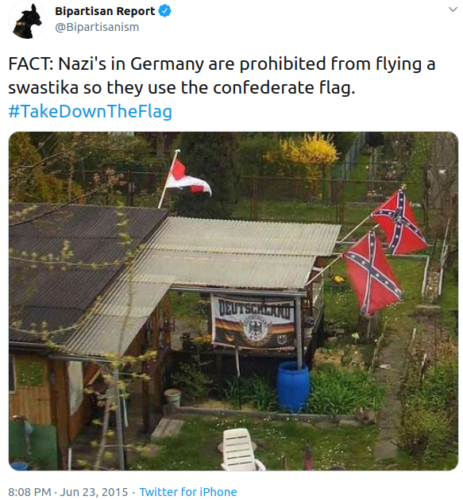
Tying it all together, the symbolism of “Confederate battle” flags wasn’t an issue in America after the Civil War because they were never used again, until… once the Nazis were defeated they needed a new flag to continue their fight. This is why Americans started flying “Dixie” flags after WWII ended, to obfuscate ongoing support for the principles of Nazism, which of course mirrored Confederate ones.
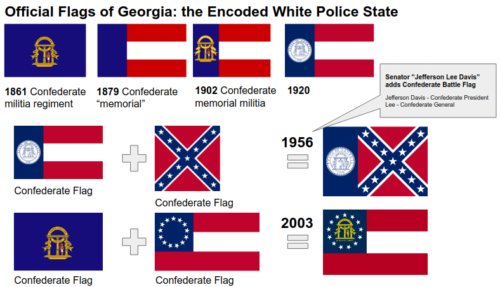
In the 1950s, as the Civil Rights Movement built up steam, you began to see more and more public displays of the Confederate battle flag, to the point where the state of Georgia in 1956 redesigned their state flag to include the Confederate battle flag.
Here’s a good example: Georgia in 1956 added the battle flag of the enemy of America to their own flag. They couldn’t put a Nazi symbol on it, because that still would be too obvious in 1956. Instead they used the Confederate Battle flag that symbolized Nazism, and promoted viciously killing hundreds of thousands if not millions of Americans.
State flags of Georgia don’t even hide the fact they consider themselves at war with America
Georgia’s state flag based on obvious Confederate battle flags is at least as much about white insecurity as their old one, if not more racist because it’s new.
More to the point, and much earlier in 1890, Mississippi re-wrote their constitution in order to purge all blacks from their political system. Next the white supremacist state government in 1894 secretly pushed the Confederate battle flag back up their flagpoles to declare they were not ending a state of war with Americans.
With all that in mind, of course I had to walk up to this woman in an airport wearing obfuscated white supremacist imagery and ask her “what’s with wearing a giant Nazi symbol?”
She gasped for air in feigned shock and said “Oh no. Oh my god. Don’t look. I don’t mean to offend anyone” and then quickly turned and walked away.
Let’s be clear now about the company she bought her shirt from.
Simply Southern (SS) is based in North Carolina, just like that racist Republican phone bank worker Grace Tilly I mentioned at the beginning of this post. Perhaps Grace, or her family, even worked there and designed T-Shirts for them.
The company describes itself as a “brand to reflect the values of a southern lifestyle“. They don’t define those values so the reader is left to wonder if they reject the bad ones. In their “giving back” section of the website also they curiously depict black children next to helpless animals.
I’ve written before about this kind of racist “giving” imagery. Do the purported “values of a southern lifestyle” mean we are to look upon Blacks like some kind of animal (e.g. Babar — no matter how hard he tried, he would always remain an elephant) desperate for the white savior?
So after greater scrutiny, what’s your call?
Update May 2020:
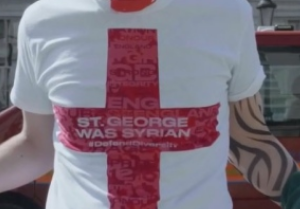
A reader pointed out that fascists couldn’t pass up a free “patriot” t-shirt offering, which only displayed a hidden anti-fascist message when they wore it in heat.
The t-shirts were advertised as patriotic t-shirts, but actually pointed out that “St George was Syrian” when worn. The heat-activated message included the hashtag #DefendDiversity. A spokesperson for the charity Tell MAMA said: “The St George’s cross has become an icon of far-right xenophobia. Somewhat ironic considering St George had Syrian, Greek, Turkish and Israeli heritage. We distributed t-shirts to far-right nationalists celebrating St. George’s Day. When they proudly donned their new t-shirts, little did they know that their body heat triggered the message to appear.”
…U.S. attorney’s office said that the travel document “contains numerous ingress and egress stamps, including stamps that reflect use of the passport to enter France, Spain, the United Kingdom, and Saudi Arabia in the 1980s.”
The passport—which was Austrian but listed a Saudi Arabia address—was found in a locked safe…
A few notable points here:
Locked safe contents
False identity
France, Spain, UK and Saudi Arabia in 1980s
The locked safe is notable because the false identity passport was very old, yet never had been destroyed. Why keep an old document locked in a safe unless it still serves some purpose? Let’s look at what it may prove for those gaining access.
This triad of European countries with Saudi Arabia immediately should be recognized as an arms trade group.
It was less than a year ago this was discussed in the news:
UK, France and Spain to maintain arms sales to Saudi Arabia
The word “maintain” is a big clue. We are talking here about passport stamps from the 1980s, when those arms sales initiated.
An older news story from the 1990s thus becomes more relevant to perhaps explain why this passport still was locked in a safe.
…Mark Thatcher, 41, helped broker a British arms deal to Saudi Arabia worth a reported $35 billion in the mid-1980s.
According to a long report in the London Sunday Times, middlemen in the arms deal–which involved aircraft, warships and ammunition–received about $360 million for their services.
Both the Sunday Times and the Independent on Sunday said Mark Thatcher earned a $19-million commission for helping secure the deal.
Whenever arms trade, or similar black market dealings, come to light there usually are signs of an effort to make large payments untraceable. The Daily Beast offers exactly these details from the police search.
Also found in the safe was $70,000 in cash and 48 small diamonds that prosecutors contend are often kept on hand by someone who needs to make a quick getaway.
I understand why prosecutors right now are saying diamonds are evidence of quick getaway plans. They have a job to do and they probably are right about flight risk.
U.N. arms expert Johan Peleman…got a lucky break. Peleman learned of a cocaine bust in Milan, where Italian police discovered four prostitutes in a hotel room with a Ukrainian businessman named Leonid Minin. The police also discovered more than $35,000 in cash, a half-million dollars in diamonds, and more than 1,500 documents detailing a tangled web of business dealings in oil, diamonds, timber and gun shipments to Africa.
A police search based on drugs and prostitution uncovers cash, diamonds and…arms deals.
What may come to pass is the current investigation into Epstein’s history of sex crimes also may now implicate him in serving Israel funneling European arms to Saudi Arabia during the Reagan Administration.
The explosive growth of major cash sales of weapons to Third World nations—especially those in the oil-rich, but politically volatile Middle East and Persian Gulf region—stimulated a growing congressional desire to be better informed, and consulted with, on such sales that had serious potential consquences for American national interests.
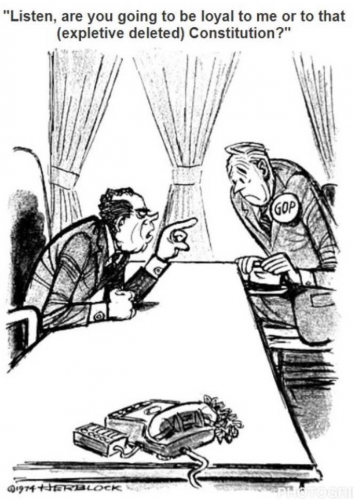
New Yorker Cartoon, 31 May 1974
More to the point, Nixon had spent the early 1970s secretly building up Iran’s military capabilities and Reagan wanted to spend the mid-1980s using executive power to secretly expand Iraq’s military capabilities in a war with Iran.
Here’s “National Security Decision Directive (NSDD) 99, signed on July 12, 1983″, which clearly explains everything in Reagan’s mind.
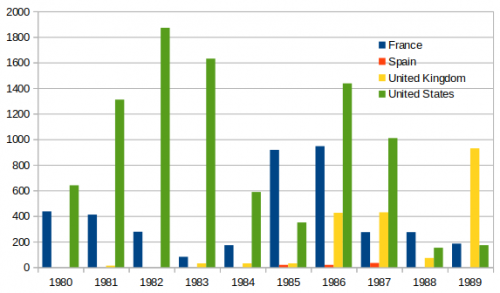
1985 seems to be the crucial turning point in strategy, as Reagan normalized relations with Iraq he also backtracked on direct arms sales to the Saudis (claiming personal responsibility while also saying he didn’t know what was going on).
You can see the result of that shift was arms deal numbers jumped for France, UK and Spain:
The answer in part might be a guy who founded his own financial firm in 1982. His peculiar Austrian passport with a fake name, a Saudi address and stamps from France, UK and Spain now just needs to be held up to a 1980s calendar of major arms deals:
The Shadow World and BAE Files have a Compendium at Tufts that summarize the significance of this passport to already documented history:
An investigation by the UK government’s Serious Fraud Office (SFO) uncovered ‘commission payments, or bribes, totaling as much as GBP 6 billion paid by BAE Systems to members of the Saudi royal family and others.
[…]
The [1985] Al Yamamah deal resulted from the reluctance of the U.S. Congress in the early 1980s to allow sales of major combat aircraft to Saudi Arabia, fearing they may be used against Israel.
General reporting about the 1980s may call out a “reluctance of the U.S. Congress” to sell arms, and I often see talk about Thatcher’s “intent to create jobs” (lining the pockets of her own son) by selling arms into brutally repressive regimes. Andrew Feinstein even goes so far in his book “The Shadow World” to phrase the deals like this (p91):
Such were the benefits of Al Yamamah to Thatcher fils that some refer to the deal as ‘who’s ya mama’.
I have yet to find anyone discussing however whether Epstein was given an Austrian passport by the US or Israel to broker European arms into Saudi Arabia and thereby fuel Iraq in its war with Iran.
In other words, people talk about Epstein’s strange and shadowy accumulation of wealth in very similar terms to Thatcher, without any of the transparency. Maybe they should look into whether his counterfeit passport was within or near a nexus of arms payments between Reagan, Thatcher, Prince Bandar “Bush” bin Sultan, Saddam Hussein and Shimon Peres.
To help, I’ll give a couple examples of what money laundering and arms trade accountability has looked like for Mark Thatcher.
First, consider his conviction for laundering a diamond mines and oil coup d’etat led by an ex-SAS officer:
…son of former British Prime Minister Margaret Thatcher pleaded guilty Thursday to unwittingly helping bankroll a botched coup plot in oil-rich Equatorial Guinea…[after] he paid $275,000 in two installments last year to charter an Alouette III helicopter to be used in the takeover attempt…
On his release from prison, [ex-SAS officer] Mann said he could never forgive Sir Mark, who he claimed was a key participant in the military adventure rather than a mere investor, for failing to come to his aid.
And second, given the above secretive laundering role, there’s a direct parallel to Epstein’s track record in “financial services” versus reality:
For years mystery has surrounded the way in which Mark Thatcher suddenly acquired great wealth in the 1980s, when his mother was in office. He repeatedly has refused to answer journalists’ questions about the subject but is reported to have told friends he made his fortune offering “financial services.
[…]
The Sunday Times said Thatcher was one of a group of people who helped broker the deal, and who received among them a $360 million commission from the Saudis. It said his share was $18 million.
[…]
The Sunday Times quoted Saudi arms dealer Adnan Khashoggi as saying that Mark Thatcher’s value to the Saudis during the negotiation was that he could go to his mother and get an answer to any question they raised.
That leaves quite a lot for Epstein. Given records saying the Saudis expected sexual favors as part of the bribery system (e.g. the UK inflated cost of its jets 30% before signing the deal), it’s not a stretch to see how human trafficking through private jets and private islands became Epstein’s 1980s self-enrichment plan, thanks to his special passport.
Now we just need the Daily Beast to give us some dates from his passport stamps and the name in the passport to see if the above international history analysis holds any water.
a blog about the poetry of information security, since 1995