Lithuania Under Attack in Information War on NATO

Useful analysis of information warfare attacks on NATO can be found in the breakdown of a campaign in Lithuania. “Eugenijus Lastauskas, head of the Lithuanian military’s Strategic Communication Department” is quoted in DefenseOne:

  • September 26 & 27 operatives hack kasvyksta.lt, a genuine news organization, to post a fake story as training for a bigger attack in October
  • October 17 operators again hack kasvyksta.lt to post a false story about purported U.S. plans to move nuclear weapons to Lithuania
  • False emails, purporting to be from known journalists, are sent to Nausėda’s office and other officials asking for official comment on the false story
  • The false story is circulated widely across Russian social media channels
  • October 18 operatives again hack legitimate media outlets to deface them with the false news
  • Journalists outside of Russia also targeted with email campaigns made to look like requests from members of the Lithuanian government

And then the icing on the cake:

…attackers even drew up a fake tweet from U.S. Secretary of State Mike Pomepo ‘congratulating’ the Lithuanian president on the news of the move of the nuclear weapons…

What is the response by the United States?

The American government now is debating the appropriate organizational structure to defend against latest formats of attack.

It is becoming increasingly clear that information warfare is a different phenomenon from traditional warfare: in information warfare, there are no sideliners, everyone is a target, and everywhere is the battlespace. Thus, any attempt to put the burden on just the Departments of Defense and State to counter information warfare efforts is likely to be fraught with complex authority issues about which domestic department or agency is charged with various information warfare tasks.[9] Here, the Department of Homeland Security, Central Intelligence Agency, Federal Bureau of Investigation, and various domestic intelligence agencies will undoubtedly have roles to play. The challenge is to precisely identify those roles.

[…]

An information warfare directorate within the National Security Council could help tease out answers by relying on expert briefs from the defense community, think tanks, corporations, and academia. In turn, the directorate could provide careful summaries to the National Security Council’s core members, allowing them to truly begin to enumerate the pragmatic policy options. Ideally, after frank debates among principal National Security Council members, resolutions for action should emerge and shape presidential policy.

It may be illustrative to note that in the 1930s FDR took quick action to research how best to respond to Nazi military intelligence campaigns, after he had watched American newspapers as well as European institutions fall victim to information warfare.

His rapid response helped slow Nazi collaborators in “America First” from expanding their influence campaigns before Germany formally declared war on America, and also led to the formation of a government team that eventually would become the CIA.

The man chosen to lead the CIA would say at the time “America cannot afford to resume it’s [America First] prewar indifference”.

Given how the current occupant of the White House literally returned to the apathy of “America First”, and has aligned with Russian interests more than American values, we are in very different times than when FDR appointed “Wild Bill” to direct what had to be done.

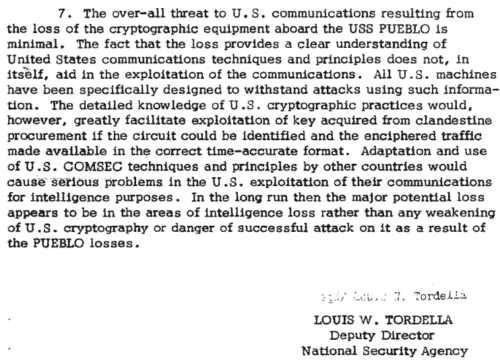
William Donovan’s duffel bag in the CIA museum

4MP Night Color Vision Cameras to Replace IR

Fundamentally I see artificial light at night as a form of pollution. It makes me cringe whenever I fly over cities at night all lit up like a garbage dump of lumens.

Clear vision in low light seems like exactly the sort of thing that technology could solve at scale the right way (enhance human vision to see dark as day) and improve the world in so many ways, when instead it was used the wrong way (very inefficiently emulate sunlight artificially).

Imagine cars with windscreens and mirrors that presented night roads as if it was still daylight, instead of having to constantly re-engineer headlight coverage.

This is why I’ve written before about night vision products, and about light risks in war too.

The good news is technology has been advancing quickly and a huge Chinese research company has announced commercial availability of 4MP Night Color vision to rival Standard IR

Popular Alabama County Sheriff Assassinated

Five on-duty law enforcement officers have killed in Alabama by gunfire this year, which carries a death penalty.

Such a penalty not only has proven to be no deterrent, in the latest killing the suspect was in no danger. He assassinated an extremely popular Sheriff and later just walked into custody with the gun in his hand.

Sheriffs essentially are a political position. In this tragic case the Sheriff’s political position was especially notable for three reasons.

One: An unpopular white man assumed historically unexpected control of Alabama after alleged electronic vote machine fraud

In 2002, Republican Bob Riley narrowly beat Democrat Don Siegelman in the Alabama gubernatorial race when several thousand votes from Baldwin County, Alabama, [87.3% white] mysteriously switched from Siegelman to Riley when Democrat observers left the polling place after midnight. “When Baldwin County reported two sets of results, it was clear to me that someone had manipulated the results,” said Auburn University political scientist James H. Gundlach in a report on the controversy, A Statistical Analysis of Possible Electronic Ballot Box Stuffing.”There is simply no way that electronic vote counting can produce two sets of results without someone using computer programs in ways that were not intended.” According to Gundlach, such electronic ballot-stuffing could be accomplished by having access to the “tabulating computer at some time before the election to install [a special electronic] card and after the election to remove the card.”

Two: That surprise Governor then attempted to push a white Sheriff into a black community and they very openly disagreed with him.

Lowndes County is predominantly black. It had a population of around 11,000 in the 2010 census. In 2007, more than 60 people gathered at the Lowndes County Courthouse to protest then-Gov. Bob Riley’s appointment of a white law enforcement officer to replace the county’s deceased sheriff. At the time, the county commission president said all five commissioners and other elected officials had recommended Williams, who is black, for the position.

Three: Instead of the plant of an unpopular white Sheriff by the unpopular white Governor, it was Williams — an exceptionally popular black veteran of military and law enforcement — who eventually was elected to the job. Willams just was assassinated by the young white son of a neighboring county’s Deputy Sheriff. As Williams was meeting a group of people at a store about a loud music complaint it was the Deputy Sheriff’s son who walked up unprovoked and fatally shot Williams reportedly in front of his own son.

..the sheriff was speaking with someone at the scene before William Chase Johnson got out of his truck and approached him. “William Chase Johnson exited his truck with his pistol in hand. William Chase Johnson approached “Big John” Williams without provocation and shot Sheriff “Big John” Williams while he was fulfilling his duties as Sheriff of Lowndes County, Alabama,” the suit states.

It is not clear yet whether and how race was a factor. However, it is clear that electronic voting fraud is real and this killing has the hallmarks of a political assassination, which already has seriously shaken the community. The suspect fled and then a few hours later returned to the scene on foot carrying the assassination weapon as he calmly turned himself in for arrest.

Defeated Governor of Kentucky in Last Days Pardons Child Abuse and Vehicular Murder

A Kentucky judge who was friends with the accused spent his retirement apparently to coerce a child victim of parental abuse to change her testimony.

Expressing concern over the “highly unusual circumstance” of [Judge] Mershon “confronting her directly and privately,” Eckerle sided with the prosecution, which contended that Mershon “altered” the victim’s memory, “and by using judicial coercion and intimidation, that he overcame her, causing her to claim falsely that she had lied (at) trial.”

When that didn’t work, because courts rejected false claims and suspected coercion, the judge somehow convinced the unpopular governor with only a few days left in office to pardon sex crimes. The judge continued to play a partial role by personally celebrating with the accused.

Mershon picked up Hurt at the state prison in La Grange on Friday and drove him to his mother’s house, the retired judge told The Courier Journal on Monday.

A child abuse expert weighed in the same story and correctly concluded this all an obvious abuse of the justice system.

Pamela Darnall, president of Family & Children’s Place, a regional child advocacy center that evaluates and treats children for sexual abuse, said she was shocked by the circumstances of the pardon. In general, children do not lie about sexual abuse, she said. “The research continually bears out that the majority of kids are not making it up,” she said. Darnall said she was disturbed that Mershon later sought out the victim, which the prosecution argued caused her to change her story. “These are people in power. This is a judge,” Darnall said. “This is what kids deal with when people who are the adults … pressure these kids.” Nor could Darnall understand Bevin’s willingness to pardon Hurt. “A leader steps in and says I simply believe it wasn’t true so I’m going to pardon him,” she said. “What kind of message does that kind of behavior send to our kids and send to adults who have lived with their secrets for so many years?”

In related news at the end of the story, the governor says murder with a vehicle is not murder.

Jerry Thompson was killed in 2014 when his vehicle was struck by a car driven by Wibbels. The governor wrote that Wibbles “was involved in a tragic accident and has been incarcerated as a result of his conviction for wanton murder. This was not a murder.”

Wibbels was driving in traffic such that he allegedly used an emergency shoulder to illegally pass when he struck Thompson’s vehicle head-on.