Nowhere did Adolf Hitler spend as much time during the Second World War — the dictator passed around 830 days in the bunkers at Wolf’s Lair. […] Hitler lived in this tomb, he worked and slept there. “It seemed as if the seven-meter-thick concrete walls that surrounded him figuratively, separated him from the outside world and imprisoned him in his madness,” said Polubinski. …where Hitler, his generals and marshals not only planned campaigns but also discussed the genocide of the Jews in detail.
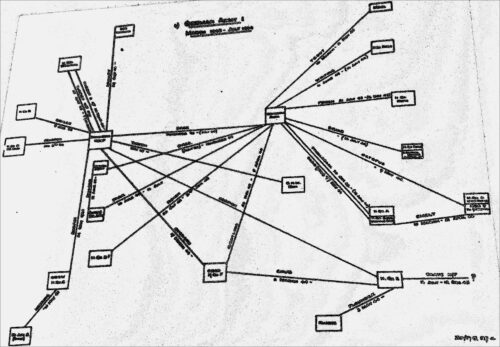
The highest and most sensitive Nazi communication ran on Lorenz, a cipher machine broken so badly that Allied intelligence built a 1943 map of the entire command structure heirarchy. Source: GCHQ
On the very far left is Rommel’s HQ (Army Group B), for example, which communicated through layers to Army HQ in the center-right.
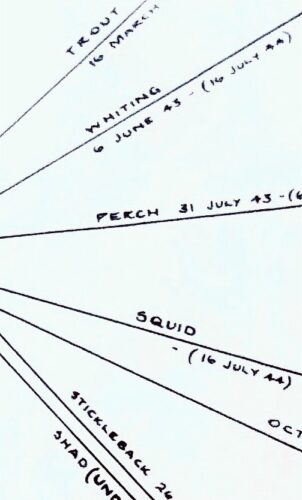
The British labeled Lorenz machine communication channels as “fish”, which you can see here in detail.
Decryption of the Nazi Army leadership allegedly was like shooting “fish” in a barrel.
After the war the Polish turned the Nazi HQ buildings at the heart of this map into a strangely “grotesque Disneyland” where locals would admire the concrete, fire toy German guns and play… things you rarely hear about.
All food for thought to those who ask me 1) can Putin avoid assassination and 2) when will he quit. The bigger question is how many generations will be lost for each month his delusions run in front of watchful eyes.
It’s no coincidence the extremist militant criminal partner of the Russian Army has been genocidally kidnapping children from occupied territory for indoctrination and servitude, after naming itself for the infamous Nazi “Wagner“.
…Wagner was the deputy commandant of the Sobibor extermination camp in eastern Poland. It was not a conventional concentration camp, because there was no work for those who arrived.
Sobibor was a killing center. Its production line was as sophisticated as a complex modern factory. In just 15 months, 250,000 men, women and children stepped off the train in the morning, were gassed by lunchtime and their corpses burnt before dawn the next day. By then their luggage had been sorted and packed for shipment to Germany. […]
He didn’t kill the same way as the other Germans. He didn’t shoot, he tortured…when he killed he smiled. Murdering was his pleasure — you could see it in his face. He didn’t consider it a duty, it was more his private matter.
Basically the Nazi children (Hitler jugend) were indoctrinated with fear and hate. Then they were forced into the unjust war their fathers already had lost, told they would be killed if they refused or surrendered.
If you didn’t know, now you do.
Delays in stopping a dictatorship’s known war crimes and ignoring ethnic cleansing has a clear precedent.
I’ve seen several people make comparison between current Russian military tactics and WWI. Here’s a new one.
Waves of young under-equipped Russian soldiers were driven to their death in barren battlefields devoid of life or purpose.
…the total number of deaths since February 24, when Russia launched its invasion, [increased] to 116,950. If these figures are accurate, Russia has now lost more troops in Ukraine than the U.S. lost during its involvement in World War I.
Three differences.
One: America in WWI saw a casualty rate of approximately 10%, and many of its dead were not from combat (e.g. disease). Russia at the same time, however, recorded a whopping 1,700,000 dead and a casualty rate closer to 80%. That alone should put any American perspective in different context.
Two: The article goes on to say that Russian propaganda today blames all deaths on the soldiers themselves, or their targets. There’s no discussion allowed in Russia of its leaders failing at invasion, because there is only lies about defending something, anything. That really changes the framing for dying in a war. Ethnic cleansing and genocide of Ukrainians has been couched in bogus language of “defense”, which intends to mobilize every Russian into dying starved and alone in a muddy trench.
Three: Many Russian casualties are from shooting each other to achieve some criminal form of power, avoid accountability, and force direction… within a flaccid masculinity system that runs on graft and corruption. Russian cemeteries quickly are filling up today from a 20th century suicidal grind, by design.
Those three big points make it hard to say the historic American WWI experience or perspective, let alone 100K dead, are going to motivate anyone in Russia to listen. It’s perhaps safe to say instead that Russia is engaged in antiquated/primitive strategies of mass mobilization, leaning on heavy artillery and human waves of frontal assaults to reduce target areas into rubble without any meaningful gains (huge waste, which leads to weakness and then destabilization). That’s the better comparison to WWI.
Update January 25: Estimates for Russian soldiers killed are already much higher, closer to 200K.
The era of the telegram came to an end in Germany with a final flourish of thousands of the once-popular message service, the country’s main postal service, Deutsche Post, said Wednesday.
Deutsche Post said that 3,228 telegrams were dispatched on the final day of service on New Year’s Eve.
Kinda curious if the last word someone paid to send was “stop”? The cost of operating and using it had gotten quite high.
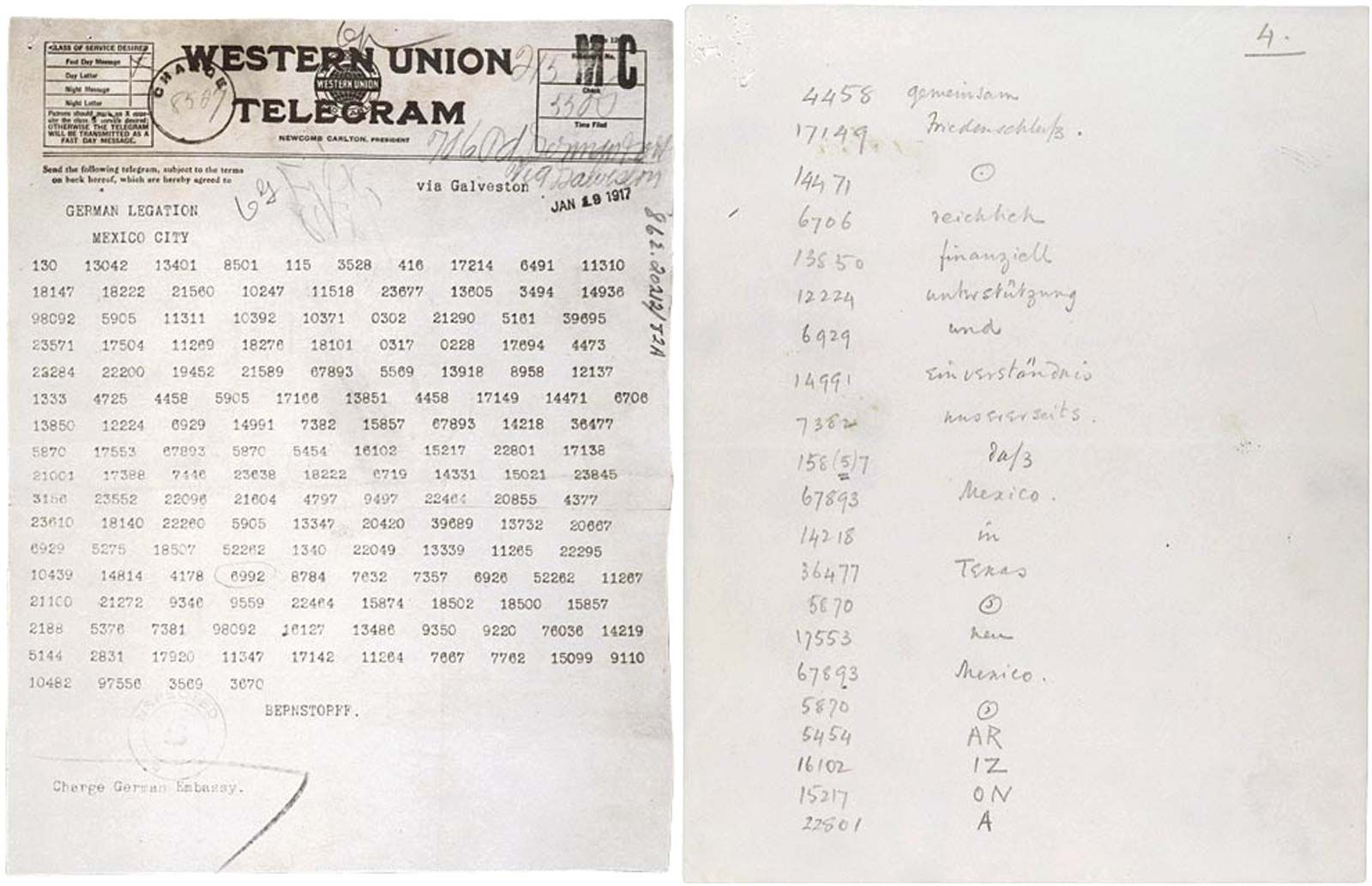
The canonical example is when German foreign secretary Arthur Zimmermann sent the following encrypted text to Germany’s minister in Mexico on January 16, 1917.
Encrypted left. Decryption work right. Click to enlarge.
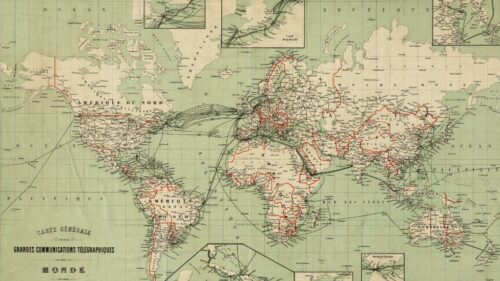
You may notice the telegram says “via Galveston” (Texas) but more importantly it routed through England. The British at the start of WWI severed cables connecting Germany to the world in order to intercept all its telegrams.
WWI map of global telegram cables. Source: BBC
The British delivered a decrypted version of Zimmerman’s telegram to the U.S. government on February 24. The text also was exposed by the press on March 1, raising public anger immediately about a German military alliance with Mexico and Japan carrying threats of invasion.
Public knowledge of these secret German plans was how the British government helped American public opinion overcome powerful leaders trying to aid Germany (i.e. Henry Ford) and shift the balance of power to better men.
Most notable, perhaps, was that former President Theodore Roosevelt along with the U.S. Army Chief of Staff (former commanding officer of the famous “Rough Riders”) had heavily promoted active response to aggression. Roosevelt objected since the start of WWI to America being passively in alignment with Germany, and objected even more in 1915 when “America First” became Wilson’s racist campaign for re-election (including a restart of the KKK).
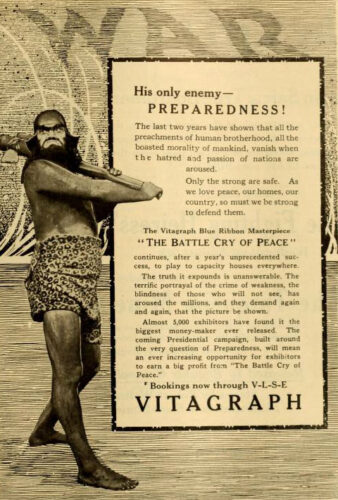
Roosevelt instead campaigned for a civilian Preparedness Movement to ready America for defense of freedom.
1915 film “The Battle Cry of Peace” promoted by U.S. Army General Leonard Wood and former President Theodore Roosevelt
Basically, in the two years before the Zimmerman telegram exposed Wilson’s treachery, Americans had watched their President fraudulently blame “leftists” and “labor” for a growing “holocaust” of German attacks bombing cities, burning factories and sinking ships.
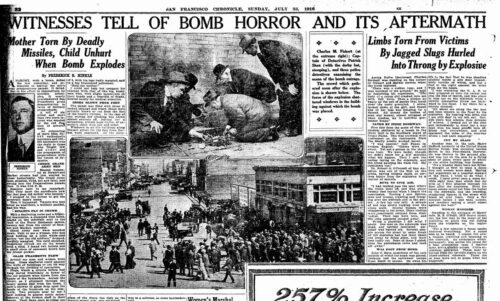
When a Preparedness Day parade was bombed by German military intelligence, for example, Wilson had for years before secretly been advised of this and related plots. On July 22, 1916 (just eight days before the infamous Black Tom explosion in NYC) a massive explosion rocked downtown San Francisco and killed 10 people.
Source: SFGate
Authorities under Wilson, despite strong counter intelligence, intentionally ignored their known and obvious German suspects and instead falsely used the violence as pretense to target “leftist organizers”. Today it’s known as a “one of America’s darkest miscarriages of justice”.
Think about the outrage then if Wilson had been caught enabling a foreign military to kill Americans so he could win elections (e.g. what Richard Nixon also did).
If that sounds like something the GOP still would do today, you know now exactly why Donald Trump calls himself America First when he invites Russian attacks and divisively blames “leftists” for everything. Separatist movements in 2016 America driven by foreign adversaries? Sounds like a memo straight out of 1916 Germany.
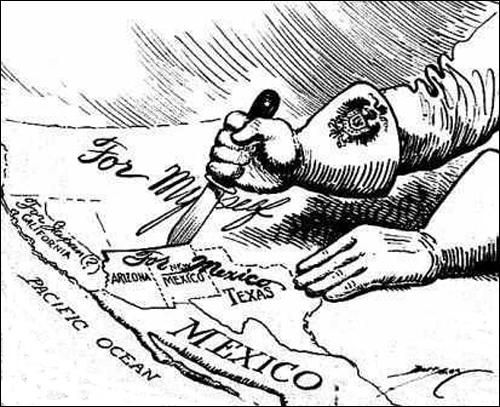
Public knowledge of secret German military plans abruptly destroyed best attempts by Henry Ford and Woodrow Wilson to side with the enemy of America. Note how California was labeled as property of Japan, an often overlooked detail that foreshadowed internment camps 30 years later.
After the British vociferously exposed the public to German secret communications, Wilson no longer could sustain such devious German alignment meant to fraudulently blame foreign military attacks killing Americans on domestic political opponents.
In April 1917 the unpopular U.S. President finally had his hands tied and Americans very quickly joined the war against Germany, with thanks to the leadership of Roosevelt and England, not to mention poets such as Alan Seeger (American soldier in Foreign Legion of France) who in 1916 wrote “I Have a Rendezvous with Death”.
I have a rendezvous with Death
At some disputed barricade,
When Spring comes back with rustling shade
And apple-blossoms fill the air—
I have a rendezvous with Death
When Spring brings back blue days and fair.
It may be he shall take my hand
And lead me into his dark land
And close my eyes and quench my breath—
It may be I shall pass him still.
I have a rendezvous with Death
On some scarred slope of battered hill,
When Spring comes round again this year
And the first meadow-flowers appear.
God knows ’twere better to be deep
Pillowed in silk and scented down,
Where Love throbs out in blissful sleep,
Pulse nigh to pulse, and breath to breath,
Where hushed awakenings are dear …
But I’ve a rendezvous with Death
At midnight in some flaming town,
When Spring trips north again this year,
And I to my pledged word am true,
I shall not fail that rendezvous.
Powerful stuff, and Roosevelt was a legend (pumping out preparedness books, movies, speeches), but nothing overcame Wilson’s secret executive alliances and elevated American public sentiment into active defense like that decrypted Zimmerman telegram.
Well done England.
Another interesting footnote is that the KKK had pushed for suffrage (white women voting) as a means to dilute Black votes, especially in “young” states like Montana.
This effect was seen clearly in 1917, after Germany had bombed major American cities, when Jeannette Rankin of Montana (first woman elected to Congress in her first term) voted against war authorization. Again in 1941, after Japan had bombed Pearl Harbor, Rankin voted against war (placing the only no vote). She expected America could align itself with Nazi Germany and Hitler.
Historians recently have pointed out something to better frame Rankin’s hard edge politics; “anti-labor” actions in 1917 were in fact planned attempts at ethnic cleansing or even genocide.
…after all of this research, the deportation was not a response to a labor action. It was that to a limited extent, but it was also in the nature of an ethnic cleansing.
Obviously she did not in any way represent Americans who weren’t white. She was especially toxic to Black women who had been rebuffed by racism of most white women’s organizations including Rankin’s suffrage groups.
Black women by comparison famously supported the war efforts and many served with distinction, despite attempts by Rankin’s carefully crafted role to erase them and their communities. This divide is what led into the tragic Red Summer and Wilson sending troops to massacre non-white Americans who had supported the war and even served in it.
Thus, one decrypted telegram from Germany also changed entirely the course of Civil Rights in America. Who knows what damage Rankin might have done if she hadn’t been exposed as part of American systemic racism.
The toxic America First platform in both WWI and WWII, a barely concealed front for the KKK, actively manipulated sentiment using highly targeted propaganda pushing white women to make their sons serve German interests instead. Obviously those efforts failed under the reality of German aggression that grew after WWI (modeling itself on Wilson and Ford), such that by WWII any mention of America First was labeled seditious.
Perhaps, with great subtlety, the fizzle and end of the historic German telegram thus signals something wider: the long overdue end to Wilson’s racist America First platform as well.
Elon Musk allegedly has citizenship in three countries and has served in none of them.
And he’s known for being a self proclaimed dumb blowhard, never knowing anything about what he’s talking about and not caring about consequences for being dead wrong.
His lack of experience, coupled with his lack of knowledge, coupled with his lack of accountability is on full display again as he tries to swing Twitter to support Russia (by interfering with smart military aid to Ukraine).
The mistakes Musk makes here are similar to all his mistakes. He tries to rush into shortcuts and drive at high speed off a cliff to the wrong conclusion.
Reports out of the Bay Area this morning say that a man and his 2014 were found at the bottom of a cliff off the 1A in Sonoma county north of San Francisco. The man was pronounced dead at the scene and represents the first owner fatality of a Model S driver. It isn’t clear yet if the crash was an accident. […] The crash represents the first owner fatality behind the wheel of a Tesla Model S though a stolen Model S that hit a pole at over 100mph and split in half killed the suspect who was then revived and died a few days later in Los Angeles. Tesla previously boasted how safe its Model S was including the 0 fatality record which will obviously have to be revised.
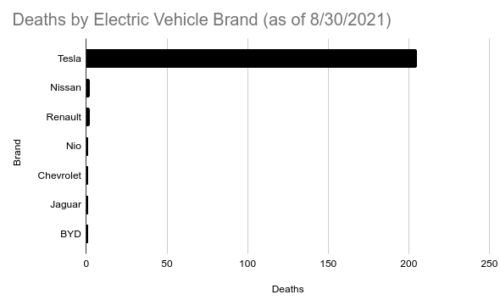
Tesla’s CEO “boasted… the 0 fatality record” in its first year with cars on the road. Since then it has gotten worse every year, allegedly killing more than all other EV companies combined. A death trap, by the numbers:
Deaths from a Tesla as of today have reached 348 (when using autopilot, 19), which is truly shocking when you consider just how fast that toll increases.
Source: tesladeaths.com
What is a death trap?
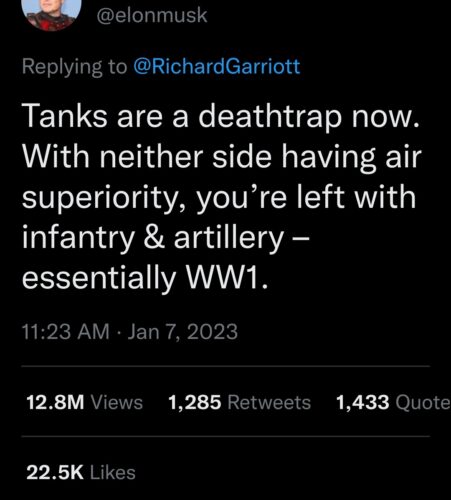
Ok, let’s start with what is a death trap in war?
Everything can be one in theory, because… it’s a war and by definition someone is turning everything they can into a trap.
A vehicle OR the lack of that very same vehicle could be a death trap.
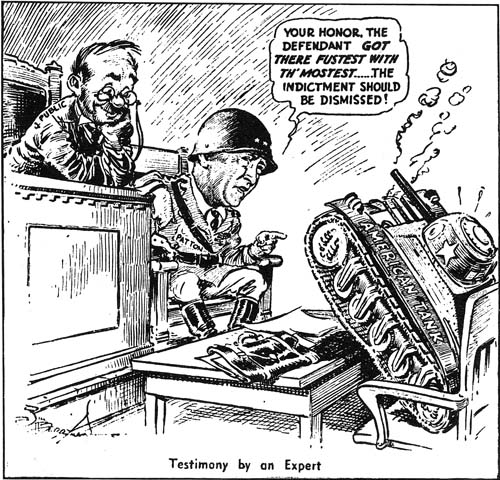
It’s like Eisenhower recognized that under General Fredendall tanks were a death trap, so he dismissed him and promoted General Patton who turned the same exact tanks into a victorious revelation.
Berryman news cartoon, Washington D.C. Evening Star, March 25, 1945. Source: “The Ordnance Department: On Beachhead and Battlefront” by Lida Mayo. Center of Military History U.S. Army, 1991. Chapter 17, p. 336-338
This is where experience and expertise matter. Many factors are required beyond a yes/no question (is it a tank), and nobody should be satisfied with such simplicity.
And yet an anti-democraticcon-artist like Musk thinks he can step in and manipulate uninformed public sentiment for some political reason.
But this isn’t a game, and Musk’s right-wing extremism repeatedly shows up as though he’s intentionally using his social media platform to get Ukrainians killed by Russia.
Musk should be shamed for soiling himself everywhere in public on Putin’s behalf, making actual experts clean up all their mess.
The recent clarion calls were meant to prevent exactly this kind of defecation from Musk.
…the idea that tanks won’t have a place in future wars is incorrect, said Maj. Gen. Patrick Donahoe, commander of the Maneuver Center of Excellence at Fort Benning. They absolutely will, he said, but they won’t be working alone. As Doland said, a “tank is really good, but a tank by itself, in some woods? Not really good.” […] “[Combined arms] is what prevents the lunacy we’re watching of what the Russian Army is doing,” Donahoe said. “I mean, you’ve just got to watch some of the videos of their forces being ambushed — they apparently are a poorly trained army that cannot fight as a combined arms team.”
The tank isn’t an inherent trap, any more than a plane or a building is inherently in all cases a trap after they are shot down and bombed.
When does something become a trap?
Hint: the answer has to do with being prevented from successful operation in any other capacity. That’s the nature of the brain-dead Tesla being centrally planned and controlled, definitely not the case with a properly deployed Bradley.
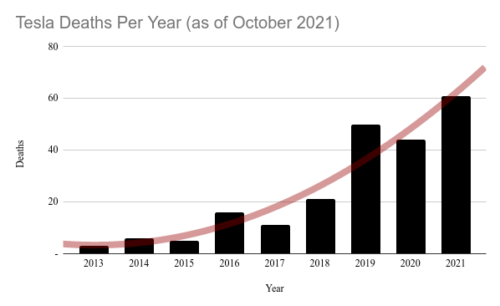
Suffice it to say that Tesla has provably been trending towards being classified a death trap since at least 2016 — worse year after year.
Source: tesladeaths.com
Any EV on the road is likely far safer, which is why for example a best-selling EV on the road for a decade (e.g. Nissan LEAF) reported zero recalls and zero crashes compared with Tesla’s growing lawsuits, complaints, investigations and funerals from far too many preventable deaths.
The Tesla CEO, as if aiming to repeat the worst chapters from the past, has rushed dangerous shortcuts and repeatedly wrong decisions with zero care for human life; delivering perhaps the worst engineering in history.
The Ford Pinto killed half as many people in fires as Tesla, for example.
You’d be safer in a Pinto because Ford was forced by regulators to stop making deathtraps, whereas Musk clearly ignores the definition, flaunts safety rules and doesn’t care about truth or consequences.
He told everybody he’s buying Twitter because he wants it to be sort of apolitical, and on the eve of the election he says you should vote for Republicans,” Lasoff told Insider. “He can have his opinion, but the thing I really despise in people is hypocrisy.”
John Byrne, a software CEO in Maryland, hadn’t been a huge fan of his 2020 Model X SUV for some time. He said it was creaky, vibrated at times, and was of an overall build quality that didn’t justify its $95,000 price tag.
But Musk’s behavior since the Twitter saga — particularly his broadcasting of right-wing views and attack on Anthony Fauci — was the final straw. Byrne traded in his car for an electric Audi in late 2022.
At this point, someone surviving death in or around a Tesla is headline news.
And that’s why Twitter and Tesla both are tanking. Musk knows tanks.
a blog about the poetry of information security, since 1995