
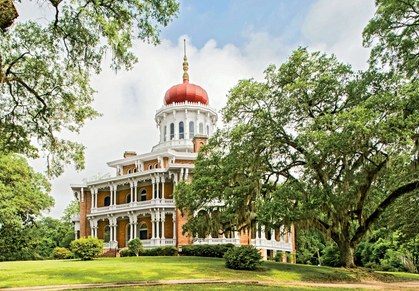
Was Devil’s Punch Bowl a concentration camp in Natchez?
Executive summary: To tell it accurately is to say it was an humanitarian crisis manufactured by bitter slaveholders who pushed Blacks towards death and desperation yet wanted it all to be blamed on anyone else (approaching Union forces abolishing slavery). American soldiers liberating Natchez from the Confederacy found opulent mansions stocked full of food and supplies; thousands of Blacks who were at the mercy of wealthy slaveholders had been forced into harsh weather practically unclothed and at starvation levels, requiring refugee camps and quarantine to stop spread of suffering.
General Eisenhower said this:
We are told that the American soldier does not know what he is fighting for. Now, at least, he will know what he is fighting against.
See also: “Deadliest Ground of the Civil War“, the 1864 Andersonville concentration camp.
Long form: One of the more annoying 1870s disinformation campaigns by remnants of the Southern Confederacy is to blame their own humanitarian disasters on liberating armies. “Devil’s Punch Bowl” in Natchez, Mississippi is one such example. Many thousands of slaves intentionally malnourished and denied basics like clothing or education were pushed upon Union forces, then fraudulently written into movies and books as entirely a Union disaster.
For some perspective consider when concentration camps of Nazi Germany were liberated, many prisoners died immediately or soon after. Nobody I know ever blames Auschwitz deaths after liberation on Allies, yet in terms of the Civil War it is common to hear the Union humanitarian efforts blamed for the Confederate slave deaths around Natchez.
At least 500 of the 4,500 patients died, many from refeeding syndrome or a lack of sanitary facilities.
I’ve met personally with survivors and liberators of Nazi concentration camps, who described tragic events to me such as a starved prisoner dying from care — eating a real meal too excitedly/quickly (something known well to anyone familiar with shipwreck history).
The first intake of food proved fatal for many prisoners, too weak from starvation to digest it. …the road to recovery would be long and painful.
And, again, nobody says Allies were killing the liberated German slaves yet that’s the talk track created by Confederates after the Civil War about Black American slaves.
The real story of Natchez is that it was one of very many camps setup to handle a refugee crisis that had been strategically manufactured by the Confederacy. After a long and brutal war started by the Southern Confederacy to perpetuate slavery, their former slaves totally dependent by design were in desperate state — in need of immediate food, shelter, clothes, education etc where none had been before.
I’ll say that again. The Confederates denied their slaves any freedoms or capabilities for self-care, while they also were denied care.
If image technology in the 1860s had been as advanced as it was in the 1940s, it’s almost certain General Grant would have done something with film as General Eisenhower did at the end of WWII…
When Eisenhower, then commanding general of Allied forces in Western Europe, learned of the concentration camps, he sent in film crews… Before the release of the photos to the public, “people heard about the tragedy of the Holocaust, and they heard statistics about it,” Prof. Brinkley says, “but suddenly to see the degradation of human life to such a degree just sort of turned the whole world’s head around. […] Photography was also crucial in highlighting the injustice of the Jim Crow South…
Here’s exactly what they mean, using an example from the Associated Press:
‘Once people saw those photos,’ says Prof. Brinkley, ‘they were repulsed by the Southern Jim Crow bigot system.’
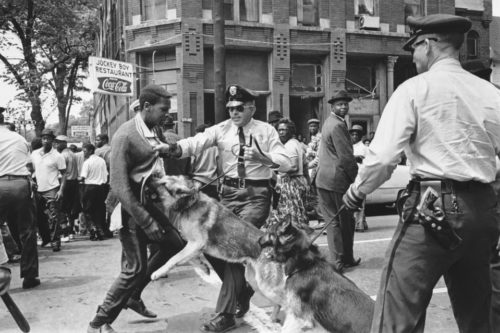
Photo: Bill Hudson/Associated Press. A 17-year-old civil-rights demonstrator is attacked by a police dog, May 3, 1963, Birmingham, Ala. President John F. Kennedy discussed this widely seen photo at a White House meeting the next afternoon.
Refugees of labor/concentration camps (e.g. American “plantations”) were essentially hostages of white police states of the South, afforded little or nothing to survive on their own because that would threaten the very existence of slavery.
Any concept of a capable Black man let alone a soldier, for example, was completely anathema to existence of the Southern Confederacy.
So forget about whether or not anyone has ever heard of an enslaved man picking up a weapon on the battlefield or wearing a uniform and marching with the army. No Confederate saw any of this as reflecting service as a soldier.
Whether or not Blacks saw themselves as emancipated, or were eager for military protection, they were seen by former captors as escapees who would be very cruelly abused intentionally if caught.
Natchez businessmen were undeniably in the disgusting business of what Union soldiers observed as profiteering upon human suffering — “getting gain by the oppression of the poor, the weak, or the defenseless”. The most helpless under this widespread exploitative tyranny of the South were set to become waves of humanitarian crisis uncovered by Union liberation forces.
Given emancipation and imminent loss of value to slaveholders, the least able hostages may even have been abandoned by Confederates — convinced to rush onto approaching forces and bog them down.
Even more to the point, Southern slave drivers had multiple selfish reasons for cruelly manufacturing a humanitarian crisis. Think about intending to profit from disaster by cornering supply markets needed during such a crisis; the Confederacy knew full well that approaching forces would be unprepared to handle large disasters and potentially create a new market for exploitation.
Such calculated cruelty was not far removed from General Lee’s infamous “butcher” tactics of denying aid to wounded soldiers on a battlefield, even murdering prisoners of war, not to mention miring down in hopeless trenches only to pointlessly increase death and suffering of his own men.
Below is a long albeit very insightful and clear-eyed write-up of the situation on the ground from a book in 1865, which should settle any debate on these matters:
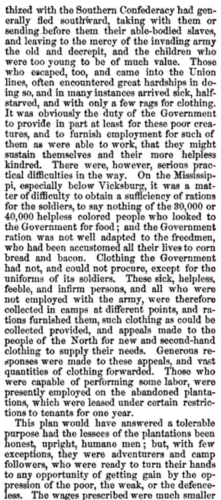
Here are a few highlights:
- “In the regions which were occupied by Federal troops, the planters [a term referencing a large number of slaves owned] who sympathized with the Southern Confederacy had generally fled, taking with them or sending before them their able-bodied slaves, and leaving to the mercy of the invading army the old and decrepit, and the children who were too young to be of much value.”
- “…in many instances arrived sick, half-starved, and with only a few rags for clothing. It was obviously the duty of the Government to provide in part at least for these poor creatures, and to furnish employment for such of them as were able to work, that they might sustain themselves and their more helpless kindred.”
- “…especially below Vicksburg, it was a matter of difficulty to obtain a sufficiency of rations for the soldiers, to say nothing for the 30,000 or 40,000 helpless colored people who looked to the Government for food…”
- “…with few exceptions [plantation owners] were adventurers and camp followers, who were ready to turn their hands to any opportunity of getting gain by the oppression of the poor, the weak, or the defenseless… no physician was allowed [by plantation owners to see the emancipated slaves]… nor were they furnished with food according to agreement… [such that plantation owners] made large fortunes on the single year’s labor.”
- “…overcrowding, want of ventilation, malarious localities, prevalence of small-pox, want of medical attendance, poor and insufficient food, and lack of clothing. […] At the camp at Natchez, where there had been 4,000 freedmen, the number was reduced to 2,100 by deaths, from fifty to seventy-five having died per day during July and August.”
In short, the area known for the highest concentration of wealth generated by slavery also somehow had the highest number of Blacks approaching total destitution. 40,000 refugees from liberated Confederate labor camps (“plantations”)!
Mind you this all was published in 1865 and was no secret. Letters from around December 1863 even speak to raising awareness of the calamity, such that northerners would immediately send aid.
The population of coloured people here, during the past year, has been some 4000. There have been 1100 deaths. This statement tells the story. […] And from exposure they cannot avoid, Pneumonia, Small-pox, and other diseases incident to camp life, are on the increase and more fatal.
The Confederacy tactically denied able-bodied slaves their emancipation (setting up the continued servitude under men like Jack Daniel even after emancipation) and then pushed masses of their mistreated, ill and infirm towards approaching Union troops.
Union troops were still concentrated to the East (where fighting was heaviest) and slave owners shifted west, hoping to avoid giving up slavery (Texans not to mention Californians continued slavery feeling protected by “remoteness“).
Here’s an excellent retelling of the situation in a report archived from the Natchez National History Park.
No formal action was taken by Union forces to occupy Natchez until after the fall of Vicksburg to Maj. Gen. Ulysses S. Grant’s army on July 4, 1863. Two weeks later, Brig. Gen. T. E. G. Ransom occupied the town and found it well stocked with sugar, cotton, and lumber. Ransom also overtook, a few miles from Natchez, 5000 Texas cattle being driven toward Confederate forces in the east. By mid-summer of 1863, Natchez was securely in Union hands.
Well stocked with food and supplies? Keep that in mind now as the report continues.
Almost immediate with its occupation, Union forces in Natchez were overwhelmed by a stampede of black refugees from the countryside. Hundreds of district slaves had been on the run since summer of 1862, hiding out in the countryside as best they could. Many had fled the plantations to avoid being taken by their masters deeper into the Confederacy, to Texas and Georgia. Others had hid out with their families, hoping to find their way north. But once Vicksburg fell, the momentum became a tidal wave of humanity, much of it cascading in the direction of Natchez.
General Ransom eagerly sought orders on what to do with the refugees: “I also desire some instructions as to what policy I shall pursue with regard to the negroes. They flock in by the thousands (about 1 able-bodied man to 6 women and children). I am feeding about 500 and working the able-bodied men among them. I can send you any number encumbered with families. I can not take care of them. They are all anxious to go; they do not know where or what for.”
One of General Grant’s corps commanders at Vicksburg responded with alacrity if not much practical advice:
With regard to the contrabands, you can say to them they are free, and that it will be better for them, especially the woman and children, old and infirm, to remain quietly where they are, as we have no means of providing for them at present.
Note that line “…avoid being taken by their masters deeper into the Confederacy, to Texas and Georgia…“.
Confederates were starving women and children then abandoning them, holding hostage and driving able-bodied slaves into Texas while driving thousands of cattle out of Texas to feed white supremacist militias in the East.
Note also this explains an intentionally cruel redistribution plan of the Confederacy; why the means of providing for refugees suddenly became so difficult despite a town known for massive wealth accumulated that had been “well stocked with food and supplies”.
Here you can see a preference to emphasize freedom, which logically meant at that time for “freemen” to stay “where they are” and start working and living for themselves. Mass migration of people liberated from the concentration camps (“plantations”) of the South couldn’t be a favored option of the Union for the simple fact that it led into a logistical and humanitarian crisis they did not want.
This report also goes on to say the Union offered immediately hiring liberated prisoners as soldiers.
With regard to the men who are strong, able-bodied, and will make good soldiers, you can bring them along with you [to Vicksburg] if they are willing to come and will leave their families behind.
This certainly undermines any notion that the Union army didn’t give the refugees they encountered some control or a role in their own destiny.
Remember how I pointed out the note about Texas? That reference is important because by the time General Granger and his 1,800 men in Texas issued their famous Juneteenth (June 19, 1865) order to free all slaves, it’s estimated 250,000 Americans were being concentrated there by the fast retreating Confederate soldiers and held under violent oppression.
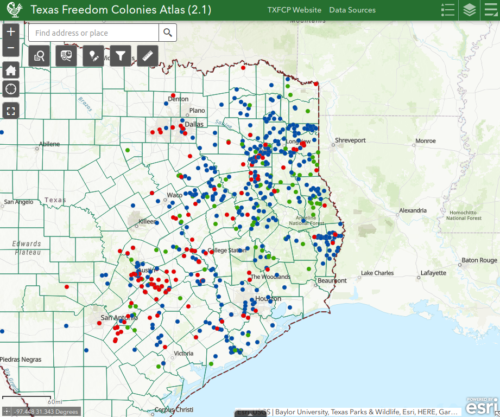
Can you imagine what it was like for these 1,800 American soldiers facing the logistics of liberating 250,000 hostages from the Confederate South?!
Again, an important point here is Granger’s precise wording in Texas had very specific orders to remain in place instead of approaching military posts. Obviously he was heading off further humanitarian disaster fomented by lingering Confederate sympathizers in this region of Texas, Louisiana and Mississippi.
The people of Texas are informed that, in accordance with a proclamation from the Executive of the United States, all slaves are free. This involves an absolute equality of personal rights and rights of property between former masters and slaves, and the connection heretofore existing between them becomes that between employer and hired labor. The freedmen are advised to remain quietly at their present homes and work for wages. They are informed that they will not be allowed to collect at military posts and that they will not be supported in idleness either there or elsewhere.
Granger not only was aiming to avoid refugees overwhelming Union forces coming to give them freedom, he also likely recognized the need to keep people where they were to avoid concentration of supplies. Indeed, slaveholders had cruelly started to profit from a disaster of their own making by afterwards cornering and corrupting emergency supply markets, spiking costs to increase suffering similar to exploitation seen in the 2021 Texas energy outages (again blaming all of it on someone or something else).
Asking freemen to continue working in place as opposed to gather around Union forces served dual purposes in preventing further human exploitation by white families of the Southern Confederacy.
We’re talking here about white families who after 1808 had very purposefully created a system of state-sanctioned rape of women for forced births (all white men were encouraged to rape Black women to increase birth rates for profit) as well as buying and selling humans — don’t be distracted by other industries (e.g. agriculture, especially cotton) as it was all about mass exploitation of Black women and their children.
…[profit from raping Black women and using or trading their children as property meant] the African-American population in the South also rose from approximately 700,000 in 1790 to nearly 4 million by 1860. By the mid-19th century, the majority of the nation’s [enslaved Black children were] raised in Mississippi, Alabama, and Louisiana, and nowhere in the antebellum South was [human trafficking] more dominant than Natchez, Mississippi, which was “…the wealthiest town per capita in the United States…” on the eve of the Civil War
Natchez operated as the second largest slave market for all the slave states. The region’s “boom” came directly from human trafficking, make no mistake about it. Yale historian David W. Blight put it like this in his 2008 lecture:
In 1860, slaves as an asset were worth more than all of America’s manufacturing, all of the railroads, all of the productive capacity of the United States put together. Slaves were the single largest, by far, financial asset of property in the American economy.
Look at it this way: states where slavery had been abolished (Vermont being the first in 1777) produced far more agricultural goods yet were opposed to slavery as a path forward in wealth generation.
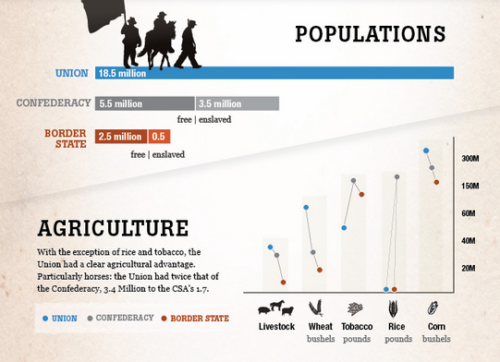
Meanwhile an average of 30% of the population in slave states owned slaves and for what? It was all about wealth generated from treating humans as property.
To make an even finer point, the term “planter” in Mississippi was the official economic term and reference to the number of people held hostage and NOT any measure of any other output or goods.
Once a white American had dehumanized another person, they treated slavery like asset wealth, like someone today might think about owning a house or a car. Buying a young Black woman to rape, and then rape all her daughters, was treated by American men like financial planning (as documented clearly in Incidents in the Life of a Slave Girl).
Southern women often marry a man knowing that he is the father of many little slaves. They do not trouble themselves about it. They regard such children as property, as marketable as the pigs on the plantation; and it is seldom that they do not make them aware of this by passing them into the slave-trader’s hands as soon as possible, and thus getting them out of their sight.
In Mississippi alone the state-sanctioned raping and trafficking of Blacks had created a slave population of 437,303 by 1860. A full 99.8% or 436,631 of Blacks in the state were owned by a white family. That’s a Black population entirely enslaved and nearly 100,000 larger than the entire white population.
Thus obvious economics of human trafficking translated into a huge amount of wealth for the slavers as they systematically raped Black women, tortured Black men, and controlled every aspect of Black lives including food, shelter, behavior, health, and even religion.
Remember that absurdly huge brick mansion picture at the top of this post? I set it there to show the kind of largess from funds in Natchez all due to slavery.
Can you estimate how many women were raped or their children ripped from them and sold to pay for the opulent displays of wealth in Natchez, or how many slaves had starved to death in order for giant mansions to host elaborate dinner parties?
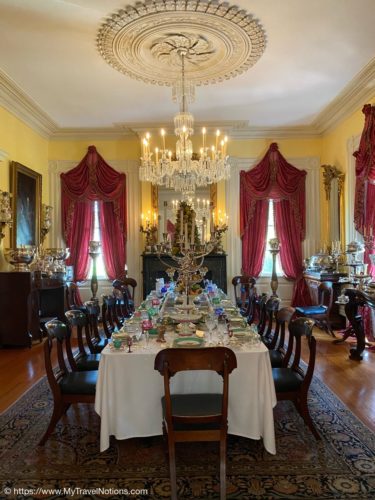
That should be in your head when you read about the Union troops who approached this area of “heavily concentrated wealth” where slaves suffered under total control of rich masters.
To put this in context of Nazi Germany, this was reported as: “Auschwitz commander who sent youngsters to gas chambers then went home to play hide and seek with his children”
Maid Janina Szczurek, 32, said; ‘He tucked his children into bed every night and he kissed his wife each morning. He wrote poems about the ‘beauty of Auschwitz.’ ‘On one occasion, the children came to me and asked me to sew bands with signs for them, just like the ones worn by the prisoners. I was not aware of what the consequences would be from this. ‘Klaus put a ‘capo [trusty]’ band on his sleeve, and the other children had the coloured triangle sewn to their clothing. ‘The happy children, running around the garden, met their father, who noticed the signs and took them into the house. I don’t know what happened but he was not pleased.’
Imagine finding tens of thousands of starving, barely clothed illiterate and ill refugees from these American concentration camps of the Confederate South, surrounding elaborate mansions stuffed with supplies… yet suddenly they are pressed upon Federal government for desperate care.
And now think about politics today in these former slave states where rich white politicians infamously demand no care be afforded the poor.
Devil’s Punchbowl of Natchez was completely a manufactured crisis by the defeated Confederacy loyalists, which was designed to maximize suffering of emancipated slaves. It was a heartless scheme for profit from loss on top of the mass suffering in a war they started.
Sadly, that disgusting plan of the Confederates worked all too well. As historians have said about the victims of Nazism, “the road to recovery would be long and painful” for slaves of the Confederacy after liberation. It even explains American “tipping culture” today.
It’s fair to say the Union military was ill-equipped (having supplies heavily stretched even for its own purposes) and unprepared to handle the crisis thrown upon them. And it was even worse off trying to work through the cruelty of defeated Confederates trying to swindle and cheat the refugee/freedmen system to increase suffering and spin a false narrative that any suffering of the most weak and ill should be blamed on their liberators.
Think about the Nazis blaming deaths of their prisoners on liberation by Allies; that’s what Devil’s Punchbowl sounds like when the (obviously biased) voices out of Mississippi try to say it was liberation that caused a humanitarian crisis for slaves.
Let me break down briefly how the Confederate propaganda works, even to this day:
- “Mostly women and children” — the Confederates relieved themselves of any responsibility for own slaves (given emancipation eliminated human trafficking market), as well as created as much burden on the approaching Federal forces as possible. Thus these populations in dire need of assistance and put into refugee camps hastily, were a direct result of what the Southern Confederacy so cruelly practiced; to abandon their own weak, ill and infirm, including elderly, women and children.
- “Men were put to hard labor” — the Union records indicate how able-bodied freemen were happier and healthier when assigned work and purpose. Chopping wood is cited, for example, and the Union encouraged this independence and self-sufficiency within the refugee camps. They also could choose the hard work of becoming educated and soldiers, which obviously opened up even more safety to them. The Union Army in several places notes that freemen who took over plantations operated them better because harder working than the white plantation owners who refused to do any work at all (dependent entirely on fraud like slavery and/or theft of wages).
- “Emancipated slaves were not allowed to leave, had to bury own dead” — the spread of small pox and other communicable diseases easily explains why movement was limited, not to mention lack of food and clothing made movement in harsh weather questionable (temperatures were reported as both extreme hot summer and cold winters, very humid). Quarantine and shelter-in-place are unfortunate refugee tactics but a reality of preventing worse disasters.
Some clues of propaganda also are easy to find. One is the number of dead being wildly overestimated without any source material. Every article on the Internet claiming 20,000 dead is to be seriously doubted. There’s no evidence of that anywhere and none of the articles give a source.
Also a clue is when no dates are mentioned anywhere. When was a camp setup? On what timeline did people die such as per day? Which months had highest death rates? Were people denied leave specifically to prevent spread of small pox?
As you can see in this post I’ve provided answers to all of these, in a way that can easily be verified by anyone else. The answer to “Was Devil’s Punch Bowl a concentration camp in Natchez” when the Union forces came is like the answer to “Was Auschwitz a concentration camp after it was liberated by Allied forces”.
Never forget that Union troops liberating Natchez found it stocked full of food and supplies while thousands of Blacks at the mercy of wealthy slaveholders were left unclothed and at starvation levels, requiring quarantine where disease began to spread.
Speaking of disease quarantine history in America, if you really get into the regional examples of camps, look at May 1802 when small pox broke out in New Orleans (still under Spanish rule at that time, about 200 miles away by boat on the Mississippi river).
The new governor of the Mississippi Territory William C. C. Claiborne, appointed by Jefferson, barred sale of goods from Louisiana, used a new health law to force vaccination (newly popularized by England in 1797) and prevent variolation (a risky practice started after 1721)… then he created a “small pox camp” just outside Natchez.
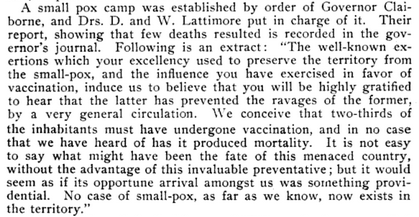
As small pox broke out among those forced into being refugees by retreating Confederates, someone very likely thought back to the Claiborne forced containment model outside Natchez.
Thus when people criticize the Federal government in 1863 for using methods that reportedly worked in 1802 to stop disease spread, they need to explain the difference.
Going back even further in time, Natchez is in fact the name for the people native to this area for a 1,000 years… who also in the 1700s were greatly affected by small pox because there was no quarantine.
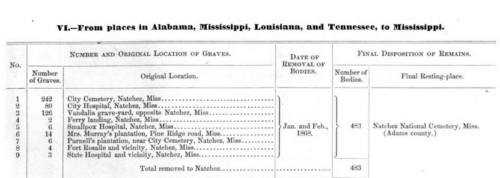
A high death toll from small pox in the Natchez region around the time of Civil War is therefore detailed and easily reviewed in Union Army records such as this one from 1868.
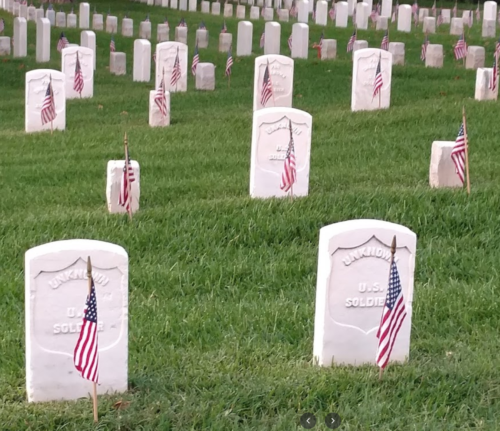
In conclusion it’s wrong to allow the Devil’s Punchbowl propaganda to continue, since a Confederate humanitarian disaster strategy shouldn’t be blamed wholesale on the Union being ill-prepared to respond. Abrupt care en masse (collapse of Confederate slavery) was a non-trivial problem for the Union military to solve, hopefully for obvious reasons.
Devil’s Punchbowl narratives thus spread from calculated slaveholder strategy to exploit emancipated slaves and harm the Union for selfish gain, as ever. It mostly continues as a propaganda campaign based on a grain of truth turned into a pernicious lie about America.
To tell it accurately is to say it was a humanitarian crisis manufactured by bitter slaveholders who pushed Blacks towards death and desperation yet wanted it all to be blamed on someone else (approaching Union forces abolishing slavery).
For further reading, as THE BLACK EXPERIENCE IN NATCHEZ 1720-1880 puts it on page 180…
The relevant secondary literature affording insight to the black experience in Natchez in the post-war era from 1865 to 1880 is immense. Among the most important works are the following:
- Martha Mitchell Bigelow, “Freedmen of the Mississippi Valley, 1862-1865,” Civil War History VIII (March. 1962). pp. 38-47;
- Ronald L.F. Davis, Good and Faithful Labor: From Slavery to Sharecropping in the Natchez District. 1860- 1890 (Westport, Conn., 1982);
- Michael W. Fitzgerald, The Union League Movement in the Deep South: Politics and Agricultural Change During Reconstruction (Baton Rouge, La., 1989);
- James Wilford Garner, Reconstruction in Mississippi (Gloucester, Mass., 1961, reprint of 1901 edition);
- Kenneth S. Greenberg. “The Civil War and the Redistribution of Land: Adams County, Mississippi, 1860-1870.” Agricultural History XLII (April, 1978), pp. 292-305;
- William Ivy Hair, Bourbonism and Agrarian Protest: Louisiana Politics, 1877-1900 (Baton Rouge, La., 1969);
- William C. Harris. The Day of the Carpetbagger: Republican Reconstruction in Mississippi (Baton Rouge, La., 1979);
- Presidential Reconstruction in Mississippi (Baton Rouge. La.. 1967);
- Richard J. Haws and Michael V. Namorato, “Race, Property Rights, and the Economic Consequences of Reconstruction: A Case Study,” Vanderbilt Law Review 32 (1979), pp. 305-326;
- Jane Sharp Hermann. The Pursuit a Dream (New York, 1981);
- William E. Highsmith. “Louisiana Landholding During War and Reconstruction,” The Louisiana Historical Quarterly XXXVIII (January, 1955), pp. 39-54;
- George D. Humphrey, “The Failure of the Mississippi Freedmen’s Bureau in Black Labor Relations, 1865-1867.” The Journal of Mississippi History XLV (February, 1983). pp. 23-37;
- Gerald David Jaynes, Branches Without Roots: Genesis of the Black Working Class in the American South, 1866-1882 (New York. 1986);
- Marshal Scott Legan, “Disease and the Freedmen in Mississippi during Reconstruction,” The Journal of the History of Medicine and Allied Sciences XXVIII (July, 1973), pp. 257-267;
- Billy W. Libby. “Senator Hiram Revels of Mississippi Takes His Seat, January-february, 1870,” The Journal of Mississippi History XXXVII (November. 1975). pp. 381-394;
- John R. Lynch, The Autobiography of John Roy Lynch (Chicago. 1970. reprint edition);
- William Alexander Mabry, “Disfranchisement of the Negro in Mississippi, “The Journal of Southern History IV (August. 1938), pp. 318-333;
- Neil R. McMillen, Dark Journey: Black Mississippians in the Age of Jim Crow (Urbana, 111. 1989;
- Donald G. Nieman, “The Freedmen’s Bureau and the Mississippi Black Code,” The Journal of Mississippi History XL (May. 1978, pp. 91-118;
- Whitelaw Reid, After the War – A Tour of the Southern States. 1865-1866 (New York, N.Y.. 1965. reprint of 1866 edition);
- George A. Sewell and Margaret L. Dwight, Mississippi Black History Makers (Jackson, 1984 edition);
- Jesse Thomas Wallace. A History of Negroes of Mississippi from 1865-1890 (Clinton, Miss., 1927);
- Vernon Lane Wharton, The Negro in Mississippi, 1865-1890 (New York, NY., 1965, reprint of 1947 edition);
- B.I. Wiley, “Vicissitudes of Early Reconstruction Farming in the Lower Mississippi Valley,” The Journal of Southern History III (July. 1937), pp. 441-452;
- Theodore B. Wilson, The Black Codes of the South (University, Ala., 1965).