Category Archives: History

Carl Orff and the Swastika: a Correlation German Schools Should Count

Der Spiegel reports that Germany’s schools have learned to count antisemitism. Their April 24, 2026 edition draws a picture from a survey of the state education ministries.
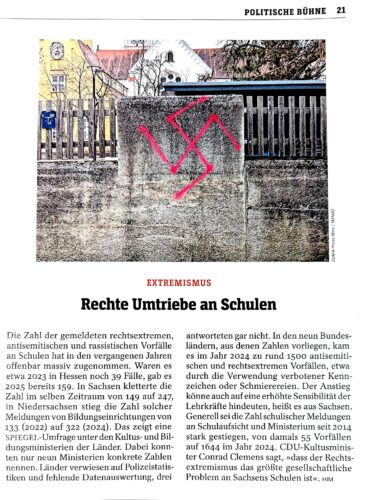
Source: Der Spiegel. April 24, 2026
  • Hesse went from 39 reported far-right, antisemitic, and racist incidents in 2023 to 159 in 2025.
  • Saxony rose from 149 to 247 over a comparable window.
  • Lower Saxony climbed from 133 in 2022 to 322 in 2024.
  • Across the nine states that gave figures, roughly 1,500 antisemitic and far-right incidents in 2024 alone, much of it banned symbols and graffiti.
  • Saxony’s education minister, Conrad Clemens of the CDU, called right-wing extremism the single largest societal problem in his state’s schools.

As always, the figures have context that matters. The comparison windows do not line up. The ministries themselves claim, without data to back it up, that teacher sensitivity improved. Saxony’s separate count of all school reports to the authorities, from 55 in 2014 to 1,644 in 2024, is incidents reported. Where’s the proof that this has anything to do with better sensing? Most people say the opposite, that sensitivity to antisemitism is declining, which is why the acts have been increasing.

The 1,500 is a self-reported number with three states declining to answer. Declining to answer certainly doesn’t sound like improved sensitivity. The direction is not in doubt, and the most obvious apparatus is still the point: the German system can still see the swastika sprayed on the schoolyard wall as a bad thing, and is registering more every year.

What the German justice machinery cannot see

There is a particular thing this counting does not do, and it is because of how some of the worst antisemitism in Germany worked hard to normalize itself after 1945. It is in the music room.

A great many of these same schools teach music through a method that carries Carl Orff’s name. His name shouldn’t even be on it, given most of the work is Gunild Keetman’s and the framework beneath it is Leo Kestenberg’s. Putting Orff’s name on the cover is the least accurate thing about it, and the parents allow it typically because they claim no knowledge about Orff’s huge importance to Hitler. The spread of his name to children is because there remains no standardized curriculum. One of the largest figures in Nazi music arrives as though he were merely an introduction to the instruments, as if his face and name on the cover carried no more weight than any other pedagogy.

Carl Orff was forty-one and remained obscure as a composer when Hitler seized power. His full two decades of work had produced no breakthrough and he was unknown; this is partly why he himself dated the beginning of his real career as 1937, when he premiered Carmina Burana. His career began, according to him, four years after Dachau had been destroying opposition to Hitler, and on the doorstep of Kristallnacht and the Nazi invasion of neighboring countries.

The success came with and because of the Third Reich, and he secured it by courting the regime’s officials when he needed to and by using adherence to the Reich to overcome the regime’s conservative critics by winning the regime’s favor. He left the Nazi dictatorship with a high fixed income, high praise and official favor, and his highest honor of all the Nazi Gottbegnadeten exemption. The regime protected and rewarded him for serving it, at the same time it was executing men like his friend Kurt Huber, whom he refused to help.

After Hitler committed suicide he fraudulently told the Americans that the Nazis had disliked his music and that no Nazi critic had ever given him a good review. Both claims were patently false and easily disproved. Fritz Stege, a Nazi critic, reviewed him favorably. Orff had lied during the denazification process because it was based on whether he had been a beneficiary of the regime. Not only had he been a huge beneficiary, the openings he took existed only because Jewish musicians had been banned. Orff after 1945 even falsely claimed the valor of his dead friend Huber as his own. He lied repeatedly in many ways to launder his role in the Reich into a “grey” post-war curriculum work. And as a matter of fact, to his very last day he never, ever criticized Nazism or Hitler. Asked about it point blank, Orff wouldn’t condemn the Reich.

The ground he claimed and rose on, his career “success”, was made by force against Jews. When the regime wanted a score to replace Mendelssohn’s banned music for A Midsummer Night’s Dream, several composers turned the commission down. Werner Egk waved off a generous fee. Richard Strauss declined. Even Hans Pfitzner, an antisemite, refused, on the grounds that Mendelssohn’s original was better than anything he could have written. Orff took it. Schulwerk was set for trials in Berlin’s elementary schools in the early 1930s, arranged through Leo Kestenberg, the official in the Prussian education ministry who knew the method and could open the door. The trials never happened. Kestenberg, a Jew, was dismissed in 1933, and the door closed with him. Orff was an opportunist, which was worse than an ideologue, because the ideologue at least held values. Long after the ideologues were caught and stopped, Orff was still rising because he benefited from erasure of Kestenberg.

So here is the question Germany needs to start answering: wherever Orff is taught, does the swastika correlate? No registry tracks it. No ministry counts it. The people best placed to report it cannot, because they do not know how to classify the correlation of a Reich celebrity the children are being told to learn about.

The missing column

That absence of evidence is usually mistaken for evidence of absence. It is, instead, the evidence. A system that has assembled an elaborate apparatus to count antisemitic incidents has no field at all for the antisemitic history sitting inside its own music curriculum. It tallies the graffiti while it teaches the erasure of victims, and registers no contradiction, because the second item never enters the ledger. You cannot regress on a variable the institution refuses to admit let alone name.

Anyone saying Orff should not be removed from a wall, unlike the swastika, needs to answer for why only Orff is on that wall and not all the people removed so he could be there at all.

The numbers from the ministries describe a system straining to see what is sprayed on its walls. The thing it still teaches, the erasure of victims of the swastika, it does not see at all.

The 1936 work of Orff was offering an engine to the institutions that wanted it, and the same year the music-teachers’ own section of the NSLB printed Arno Pardun’s “Volk ans Gewehr” in a songbook for secondary schools, a song whose verses end on a call for death to the Jews.
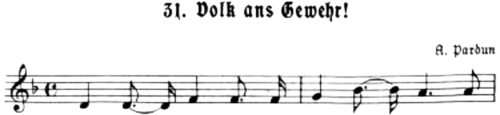
Arno Pardun’s “Volk ans Gewehr,” shown by its opening bars, on page 25 of Unser Lied: Liederbuch für höhere Schulen, compiled by the Fachgruppe Musik of the NSLB, the National Socialist (Nazi) Teachers’ League, and published in 1936. Its verses end on a call for death to the Jews. This was not fringe material and not youth-rally repertoire. The teachers’ own professional organization printed it for secondary-school classrooms.

To ignore all this is not a failure of measurement around the edges of the problem. The problem is Orff himself, promoted to children in Germany’s own schools with no mention that his success started with and because of Hitler, sitting unaudited.
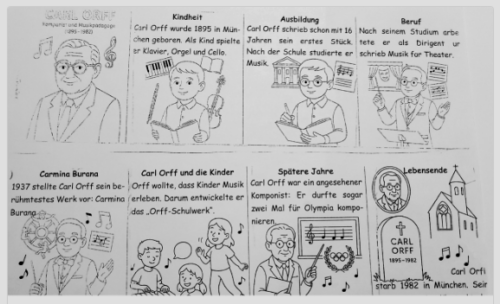
Booklet handed to children in Berlin Grundschule to learn “music.” Eight panels of Orff: birth, training, career, Carmina Burana 1937, “Orff and the Children,” then “Later Years,” which file Hitler’s 1936 Olympics after the 1937 panel that precedes them. The sheet reorders time to keep the Nazi spectacle out of his career. Context from 1933 to 1945 is erased, along with Mendelssohn, Kestenberg, Maria Leo, and Keetman, which is what enables the Orff glorification.

Where a swastika gets painted, it is worth asking the music teachers how often, and where, Orff appears in their classrooms.

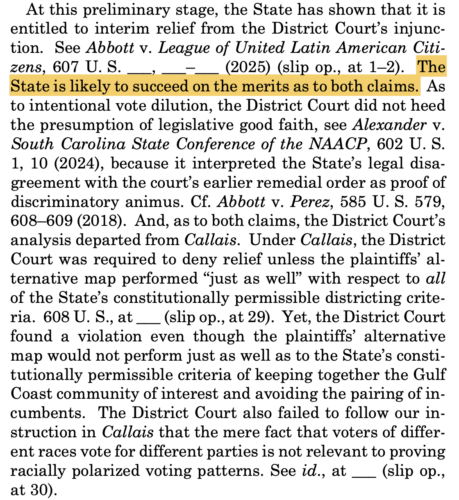
SCOTUS kills American Black votes with the bullet of Emergency Decree

Emergency Decree after Emergency Decree. An unargued emergency order of Texas is now cited authority inside another unargued emergency order for Alabama. Do you recognize the Trump platform yet?

A map governing Alabama’s 2026 elections will be aggressively reversed to a 2023 plan that the unanimous panel found unconstitutional after trial and again on remand. How is this even possible? SCOTUS freezes any remedy to racism, never the violations.

“Unsigned, per curiam opinion on the shadow docket, the SCOTUS conservatives allow Alabama to use a congressional map held repeatedly by a lower court to have been enacted with discriminatory intent.” Source: LawDork

Louisiana was the opinion that loaded the Emergency Decree and Alabama was the decree that fired it. America’s highest court just ran redeemer-era logic to kill American Black votes with the bullet of Emergency Decree.

The harm being done by SCOTUS is intentional and specific to 2026 because it is irreparable. They want a discriminatory election because it cannot be re-run. The voters in a district they just collapsed lose at least a full term of representation, if not permanent, and no later judgment returns it. The Emergency Decree was used for a violation to be unrecoverable. That is why the timing was chosen. Proximity to the election was not an obstacle the Court worked around, it was the design. Run an emergency docket, with a manufactured emergency for the court to block American Black votes, and the election is over before any merits ruling could touch it.

The unsigned opinion is forcing Alabama to reverse to a map that has been blocked twice, both before and since Callais, under Section 2 and the Fourteenth Amendment.

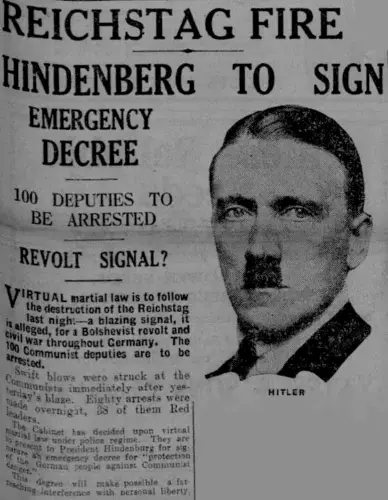
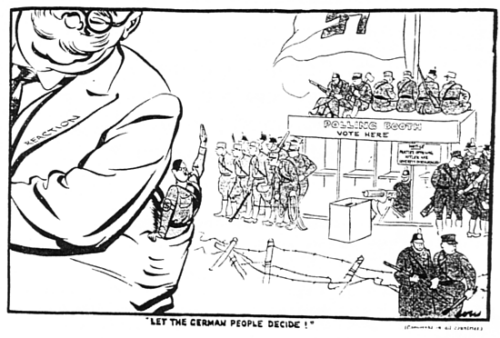
The KPD held exactly 100 seats from the November 1932 election, and NSDAP was rapidly declining in popularity, so “100 deputies to be arrested” is literal, and the decree is what let Hitler clear political opponents from the chamber before the 5 March vote. The emergency was manufactured to end democracy.

Essence from the Duck

Prussia wasn’t a state with an army, it was an army with a state. And when Frederick demanded French replace German cuisine, the essence replaced the duck.

I’m starving, where’s the duck?

It is in the essence, now get back in line.

Are you sure this is duck? Looks like tap water.

Eat or don’t eat the noumenal duck remains forever beyond the spoon. You can’t afford the certainty.

Berlin Museum Pumps Nazi War Z3 Research as Birth of Computing

I hate Nazis. Just one of the many reasons why is how classification and words are turned into their weapons. They “win” by changing the rules until everyone else is, by their own definition, losers.


“Get that car’s license plate number!”

A museum in Berlin is abusing a technical claim of “first” for a contest where they wrote the rules suspiciously. On any and every neutral axis of electronic, operational, programmable, general-purpose, stored-program, the actual trophy sits in Iowa, or Bletchley, or Philadelphia, or Manchester. Berlin wins only the category they created called “fully functional programmable automatic” to fit one machine in 1941 Nazi Germany, promoted by the people who need it to win in 2026.

For those who decide at the last minute:
May 12, 1941, is considered the birth of the first fully functional computer, the Z3. On this day, Konrad Zuse presented his Z3 relay computer to a group of scientists. To mark the 85th anniversary, Horst Zuse will give a lecture on the development of the Z3 and the computer innovations of his father, Konrad Zuse.
Participation is free; all you need is a museum admission ticket.
#Computer #coding #Museum #technology

“Considered.” Cute. “Fully functioning”. Please.

The claim of a never-operational Z3 being Turing-complete is from a single 1998 paper whose own author admits it’s just an impractical theory for a demonstration machine destroyed in WWII. The German “Gesellschaft für Informatik” admits this too while building a virtual one because the Munich replica had to be shut down for fire safety. The truth runs opposite to any claims of the Reich’s Z3 birthing anything. But you know, for Germans who gotta find something in 1941 Berlin to get away with being proud of something, I guess this fits their bill. I mean, who knew a German museum in 2026 would file the serial numbers off Nazi war research to claim the “birth” of a “fully functional computer”?

Let’s cut the propaganda and speak plain English for a moment, because the actual first functional computers were not made in Germany.

The Z3 was cobbled together from old ideas and marketed as research. The German Reich office known as DVL paid Zuse to automate the calculations that enabled Luftwaffe airframes to carry heavier bombs. You know, they needed heavier bombs to kill more civilians. This very same DVL provided the low-pressure chamber for the high-altitude experiments at Dachau in 1942, experiments in which 70 to 80 of approximately 200 prisoners died. The monsters running the DVL are quite a “birth moment” context if you know it.

And what was the birth? What new principle was brought into this world by the Z3?

NOTHING. ZILCH. NADA.

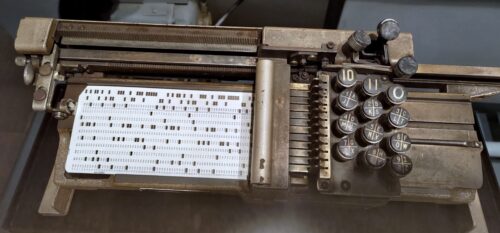
Its binary arithmetic came from Leibniz; its logic from Boole; its relays from the telephone exchange; and its punched-tape control from Jacquard and the Hollerith line, specifically the very Dehomag machines that the SS operated in the camps (Dachau included) to register prisoners and run them through to the gas chamber by number.

Deutsche Hollerith-Maschinen Gesellschaft

The Z3 couldn’t even perform conditional branching based on its own results. Any claims of “first computer” are transparent retroactive PR, thinly substantiated, nationally flattering, and only theoretically “upgraded” to Turing completeness on paper in 1998 by Rojas, who later helped build the replica.

First ahead of what, exactly? The phrase “fully functional” doesn’t even make sense. Functioning in what capacity? Full of what?

Electronic earlier examples the museum is trying hard to omit: the Atanasoff-Berry Computer, Iowa, conceived in 1937 and built by 1942, running on vacuum tubes while Zuse was still clacking relays. Unlike the Z3, that claim was actually tested independently in a court. In 1973 a US federal judge invalidated the ENIAC patent and ruled the electronic computer was derived from Atanasoff. The decision was never appealed. No German court ever ruled anything of the sort for Zuse, because the title was never evidence. It was always a particular form of nationalism sneaking into PR.

Electronic, operational, and programmed examples? Well, obviously we have the Colossus, Bletchley Park, 1943, breaking live German ciphers in daily wartime service while the Z3 sat in Zuse’s flat as a demonstrator and the real flutter production ran on his separate S1 and S2 machines at Henschel. Colossus would lose a “first” race for one reason only. Britain kept it secret. The same disappearing act that lets the Germans promote the Z3 claim, except Britain has receipts unlike self-shredding evidence-allergic 1945 Germans.

What about electronic, general-purpose, and Turing-complete in actual hardware, with conditional branching included? That’s the ENIAC, 1945. Everything the Z3 was falsely and retroactively awarded on paper in 1998, ENIAC proved in operation, while the Z3 was never deployed to production use.

And if we want to name a machine during this era that was the mother of every computer you have ever touched: the Manchester Baby, 1948, the first stored-program computer, followed by Cambridge’s EDSAC in regular service by 1949. That is the more accurate “first”.

The Z3 doesn’t hold a candle. It was obscure research about assembly of known parts, a demonstrator the institute never deployed, secret, then rubble, then unknown for twenty years, so it not only contributed nothing to the computers that actually got built and used around the same period, it’s a form of unverifiable revisionism. Its only real use ever seems to be the modern nationalist propaganda campaigns that obscure how it never really was used.

Here is the history fact that should end the argument. The engineering profession’s own milestone records list the Z3 among the candidates and then disqualify it in a single sentence: built for narrow engineering sums, not a stored-program machine because it held its instructions outside itself on perforated film, and hardly general-purpose in any normal sense.

The Germans that ought to be Zuse’s loudest champion name his machine in the contest and rule it out, TWICE.

The original was bombed to rubble; the historical narrative stems from Zuse’s own memoirs; the replica currently on display belongs to his son (on convenient loan from the son who also is honored with an anniversary lecture about his family “win” under the NS); and the proof of universality comes from the very man who helped build that replica for the son. Integrity breach alert.

Stakeholders shouldn’t be allowed to set their own interest rates. Or is this perhaps just for those impulsive types in Berlin who prefer records shredded so their Nazi-era computer history can be served cold and without the facts?

Machine Electronic Branching Used “Fully functional programmable automatic”
Babbage Analytical Engine, 1837 design No YES, by design No. Unbuilt No
Aiken Mark I, Harvard 1937 design No No YES, from 1944 No
Stibitz relay binary, Bell Labs 1937 No No YES, from 1940 No
Zuse Z1, Berlin 1938 No No No. Unreliable No
Zuse Z3, Berlin 1941 No, relays No No. Demo Did someone say FIFA Peace Prize?
Atanasoff-Berry, Iowa 1942 YES, tubes No No, never finished No
Colossus, Bletchley 1943 YES, tubes Limited YES, daily in the war No
ENIAC, Philadelphia 1945 YES, tubes YES YES, ballistics No
Manchester Baby, 1948 YES, tubes YES YES, foundational No

The title has to be won in a public assessment, not self-awarded or even through a corrupted process. A real assessment in America looked like this.

Computer architect Gordon Bell refers to the judgment, which invalidated the ENIAC patent, as the “disinvention” of the computer.

His point is that a 1973 ruling invalidated the ENIAC patent on the ground that the ideas derived from Atanasoff. The court left a foundational invention owned by no one. Put the Z3 in a fair courtroom and let’s see how that turns out.