Category Archives: History

Datacenters Are America’s National Security Blunder Vulnerable to Small Drones

On March 1, 2026, Iranian drones directly struck two AWS data centers in the UAE and damaged a third facility in Bahrain, the first time a major US tech company’s data center was disrupted by military action. The IRGC claimed it, citing the centers’ role supporting US military and intelligence networks. Then on March 31 Iran formally labeled 18 US technology companies as legitimate military targets, including Amazon, Microsoft, Nvidia, Google, Apple, Meta, Oracle, Cisco, and IBM.

The AWS strikes took down two of the three availability zones in the UAE region and one in Bahrain, and because multiple zones failed at once, standard redundancy models failed. Cloud redundancy is engineered against independent failures: a transformer dies, a switch fails, a zone floods. The company has designed resilience to failures as uncorrelated, so the odds of two at once are the product of two small numbers.

That’s not how warfare works.

A wartime adversary creates a correlated failure on purpose. It hits the redundancy in the same cycles, and the independence assumption that the whole design rests on is gone. Availability zones sit tens of kilometers apart so synchronous replication can balance being fast and inexpensive. That proximity is a feature against random failure and a target package against an area weapon. American resilience, despite the lessons of 9/11, designs fit inside a single firing range.

As many of us know first-hand from working in the trenches of the early 2000s datacenter build-outs, cross-region failover exists. Yet when Iran attacked, AWS told customers to back up and migrate to other regions manually, and data-residency law pins much government and regional data to the region it lives in. The outage took down Abu Dhabi Commercial Bank, Emirates NBD, First Abu Dhabi Bank, Snowflake, and Careem.

Manual migration in 2026 isn’t on anyone’s plan.

Now consider the exposure of the current centralized “giga” strategy of American AI data build-outs. In particular, the Anthropic deal with xAI is a national security disaster on multiple levels. Training is worse than serving, and xAI (literally named Colossus) is the world’s largest single-site vulnerable AI training installation, near 2 GW with about 555,000 GPUs on one Memphis site running on on-site gas generation.

Have you seen those videos of the Russian gas sites burning after drone strikes? In the fog of war, xAI is building the largest fully operational single-coherent cluster, which means it is one synchronous fabric with no failover at all.

None. Nothing.

Lose even a tiny piece of the site, lose an entire run. The “Tesla Mad Max” mentality to make it the fastest and most polluting trainer on earth makes it the most concentrated single point of failure on the earth.

One site. One power source.

Anthropic is inherently vulnerable as it runs on this over-concentration of power. It has contracted up to 5 GW from Amazon, with the first gigawatt expected by the end of 2026, and just took all of xAI’s Colossus 1 in Memphis to serve Claude capacity. That suggests all of Anthropic data has no privacy protection from Elon Musk and Trump. But that’s privacy. In terms of availability and integrity, it’s extremely exposed to catastrophic failure.

The Amazon infrastructure that was struck in the Gulf and the single Memphis cluster are both how Claude gets served, vulnerably and controversially. The Elon Musk rushed plant design in particular has been firing huge, deadly plumes of pollution at the neighborhood, which makes the controversial datacenter strategy stand out even more.

Source: Brockovich Data Center

We’ve been talking about rising asymmetric threats on critical infrastructure for years, although subtle, around the world. From a drone in the Gulf, blackmail by Russian hackers, bomb on a pipeline, Volt Typhoon on the grid, disgruntled Russian developer, or contractors in San Francisco and Berlin.

When Elon Musk cosplays being a ruthless Emperor, think about why Napoleon Bonaparte was such an inhumane and incompetent disaster (killing his own troops faster than the enemy could) When someone says the Pentagon is relying on the biggest and most concentrated compute ever for identification and targeting, feel free to say there’s a simple reason “Mr. Blownapart” ships went to the bottom of the sea.
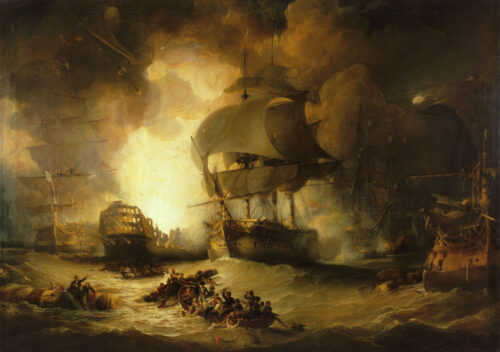
Perhaps France’s infamously aggressive “move fast, break things” dictator should be referenced today more often as Mr. Napoleon Blownapart? The gargantuan French warship L’Orient explodes at 10PM. Source: National Maritime Museum, Greenwich, London

Or if you prefer more modern military lessons, Mussolini marched into north Africa with no go plans and several hundred thousands of his best Italian soldiers. Then the Allied Operation Compass in February 1941 used only around 30K troops to wreck the entire fascist army and take 130,000 prisoners in Libya and Egypt. Wingate’s tiny Gideon Force, using just a few thousand men, punched even harder and took the surrender of tens of thousands of Italian troops in Ethiopia.

One element I haven’t discussed here, which would significantly shift the threat model, is whether these “datacenters” of empty space waiting for power are meant to be pivoted into human incarceration as fascism has done in the past. Massive concentration camps of political prisoners certainly would make more sense for the rushed build-out economics, and remove all the worry about supplying them with infrastructure like water and power (scarcity being the point). US datacenter construction has been on pace to overtake what the country spends building offices, whether these massive concentration halls are filled with computers or anyone Trump points his finger at.


“Swing Heil!” Why the Nazis Hated Jazz

The simple answer is that the government of Hitler publicly classified Jazz as Jewish music, even though it came from American Blacks. The German news site DW emphasizes the “bravery” of non-Jewish kids in Nazi Germany who “dared to be themselves” by wearing plaid jackets to meet in cafes to keep listening to the forbidden “degenerate” and fremdländisch (alien) tunes.

Nazis produced touring exhibitions denouncing so-called ‘degenerate’ art and music, pictured here in Düsseldorf in 1938, and sought to link jazz with Jewish identity. Source: DW

…not all young people in Nazi Germany supported the regime’s ideology, and for the Swing Youth, jazz music became a vehicle for rebellion. Its members tried to distinguish themselves from Nazi youth movements by appropriating American fashion trends and names. They wore their hair long and dressed in plaid jackets to meet in cafes and clubs playing swing, a jazz sub-genre. They were also said to have greeted one another with the phrase: “Swing Heil!”

1930s jacket style

The bans on Jazz weren’t strictly enforced, is another way to put it, for those who weren’t Jewish. And the Nazis even remixed Jazz tunes as propaganda.

The Jews of USA have asked Eddie Cantor to write a new version of his famous old-timer “Makin’ Whoopee.” In one of his latest programs on the air, he sang the following song. (Singing) Another war, another profit, another Jewish business trick, another season, another reason for makin’ whoopee. A lot of dough, a lot of gold. The British Empire’s being sold. We’re in the money thanks to Frankie. We’re making whoopee. Washington is our ghetto, Roosevelt our king. Democracy is our motto. Think what a war can bring. We throw our German names away. We are the kikes of USA. You are the goys, folks. We are the boys, folks. We’re making whoopee.

Only towards the end of 1942, as it became clear Germany was going to lose WWII, did Goebbels really clamp down on Germans enjoying Jazz.

Amnesty International Report Leaves Door Open for Anthropic Murderbots

Anthropic drew three lines for the Pentagon, two of which are well known.

  1. NO to domestic surveillance.
  2. NO to autonomous weapons.
  3. YES to target identification and prioritization, where a human presses the button.

Why yes?

The pattern is liability. The two no’s of the triad protect a victim in a US courtroom. Domestic surveillance has a plaintiff and the Fourth Amendment. Autonomous weapons remove the human signature that absorbs the blame. The yes is because it kills people classified as “abroad”. To the system it is a flag, meaning unprotected by laws. Victims have no forum, no standing to sue Anthropic. That tracks to liability, not war ethics.

This all comes out in an Amnesty International report that condemns AI (no pun intended) as unlawful. It cites international human rights law page after page. IHRL is for the people that a domestic court can not help. It binds a state to the person’s rights “wherever” harm lands. If Anthropic were pressured under such law, the third yes also becomes a no. The Amnesty report fixates instead on web scraping and training data, then recommends a prohibition keyed to scraping and bias. Neither of those will stop the actual AI kill chain.

The problem with not seeing the triad in the room is that it amounts to an endorsement. Anthropic can train on licensed data, stamp it with a human print, and unleash murderbots. Yes, they are still murderbots.

Anthropic banned the machine from pulling its own trigger yet kept the machine choosing who dies. Human in the loop is defined by some product manager as ninety seconds to object.

First, that is an alibi, not a safety control. Picture a machine gun that fires on its own and hands you a button to stop each round, faster than you can see what you are shooting at. That means a default is shoot first ask questions later.

Second, the machine prompts with a target for death on a ninety second fuse, based on a list that cannot be audited. Operator fatigue logic says nobody will stop because the mental toll designed by such a machine is too high. Compliance in killing fields becomes survival. We’ve known this since at least Silas Soule was assassinated for ordering his men not to fire on unarmed civilians.

Based on the horrific massacre at Sand Creek, Soul of Silas is a dramatic Western. The film chronicles brave acts of one of America’s greatest heroes: Captain Silas Soule, no stranger to the battle for justice.

Amnesty spilled so much ink on holding AI accountable in war, then left the barn door wide open for the Anthropic death nightmares to bolt through.

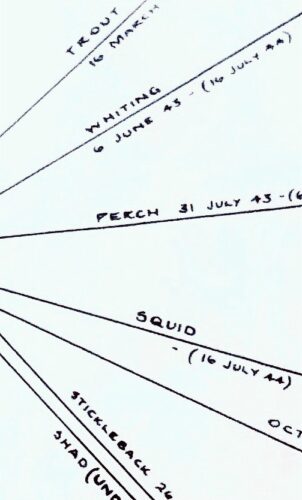
British “Fish” Chart of Nazi Encryption

Bletchley Park called the entire family of German teleprinter cipher traffic “fish.” The Lorenz SZ40/42 machine’s traffic specifically became “Tunny” (tunafish); the rival Siemens T52 was “Sturgeon.” Every individual radio link got its own fish name.

Named point-to-point Lorenz links between Nazi German command centres, each a separate teleprinter circuit Bletchley tracked and tried to read.

The dates are operational visibility into when the fish were biting. In this case Rommel was dispatching orders. Perch is the notable one, as it was among the earliest and most-read Eastern Front links, and the kind of traffic that justified building Colossus to attack the wheel settings at speed. Each fish gave the British a window into a different slice of the German high command’s communications.