After reading the excellent article “Rhodesia’s Dead — but White Supremacists Have Given It New Life Online“, I was left with questions about what people were seeing lately.
“All the talk right now among people in the alt-right and the broader white supremacist movement is about the need for a white ethno-state. And when you praise Rhodesia, in this context, what you’re praising is violence to that end.”
So I thought I would dive into a brand new book titled Secret SAS Missions in Africa and see if it praises violence for a white ethno-state.
Indeed, the book unintentionally reveals how the UK had long fomented civil wars in Africa to prevent black power, killing millions with covert white militias during the de-colonization period. That is a comment on consequences of policy, not really about motives.
Readers of this book looking for military insights, beware a skewed political perspective of soldiers terrorizing civilians to perpetuate white supremacist doctrine (consequence) while calling themselves the good guys (motive).
The book was published by Michael Graham, a Special Air Service (SAS) veteran of the British Army who retired at the rank of Major and emigrated to New Zealand in 1980. The NZ press has offered us some brief glimpses into 1970s-era perspectives of British operators in Africa:
There were shouts on the hill slope below us. Shots came our way. With the advantage of the high ground, we lobbed fragmentation grenades down on top of them, followed by a couple of white phosphorous canisters.
We heard screams as the chemical burned into flesh. Dry grass caught fire. We fired mercilessly at the sounds and movement below.
From the civilian camp we could hear shouts of confusion and terror. I felt for those poor people. We would do them no harm that night. If we did succeed in driving away the terrorists, they would get back their freedom. They wouldn’t know it, but we were their best option.
Graham repeatedly refers to his targets as terrorists, and the subtitle of his book is even “C Squadron’s Counter-Terrorist Operations 1968-1980”.
That’s very misleading of him, particularly given he throws out analysis like “we were their best option” for civilians while also he admits “from the civilian camp we could hear shouts of confusion and terror”. It’s in fact an offshoot of slang borrowed from American soldiers in the Vietnam War, which is quite clear when Graham operated within a group that was calling black Africans the “gooks” on a “Ho Chi Minh Trail” of Mozambique.
The terrorists that Graham refers to in his writing seem in fact to be the opposite, as they were dissatisfied black Africans who very overtly were intending to establish self-rule that would end the tyranny of colonial white police states. Graham however was serving an illegal white separatist militia that had no real plans for any pacification or development, only bloodshed and terror.
…ambushes and larger sweep operations aimed solely at killing insurgents. Protection and administration of [concentration camps], where peasants were forcibly resettled to isolate insurgents from the population, fell under the responsibility of the separate Guard Force. Rhodesian soldiers never engaged in the pacification and development of a specific area. The only internal task not directly aimed at killing was intelligence gathers. However, this had such meager results…
C Squadron’s terror tactics
Of course any historian of the Cold War should be able to tell you that this “C Squadron” was meant to serve the aims of white supremacist policy; elite troops sent to aid Rhodesia’s Light Infantry (RLI) to destroy African nationalism as evidenced in studies of special operations in the Rhodesian Bush War, which started in 1964.
During the Rhodesian Bush War (1964-1979) the white minority-controlled Rhodesian government carried out a remarkably successful counterinsurgency campaign against insurgent groups representing the disenfranchised black majority by relying heavily on the use of pseudo-operations. Pseudo-operations constitute a set of tactics government-controlled paramilitary units use to infiltrate insurgent-controlled territory and networks by imitating the actions of insurgent groups. Pseudo-units may damage infrastructure, set fire to farmlands, or commit general acts of violence while disguised as insurgents.
“C Squadron” was white-only and sent to preserve white-only rule in colonies by any means necessary (even to this day you won’t see a black person attending a “C Squadron” memorial service unless you count the wait staff).
Once colonial rule was lost, their role shifted to discredit and destroy black self-determination to help perpetuate South Africa’s apartheid rule.
Veterans and fans of the “C Squadron” cite an “Operation Dingo” in Mozambique (23 November 1977) as perhaps their greatest moment (100 troops with air support able to kill over 3,000 people in a few hours).
This operation applied a “vertical envelopment” concept — called “Fireforce” in Mozambique since 1973 by the SAS paratroopers — to create a killing zone of extremely high death rates very quickly. The NYT reported in 1979 it was modeled on U.S. military techniques.
The fire force is Rhodesia’s adaptation on a smaller scale of the helicopter warfare used by American forces in Vietnam…. [On the ground] troopers blacked their faces… as in almost any unit of the Rhodesian Army, were several foreigners. Britons, Australians, South Africans and one Austrian, all drawn to the fighting not by the $500 a month a trooper earns but by a complex of reasons – adventure, the desire to “fight Communism” and problems at home.
And to be fair, the “helicopter warfare used by American forces in Vietnam” is too narrow a legacy. Horizontally-firing gunships raining continuous fire is a tactic that dates more probably to a 1926 concept in Texas of a .30-caliber machine gun on a DH-4 biplane circling above a ground point to annihilate it.
Various concepts were researched until 1965 the C-47 “puff the magic dragon” gunship emerged in Vietnam to unload guns firing 6,000 rounds per minute at the ground under a pretense of Vietnamese “hamlet defense”. These kill-rate machines were successfully deployed by the USAF and were turning tide in battles until just a year later radar-guided anti-aircraft easily shot them down. A decade later, thousands of Vietnam War vets were advising and fighting in southern African battles.
In great detail doctors at the scene during Operation Dingo in Mozambique described the true scene of Vietnam-like Fireforce tactics shifted to this other continent — thousands of cluster bombs and napalm hitting civilians followed by a chilling murder spree killing everyone:
At Chindunduma Base hundreds of children had been caught by both cluster and napalm bombs while they were still on morning parade. Around mid-day, the SAS quickly advanced towards the tented base and children who had survived the morning bombing had rushed towards them, crying for help, and almost every one of the children had got a pistol bullet between their eyes. […] …believing they would be spared since the ambulance was clearly marked with a Red Cross emblem “All of the patients were shot mercilessly”… “The SAS had literally executed the young girls and women, one by one. Hundreds of them! For almost one hour, from around 1400 hours, their M16 rifles had been heard firing non-stop.”
The book “A Handful of Hard Men: The SAS and the Battle for Rhodesia” described the operation as an intentionally closed box killing everyone inside and blocking any exits.
The vertical envelopment would cover three sides of the target ‘box’, while the gap would be closed by ‘K-Cars’ armed with 20mm cannon. Coordination of the air-strike and the para-drop had to be perfectly timed. […] Once the escape routes were closed, troops in sweep-lines would advance to flush the trenches and gun-pits and kill anyone who appeared before them. Those choosing to flee rather than fight would run into the stop-groups.
K-Cars stood for “Killing” with a cannon.
Peter Petter-Bowyer (who helped design the 450kg Golf cluster bombs as well as giant napalm bombs dropped in Operation Dingo, somewhat copying the 1942 work of British engineer Barnes Wallis) wrote in his autobiography how “totally successful” boxing in and murdering unarmed civilians felt:
Upon their return, Op Dingo ended. For their superb planning and personal participation in these two operations, Group Captain Norman Walsh, BCR, and Major Brian Robinson, MCM, were made Officers of the Legion of Merit (Operational). The most certainly deserved it. Harold Griffiths received the Jacklin Trophy from Air Marshal Mick McLaren…
Back on the ground, it is highly plausible that Graham’s team of whites used false flag operations to similarly commit acts of terror and frame them as black government forces, in order to undermine black rule and self-determination.
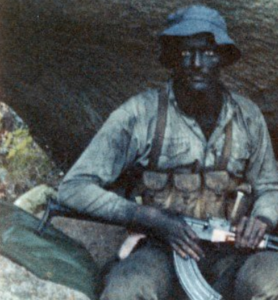
Here you can see members of “C Squadron” applying “blackface” in the sort of preparation used for a pseudo-operation to harm civilians and blame it on others:
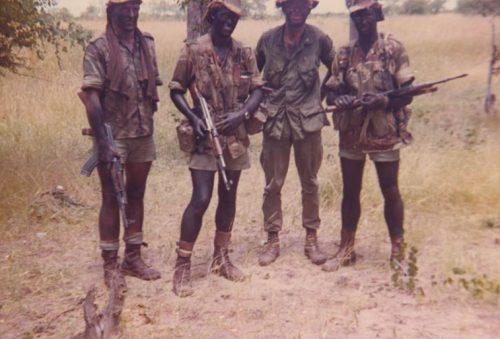
And there are many more images like this easily found, showing blackface regularly applied.
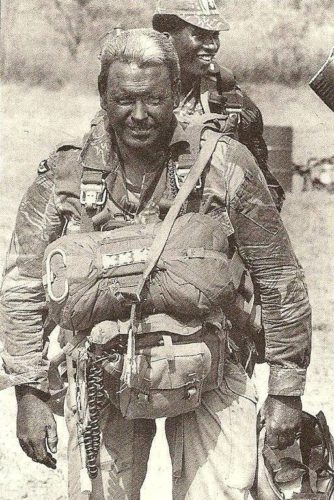
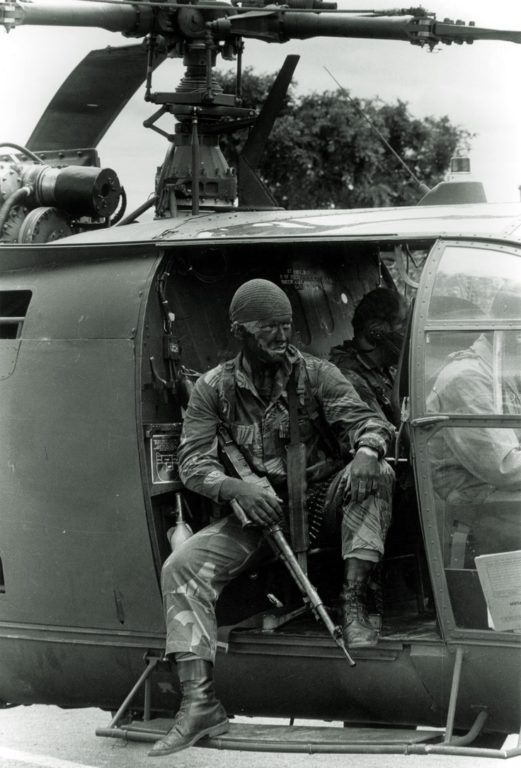
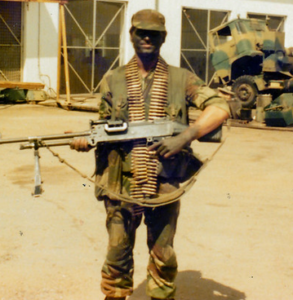
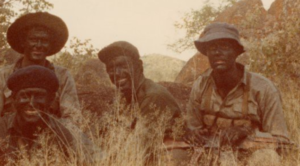
For some historic perspective on this tactic, the US Marine Corps in 1919 infamously used “black cork coloring” to infiltrate Haitian rebel (cacos) camps and assassinate their leader Charlemagne Peralte.
Marines produced hundreds of copies of the photo [showing Peralte had been assassinated] and disseminated them by airplane across the countryside, as a warning to the cacos. Instead, the image of Péralte’s body, with its unintended evocation of a crucifixion, became an icon of the resistance.
Let’s look more closely now at the excerpt at the start of this blog to see where the SAS soldiers were being inserted, and what in the news at that time that might have required such white power mercenary services.
Mozambique, May 1977
Mozambique had been a Portuguese colony until April 1974 when widespread protests in Portugal against colonial wars precipitated a bloodless coup by the Armed Forces Movement. It was a series of military wins by Mozambique’s main anti-colonial force (FRELIMO) that had shaken confidence in Portugal’s military at a time when over 80% of their available forces were committed to three major colonial wars in Africa.
The coup had promises of an abrupt end to Portugal’s colonial rule as the military-led government set about proposing cease-fire terms and granting self-determination to Mozambique. Optimistic theories about a Portuguese-speaking economic union with its former colonies were floated. The nature of these proposals did not sit well with FRELIMO who in their minds had been fighting an independence war of freedom from Portugal, to overthrow the tyranny of colonialism not shift to a free-trade market.
FRELIMO, as their military victory seemed near, countered that any cease-fire come with full authority over Mozambique to establish formal governance. This wasn’t well received by the new government in Portugal for simple historic reasons. FRELIMO had a commanding role in the war yet traditional colonial counter-insurgent/destabilization arguments were that no widespread black representation was acceptable. Other nationalist factions were fomented to dispute FRELIMO in a new government (enhancing and creating fissures and stoking inter-group rivalries was a key tactic of white supremacist regimes aiming to undermine self-determination of large oppressed populations and prevent their union).
These political negotiations didn’t last long as Portugal simply was unable to keep its military from losing all morale, and the 60,000 troops refused to continue despite vastly outnumbering FRELIMO’s 7,000. Thus months after its coup to end colonial wars, Portugal gave up any overt military effort and quickly recognized independence of its colonies.
Thirteen years to the day after FRELIMO was founded, Mozambique became independent, thus marking an official end to its white police state (June 25, 1975). A transitional government was setup with FRELIMO posting six cabinet ministers, and the Portuguese appointing a prime minister and three more cabinet ministers. FRELIMO was given national security responsibilities of the newly independent country.
White savior narrative, May 1977
Graham’s book boldly tries to spin a narrative that FRELIMO, the officially recognized government of Mozambique tasked with defending itself from foreign adversaries, are terrorists he has been sent to assassinate and otherwise secretly destabilize. What he reveals is Britain and America were directly involved in white supremacists of southern Africa switching tactics from the failed overt war against FRELIMO to a covert one using terror tactics and pseudo operations. As Graham puts it, just a year after the new government was making a transition from cease-fire to independent rule, he was sent to instill fear to halt political progress by blacks and foment a civil war:
…we were going to kill a few more of them and put the fear of God into the survivors.
They didn’t know who we were, or where we had come from, and we would again show them we could strike anywhere.
This phrasing reminds me of 1969, when a package was sent to FRELIMO headquarters in Dar es Salaam, Tanzania. It held a bomb disguised as a notebook that exploded and killed Eduardo Mondlane, leader of the independence movement, when he opened it. His assassination was never attributed.
Historian pro-tip: I’ve already laid out that Graham was a professional killer trained by the British to undermine anti-colonial movements and use terror tactics to slow the inevitable movement towards black self-rule.
For example, by 1963 the British had been attempting to sloppily sail “wind of change” and jettison Northern Rhodesia towards independence (later to become Zambia). It moved quickly as inroads had started to develop for a majority rule system.
However, Southern Rhodesia lacked any such majority rule aspiration or infrastructure at all. And the south was thus held up with Britain’s basic “five principles” of governance being met before independence could be granted.
Southern Rhodesia’s government, reverting to a self-governing colony in the meantime, was strangely awarded control by Britain of the existing Air Force, parachute squadron and a regular army of over 3,000 men. With the SAS headquarters formerly in Northern Rhodesia, soldiers were given the option to “head south”. At least 30 SAS troops relocated to Southern Rhodesia.
The Foreign Office of Britain allegedly thought so poorly of Rhodesians, looking down on them with disgust, that they expected no resistance and no real capability of the whites there to put together any real political thought or organization.
They were very wrong, while also being right. Rhodesia’s white nationalists would prove to be far more bold and take action that would last longer than expected. However, in an ironic twist the Rhodesian white nationalists themselves would misjudge the blacks, who were far more bold and took action that would last longer than expected. A cascade of tragedy, if you will.
Just over 250,000 whites in Rhodesia, with British and South African soldiers under this arrangement, were aiming to very abruptly “independently” rule a country of nearly five million blacks. One-party rule was setup, with all its brutal modes of repression such as draconian Emergency Powers (laying a foundation for subsequent politicians to extend oppressive and elitist militant rule, as Mugabe was known for when he took office).
The Ghanaian Government explained this all very dryly in their statement of 12 November 1965 — the day after Southern Rhodesia declared it was breaking from Britain and unilaterally considered itself “independent” (recorded in the CIA’s “Daily Report, Foreign Radio Broadcasts”: Issues 216-220)…
…Britain provided settlers with the armed forces which they now use to defy British authority and to threaten the African Continent with a racial war…. It is a myth to say that such a thing as a Southern Rhodesian air force, army or police force exists. Except where African personnel are employed in a menial capacity, these forces are composed almost exclusively of British and South African citizens…
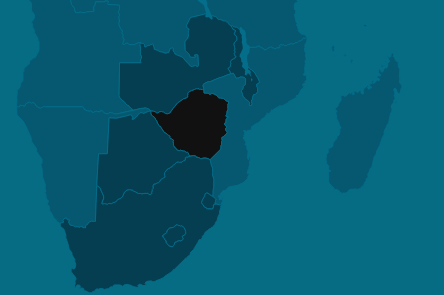
Aside from Rhodesia needing access to the Indian Ocean somewhere through Mozambique, the white Rhodesians were very concerned with the idea of any black African nationalist government sharing their 700 mile border.
The insecure white Rhodesian forces saw black African politicians in Rhodesia and Mozambique almost immediately as a target for their military operations. To put it more directly (confirming some of the Foreign Office predictions), white Rhodesians in their antiquated colonial ways believed blacks only respected violent force and would be unable of developing any thoughts or organization on their own.
The Rhodesians foolishly reasoned from pure racism that any black resistance to white “supremacy” violent force was proof of outside communist agitators directed by China or the Soviet Union. Violent conflict then escalated quickly into a white nationalist mass killing engine that peddled an “intruder” apologist narrative, which for hopefully obvious reasons turned out to be tragic and ineffective.
…there was no program to win over the African population by positive measures. The army focused on achieving a high “kill rate.” It became skillful at this; even with its outdated equipment the Rhodesian Army killed over 10,000 guerrillas inside Rhodesia and thousands outside it, and it lost only 1,361 service members between December 1972 and December 1979.
Again, as I pointed out above, apologists for the British trained military “kill-rate” strategy in this region still refer to the 1977 mass murder of unarmed women and children in Operation Dingo as one of their proudest days. Numbers, just big numbers of dead black Africans, is what they think mattered most for their dreams of governing Rhodesia.
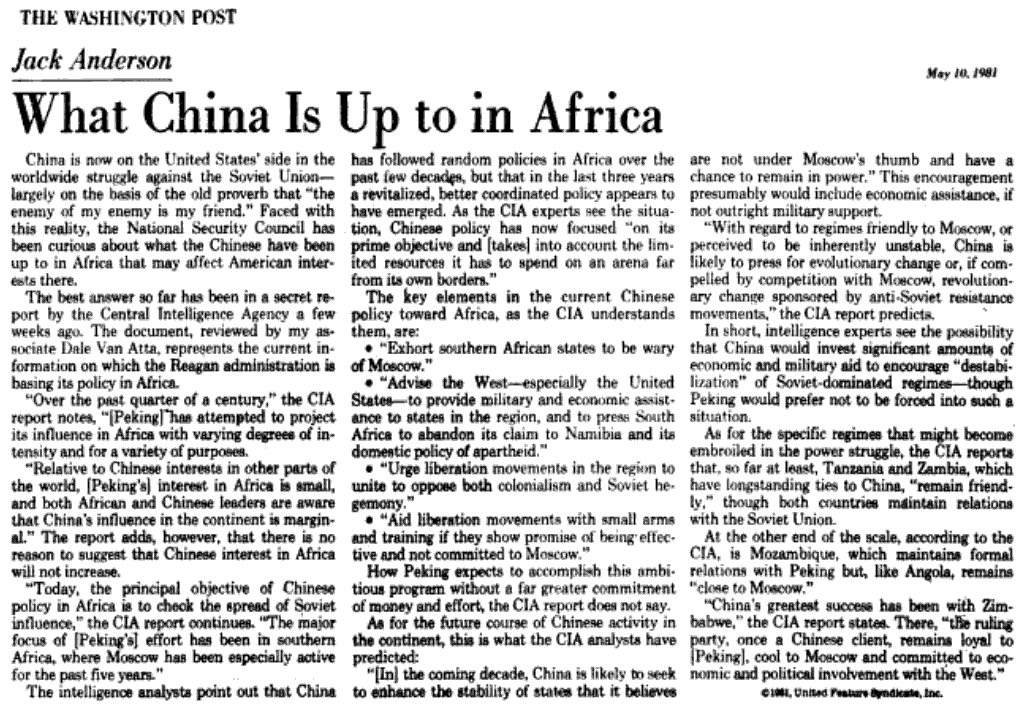
The CIA years later reported a much more sophisticated situation that Rhodesdians seemed incapable of seeing through their racist lens; China’s involvement with regional black militant groups at this time was to undermine and hold back Soviet influence in the region, despite both Communist countries being somewhat aligned in staunch opposition to any colonial rule, even a “self-governing” colony.
It was typical complexity in the independence movements after colonialism, documented by America’s OSS (forerunner to CIA) in Vietnam over a decade earlier as retold by American Colonel Patti in his 1981 interview.
Ho Chi Minh was on a silver platter in 1945. We had him. He was willing to, to be a democratic republic, if nothing else. Socialist yes, but a democratic republican. He was leaning not towards the Soviet Union, which at the time he told me that USSR could not assist him…they were in no position to help anyone. So really, we had Ho Chi Minh, we had the Viet Minh, we had the Indochina question in our hand, but for reasons which defy good logic we find today that we supported the French for a war which they themselves dubbed “la sale guerre,” the dirty war, and we paid to the tune of 80 percent of the cost of that French war and then we picked up 100 percent of the American-Vietnam War. That is about it in a nutshell.
“At first, patriotism, not yet Communism…” was written by Ho Chi Minh. Arguably you could say this was inauthentic, but the same could be said in reverse that he faked interest in communism.
In either case the colonial-era thinking in “kill-rate” (terrorism) tactics used by the British (while Britain officially opposed itself) punished independence-minded anti-colonial blacks. This sadly and predictably backfired with increased political and military resistance; mass-produced the whites’ own enemy by ballooning resentment through intense suffering.
The black Africans were systematically pushed by white terrorism doctrine into the lap of Chinese intelligence infiltrating rural areas (as stated already for China’s attempt to block Soviet influence).
Now consider that Graham’s book cites 1968 for the beginning of his operations and that FRELIMO’s leader was assassinated in 1969.
Eduardo began his college education at Witwatersrand University in South Africa, but, after a year, was forced to withdraw by the new apartheid-oriented Nationalist Party government. Protestant missionaries in Mozambique helped arrange a scholarship from the Phelps-Stokes Fund in New York for Eduardo to study in the United States, but Eduardo decided to attend Lisbon University where he could learn first-hand about Portuguese government and policies, and gain a better command of the language. However, after a year of ill-treatment as an African student, he accepted the scholarship and arrived at Oberlin.
His “American decade” began as he earned his Oberlin BA in sociology and anthropology in 1953, followed by an MA at Northwestern University, and a PhD in anthropology at Harvard. He married Janet Rae Johnson, a young white woman from Indiana while he was doing a year of research at Harvard. They had met five years earlier at a Christian summer camp, and had continued to see one another, although her parents were intensely hostile to their friendship.
[…]
In a faculty resolution conducted soon after his death, Eduardo Mondlane was remembered as “a strong, intelligent, eloquent, and valiant man–a man of the highest character and ideals. Dedicated to the cause of freedom for his own country, he was in every sense a citizen of the world.”
With the FRELIMO leader profile in mind here is a photo Graham offers us to illustrate his story. It comes from a roll of film in a camera that he grabbed from some of the soldiers his team killed. Note the bottom caption starts with the propagandist phrase “Frelimo terrorists”.
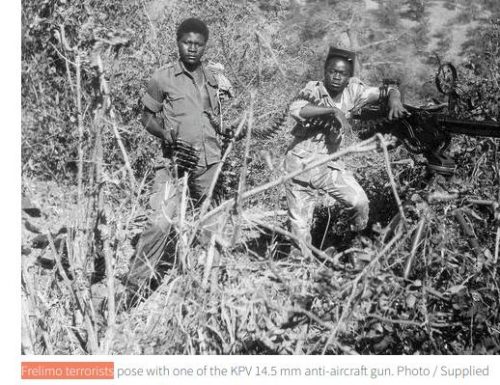
The use of “terrorist” as I pointed out at the start of this post sure seems backwards by Graham, given context of white supremacist covert terror being enacted on the official government soldiers of Mozambique as well as its civilians.
Perhaps Foreign Policy does a better job than me in explaining Graham’s role in the elite British-trained killers of Rhodesian “C Squadron” tasked with terrorizing blacks who dared to resist colonial rule:
Mozambique’s civil war was noted for its brutality, meted out in particular by Renamo, a rebel group that was founded, financed, and armed by foreigners bent on destabilizing the country: first by white Rhodesia, then apartheid South Africa.
Just to be clear here, Renamo was known at this time for initiating excessive violence against civilians. This is quite literally who Graham writes about at the start of this blog post, where he tosses grenades and thinks aloud “[civilians] wouldn’t know it, but [Renamo] were their best option”.
It is no coincidence that along with refusing to recognize the legitimacy of black self-rule, Graham proudly displays a photo of himself seated with the notoriously pro-colonialism white-supremacist Rhodesian politician Pieter Kenyon Fleming-Voltelyn van der Byl.
Over the next twelve years, Graham’s role in acting out the genocidal destabilization policies of the Rhodesian white supremacist regime in neighboring Mozambique resulted in shocking crimes against civilians: one million people killed (60% children), 200,000 children orphaned, 250,000 children separated from their families, 1.7 million people (over 10% of total population) fleeing to neighboring countries and 4.3 million people displaced.
Also take note that these devastating numbers on harm to children are symptomatic of the Renamo tactic of kidnapping children, forcing them to murder their own family and then carry out violent raids on civilians to keep their kidnappers well supplied with rations as well as kidnap more children…to continue the violence cycle.
FRELIMO was founded by a man educated in America who held up the principle of bringing education to the entire black population and lifting people up.
Whereas the SAS-aided white supremacist “kill rate” tactics targeted civilians, destroyed 50% of the country’s primary schools, deprived a half million children of education… to continue the violence cycle.
Graham looks at these two and calls his terrorism the best option?
…or as the NYT reporter wrote on the ground in 1979 (observing a black woman who had been shot by Graham’s peers and then tied to a tree):
Although she was in pain, occasionally crying, she was surrounded on the ground by young white troopers mocking her for her partial nakedness and chiding the army medic for helping her. …to Miss Johnson, they were affirmation of her reason for fighting. “This,” she said, gesturing at the troopers, “this is not freedom.”
Best option?