
Hundreds of workers in a Utah office watch horror films for a living. Their job is to observe Teslas as they drive. The cars tragically hit dogs and deer at speed, brakes untouched. The cars miss school buses with the stop arm out. They come within inches of some children in the street. Others are killed. The workers annotate the footage and escalate the worst of it, like war zone reporters.
Reuters calls this, without apology, a job for “data labelers”. And while they point out that the humans doing the labeling are how the car is trained, they say the real story is that seven of nine refuse to ride in a Tesla that they trained.
They watch copious amounts of raw video. They built the product they describe as unfit for human passengers. Their refusal is testimony. One said he would refuse a robotaxi even “if you fucking paid me”. Not exactly a high bar. A veteran self-driving engineer who reviewed the crash data for years called the safety claims bullshit and said, “Don’t trust Elon on this.”
Yeah, in related news, water is wet.
We’ve known since 2016 that Tesla has been lying. A lot, about everything. We’ve seen Elon Musk ruthlessly attack messengers over the years to stop the truth.
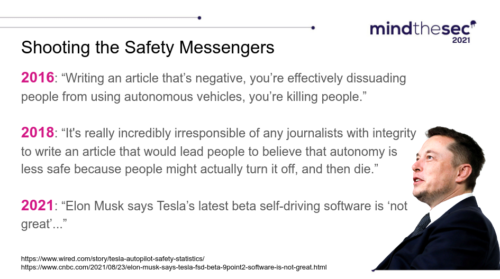
Reuters, has finally caught up and agrees with everyone who disagrees with the CEO. Tesla built a Potemkin autonomy, using hand labeling route by route, to fraudulently market software as able to drive anywhere.
Eight years after their foundational lie about driverless being a solved problem, Tesla planned an October 2024 Cybercab reveal at the Warner Brothers lot. They had staff run prototypes every night from six until dawn, filming the exact path the cars would follow on stage. Labelers spent hundreds of hours marking curbs and lines.
Yeah, it’s all a lie.
Tesla repeated the process before the June 2025 Austin launch, mapping the service zone and doubling the Utah team to about 300 people to make one small area run clean.
For some reason people still buy Tesla.
Musk sells the opposite of what he has to sell. In 2024 he jealously called Waymo’s local maps “fragile” and promised a magical general AI to read any street in real time and scale at hyperexponential speed. One labeler described the result as the exact opposite: Tesla locked a car into a cage, trained for inside, and won’t let it operate outside.
It’s untrue, and it’s unsafe.
The $1.6 trillion valuation of Tesla has become a joke. It rests on a false safety claim. Tesla will tell you that FSD is up to 10 times safer than a human. Taneja, the CFO, said it first last July. Denholm, the chair, repeated it in November at the meeting where shareholders approved a pay package worth up to $1 trillion in Musk stock. Can you believe it?
Eleven traffic-safety researchers reviewed the method for Reuters. Ten called it marketing rather than a study.
Tesla games the system with a simple cheat. It compares its crashes severe enough to deploy airbags against a federal rate that includes far milder accidents. That swap alone inflates the claim threefold. It also sets a fleet averaging 4.1 years old against an American average of 12.8, and new cars crash less.
I’ve written about this extensively before.
Marco Benedetti, a former NHTSA statistician now at the University of Michigan, matched airbag to airbag and got about three times, and he calls even that generous: Tesla measures a Tesla driver against the average driver, counts only crashes within 5 seconds of disengagement where the government requires 30, and excludes the rest behind fleet age.
Koopman of Carnegie Mellon mocked Tesla by saying their comparison is like bragging a jet beats a World War II bomber. New beats old doesn’t mean much.
The biggest indicator of the lie is that Tesla keeps its crash data secret and seeks no peer review. Waymo adjusts for road and neighborhood type, compares its cars to human cars in the same markets, and publishes through review with outside researchers. A closed self-attesting number against an externally checkable one. I’ve written about their problems too. It’s not great, and arguably injuries increase wherever Waymo goes.
The Tesla CEO repeatedly says, year after year, he’s made a car that drives itself, and attacks anyone who says otherwise. The fine print on his website requires active driver supervision, and Tesla cites it in court every time as proof that their CEO is a liar and should never be trusted. The promise lifts the stock. The disclaimer assigns the blame to the dead. The courts let it continue.
We have watched the blame land. An 18 year old on Highway 101 outside Ventura, asleep as the car left the road. A driver into a pole in Colleton County. The reports say “veered” into a pole or a tree, day after day. Reuters shows what lawyers know “veered” conceals: the car failing to brake on an off-ramp and meeting a concrete wall, the car at 60 in a 25 after an engineer named the setting Mad Max, the car into a construction zone and nearly taking the workers with it.
Spring 2018, both Tesla and Uber ran over and killed a pedestrian. What happened? Uber cancelled its own driverless program. Uber went to court. Uber was in the headlines for it all. Not Tesla.
Yoshihiro Umeda, 44. RIP.
Now the trainers who annotated every curb, who refuse to get in, are talking to Reuters. That is a Tesla safety review that confirms the decade of what has already been published and litigated extensively. And yet, Tesla hasn’t been stopped.