It’s a completely bogus framework of law designed to promote wealthy white car ownership, and moreover normalize racist violence against non-motorists.
Texas is a fourth-world country that likes to hurt people, and is more proud of its legacy of slavery (“Remember the Alamo”) or hate doctrines (“Lone Star”) than anything else.
Put these two things together and… color me surprised that the notoriously tyrannical College Station police within the backwards state of Texas were just caught on film being obvious thugs and bullies.
In Texas they simply don’t care.
Was the cyclist riding around where nobody was at risk somehow posing a risk? There’s no risk and the cyclist keeps asking “for what?”
If the police don’t care, they don’t care. Eventually the police said there was a minor traffic violation.
In other words, can you believe Texas police actually were concerned with anyone’s safety? The video shows police treating a cyclist as convenient punching bag and target for their itchy fingers… with no evidence of threat.
Even the wider context doesn’t help change this narrative. The police themselves say they just wanted to prove a point by hurting the cyclist because he didn’t “obey” them.
The Texas police literally crashed (dropped their bike) without justification and then claimed falsely that they were most concerned with stopping crashes.
Police said at 1:04 p.m. the bicyclist was seen running through a red light at University and Nagle Street.
In other words, a cyclist rode in a manner the police disliked and didn’t seem to take their anger seriously. To force him to respect their authority to continue enforcing pointless and racist laws, then they did the dumbest thing possible and perhaps lost all respect.
There are many rational SAFETY-BASED reasons for cyclists to both ride through red lights as well as “jaywalk”.
Two thirds of bike commuters run red lights: “…three main reasons: the need to turn, the failure of a signal to recognize them at an intersection, and the absence of others on the road…”
“I treat red lights and stop signs as if they were yield signs. A fundamental concern of ethics is the effect of our actions on others. My actions harm no one.”
Logically (ethically) and historically the cyclist already was on more firm ground than the police, and then a pointless violent assault removed the moral standing police obviously thought they deserved.
On the 22nd of February 1943 a brave 21-year-old woman walked to a Nazi guillotine, displaying full conviction she “had done the best I could have done for my people”.
This is where her life ended. But how did it begin?
Today marks what would have been the 100th birthday of Sophie Scholl. On May 9th, 1921 her protestant liberal German parents had their fourth child, who grew interested in art and music.
Like all “eligible” German children she was forced to endure indoctrination from the “Hitler Youth” program. The Nazi system of hate was designed to stomp children into becoming obedient followers of a fascist regime of ruthless intolerance, and to rebel against their parents.
Sophie, as might be expected of such heavy propaganda, at first participated in regular programmed camaraderie and adventures. She became a squad leader of the Nazi Bund Deutscher Mädel (League of German Girls), where they were trained to sing songs like this one.
Läutet, daß blutig die Seile sich röten,
Rings lauter Brennen und Martern und Töten
(Ringing, until ropes run red with blood,
Ring louder with burning, torture and murder)
Then her loyalty and intelligence began to take effect. Major doubts arose: Why were her friends denied membership for being Jewish? Why were books mysteriously forbidden from any discussion with her own squad? Why were women being denied any future except “wife, mother, and homemaker”?
Her older brother Hans was arrested in 1936 when he crossed one of these invisible lines of secret police, accused of being in a forbidden youth movement (Deutsche Jungenschaft, Bündische Jugend — basically the Boy Scouts).
It was this arrest of her brother that turned Sophie as a 15 year old girl away from Nazism — she felt loyalty to her family and to human values more than the irrational hate programming.
Six years later in 1942 Sophie joined her brother Hans at Munich university, where he already had been active in a group called The White Rose that opposed German fascism.
Sophie then convinced her fiancee — a 25-year-old law student and officer in the Nazi air force named Fritz Hartnagel — to also support the resistance group.
On the 23rd January 1943, just a month before The White Rose was uncovered and Sophie would be executed, Hartnagel returned to Germany on the last military evacuation plane out of Stalingrad. Dutiful as a Nazi officer, yet supportive of Sophie in The White Rose, he survived the war and died in 2001 at age 84.
Today she is considered one of the most important Germans of all time.
Straight armed salute popularized by Hitler, with hand configurations popularized by the KKK… what’s not to like about these giant white crowds in Texas funded by slavery and pledging cryptic loyalty oaths?
UT-Austin released a report… that concluded there was ‘no racist intent’ behind the song, even as the song was written in a racist setting.
I totally get where that report is coming from. This is like UT-Austin saying its culinary school had no intent to poison its students when the food was prepared in a poisonous setting.
Being unconcerned about safety doesn’t prove intent to be unsafe, it’s a proof that safety wasn’t intended.
So the school is saying when its students are unsafe and harmed, that’s because the school didn’t intend to keep them safe and unharmed.
The key point is when UT-Austin fails to show it has anti-racist intent today, it has no intent for the abolition of racism, it is admitting to being racist.
However, if we find that no student is expected to get poisoned from their dining halls (or even from other students), then why should we be expected to put up with dangerous racism at all? That’s inconsistent and illogical.
Study may explain how racial discrimination raises the risks of disease among African Americans…
And now for a little history about UT-Austin’s “racist setting“:
…Littlefield has long been known as one of UT’s earliest and most prolific donors, and all around campus, you can still see his influence: a cafe and residence hall are named after him, and two of the campus’s most prominent landmarks are the Littlefield Home and Littlefield Fountain. In their letter, student athletes are calling for his name to be removed from Littlefield Hall because, as Gordon teaches, Littlefield was a slave owner who fought for the Confederacy in the Civil War.
Late in his life, Littlefield poured money into making UT more Southern-centric and commissioned Italian sculptor Pompeo Coppini to design statues of Jefferson Davis and Robert E. Lee, as well as his namesake fountain. The fountain’s inscription, which was removed in 2016, described how Confederates were “not dismayed by defeat nor discouraged by misrule [and] builded [sic] from the ruins of a devastating war a greater South.” Interestingly, when he was completing the project, Coppini recommended to Littlefield that the monuments should honor Americans fighting in World War I. When Littlefield refused, Coppini replied: “As time goes by, they will look to the Civil War as a blot on the pages of American history, and the Littlefield Memorial will be resented as keeping up the hatred between the Northern and Southern states.”
Would you go to Goebbels Cafe? Why eat at Littlefield’s?
Nothing says “food isn’t safe here” like a cafe named after someone who was really into cutting corners and making money from harming others, like slavery and mass atrocity crimes.
If these Indonesians had named their cafe Littlefield’s instead and covered the walls with pictures of lynchings nobody would have complained, right?
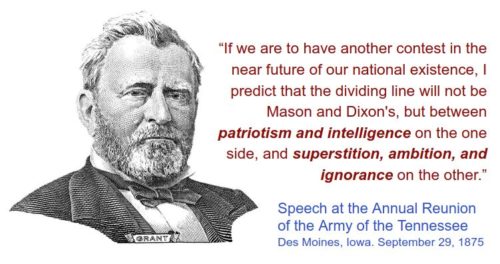
A “greater South” obviously was Littlefield’s way of saying he was continuing Civil War by other means, as President Grant very openly warned American soldiers.
To be clear, when UT-Austin’s big donor poured his money from slavery into commemorations of discredited and defeated domestic terrorists who killed Americans, he was asked at that time to also at least honor some American soldiers.
He refused. His superstition, ambition and ignorance was on full display.
Such a failure of patriotism, refusing to honor American soldiers, was made even worse by instead erecting giant monuments to slavery that celebrate rape, torture and killing of Americans… it is clear that safety for UT-Austin students was never intended.
If they can’t commit to something so basic as anti-racism, then surely they aren’t capable of things like food safety either. Anyone caught poisoning others on campus now surely would be excused for lack of intent, and being just a natural outcome in such a poisonous setting.
Again, the key point is when UT-Austin fails to show anti-racist intent today, no abolition of racism, they are being racist.
UTA is giving a big FU to its own people.
Perhaps it’s past due time to change their song and their hand gestures? I mean why not just roll with “Longhorn Coach” protocol and tell students and fans they must learn now how to give a “Herman salute” (middle finger).
Source: Texas Takes claims “Coach Herman was just reviewing the signal for the ‘Go Fuck Yourself Bitch’ play”
And now to lighten the mood, here’s a comedian telling jokes about racism and schools in America:
Yes, yes it is. It is flown by extremist insecurity groups to intentionally make Blacks feel unwelcome in America.
Executive summary: It’s highly unlikely that the Betsy Ross flag was created by Betsy Ross herself. Instead, it was far more likely a hate symbol of the KKK, meaning propaganda fabricated in the late 1880s. Regardless of its origins, this flag is associated with a time when America didn’t recognize the humanity of Black individuals. As a result, it can be seen mainly as a hate symbol used to promote a racist white-dominated state, in the same way the Nazi swastika promotes domestic terrorism against Americans.
Source: Twitter
Let me say it so people can hear all the way in the back, the BETSY ROSS FLAG ORIGIN IS 1870s DOMESTIC TERRORISM: RISE OF THE KKK.
Long form: Let me kick off what I mean by way of an example. I was really excited to watch this video about Chinook “electronic warfare” until I clicked on play and a giant Betsy Ross flag showed up as the backdrop.
That’s just wrong. Why are they flying this flag here? Was their Nazi Swastika at the cleaners? There are some places a flag featuring a 13-star circle (colloquially known as the Betsy Ross) could be appropriate. This is NOT one of them.
“Every historian who’s looked into it has found no credible evidence that Betsy Ross made the first American flag, or helped design it, or even that there was a flag committee,” says journalist and historian Marc Leepson, author of Flag: An American Biography. “It could have existed, but there is no evidence whatsoever.”
Let me be even more clear. Some basic history facts should settle any questions about use rather quickly, such that the Betsy Ross story is a fiction dating only back to Reconstruction from after the Civil War.
July 1775 Washington was gone. One of the initial things the First Continental Congress did was to appoint Washington commander-in-chief of a Continental Army. A full two years before national flags were discussed he was out of the picture — definitely not a congressional committee head by 1776.
June 1777 brought the first discussions about a national flag. Out of all available records — news, letters and diaries, official papers and memos — neither Washington, Ross, Morris, nor anyone else in the Congress of 1776 mentioned anything about one.
After emancipation of slaves and thirty years after her death, it was only in 1870 that a sudden push about a Betsy Ross story was made by her own family to draw attention to themselves. It was a 10-year old fiction rising out of Reconstruction, when her grandson “Canby” suddenly cooked an unverifiable story about his relative who allegedly created an American flag using five pointed stars, based on an alleged random visit by Washington. Betsy Ross had died in 1836 when Canby was just 11, so it was a full twenty years later that he started campaigning for his childhood memory to become accepted as national history (1857). In fact, he originally never claimed a Continental Congress created any flag design committee anytime in 1776 (see above two points).
That last point is perhaps the most important because I haven’t seen enough coverage by historians of the fact that the Betsy Ross story literally originates in the 1870 rise of the KKK.
Let me say that again so people in the back can hear, the BETSY ROSS FLAG STORY ORIGIN IS FROM AFTER CIVIL WAR IN THE 1870s RISE OF THE KKK.
The story died down when President Grant established the Department of Justice and destroyed the KKK in the 1870s (after already destroying them on the battlefield a decade prior). However, when the second rise of the KKK comes in the late 1890s and early 1900s the Betsy Ross flag fiction spreads again and sticks.
Take for example that the circle of stars in the infamous “Birth of Our Nations Flag” painting was in 1893 during Jim Crow and a dramatic rise of domestic terrorism based on racism and misogyny.
How Betsy Ross became famous also struggles with the theme of men profiting of their own portrayals of women figures. […] Not only did Weisberger impose his own idea of the domestic patriotism upon Betsy Ross but he profited off of her name. He started a movement to renovate the home thought to be Betsy’s then moved his family into it. He Was a charter member of the American flag house as well as the Betsy Ross Memorial association. His own promotion of Betsy Ross appears to be much less a desire to increase awareness as it is a business venture.
From 1890 to 1905 every southern state passed laws designed to keep blacks from voting.
Nearly 190 lynchings were carried out every year in the 1890s (two/week) with large crowds of Americans taking turns publicly torturing victims and taking body parts as souvenirs.
This gruesome inhumane time of that painting and racist mob violence was just a decade before the similarly named “Birth of a Nation” film in 1915 (credited with restarting the KKK under passive support of pro-KKK President Woodrow Wilson).
Is it becoming clear why the KKK strongly promoted a fictional story from the 1870s about Betsy Ross and this specific flag design in their political campaigns? When examining the 1893 painting that aimed to endorse the fabricated narrative of a circle of stars, it’s crucial to consider the true historical context. Interestingly, there is a nation that actually utilized a circle of stars as their very first official flag…
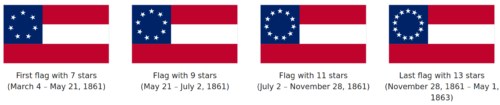
The actual Confederate South flags as they first appeared. The circle seems… important.
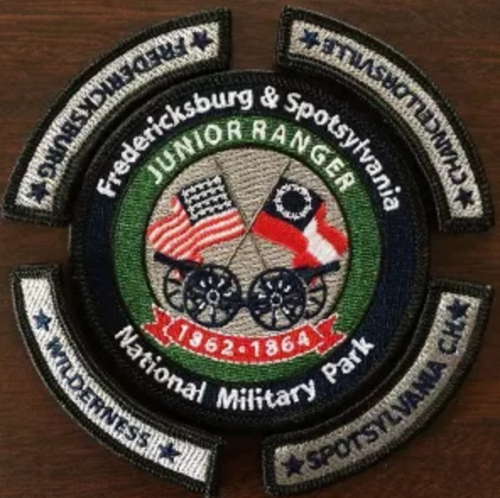
See? The circle of stars clearly represents the militant enemy of America, as seen clearly here in the battlefield national park service (NPS) patch for kids encouraging them to learn real history.
Source: NPS “Be a Junior Ranger”
Hey American kids, the ol’ circle of stars means your enemy because that flag was flown specifically to perpetuate and extend slavery by declaring war on America.
Can it be made any clearer? Howabout we look at the enemy’s “Navy Jack” on their warship.
Source: 1/200 scale C.S.S. Atlanta model by Verlinden Productions
The CSS Atlanta was infamous for being underpowered, unsteerable, and constantly sinking, not to mention running aground repeatedly… she surrendered within 20 minutes of battle. Her prominent flag that was meant to clearly indicate an enemy of America, allegedly was the circle of stars.
Like the CSS Atlanta the KKK thus went with a circle of stars for their flag. A Confederate South flag, despite later falsely connected to the Betsy Ross story, has been popularized since the end of Civil War as a means of preventing end of the Civil War.
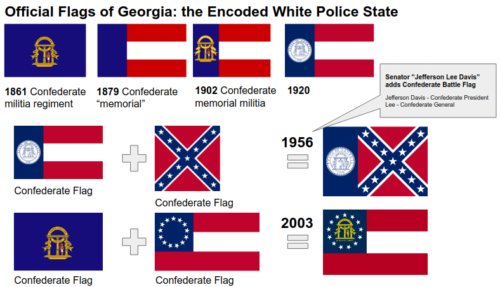
The history of Georgia reveals this evolution by being stupidly obvious while trying to repeatedly force symbols of slavery into their state flags.
They moved from an “X” to an “O” flying their 13 stars in a circle just to keep alive a sentiment of Civil War meant to destroy the Constitution and replace federal government with a tyranny by white men.
Georgia’s new flag is like if Germany removed the swastika from their flag 100 years after WWII ended only to replace it with a picture of Adolf Hitler. Who voted for this?
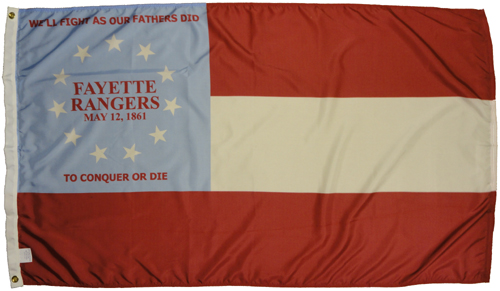
Or as one Georgia militia wrote on their flag, in a sentiment grotesquely similar to the 2003 state flag using a circle of stars, “We’ll fight as our fathers did, to conquer [America] or die”.
Militia group dedicated to terrorizing Americans and destroying the Constitution flew a flag similar to the controversial one adopted by the State of Georgia in 2003 to symbolize perpetual hate
See how a circle of stars is so clearly important for signaling among American domestic terror groups?
The circle of stars is without question linked to KKK terror campaigns throughout history
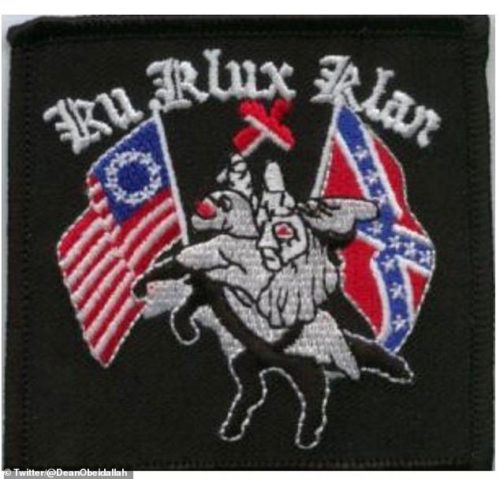
Both times in history before today that a circle of stars design was popular was to facilitate a rapid growth of the KKK. You can plainly see the “last flag” of the Confederacy is a circle of 13 stars, and how Georgia thought it was being so clever swapping an “X” of stars with an “O” of stars (both Confederate flags) even in 2003…
So all that being said, does this Xs and Os patch by the KKK seem like some kind of strange coincidence to you?
Now let’s go back to the 1700s, just to take a minute to recognize that Washington’s actual commander-in-chief flag was very clearly NOT a circle of stars.
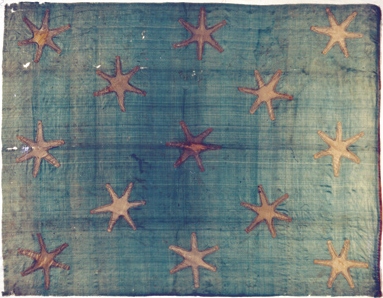
Washington’s personal standard as Commander-in-Chief of the Continental Army was undeniably 13 six-pointed stars. That’s right, I said six.
“Yo dawg! I heard you wanted a SIX sided star of SIX sided stars for your first flag of 13.” Source: A real first American flag creator that the KKK does NOT want anyone to think about.
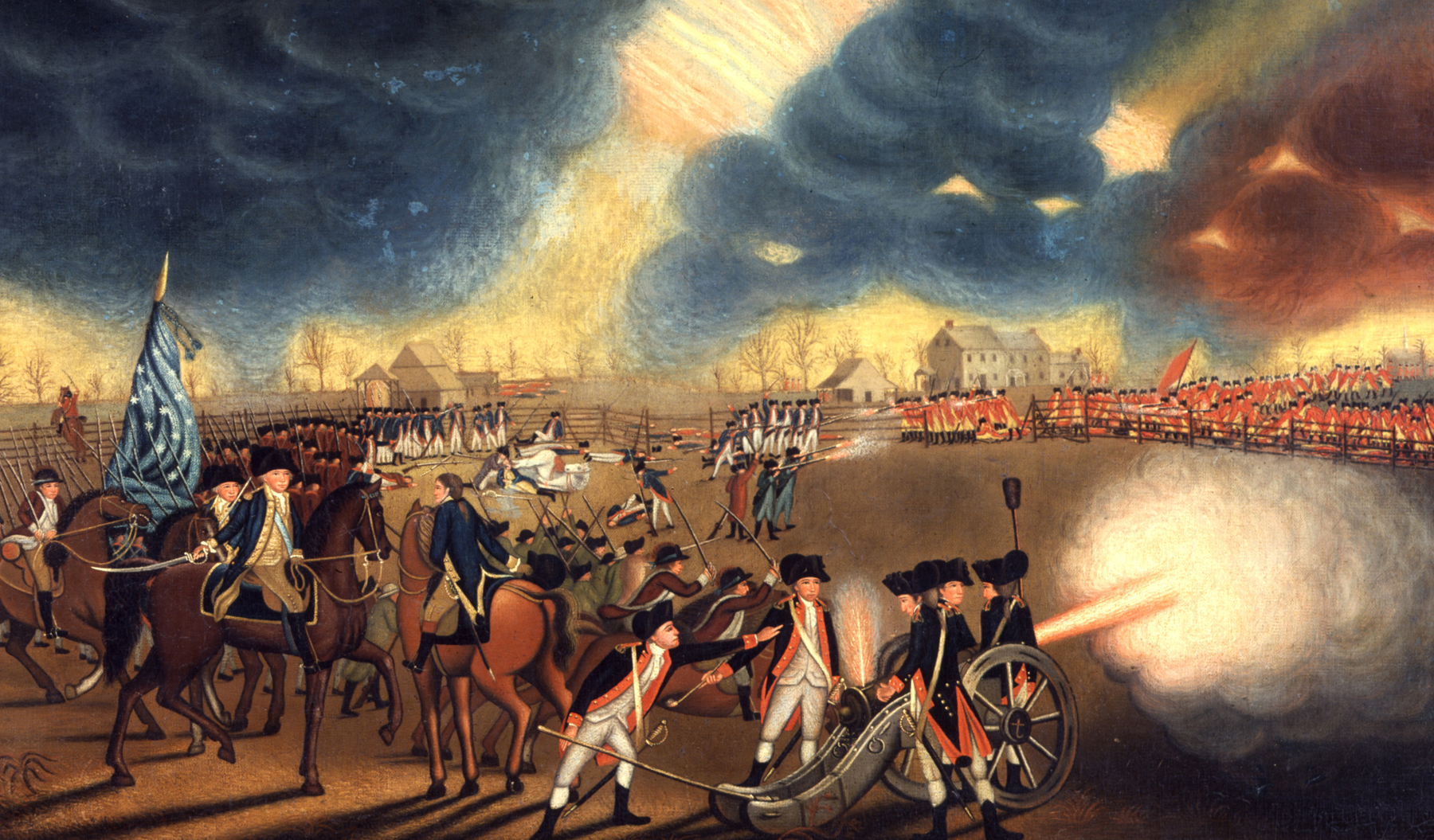
And here’s a painting by James Peale called “The Battle of Princeton” from 1782 (far more influential than his 1779 painting), depicting Washington flying his rows of stars in battle.
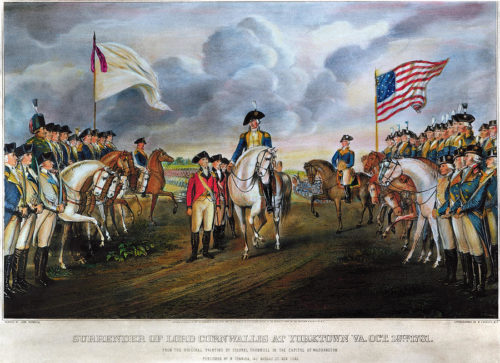
Trumbull is said to have started painting this in 1785, showing Washington (brown horse to the right) at the 1781 surrender of the British army at Yorktown, Virginia — the last major campaign of the American Revolutionary War.
You can see clearly the problem with a Betsy Ross story. Washington was regularly depicted with his flag, which was rows of stars.
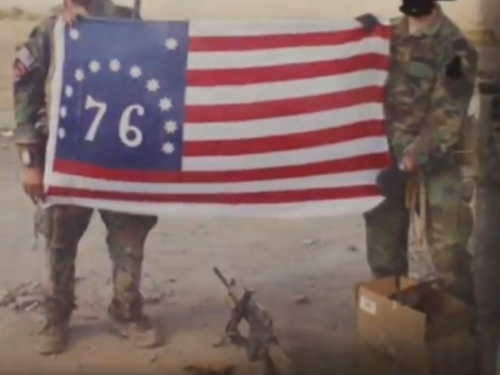
And that’s not to mention there may have been hundreds of interpretations of the Flag Act of 1777 “constellation” of white stars, including a “sad face Bennington” you can see here flown recently by operators overseas:
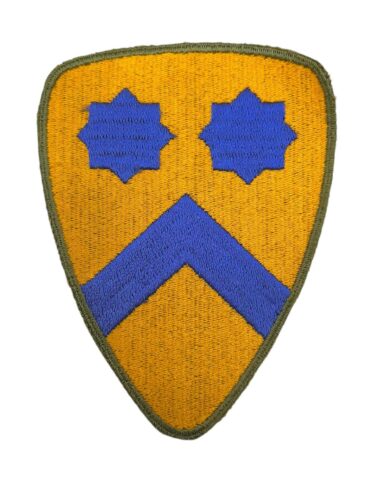
That flag variation reminds me of the 2nd Cavalry in WWII, who should perhaps be credited with one of the first modern emoji.
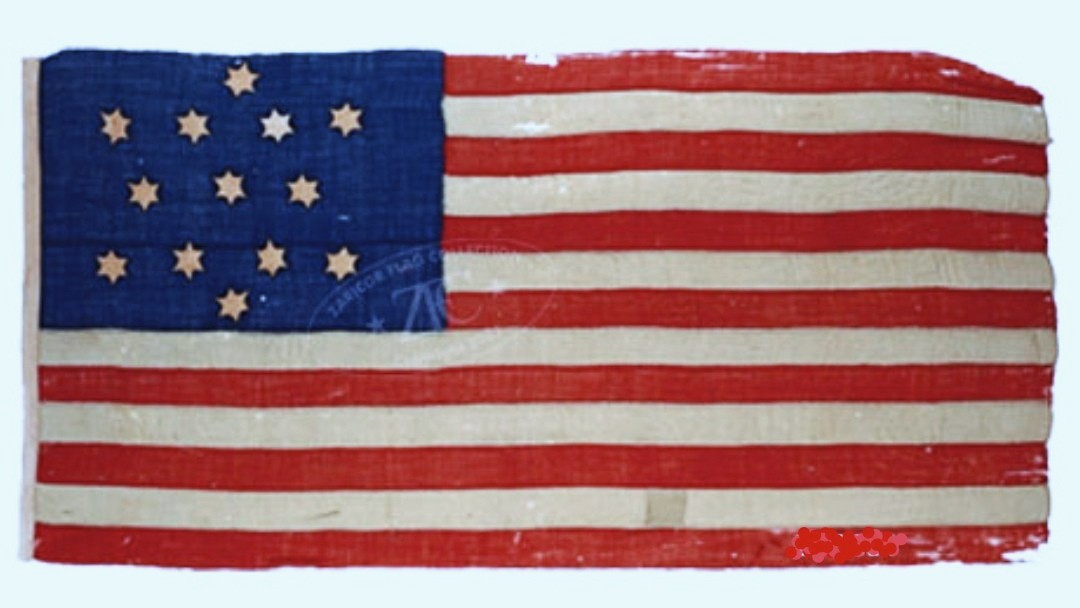
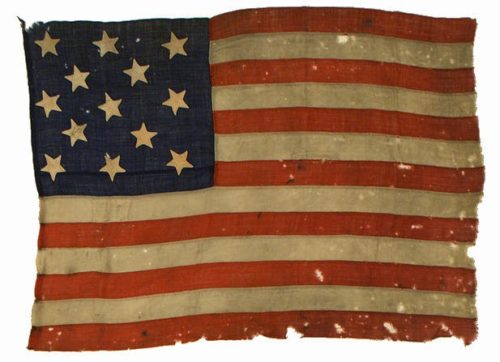
But I digress… back to the “Hopkinson” variation of America’s thirteen stars on a flag, it not only has a true “origin” story unlike the fiction of Betsy, it looks remarkably similar to Washington’s actual flag.
An important note on this real design: the Board of the Treasury in a 1780 report rejected Hopkinson’s request he be paid for it. His arrangement of stars was ruled to be a collaboration that no individual could claim.
This goes even further to blowing up the whole Betsy Ross flag story as a weird yarn of little historical basis, more like an attempt by one family at selfish enrichment using a bogus origin story.
Taking into account the many possibilities of stars on a flag, a Hopkinson design (really the Washington flag, really a collaboration that nobody should claim) makes a lot more sense on many levels for anyone who actually intends to fly any kind of true “origin” flag of the United States.
Should people trash the bogus circle if they want to be accurate about American history? Yes, Hopkinson’s is genuine, is collaborative (democratic) instead of individual (monarchist), and of course even looks more like the natural progenitor of a modern American flag as well.
Thus, as a design it just makes so much sense… you must now wonder why anyone in 1870, in 1915 and in 2016 would instead use a circle (other than to promote false history or signal chains of oppression… but I’m getting ahead of myself).
The real story here is that flying today any flag commissioned just before the 1780s, whether stars are in a circle or not, has a giant problem that can’t be avoided.
Do you know what was a hot topic of the 1780s?
Slavery.
More precisely, abolition was the hot topic. Slavery was openly criticized yet people like George Washington very passively allowed racist tyranny to continue for his own personal gain.
…I’m certain that few of the people involved in these situations actively dislike black people – or think lowly of them. Instead, they’re just people acting normally in a system that promotes and protects Eurocentric power by denying, and at best bracketing, the humanity of Africans and Afro-descendant people. In this world, you don’t have to be a racist to be racist; it’s racist to just passively allow racism to continue.
Let’s be specific here.
Pennsylvania’s Act for the Gradual Abolition of Slavery of 1780 set forth truly revolutionary concepts like proposing an end to racism — all children born in the state would be free persons regardless of race or their parents’ race.
It followed Vermont’s total abolition of slavery in 1777, not to mention Britain’s abolition of slavery in the colony of Georgia in 1735. That’s right, Britain was telling the colonies of America that slavery was done and needed to end.
In other words, a 1780s flag with stars in a chain might make sense in a video about life in the 1780s that discusses the pressing need to abolish the chains of slavery and the missed opportunity, the unforced error, by American founders.
America not only failed to overthrow tyranny in that truest sense of the word, its flag represented rebranding and expanding tyranny by very intentionally perpetuating slavery.
Think about a display of all the flags in American history (updated 27 times so far), flying side by side. THAT would be a good place to find flags like the Betsy Ross (although honestly there’s no real reason to fly a circle of stars instead of the Hopkinson flag).
The old flag would be among all the later flags, symbolizing a far less-than-ideal chapter from the past when America decided to go backwards and restart and expand slavery despite it having already been abolished.
Kind of like saying “here’s an old flag that we no longer fly, it’s from a time of slavery and we use it to show how far we’ve come since that awful time of Betsy Ross”. It is a flag to symbolize mistakes made, with other flags present to show some direction and progress since that time and contextualize it properly.
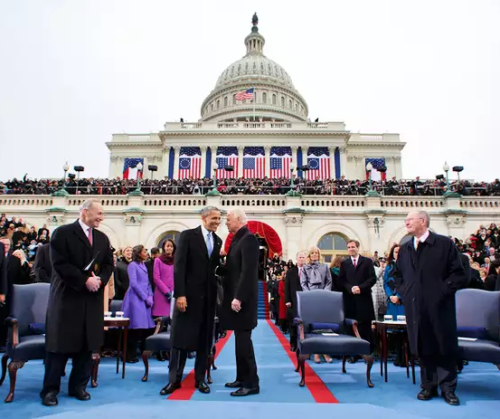
Kind of like… the Obama inauguration in 2013, which had a couple Betsy Ross flying abreast the Illinois version (28 stars for 1846 when it became a state) and current American flag. As a timeline for context, in an official capacity for a transition ceremony, it’s acceptable (note also it hangs far below the current American flag flying proudly above).
Source: AP
In fact it would have been an excellent rhetorical prop had Obama pointed to the Betsy Ross and said “this is not who we are, we have come a long way from the KKK” if you see what I mean. However, just because Nazis in Illinois fly swastika flags doesn’t mean the US Presidential inauguration should have one up as a prop — nations don’t usually fly flags of their enemies just to explain the threat is real.
For another example, think about a video where the topic is the history of flags, or a blog post for that matter such as this one. I am obviously putting a lot of Betsy Ross on this page.
Perhaps the flag should always come along with historians who discuss what it means (like I’m doing here), or in a museum about how awful life was for people in the 1780s and how George Washington clearly opposed abolitionists and secretly violated laws of America to keep hundreds of humans hostages against their will.
Ample opportunity would be given to explain how this flag is from long ago, all the way back to Civil War, a time that nobody would want to go back towards because… slavery, not to mention misogyny and a host of other things.
Again, was the Betsy Ross the only flag of this time (if it existed at all)? Definitely NOT. Was it the primary flag? Again NOT at all.
This “circle of jerks” flag really isn’t really able to speak for itself because on its own it raises many important questions that really shouldn’t be left unanswered.
When flown or shown with no context, especially as a substitution for the present American flag, it begs whether someone is thinking “forget all the Amendments, forget Civil War, never mind victory against threats, let’s go backwards to white nationalism of the 1870s and 1780s and wallow in failure”.
Or more literally, the Betsy Ross flag typically serves as a warning to Black people they are “neither welcome nor seen as equal”.
To be fair, hate groups today (outside of Georgia official use, of course) tend not to rely on the Betsy Ross flag alone to signal everything they want to say about their war against America.
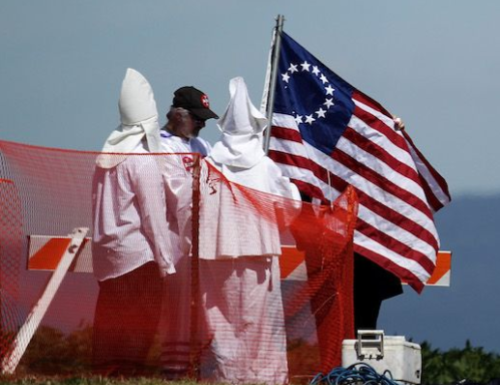
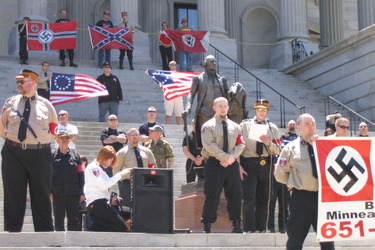
Nazis and KKK in other words tended to wave this flag along with other flags. That might be changing lately as the circle of stars becomes unquestionably a symbol of hate, arguably achieving some kind of original goal in the 1870s.
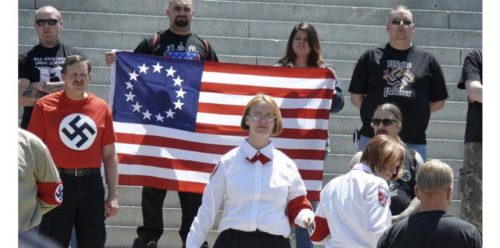
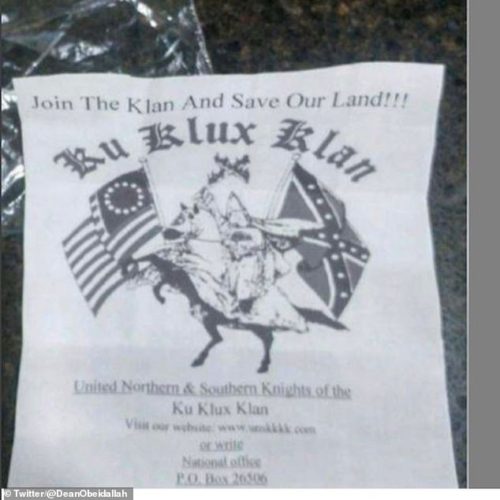
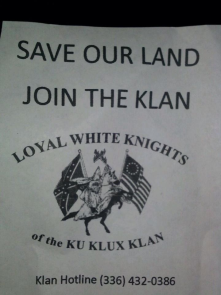
Here’s how the Betsy Ross used to show up in domestic terrorism meetups:
Source: Brad Warthen
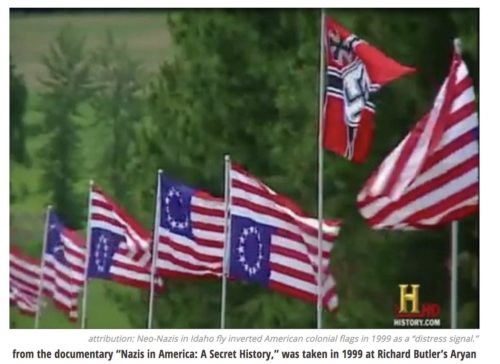
And again:
An entire video from 2007 shows how the Betsy Ross is too weak on its own and allegedly “appropriated”. The argument has been made that Betsy Ross is so milquetoast, other hate flags are required to make the main point.
There’s an important subtext here, which is that even by 2007 Nazis were still very much attached to displaying the swastika and costuming to look like Hitler.
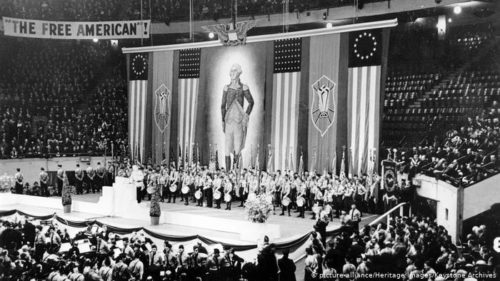
It seems absurd in 2021, but just a few years ago it was still a Nazi thing to dress like a reenactment of 1936 Germany. Speaking which, here is a photo of the 1939 Nazi Party rally in New York City. Any guesses why a giant circle of stars sits next to their swastikas?
After 2016 the American Nazis were very much opposed to openly wearing the “loser” swastika (they literally banned it themselves despite claiming for decades any bans on swastikas would be immoral and cause slippery slope end of all freedoms).
That of course opened the door to Betsy Ross being sufficient on her own as a message of hate, yet Nazis also realized they could fly a Trump family flag next to a 1870 KKK flag with a circle of stars…
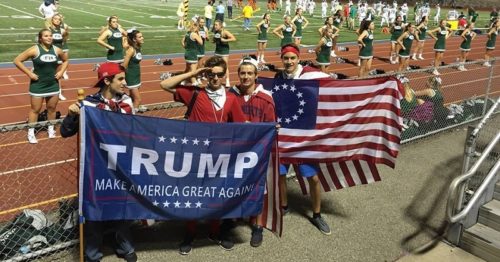
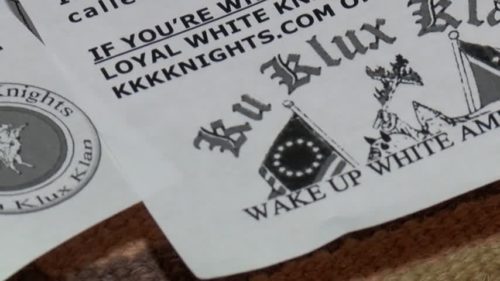
In other words, here’s what hate group meetups look like now in America, where a Betsy Ross still isn’t on its own but you’d be hard pressed to say which one is the replacement for the swastika if not both:
Source: Twitter
Trump plus Betsy Ross = KKK/Nazi (this shouldn’t be news to anyone literate in basic American history).
For what it’s worth, the person who took credit for one of these campaigns was found dead after warning he was threatened by others in his group for “not being racist enough”.
That reminds me of how some experts maintain that the Betsy Ross isn’t racist enough yet for them to register it alone as a symbol of hate. Those kind of comments might have been a basis for the KKK to kill their own man.
So what does flying a Betsy Ross represent?
All of this being said, the bottom line is still a Betsy Ross flag probably didn’t come from Betsy Ross, and it absolutely did come from a time when America didn’t consider Black people human and it basically operated as a white police state.
That’s pretty bad on its own.
If there were any real proof the Betsy Ross flag came from Betsy Ross, we might also have to ask whether her design was meant to represent her values of the time (she eloped and intermarried and suffered from American misogyny, in a story not unlike Hutchinson).
Still not great.
It’s like asking the question whether America is racist. The answer is obviously yes, especially at the time of ill-gotten gains under this flag, as Brookings wrote:
When a person critiques America for the racism that is deeply embedded in our social institutions, some feel they are being personally attacked. This is because deep down they realize that they benefit from unearned assets associated with whiteness.
Discussing whether a flag of 1776 America is racist is like someone asking if the “America First” platform of 1915 was racist, or for that matter like asking whether a 1938 flag of Germany was anti-semitic.
Washington could have demanded “all men created equal” was written as all people. He did not.
Washington could have cited the Georgia (1735) or the Vermont (1777) colony formal abolition of slavery as a model for the nation. He did not.
…July 2, 1777. In response to abolitionists’ calls across the colonies to end slavery, Vermont became the first colony to ban it outright. Not only did Vermont’s legislature agree to abolish slavery entirely, it also moved to provide full voting rights for African American males.
Heck, Washington could have spent more than six months at a time in Philadelphia and thus simply agreed to the law of the land — abide by terms of the local 1780 Act for the Gradual Abolition of Slavery.
He did not!
In fact it seems the opposite.
While flying his 13 stars and bars flag, Washington is said to have knowingly and repeatedly violated the state’s law (as well as its 1788 Amendment) by constantly rotating his slaves so he could keep them.
Let’s be honest. The American Revolution almost certainly extended and expanded slavery, and repressed women, far more than if Britain had maintained control of its colonies. In the War of 1812 America started enlisting Black freemen to fight against the British and then afterwards taking away the guns and freedoms of the victorious Black veterans (a racist theme that would repeat again in 1899 after the Spanish American War, in 1918 after WWI and so on).
America of 1776 thus can not be separated from the act of forming a new framework of tyranny, especially in Georgia (never forget British abolition of slavery in 1735 was violently reversed by colonists who restarted slavery and said it was impossible for white people to live in America without Blacks doing all their work for them). This is a story repeated in Texas and Florida as well.
That’s right, I keep bringing up the year 1735 for abolition of slavery in the colonies by the British. America’s Revolutionary war was fought by whites who fully intended to restore and extend slavery, and who were setting the stage for an even bloodier Civil War a century later on the same principles of tyranny.
Britain (as well as France), to put it simply, had been debating release of slaves in the 1700s and then freed them. Yet during that same time in America was doubling down on slavery and violent white militias were killing anyone who even dared report on mistreatment of Blacks or speak of abolition.
“The decision to reestablish slavery isn’t just a stain on Napoleon’s legacy, it’s a crime,” Louis-Georges Tin, campaigner and honorary president of the Representative Council of Black Associations (CRAN), told DW. Napoleon’s decision in 1802 to reinstate slavery not only betrayed the ideals of the French Revolution, it also condemned an estimated 300,000 people into a life of bondage for several more years, before France definitively abolished slavery in 1848.
At least 250,000 slaves were liberated in Texas alone, but almost two decades later.
Even more to the point, America after 1808 decided to build a whole new slavery economy based on the state-sanctioned rape of Black women by any white man available… Black children were forcibly birthed (roots of the anti-abortion movement) so they could be bought and sold in the millions! It wasn’t about cotton, it was systemic racism for profit — human trafficking.
Thus if you’re showing a Betsy Ross flag without some clear reason and some context to be displaying the militant symbol of a white police state that ruthlessly trafficked humans and murdered the press to silence speech, what are you even doing?
On its own it begs the important question whether you actually meant to be flying a Confederate South (treason) flag, or you have a 14/88 tattoo somewhere. What’s your context for the 13 stars instead of 50?
I mean to put it another way, even Nazis and KKK bring context whenever they fly it. The Betsy Ross flag amplifies such messaging for very clear reasons despite being unable to carry a hate tune on its own. It both leads people to Andrew Jackson, as well as Barack Obama, but on its own it’s an open question.
It’s obvious why hate groups like such a flag. When they fly it on its own it’s like a subtle invitation to normalize and talk up white nationalism without revealing their full regalia. Psssst, hey kids do you like Washington? Yeah? How about Andrew Jackson or Woodrow Wilson?
In dissolving the 1776 Commission on his first day in office, President Biden helped end one source of misinformation about our past, a reminder that, as we work to restore democracy, we will need to restore honest inquiry and accurate history as well.
It’s an encoded signal to recruit for extremism. Much like flying the various flags of Germany — the revision you choose to fly reveals a lot.
If America had always had one flag this would be an entirely different story, yet this flag is tied only to a particular time of systemic racism and oppression by whites.
Update May 2021: Research suggests use of a national flag has damaging impact to social cohesion
“Flags are tricky,” Kemmelmeier says. “If you allude to a collective and say, ‘This is us,’ there’s always somebody that’s not included.”
Decades of research has demonstrated that simply assigning a symbol, such as a flag, to an arbitrary group can cause a hardening of attitudes. A study published in 2016 by social psychologists Shannon Callahan and Alison Ledgerwood found that people perceived others as less warm and more threatening if the group was assigned a flag. “A consistent picture emerges,” writes David Smith, a psychology lecturer from Robert Gordon University in Aberdeen. “Flags bond insiders but make outsiders feel unwelcome.”
Again, one simple way of explaining the Betsy Ross is racist is to say it’s a flag flown by white insecurity groups as an obvious way to make blacks feel unwelcome.
a blog about the poetry of information security, since 1995