Category Archives: History

Why We Need a Separation of AI Church and State

Margaret Hu has been making this argument for years, before I caught up to it. She is a professor of law at William and Mary, directs the Digital Democracy Lab, and has testified before Congress on AI regulation.

She just mentioned the separation of AI Church and State has been a rising topic for several years, most recently on the Federal Newswire podcast.

She pointed out separation of Church and State rhymes with separation of AI and State. The Church minted the coin and then charged for salvation. The labs mint the token and charge for salvation. Same institutional makeup, eight centuries apart. That got me thinking:

Church Coin AI Token
The instrument Placed on the altar Submitted via API
Who mints Empire grants it, commune holds it, the Church absorbs it and the ius monetae migrating across one disc of metal The lab holds it, ungoverned
Booked twice The offering in the box, plus a credit struck against purgatory Compute revenue, plus a mark-to-market gain on the same dollar
The salvation sold Time taken off the afterlife AGI, alignment, civilization rescued, cure disease, reduce labor, blah blah blah
The half you can audit 70,000 coins found beneath Scandinavian church floors Amazon’s 16.8 billion dollar mark, booked in the open
The half you cannot The grace. Never recoverable The capability claim. Never independently proven
The trinity Mints the coin, sells the salvation, writes the law of usury Mints the token, sells the salvation, writes the safety framework

Where This Ends is Ugly

An institution that mints the money, sells the salvation, and writes the morality of money holds all three levers with no independence or separation. Nothing inside would work to pry them apart. The medieval version did not reform by memo. It was Luther who nailed the indulgence (the AI double-booking of his day) to a door in 1517. Then a brutal correction unfolded over the next hundred and thirty years. Princes seized the mints and the monastery lands. The wars of religion ran into the Thirty Years War, which emptied as much as a third of the German lands in the worst regions.

The act of “disestablishment” (prying mint and salvation away from the sword) was Westphalia in 1648.

The AI labs clearly are bringing back the trinity and infusing it into the state: we just saw an export ban on who may run a model, we just saw empty warehouses permitted as datacenters and ruled as critical infrastructure, with the national-security frame doing all the consecrating. They may as well say national holiness. Elon Musk may as well be called the holy emperor of SpaceX, presiding over what looks like the biggest fraud in history. The records are blunt about the very high price of undoing the Church coin collapse. Elon Musk isn’t going to disestablish himself any sooner than he will admit he isn’t going to achieve driverless by 2017 or land on Mars by 2018.

Someone has to seize the AI tokens before more people die from AI. Or to put it how was said a very long time ago:

Doch schweig ich noch von dem, was ärger als der Tod,
Was grimmer denn die Pest und Glut und Hungersnot:
Daß auch der Seelen Schatz so vielen abgezwungen.

Andreas Gryphius wrote that in 1636, mid-war, which reads: “and yet I stay silent on what is worse than death, grimmer than plague and fire and famine: that the treasure of the soul was wrested from so many.”

The AI token is today’s Seelenschatz: sold as salvation, never proven, never refunded. The medieval fix wasn’t a stronger emperor. That kind of escalation always fails. It was prying the mint, the salvation, and the sword into separate hands and holding the line. Separate the AI Church from the State before the unauditable claim bills us in death again.

AI Is Not a Fascist Artifact

Several people have asked what I thought when Jürgen Geuter, writing as tante, argued that AI is a fascist artifact.

He’s not saying AI is being deployed badly. He’s saying AI is inherently fascist. He places it in the category Langdon Winner reserved for technologies that demand a particular social order, the way the atom bomb demands a centralized command state. You cannot run that particular bomb democratically. In that sense, tante wants the model in the same classification.

I get it. I typically talk about minefields or cluster bombs as inhumane, and therefore a crime. If we can classify a weapon off limits, we can feel comfortable saying it crosses a bright line.

The problem for me is how his argument refutes itself.

He leans on Stafford Beer’s maxim that the purpose of a system is what it does. As such, tante reads the purpose of AI off its most disgusting and reprehensible deployments. Palantir, an overtly fascist company out to destroy democracy, markets its software as a weapon for kill decisions. Andreessen, an inhumane mockery of tech, demands the right to build without regulation while also demanding regulations that erase its critics. Image models infamously inherit the racism of the data scraped to train them. These deployments are all good examples of the bad, and they are reactionary.

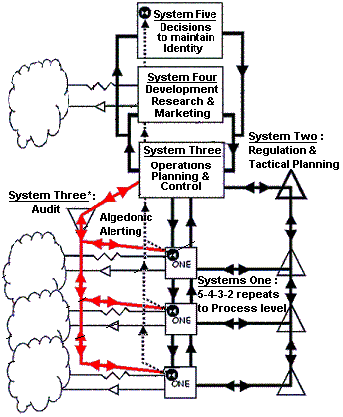
The lean into Beer comes from tante saying he is an admirer. Beer built Project Cybersyn, a centralized computer system meant to coordinate the nationalized economy of Allende’s Chile.

Stafford Beer’s VSM (Viable System Model)

That’s interesting because it’s in the similar class as the bad examples above. Centralized computational coordination of an economy. By tante’s own logic a system is whatever it does, so Cybersyn was socialist because it served socialism. The politics are defined by the person in control and to what end they are aiming.

Record scratch.

This is the applied, contingent politics tante insists does not exist. He cannot endorse the principle that a system is what it does and condemn the model class as fascism in the same breath. That principle is what makes Cybersyn liberatory, and it puts the politics in the operator of the system.

Going back to Winner instead, we should separate two kinds of political technology. For example, when Robert Moses built overpasses so low that large buses carrying poor families could not reach the beach, that was politics by design.

Jones Beach was made inaccessible by bus due to the intentionally low overpasses, like this one. Source: Pin-Up

The bomb is different from the overpass. Its politics are in the functional necessity. In other words, the evidence tante uses is all about the overpass. The frontier vendors would concentrate power because of how it is financed and owned, not because a working model can only exist in a form that prevents poor families from going to the beach.

On that point, we have evidence of models that pass the test. Apertus, from ETH Zurich and EPFL, was pretrained from scratch on rights-clean data. Pleias built its models on the Common Corpus the same way. Run the weights locally through Ollama with no telemetry and no API, and the capability should be free of fascism. And this trend seems like common sense. The model does not need its lab, while the bomb always and still needs the state.

M28/M29 Davy Crockett entered service in May 1961. It fired an “atomic watermelon” with 20 tons of force up to 2.5 miles away, bad news for the operators.

What the bomb actually requires is not centralized command but a centralized means of production: a secret, capital-heavy, state-scale enrichment and weapons base. The Davy Crockett above makes the case clear. The Army handed the trigger to a three-man crew, the most decentralized nuclear launch ever fielded, and it still came out of Los Alamos and the Atomic Energy Commission. You can decentralize the distribution. You cannot decentralize production. Every warhead that has existed came out of that base.

The simple contradictions by tante make me wonder why he didn’t see them. He grants that oppressive tools can be turned against their makers. Ok, so they become good? But then he still tries to land the campaign to destroy AI. Destruction doesn’t follow from the premise that the tool is dual-use. If the politics is in the ownership and operation, the answer is to take ownership and operate another way: public compute, worker control over deployment. Destroy AI foolishly tries to name an enemy, which unfortunately could be the self.

The reactionary political economy of frontier AI is a real problem. The firms deserve the harshest criticism, especially Palantir. Calling the company fascist makes perfect sense to me, but their tools don’t carry the same labels. I’m no more likely to say an LLM has to be fascist than the rest of their compute infrastructure. And I say that because if you follow tante’s very broken and self-defeating logic, we start signaling that to build the alternative is forbidden if not impossible. And that’s simply not true.

The Amish refuse the public grid. The line to the utility is a tether to the outside world, and that relationship as dependence is what they reject. Electricity itself is fine. Build your own windmill, run it locally, and no one objects. The objection was never to electricity itself, which has no political stake. It was to the politics of someone else taking control.

Stammtischler by Klee

In 1931, Paul Klee sketched “Drinking Companion” (Stammtischler), as if to capture the obnoxious, poorly informed loud mouth you wouldn’t want in charge of anything.

Klee was one of the first German artists the Nazis labeled “degenerate,” which Nazis said meant Jewish, so they accused him of being Jewish. He was not Jewish.

The Nazis had been losing popularity in 1932 but then they abruptly seized power, with Hitler appointed in January 1933 to Chancellor. Klee was dismissed from the Düsseldorf academy, his home was searched by the Gestapo, and he moved with his family to Bern, Switzerland. In 1937 the Nazis still attacked him, trying to shame him in a “Degenerate Art exhibition” that compared his work to mental illness.

Paid in Full: The Data Center Economy and the Criminalized Protester

A Trump government contract reached the public last month by accident, after CoreCivic’s lawyers attached it to an email to the Houston Chronicle. The figures it revealed put the cost of running Dilley, the only family detention center in the country, at about $15.6 million a month, $13.1 million to operate and $2.5 million for medical care. The cost to taxpayers has been made constant, whether the facility is full or nearly empty.

The problem has been known much longer. A ICE itself called the Dilley arrangement unique, a fixed monthly fee for the entire facility regardless of how many people are held. A Homeland Security inspector general found the contract improperly obtained, routed through a middleman town in a way that shielded the operator and left the agency with no assurance it served taxpayers or detainees.

Pay for prisoners was improper, unaccountable, and fixed to a building. Why?

Look deeper, into the context, the geography, and the care model of “centers”. The human detention operator collects the same sum whether their water is clean or not, whether a sick child is seen or left unseen (to die). Lawmakers who toured in May counted fewer than 400 people, including 93 children, and ran the division.

Taxpayers are being charged roughly $37,500 per detained person per month.

Most people being held carry no criminal charge, and many have active asylum claims being ignored. They are being seized on streets far from any border, like the five year old taken outside his Minnesota home. The revenue is the purpose of these centers, not justice, not safety. CoreCivic reported $116.5 million in profit for 2025, up nearly 70 percent, and guided investors higher. Dilley alone generated $180 million in revenue, inside a $45 billion congressional expansion of detention. The same record documents a measles outbreak and food and water detainees call moldy and foul. A toddler died, after release in the facility’s earlier years.

This is a known pattern in history.

It’s the ordinary shape of administered harm. Atrocity at scale rarely sustains itself as spectacle. Spectacle draws resistance, so the apparatus migrates into procurement within an already established, rushed trajectory. The lethal variable to watch for is a revenue line uncoupled from the human outcome, a fixed fee or a quota that pays the same whether the people inside are tended or neglected. The pattern is neglect performing the harm within a trajectory so no one has to authorize it. It’s been called the crematorium that needs no fire.

Germans study the history that Americans rarely understand. In 1933 voices of opposition were violently erased, leading to the “cold crematorium” of camps that killed by willful neglect.

The evidence tends to precede the public reckoning, because it’s unbelievable, too hard for people to process until it’s too late. On December 9, 1931, a Munich newspaper printed a leaked Nazi plan for the Jews and the euphemism, Endlösung. The “final solution” was known long before the regime would invade neighboring countries and spin up industrialized murder camps. The paper was attacked for saying it, then shut down violently, its reporters sent to Dachau, the first Nazi concentration camp, built to detain and break the regime’s political opponents, where many were murdered.

Memorial block for Richard Lipinski, a well known Leipzig SPD politician who voted against Hitler “Enabling Act” in 1933 and was put into “protective custody” and died from “effects of his detention”. Phrases that to this day try to normalize fascism, literal murder for power.

Administered harm shows up like a payment schedule, for outcomes that should be raising the highest alarms. Notably, Britain read the warnings through the 1930s and held back from stopping Hitler in March 1936, when his troops entered the Rhineland under orders to retreat if France resisted. London and Paris accommodated instead of attacked. Why did they wait?

This contract just became public because a lawyer attached the wrong file to an email. Who today sees it and waits? What are they waiting for?

Target Hospitality owns the Dilley family detention center and runs its food service, the place notorious for a measles outbreak and 911 calls about children struggling to breathe. CoreCivic operates it. In March, Target announced a pivot into data center company towns, to wash the stink of the ICE deal off its name. The lodging contractor moved its brand from feeding and housing a detention center to housing the crews who build data centers.

When you look at the datacenter maps, you are looking at land permits, a slab, tilt-up walls, and a power easement that may never energize. Very large campuses of empty boxes on cheap land in scarce-water country, their end use left unsettled.

Source: Brockovich Data Centers

A July 2025 executive order made the data centers critical infrastructure. Federal agencies and fusion centers then began tracking fictional “anti-tech violent extremism,” sweeping peaceful critics and town-hall attendees into the framework built to criminalize protected political speech into domestic violent extremists. The order protects the box, which rhymes with the detention economy, even when it does not yet show a data center becoming a human center. Oppose the data center box, and the security state opens a terrorism file.

A terrorism designation of people outside the data centers feeds the same detention expansion that the Dilley contract pays for. It’s like a fascist LEGO set: build the box, file the objector as a terrorist, fund detention that pays whether the beds fill or not, and the only open question left is how all those unpopular empty boxes will be making any money.