A Trump government contract reached the public last month by accident, after CoreCivic’s lawyers attached it to an email to the Houston Chronicle. The figures it revealed put the cost of running Dilley, the only family detention center in the country, at about $15.6 million a month, $13.1 million to operate and $2.5 million for medical care. The cost to taxpayers has been made constant, whether the facility is full or nearly empty.
The problem has been known much longer. A ICE itself called the Dilley arrangement unique, a fixed monthly fee for the entire facility regardless of how many people are held. A Homeland Security inspector general found the contract improperly obtained, routed through a middleman town in a way that shielded the operator and left the agency with no assurance it served taxpayers or detainees.
Pay for prisoners was improper, unaccountable, and fixed to a building. Why?
Look deeper, into the context, the geography, and the care model of “centers”. The human detention operator collects the same sum whether their water is clean or not, whether a sick child is seen or left unseen (to die). Lawmakers who toured in May counted fewer than 400 people, including 93 children, and ran the division.
Taxpayers are being charged roughly $37,500 per detained person per month.
Most people being held carry no criminal charge, and many have active asylum claims being ignored. They are being seized on streets far from any border, like the five year old taken outside his Minnesota home. The revenue is the purpose of these centers, not justice, not safety. CoreCivic reported $116.5 million in profit for 2025, up nearly 70 percent, and guided investors higher. Dilley alone generated $180 million in revenue, inside a $45 billion congressional expansion of detention. The same record documents a measles outbreak and food and water detainees call moldy and foul. A toddler died, after release in the facility’s earlier years.
This is a known pattern in history.
It’s the ordinary shape of administered harm. Atrocity at scale rarely sustains itself as spectacle. Spectacle draws resistance, so the apparatus migrates into procurement within an already established, rushed trajectory. The lethal variable to watch for is a revenue line uncoupled from the human outcome, a fixed fee or a quota that pays the same whether the people inside are tended or neglected. The pattern is neglect performing the harm within a trajectory so no one has to authorize it. It’s been called the crematorium that needs no fire.

The evidence tends to precede the public reckoning, because it’s unbelievable, too hard for people to process until it’s too late. On December 9, 1931, a Munich newspaper printed a leaked Nazi plan for the Jews and the euphemism, Endlösung. The “final solution” was known long before the regime would invade neighboring countries and spin up industrialized murder camps. The paper was attacked for saying it, then shut down violently, its reporters sent to Dachau, the first Nazi concentration camp, built to detain and break the regime’s political opponents, where many were murdered.

Administered harm shows up like a payment schedule, for outcomes that should be raising the highest alarms. Notably, Britain read the warnings through the 1930s and held back from stopping Hitler in March 1936, when his troops entered the Rhineland under orders to retreat if France resisted. London and Paris accommodated instead of attacked. Why did they wait?
This contract just became public because a lawyer attached the wrong file to an email. Who today sees it and waits? What are they waiting for?
When you look at the datacenter maps, you are looking at land permits, a slab, tilt-up walls, and a power easement that may never energize. Very large campuses of empty boxes on cheap land in scarce-water country, their end use left unsettled.
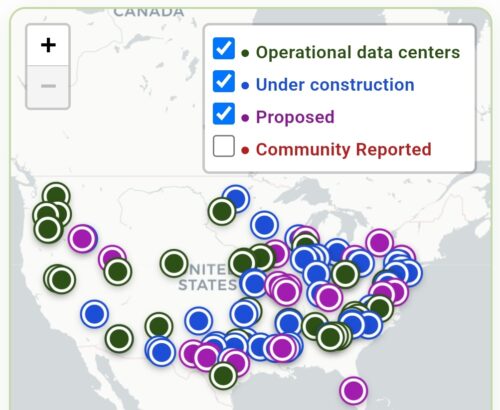
A July 2025 executive order made the data centers critical infrastructure. Federal agencies and fusion centers then began tracking fictional “anti-tech violent extremism,” sweeping peaceful critics and town-hall attendees into the framework built to criminalize protected political speech into domestic violent extremists. The order protects the box, which rhymes with the detention economy, even when it does not yet show a data center becoming a human center. Oppose the data center box, and the security state opens a terrorism file.
A terrorism designation of people outside the data centers feeds the same detention expansion that the Dilley contract pays for. It’s like a fascist LEGO set: build the box, file the objector as a terrorist, fund detention that pays whether the beds fill or not, and the only open question left is how all those unpopular empty boxes will be making any money.
Target Hospitality owns the Dilley family detention center and runs its food service, the place notorious for a measles outbreak and 911 calls about children struggling to breathe. CoreCivic operates it. In March, Target announced a pivot into data center company towns, to wash the stink of the ICE deal off its name. The lodging contractor moved its brand from feeding and housing a detention center to housing the crews who build data centers.