I hate Nazis. Just one of the many reasons why is how classification and words are turned into their weapons. They “win” by changing the rules until everyone else is, by their own definition, losers.
“Get that car’s license plate number!”
A museum in Berlin is abusing a technical claim of “first” for a contest where they wrote the rules suspiciously. On any and every neutral axis of electronic, operational, programmable, general-purpose, stored-program, the actual trophy sits in Iowa, or Bletchley, or Philadelphia, or Manchester. Berlin wins only the category they created called “fully functional programmable automatic” to fit one machine in 1941 Nazi Germany, promoted by the people who need it to win in 2026.
For those who decide at the last minute:
May 12, 1941, is considered the birth of the first fully functional computer, the Z3. On this day, Konrad Zuse presented his Z3 relay computer to a group of scientists. To mark the 85th anniversary, Horst Zuse will give a lecture on the development of the Z3 and the computer innovations of his father, Konrad Zuse.
Participation is free; all you need is a museum admission ticket.
#Computer #coding #Museum #technology
“Considered.” Cute. “Fully functioning”. Please.
The claim of a never-operational Z3 being Turing-complete is from a single 1998 paper whose own author admits it’s just an impractical theory for a demonstration machine destroyed in WWII. The German “Gesellschaft für Informatik” admits this too while building a virtual one because the Munich replica had to be shut down for fire safety. The truth runs opposite to any claims of the Reich’s Z3 birthing anything. But you know, for Germans who gotta find something in 1941 Berlin to get away with being proud of something, I guess this fits their bill. I mean, who knew a German museum in 2026 would file the serial numbers off Nazi war research to claim the “birth” of a “fully functional computer”?
Let’s cut the propaganda and speak plain English for a moment, because the actual first functional computers were not made in Germany.
The Z3 was cobbled together from old ideas and marketed as research. The German Reich office known as DVL paid Zuse to automate the calculations that enabled Luftwaffe airframes to carry heavier bombs. You know, they needed heavier bombs to kill more civilians. This very same DVL provided the low-pressure chamber for the high-altitude experiments at Dachau in 1942, experiments in which 70 to 80 of approximately 200 prisoners died. The monsters running the DVL are quite a “birth moment” context if you know it.
And what was the birth? What new principle was brought into this world by the Z3?
NOTHING. ZILCH. NADA.
Its binary arithmetic came from Leibniz; its logic from Boole; its relays from the telephone exchange; and its punched-tape control from Jacquard and the Hollerith line, specifically the very Dehomag machines that the SS operated in the camps (Dachau included) to register prisoners and run them through to the gas chamber by number.
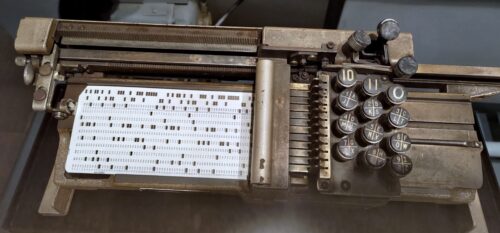
The Z3 couldn’t even perform conditional branching based on its own results. Any claims of “first computer” are transparent retroactive PR, thinly substantiated, nationally flattering, and only theoretically “upgraded” to Turing completeness on paper in 1998 by Rojas, who later helped build the replica.
First ahead of what, exactly? The phrase “fully functional” doesn’t even make sense. Functioning in what capacity? Full of what?
Electronic earlier examples the museum is trying hard to omit: the Atanasoff-Berry Computer, Iowa, conceived in 1937 and built by 1942, running on vacuum tubes while Zuse was still clacking relays. Unlike the Z3, that claim was actually tested independently in a court. In 1973 a US federal judge invalidated the ENIAC patent and ruled the electronic computer was derived from Atanasoff. The decision was never appealed. No German court ever ruled anything of the sort for Zuse, because the title was never evidence. It was always a particular form of nationalism sneaking into PR.
Electronic, operational, and programmed examples? Well, obviously we have the Colossus, Bletchley Park, 1943, breaking live German ciphers in daily wartime service while the Z3 sat in Zuse’s flat as a demonstrator and the real flutter production ran on his separate S1 and S2 machines at Henschel. Colossus would lose a “first” race for one reason only. Britain kept it secret. The same disappearing act that lets the Germans promote the Z3 claim, except Britain has receipts unlike self-shredding evidence-allergic 1945 Germans.
What about electronic, general-purpose, and Turing-complete in actual hardware, with conditional branching included? That’s the ENIAC, 1945. Everything the Z3 was falsely and retroactively awarded on paper in 1998, ENIAC proved in operation, while the Z3 was never deployed to production use.
And if we want to name a machine during this era that was the mother of every computer you have ever touched: the Manchester Baby, 1948, the first stored-program computer, followed by Cambridge’s EDSAC in regular service by 1949. That is the more accurate “first”.
The Z3 doesn’t hold a candle. It was obscure research about assembly of known parts, a demonstrator the institute never deployed, secret, then rubble, then unknown for twenty years, so it not only contributed nothing to the computers that actually got built and used around the same period, it’s a form of unverifiable revisionism. Its only real use ever seems to be the modern nationalist propaganda campaigns that obscure how it never really was used.
Here is the history fact that should end the argument. The engineering profession’s own milestone records list the Z3 among the candidates and then disqualify it in a single sentence: built for narrow engineering sums, not a stored-program machine because it held its instructions outside itself on perforated film, and hardly general-purpose in any normal sense.
The Germans that ought to be Zuse’s loudest champion name his machine in the contest and rule it out, TWICE.
The original was bombed to rubble; the historical narrative stems from Zuse’s own memoirs; the replica currently on display belongs to his son (on convenient loan from the son who also is honored with an anniversary lecture about his family “win” under the NS); and the proof of universality comes from the very man who helped build that replica for the son. Integrity breach alert.
Stakeholders shouldn’t be allowed to set their own interest rates. Or is this perhaps just for those impulsive types in Berlin who prefer records shredded so their Nazi-era computer history can be served cold and without the facts?
| Machine | Electronic | Branching | Used | “Fully functional programmable automatic” |
| Babbage Analytical Engine, 1837 design | No | YES, by design | No. Unbuilt | No |
| Aiken Mark I, Harvard 1937 design | No | No | YES, from 1944 | No |
| Stibitz relay binary, Bell Labs 1937 | No | No | YES, from 1940 | No |
| Zuse Z1, Berlin 1938 | No | No | No. Unreliable | No |
| Zuse Z3, Berlin 1941 | No, relays | No | No. Demo | Did someone say FIFA Peace Prize? |
| Atanasoff-Berry, Iowa 1942 | YES, tubes | No | No, never finished | No |
| Colossus, Bletchley 1943 | YES, tubes | Limited | YES, daily in the war | No |
| ENIAC, Philadelphia 1945 | YES, tubes | YES | YES, ballistics | No |
| Manchester Baby, 1948 | YES, tubes | YES | YES, foundational | No |
The title has to be won in a public assessment, not self-awarded or even through a corrupted process. A real assessment in America looked like this.
Computer architect Gordon Bell refers to the judgment, which invalidated the ENIAC patent, as the “disinvention” of the computer.
His point is that a 1973 ruling invalidated the ENIAC patent on the ground that the ideas derived from Atanasoff. The court left a foundational invention owned by no one. Put the Z3 in a fair courtroom and let’s see how that turns out.